August 8, 2026
Global energy markets face unprecedented volatility as oil prices rise as US-Israeli war with Iran disrupts supply chains, creating cascading economic effects across interconnected petroleum distribution networks. Furthermore, sophisticated risk assessment frameworks reveal that regional conflicts trigger systematic price volatility far beyond actual capacity constraints, amplifying market psychology effects throughout energy-importing nations.
Strategic Petroleum Infrastructure Vulnerabilities Create Systematic Market Risks
Global energy markets demonstrate extreme sensitivity to chokepoint disruptions due to the concentration of crude oil flows through a limited number of strategic waterways. The Strait of Hormuz serves as the world's most critical petroleum transit corridor, handling approximately 21 million barrels per day of crude oil and condensate, representing roughly 21% of global petroleum consumption.
The strait's physical characteristics create inherent vulnerability: at its narrowest point, the shipping lane measures only 2 miles wide in each direction, forcing massive tanker traffic through an extremely constrained geographic space. Consequently, even partial disruptions can generate disproportionate market impacts.
Historical precedents demonstrate the rapid price transmission mechanisms that activate during chokepoint crises. During the 1990-1991 Gulf War, WTI crude prices spiked from $15 per barrel to $40 per barrel within weeks, representing a 167% increase driven primarily by supply disruption fears. Similarly, the 2011 Iran sanctions crisis saw the oil price rally climb from approximately $85 per barrel to $127 per barrel over four months.
Supply Chain Interdependency Mapping Reveals Cascading Vulnerabilities
Energy economists have identified several transmission channels through which petroleum supply disruptions propagate across global economic systems:
- Direct consumption impacts: Transportation and heating costs increase immediately for consumers
- Industrial input cost escalation: Manufacturing sectors face compressed margins as energy represents 20-40% of production costs in energy-intensive industries
- Logistics cost multipliers: Container shipping rates typically increase by 30-50% within 2-3 months following a 50% oil price spike
- Financial market confidence effects: Uncertainty regarding disruption duration triggers precautionary behaviour across investment markets
The elasticity characteristics of oil markets explain why supply disruptions create disproportionate price movements. Short-term oil demand elasticity measures between -0.05 to -0.10, meaning demand remains relatively inflexible even during significant price increases. In addition, short-term supply elasticity ranges from +0.10 to +0.20, indicating limited capacity to rapidly increase production during disruptions.
When big ASX news breaks, our subscribers know first
Regional Economic Divergence Patterns Under Energy Supply Stress
Energy import dependency creates vastly different vulnerability profiles across global economies, with some nations facing existential economic threats while others experience minimal direct impact. Japan exemplifies extreme vulnerability, importing 88% of its oil consumption with 82% originating from Middle East sources.
South Korea faces similarly acute risks, importing 91% of its oil consumption with 68% from Middle Eastern sources. However, the concentration of heavy industry and petrochemical production amplifies the economic impact of energy price volatility, as these sectors cannot quickly adjust input costs or production processes.
| Region | Oil Import Dependency | Middle East Share | Vulnerability Assessment |
|---|---|---|---|
| Japan | 88% of consumption | 82% of imports | Extreme – minimal domestic alternatives |
| South Korea | 91% of consumption | 68% of imports | Extreme – industrial concentration risk |
| European Union | 27% of consumption | 12% of imports | Moderate – successful diversification |
| United States | Net oil exporter | Minimal direct exposure | Low – indirect price effects only |
The transmission of energy price shocks to broader economic indicators occurs through multiple channels. Manufacturing sectors demonstrate differential vulnerability based on energy intensity:
- Petrochemical industries: Production costs increase 15-25% per 50% oil price rise
- Transportation-dependent manufacturing: Logistics costs rise 8-12% with additional 2-4 week supply chain delays
- Thermal processing industries: Energy represents 20-40% of total production costs
Macro-Economic Impact Quantification Through Historical Analysis
The 2008 oil price shock, when crude reached $147 per barrel, demonstrated the systemic economic impacts of extreme energy price volatility. Global manufacturing PMI collapsed to 36.5 in November 2008, indicating severe industrial contraction.
World trade volume contracted by 12% year-over-year as transportation costs soared and industrial demand weakened. Furthermore, the trade war impact on oil markets during this period highlighted additional complexity factors affecting global energy distribution.
Oil price elasticity to consumer inflation measures between +0.03 to +0.05, meaning a 10% oil price increase correlates with 0.3-0.5% consumer price index increases within 6-12 months. This transmission occurs more rapidly in energy-importing developing nations, where fuel components represent 5-8% of CPI baskets compared to 3-4% in developed economies.
Strategic Reserve Deployment Mechanisms and Market Stabilisation Protocols
Strategic petroleum reserves represent the primary tool available to governments for moderating oil price volatility during supply disruptions. However, the effectiveness of reserve deployments depends critically on scale, timing, and coordination mechanisms.
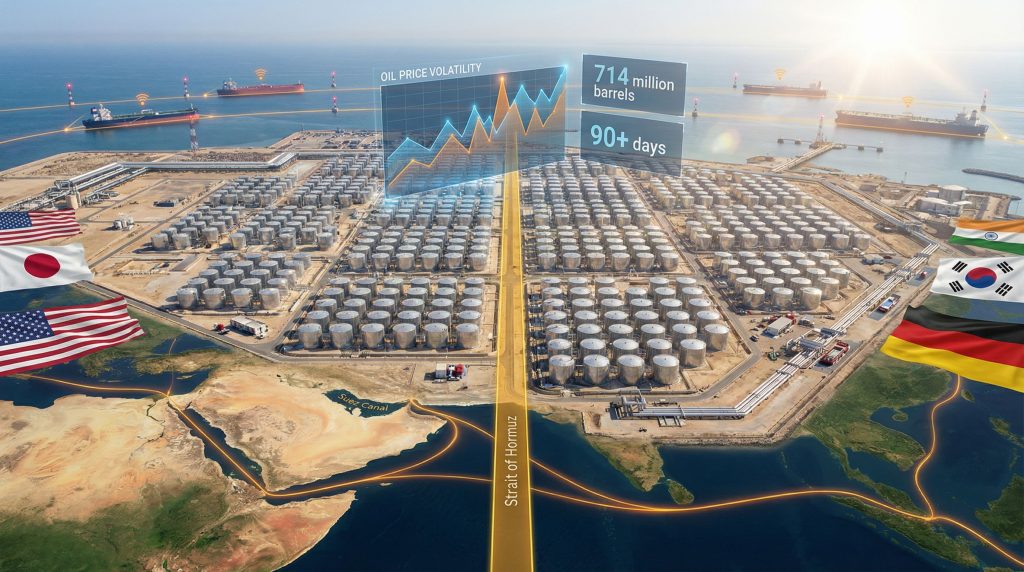
The United States maintains the world's largest strategic reserve at 714 million barrels, though recent sales have reduced capacity utilisation to approximately 47% as of 2024. Maximum release capability reaches 4.4 million barrels per day, representing roughly 4% of global daily consumption.
International coordination through the International Energy Agency emergency response system can aggregate member country releases to achieve greater market impact. The 2022 coordinated release of 180 million barrels over six months provided temporary price moderation during the Russia-Ukraine conflict.
| Country | Reserve Capacity | Import Coverage | Max Release Rate | Current Status |
|---|---|---|---|---|
| United States | 714 million barrels | 90+ days | 4.4 million bpd | 47% capacity (2024) |
| Japan | 324 million barrels | 150+ days | 2.1 million bpd | 83% capacity |
| South Korea | 96 million barrels | 100+ days | 1.2 million bpd | 70% capacity |
| Germany | 24 million barrels | 90+ days | 0.8 million bpd | Status undisclosed |
Reserve Deployment Optimisation Through Market Psychology
Energy policy experts have identified key principles governing effective strategic reserve utilisation. Signal timing proves crucial, as announcement of potential releases can reduce prices before physical delivery through market psychology effects.
Scale proportionality requires sizing releases to match disruption magnitude. Undersized releases signal policy uncertainty and may actually increase market anxiety. The 1991 Gulf War release of 37.1 million barrels over 42 days failed to prevent oil prices rise as US-Israeli war with Iran disrupts supply scenarios from developing similar patterns.
Coordination multipliers demonstrate that multilateral releases through IEA frameworks generate larger price impacts than unilateral action. The aggregated supply addition, combined with confidence effects from international cooperation, creates more significant market psychology impacts than individual country actions.
Alternative Supply Chain Adaptation Strategies During Crisis Scenarios
When primary supply routes face disruption, global energy markets rapidly adapt through alternative sourcing and transportation strategies. Nevertheless, these adaptations involve significant cost premiums and capacity constraints that influence price dynamics.
Non-Middle East production capacity includes approximately 15-18 million barrels per day from North American sources, 3-4 million barrels per day from Brazilian offshore fields, and 2-3 million barrels per day from Norwegian North Sea operations. However, much of this capacity already serves established markets, limiting availability for emergency reallocation.
Transportation route optimisation involves significant trade-offs between cost, time, and capacity. Alternative routing options include:
- Suez Canal and Red Sea routing: Adds 5-7 days transit time with higher insurance premiums
- Cape of Good Hope routing: Adds approximately 2 weeks to delivery schedules
- Pipeline alternatives: Saudi Arabia's East-West Pipeline provides 5 million barrels per day capacity, bypassing Hormuz entirely
Quality Differential Arbitrage and Crude Substitution Economics
During supply disruptions, refineries face complex optimisation decisions regarding crude quality substitution. Light, sweet crude oils from disrupted Middle Eastern sources cannot be perfectly substituted with heavy, sour alternatives without refinery modifications and yield adjustments.
Quality differential pricing becomes amplified during crises. Typically, light-heavy crude spreads range from $2-5 per barrel under normal conditions. During supply disruptions affecting primarily light crude sources, these spreads can expand to $10-15 per barrel as refineries compete for limited suitable feedstocks.
Emergency procurement strategies involve accepting significant cost premiums for spot market purchases. During the 2022 Russia-Ukraine conflict, European refineries paid premiums of $5-8 per barrel above benchmark prices for alternative crude sources, demonstrating the cost impact of rapid supply chain reconfiguration.
Financial Market Risk Assessment and Derivatives Pricing Mechanisms
Oil price volatility during geopolitical crises creates complex derivatives market dynamics as traders attempt to price uncertain disruption scenarios. Volatility surfaces demonstrate how option markets assess probability-weighted outcomes across different time horizons.
During the initial weeks of supply disruption concerns, implied volatility typically increases by 15-25 percentage points above baseline levels. This volatility expansion reflects uncertainty regarding both disruption severity and duration.
Options markets demonstrate steep volatility curves, with near-term contracts pricing much higher uncertainty than longer-dated positions. Furthermore, the Iran conflicts' energy shocks continue to influence market psychology throughout crisis periods.
Cross-Commodity Correlation Analysis and Portfolio Implications
Energy sector equity performance demonstrates high correlation with underlying commodity prices during crisis periods. Integrated oil company valuations typically move with 0.8-0.9 correlation to crude oil prices during volatile periods, compared to 0.5-0.6 correlation during normal market conditions.
Currency impacts create additional complexity for international investors. Oil-importing nations often experience currency depreciation during energy price spikes, amplifying domestic cost impacts.
Each 10% currency depreciation effectively increases oil import costs by approximately 10% for the affected economy. Investment strategy implications include increased allocation to real assets as inflation hedges.
Long-Term Strategic Energy Security Acceleration Scenarios
Geopolitical energy crises consistently accelerate domestic production investments and alternative energy development programmes. The current crisis environment has triggered renewed focus on energy independence strategies across multiple regions and technologies.
Domestic production investment receives crisis-driven policy support through expedited permitting and tax incentives. U.S. shale production capacity demonstrated significant responsiveness during previous price cycles, though current environmental constraints may limit near-term expansion potential.
Moreover, renewable energy solutions transition acceleration occurs through both policy mechanisms and private capital reallocation. Crisis periods consistently generate political support for alternative energy investments as strategic security measures.
Energy storage strategic importance increases exponentially during conventional energy supply uncertainty. Grid-scale battery storage, pumped hydro capacity, and hydrogen infrastructure receive enhanced investment priority as backup systems during supply chain disruptions.
Geopolitical Alliance Evolution and Energy Partnership Development
Energy security concerns drive alliance structure evolution as nations prioritise reliable supply sources over purely economic optimisation. Long-term contract frameworks increasingly include strategic partnership elements beyond traditional commercial terms.
Technology transfer acceleration occurs as countries seek to develop domestic energy capabilities rapidly. International cooperation in renewable energy technologies, energy storage systems, and grid management receives strategic priority during crisis periods.
Trade route diversification becomes a national security imperative, driving infrastructure investments in alternative transportation corridors. Pipeline projects, port facilities, and strategic storage locations receive enhanced government support during periods of supply chain vulnerability.
The next major ASX story will hit our subscribers first
OPEC+ Production Coordination Under Crisis Constraints
OPEC market influence production optimisation faces complex challenges during regional conflicts as member countries balance revenue maximisation against market stability objectives. Spare capacity deployment requires careful coordination to avoid triggering additional price volatility.
Saudi Arabia maintains approximately 2-3 million barrels per day of spare production capacity under normal conditions, representing the primary mechanism for rapid supply response during crisis scenarios. However, geopolitical constraints may limit willingness to deploy this capacity if doing so appears to offset disrupted production.
Production coordination challenges intensify when member countries face conflicting national interests. Revenue maximisation through higher prices may conflict with market share preservation objectives, particularly when non-OPEC+ producers benefit from price spikes.
Furthermore, OPEC production boost strategies require careful calibration during periods when oil prices rise as US-Israeli war with Iran disrupts supply chains globally.
Corporate Risk Management Framework Development for Energy-Dependent Industries
Energy-intensive industries require sophisticated hedging strategies extending beyond traditional financial instruments to encompass operational flexibility and supply chain diversification. Manufacturing companies increasingly implement multi-fuel capability investments to reduce dependence on single energy sources.
Financial instrument portfolio construction involves complex optimisation across futures contracts, options strategies, and swap agreements. Effective hedging typically combines:
- Baseline hedge ratios: 60-80% of anticipated energy consumption hedged 12-18 months forward
- Volatility overlays: Option strategies to provide protection against extreme price movements
- Operational hedging: Multi-fuel equipment investments and alternative supplier arrangements
Scenario planning methodologies employ Monte Carlo simulation frameworks to model probability-weighted outcomes across multiple variables. Stress testing protocols examine company performance under extreme scenarios, including sustained energy price elevation.
Early Warning System Development and Predictive Analytics
Geopolitical risk indicators require continuous monitoring across multiple data sources, including satellite imagery of energy infrastructure, shipping traffic patterns, and political development analysis. Advanced analytics platforms integrate these data streams to provide early warning of potential supply disruptions.
Supply chain resilience building involves strategic inventory optimisation, balancing carrying costs against disruption insurance value. Energy-intensive manufacturers increasingly maintain 30-60 days of energy input inventory compared to traditional just-in-time approaches.
Moreover, according to recent reports on oil prices opening higher amid ongoing disruptions, market participants continue to adjust risk assessment frameworks based on evolving geopolitical developments.
Critical Strategic Insight: Contemporary energy market volatility reflects fundamental structural vulnerabilities in global petroleum supply chains, requiring comprehensive risk management approaches that integrate financial hedging, operational flexibility, and strategic supply diversification to mitigate exposure to geopolitical supply disruptions.
The convergence of geopolitical instability with concentrated energy infrastructure creates systemic risks that extend far beyond traditional commodity price cycles. Organisations dependent on stable energy costs must develop multi-layered defence strategies encompassing financial instruments, operational adaptability, and strategic partnerships.
Investment Prioritisation Framework:
- Energy security infrastructure: Strategic petroleum storage, alternative transportation routes, and redundant supply agreements
- Renewable energy acceleration: Crisis-driven policy support creates enhanced investment returns for alternative energy projects
- Operational flexibility: Multi-fuel capability and supply chain diversification provide insurance value against future disruptions
- Advanced analytics: Early warning systems and predictive modelling capabilities enable proactive risk management
Risk Management Evolution Requirements:
- Integrated hedging strategies: Combining financial instruments with operational flexibility investments
- Enhanced scenario planning: Probability-weighted modelling across geopolitical and economic variables
- Strategic partnership development: Long-term supply agreements with multiple geographic sources
- Technology investment acceleration: Energy efficiency and alternative fuel capabilities as strategic assets
This analysis employs strategic scenario modelling methodologies to examine energy market dynamics during geopolitical crises, providing frameworks for enhanced risk assessment and mitigation planning across energy-dependent sectors. All price projections and scenario analyses should be considered alongside comprehensive risk disclosures and professional investment guidance.
Are You Positioning Yourself for Opportunities in Resource Markets?
Discovery Alert's proprietary Discovery IQ model delivers real-time alerts on significant ASX mineral discoveries, helping subscribers identify actionable opportunities as global energy market volatility creates renewed focus on domestic resource security. Explore Discovery Alert's discoveries page to understand how major mineral discoveries can lead to substantial returns, then begin your 14-day free trial to gain a market-leading advantage in resource investing.