August 5, 2026
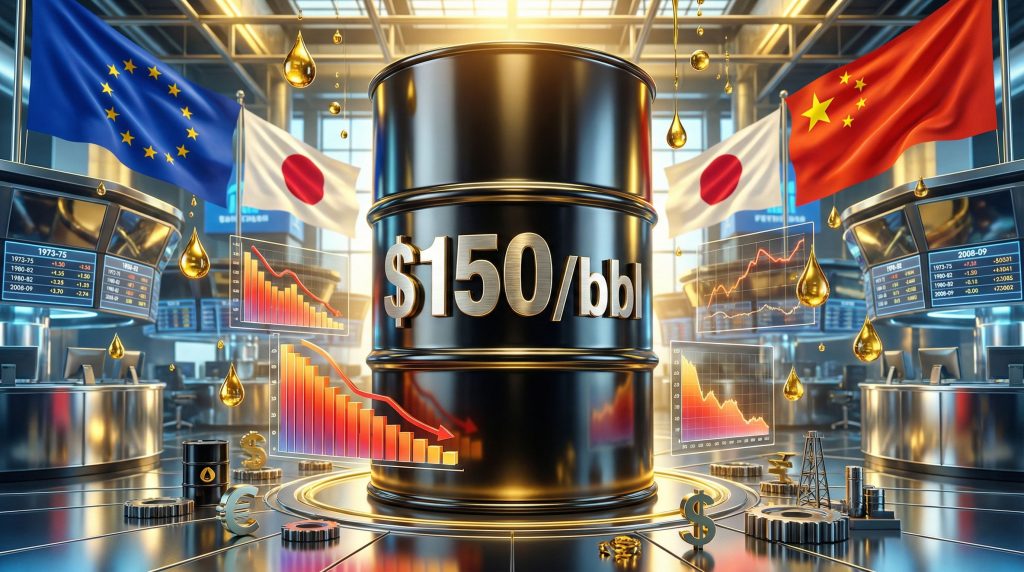
Oil prices trigger global recession scenarios when sustained energy cost increases create cascading economic effects across multiple transmission channels simultaneously. Throughout modern economic history, major oil price spikes have consistently preceded widespread economic contractions, with sustained crude prices above $120-130 per barrel creating increasing recession probability that approaches virtual certainty when levels reach $150 per barrel ranges.
The relationship between energy costs and economic stability reflects fundamental structural dependencies within global commerce, where petroleum price increases propagate through production, transportation, and consumption systems. Understanding these oil rally analysis patterns becomes increasingly critical as geopolitical tensions continue escalating in key energy-producing regions.
Understanding the Oil Price-Recession Connection: Historical Economic Patterns
The correlation between sustained energy price increases and economic downturns reflects deep structural vulnerabilities within modern economies that remain heavily dependent on petroleum-based energy systems. When oil prices trigger global recession conditions, the impact cascades through multiple economic channels simultaneously, creating compounding effects that traditional monetary policy tools struggle to address effectively.
The Stagflation Mechanism Behind Energy-Driven Downturns
Energy-driven recessions differ fundamentally from demand-side economic contractions because they create simultaneous inflationary pressures and growth deceleration. This stagflationary environment occurs when rising energy costs increase production expenses across all sectors while simultaneously reducing consumer purchasing power through higher transportation and heating costs.
The transmission mechanism operates through several critical pathways:
• Direct consumer impact through gasoline, heating oil, and electricity price increases that reduce discretionary spending capacity
• Industrial cost inflation affecting manufacturing, chemicals, agriculture, and transportation sectors
• Secondary price effects as energy-intensive goods become more expensive, spreading inflation throughout the economy
• Monetary policy constraints as central banks face conflicting pressures to combat inflation while supporting economic growth
Consumer spending patterns reveal particular vulnerability to energy price shocks, with households typically reducing non-essential purchases when transportation and utility costs consume larger portions of disposable income. This behavioral response creates immediate demand destruction in retail, hospitality, and discretionary services sectors, amplifying the initial energy shock's economic impact.
Historical Recession Triggers: When Energy Costs Break Economic Growth
Examining major oil-driven recessions reveals consistent patterns in how energy price spikes translate into broader economic contractions. The 1973-74 oil embargo demonstrated how geopolitical supply disruptions could rapidly transform regional conflicts into global economic crises, while subsequent energy shocks in 1979-80 and 2008 reinforced these transmission mechanisms.
| Period | Peak Oil Price | Recession Duration | GDP Decline | Primary Trigger |
|---|---|---|---|---|
| 1973-75 | $39/bbl (2024$) | 16 months | -3.2% | Arab Oil Embargo |
| 1980-82 | $117/bbl (2024$) | 18 months | -2.7% | Iran-Iraq War |
| 2008-09 | $147/bbl | 18 months | -4.3% | Financial Crisis + Oil Spike |
Each historical episode reveals that sustained price elevation, rather than temporary spikes, determines recession probability. The 1973 crisis began with oil prices quadrupling within months, but the economic damage intensified as prices remained elevated for extended periods, preventing economic adaptation and forcing structural adjustments across energy-intensive industries.
Analysis of these historical patterns indicates that recession risk accelerates when oil price increases exceed 100% from baseline levels and persist beyond six-month timeframes. This persistence threshold reflects the time required for supply chain disruptions to propagate throughout interconnected global economies.
When big ASX news breaks, our subscribers know first
What Oil Price Levels Actually Trigger Global Recessions?
Determining precise oil price thresholds that trigger recession conditions requires analysing both absolute price levels and rate-of-change dynamics that determine economic adjustment capabilities. Recent analysis by financial industry leaders provides contemporary perspective on these critical thresholds, with BlackRock CEO Larry Fink warning that sustained prices approaching $150 per barrel would create global recession conditions.
The Critical Threshold Analysis: $120-$150 Per Barrel Range
Economic modelling suggests that recession probability increases dramatically when oil prices sustain levels above $120-130 per barrel for extended periods, with virtual certainty of global contraction when prices approach $150 per barrel. These thresholds reflect underlying economic vulnerabilities that vary by regional energy intensity and import dependency patterns.
The $119.50 per barrel peak reached during recent Middle East conflicts demonstrates market proximity to historically dangerous territory. BlackRock's analysis of these trade war oil movements specifically warns that prolonged instability could push prices closer to $150 per barrel, stating that such levels would trigger widespread recession conditions across major economies.
Consumer discretionary spending exhibits particular sensitivity within this price range, with households typically reducing non-essential purchases when energy costs consume more than 6-8% of disposable income. Industrial production costs simultaneously increase through higher electricity, transportation, and petrochemical feedstock expenses, creating dual pressure on economic growth.
Key recession probability indicators include:
• Consumer spending compression when transportation costs increase beyond 4% of household budgets
• Manufacturing margin deterioration as energy-intensive production becomes uneconomical
• International competitiveness shifts favouring less energy-dependent economies
• Central bank policy effectiveness limitations during supply-side inflation episodes
Duration vs. Peak Price: Why Sustained Shocks Matter More
Economic research consistently demonstrates that sustained moderate price increases create more recession risk than brief extreme spikes, reflecting the time required for energy costs to propagate through complex supply chains and consumer behaviour patterns. Three-month price spikes typically allow economic adaptation through inventory adjustments and temporary substitution, while twelve-month elevations force structural changes that can trigger broader contractions.
Supply chain adaptation mechanisms require 4-6 months to implement alternative sourcing, transportation route changes, or production process modifications. When oil price increases persist beyond these adjustment timeframes, companies face impossible choices between absorbing higher costs or passing increases to consumers already struggling with reduced purchasing power.
Critical Insight: Economic resilience to oil price shocks depends more on duration than peak intensity, with 6+ month sustained increases above $130 per barrel creating recession conditions regardless of whether prices reach extreme peaks.
Industrial production data reveals that energy-intensive sectors begin permanent capacity reductions after 8-10 months of elevated energy costs, creating employment effects that extend recession duration even after oil prices moderate. This lagged response explains why oil-driven recessions often persist months beyond the initial energy shock resolution.
Current Geopolitical Oil Supply Risks: Middle East Disruption Scenarios
Contemporary geopolitical tensions in critical energy transit routes create unprecedented supply disruption risks that could rapidly push oil prices trigger global recession territory. The Strait of Hormuz remains the world's most critical energy chokepoint, handling approximately one-fifth of global petroleum supply flows under increasingly precarious security conditions.
How Does Strait of Hormuz Closure Impact Global Supply?
The International Energy Agency has described current Middle East conflicts as potentially creating the largest oil supply disruption on record, given the strategic importance of shipping routes through the Persian Gulf. The Strait of Hormuz typically facilitates passage for roughly 20% of global oil supplies, making any sustained closure capable of removing more petroleum from markets than strategic reserve releases could effectively replace.
Current conflict dynamics have already severely disrupted crude oil and liquefied natural gas shipments through the strait since military operations began in February 2026. This ongoing disruption demonstrates the immediate transmission from geopolitical events to global energy markets, with price volatility reaching $119.50 per barrel amid supply concerns.
Alternative routing capabilities remain severely limited, with pipeline capacity insufficient to replace maritime transport volumes and alternative shipping routes adding significant time and cost penalties. The Suez Canal and Cape of Good Hope routes can handle only partial redirection of Persian Gulf exports, creating fundamental supply bottlenecks during any sustained Strait of Hormuz closure.
Strategic implications include:
• Daily supply risk of approximately 21 million barrels if transit becomes impossible
• Alternative route costs adding $8-12 per barrel through longer shipping distances
• Infrastructure limitations preventing full supply replacement through existing pipelines
• Reserve deployment scenarios providing only 60-90 days of supply buffer at current consumption rates
Iran Production Capacity and Sanctions Impact Assessment
Iranian oil production capacity represents a critical variable in global supply security, with current output levels significantly below pre-2018 sanctions capacity due to infrastructure degradation and limited investment access. Restoration of full Iranian production could add 1.5-2 million barrels per day to global markets under normalised conditions, but achieving this output requires 18-24 months of intensive infrastructure rehabilitation.
Regional production compensation capabilities in Saudi Arabia and UAE face technical constraints that limit rapid capacity increases beyond 1-1.5 million barrels per day without compromising reservoir management practices. These limitations mean that Iranian supply disruptions cannot be immediately offset by other Gulf producers, creating persistent supply vulnerability.
Current ceasefire negotiations demonstrate market sensitivity to diplomatic developments, with oil prices declining approximately 5% following reports of potential 15-point U.S. ceasefire proposals. This price responsiveness indicates that sustained diplomatic resolution could rapidly alleviate supply concerns, whilst continued conflict escalation threatens further price increases toward recession-triggering levels.
How Rising Oil Prices Cascade Through the Global Economy
The economic transmission mechanisms through which oil price increases create widespread recession conditions operate simultaneously across multiple channels, creating compounding effects that amplify the initial energy shock's impact throughout interconnected global systems.
Direct Consumer Impact: Transportation and Heating Cost Inflation
Rising oil prices immediately affect household budgets through increased gasoline, heating oil, and electricity costs that reduce available income for discretionary spending. Regional variations in energy cost exposure create differential economic impacts, with European households typically facing higher vulnerability due to greater dependence on imported energy supplies.
Transportation cost increases propagate through food distribution systems, increasing grocery prices and further compressing household purchasing power. This dual impact creates particularly severe pressures on low-income households that allocate larger budget percentages to energy and food expenses, reducing overall consumer demand across retail sectors.
Energy price elasticity studies indicate that gasoline price increases above $4.50-5.00 per gallon (equivalent to $110-120 oil) begin triggering measurable reductions in vehicle miles travelled and discretionary trip elimination. These behavioural changes immediately impact hospitality, retail, and entertainment industries that depend on consumer mobility.
Key consumer impact mechanisms:
• Budget compression when energy costs exceed 8% of household income
• Discretionary spending reductions in retail, dining, and entertainment sectors
• Transportation behaviour changes reducing mobility-dependent economic activity
• Regional vulnerability variations based on energy import dependency and heating requirements
Industrial and Manufacturing Cost Transmission Mechanisms
Manufacturing sectors face immediate cost pressures through higher electricity, natural gas, and petrochemical feedstock prices that increase production expenses across virtually all industrial processes. Energy-intensive industries including aluminium, steel, cement, and chemicals become particularly vulnerable to margin compression and international competitiveness losses.
Petrochemical feedstock cost increases create multiplier effects throughout plastics, synthetic materials, and pharmaceutical supply chains, with price increases typically lagging energy cost spikes by 2-3 months as existing inventory contracts provide temporary cost protection. This lagged transmission means industrial recession effects often intensify after initial oil price peaks, extending economic contraction duration.
International trade competitiveness shifts occur as energy-dependent production relocates toward regions with lower energy costs or more stable supply access. These structural changes create permanent employment losses in affected regions and industries, contributing to sustained economic weakness beyond the initial energy shock period.
Central Bank Policy Complications During Energy Inflation
Energy-driven inflation creates unprecedented challenges for central bank monetary policy, as traditional interest rate tools prove ineffective at addressing supply-side price increases whilst simultaneously threatening to worsen economic contraction through demand destruction. This policy dilemma explains why energy-driven recessions often prove more persistent and difficult to resolve than demand-side downturns.
Quantitative easing programmes face effectiveness limitations during stagflationary periods, as monetary stimulus can exacerbate inflationary pressures whilst providing minimal economic growth support. Central banks must balance inflation targeting mandates against employment stability objectives, often resulting in policy paralysis during critical recession development periods.
International monetary coordination becomes essential during global energy crises, as unilateral policy responses can create currency instabilities and competitive devaluations that worsen the underlying economic disruption. Historical analysis shows that successful energy crisis resolution typically requires coordinated fiscal and monetary responses across major economies.
Regional Economic Vulnerability: Which Countries Face Greatest Recession Risk?
Regional recession vulnerability during oil price shocks correlates directly with energy import dependency ratios, economic energy intensity, and currency stability characteristics that determine how effectively different economies can absorb energy cost increases without triggering broad-based contractions.
Net Oil Importing Nations: Europe and Asia Exposure Analysis
European Union economies face particularly acute recession risks during oil price spikes due to 87% import dependency and limited strategic reserve capacity relative to consumption requirements. This vulnerability was demonstrated during previous energy crises and remains a critical factor in current geopolitical risk assessments.
Japan's 99% oil import dependency creates extreme vulnerability to supply disruptions, though improved energy efficiency since the 1970s provides some protection against price-induced recession. China's 73% import dependency, combined with rapid economic growth requirements, creates significant recession risk when sustained oil prices exceed $120-130 per barrel ranges.
| Region | Oil Import Dependency | GDP Energy Intensity | Recession Risk Assessment |
|---|---|---|---|
| European Union | 87% | 4.2% of GDP | High |
| Japan | 99% | 3.8% of GDP | High |
| China | 73% | 6.1% of GDP | Medium-High |
| United States | 19% | 2.9% of GDP | Medium |
Currency stability during energy crises becomes critical for import-dependent economies, as currency devaluation can amplify oil price increases in domestic currency terms. The euro and yen typically face pressure during energy crises, creating additional inflationary pressures beyond dollar-denominated oil price increases.
Regional energy infrastructure resilience varies significantly, with European natural gas storage capabilities providing some buffer against supply disruptions, whilst Asian economies rely more heavily on just-in-time delivery systems that offer limited protection during supply interruptions.
Emerging Market Debt Crisis Potential During Oil Shocks
Emerging market economies face compounding vulnerabilities during oil price spikes, particularly those with substantial dollar-denominated debt obligations and limited foreign exchange reserves. Currency devaluation pressures during energy crises can rapidly transform manageable debt burdens into crisis-level obligations requiring international intervention.
Capital flight patterns during global risk-off periods typically accelerate when oil price increases signal broader economic instability, creating funding difficulties for emerging market governments and corporations that rely on international capital market access. These funding pressures often force pro-cyclical fiscal austerity measures that worsen domestic economic conditions.
Oil-importing emerging markets face particularly severe challenges, as they experience simultaneous current account deterioration and currency pressure without the offsetting benefits that energy exporters receive from higher commodity prices. This asymmetric impact creates divergent economic performance patterns that can destabilise regional economic integration efforts.
Debt service capabilities deteriorate rapidly when local currencies depreciate against the dollar during energy-driven global instability, potentially triggering sovereign debt restructuring requirements and IMF intervention programmes that impose additional economic adjustment costs on affected populations.
Investment Market Reactions: Asset Class Performance During Oil Crises
Financial markets exhibit predictable but complex response patterns during oil-driven recession periods, with sector rotation, currency movements, and commodity correlations creating both significant risks and strategic opportunities for informed investors.
Equity Market Sector Rotation Patterns
Energy sector equities typically outperform broad market indices during oil price spikes, though performance depends on company-specific factors including production costs, reserve quality, and debt levels. Integrated oil companies with downstream refining operations may experience margin compression despite higher crude prices, whilst pure-play exploration and production companies benefit more directly from price increases.
Consumer discretionary sectors face immediate pressure as household spending shifts toward essential energy and food purchases, reducing demand for retail, automotive, and hospitality services. This sector rotation pattern typically intensifies as oil prices remain elevated beyond 3-6 month timeframes, creating sustained underperformance in consumer-dependent industries.
Defensive sectors including utilities, consumer staples, and healthcare typically outperform during energy-driven economic uncertainty, though utilities face margin pressures from higher natural gas costs that can offset their defensive characteristics. Pharmaceutical and food companies benefit from inelastic demand patterns that provide revenue stability during economic contractions.
Market capitalisation effects vary significantly, with large-cap companies generally demonstrating greater resilience through superior balance sheet strength and operational flexibility, whilst small-cap stocks face heightened bankruptcy risks during sustained energy cost increases that compress profit margins.
Bond Market Dynamics: Yield Curve Implications
Government bond markets experience complex dynamics during oil-driven recessions, as inflation expectations conflict with economic growth concerns to create unusual yield curve patterns. Long-term inflation expectations typically increase more rapidly than short-term rates, creating yield curve steepening that differs from typical recession environments.
Credit markets exhibit rapid spread widening in energy-intensive industries, with particular pressure on high-yield bonds issued by companies with significant energy cost exposure. Investment-grade corporate bonds demonstrate relative resilience, though sectors including airlines, trucking, and chemicals face credit rating pressure during sustained oil price increases.
Inflation-protected securities (TIPS) typically outperform nominal bonds during energy-driven inflation episodes, though real yields may remain negative as inflation increases exceed nominal yield adjustments. This performance pattern creates portfolio management challenges for fixed-income investors seeking positive real returns.
International bond markets reflect currency and sovereign risk factors, with emerging market bonds facing particular pressure as energy import costs strain government finances and current account balances deteriorate rapidly during sustained oil price increases.
Currency and Commodity Market Correlations
Currency markets exhibit strong correlations with energy trade balances, as oil-exporting nations' currencies typically strengthen whilst importers' currencies weaken during sustained price increases. The U.S. dollar often strengthens initially due to safe-haven demand, though petrodollar recycling patterns can create complex medium-term dynamics.
Gold demonstrates mixed performance during oil-driven recessions, typically strengthening as an inflation hedge but facing potential weakness if recession fears dominate inflation concerns. Silver and industrial metals often decline due to reduced manufacturing demand, despite their traditional inflation hedge characteristics.
Agricultural commodities frequently rise during oil price spikes due to increased fertiliser and transportation costs, creating food inflation that compounds the economic pressures from energy price increases. This correlation pattern explains why oil-driven recessions often involve broader commodity price inflation.
Commodity currency correlations become particularly important for countries like Canada, Australia, and Norway, where energy and mineral exports provide natural currency hedges against oil price increases, though timing differences can create short-term volatility.
The next major ASX story will hit our subscribers first
Economic Policy Responses: Government Tools During Oil-Driven Recessions
Government policy responses to oil-driven recession threats require careful balance between providing economic relief and avoiding measures that could worsen long-term energy security or fiscal stability challenges.
Strategic Petroleum Reserve Deployment Effectiveness
Strategic petroleum reserve releases provide limited but meaningful short-term price relief, typically reducing oil prices by $8-12 per barrel during 60-90 day deployment periods. However, reserve effectiveness depends critically on international coordination, as unilateral releases prove insufficient against major supply disruptions.
Historical reserve deployment data indicates that market impact duration rarely exceeds 120 days, after which underlying supply-demand imbalances reassert price pressure. This limitation means reserves serve as crisis management tools rather than fundamental solutions to sustained supply disruptions.
Replenishment timing creates strategic challenges, as purchasing oil for reserve restocking can support prices during recovery periods, potentially extending the economic adjustment period. Optimal replenishment strategies require careful coordination with broader fiscal and monetary policy responses.
International Energy Agency coordination mechanisms enable collective reserve releases that multiply individual nation impacts, though political coordination challenges often delay implementation until crises reach severe stages that limit policy effectiveness.
Fiscal Policy Options: Fuel Subsidies vs. Direct Transfers
Fuel subsidies offer immediate consumer relief but create several significant drawbacks including reduced price signals that discourage conservation, regressive distribution effects that provide larger benefits to higher-income households with greater fuel consumption, and substantial fiscal costs that can worsen government debt positions during recession periods.
Direct cash transfers provide more efficient support for low-income households most affected by energy price increases, whilst preserving price incentives for conservation and alternative energy adoption. Implementation challenges include targeting mechanisms and administrative costs, though existing social safety net infrastructure can often facilitate rapid deployment.
Temporary tax reductions on fuel purchases offer middle-ground approaches that provide consumer relief whilst maintaining some price sensitivity. However, these measures reduce government revenues during periods when increased social spending typically becomes necessary, creating fiscal policy tensions.
Political sustainability varies significantly across different relief mechanisms, with fuel subsidies often proving easier to implement but more difficult to eliminate once oil prices moderate, creating long-term fiscal commitments that persist beyond the original crisis period.
Monetary Policy Adaptation Strategies
Central bank responses to oil-driven recession threats must navigate conflicting inflation and growth objectives, often requiring modified policy frameworks that acknowledge the limitations of traditional interest rate tools during supply-side price shocks.
Forward guidance becomes particularly challenging during energy crises, as central banks must communicate policy intentions without exacerbating either inflation expectations or recession fears. Clear communication about distinguishing temporary energy price increases from broader inflation trends helps anchor long-term expectations.
International monetary coordination through currency swap arrangements and synchronised policy responses can prevent competitive devaluations and currency instabilities that would worsen global economic adjustment processes. The Federal Reserve's swap line arrangements proved crucial during previous global financial stress periods.
Quantitative easing effectiveness faces limitations during stagflationary periods, as monetary expansion can worsen inflation whilst providing minimal growth support. Alternative approaches including targeted lending facilities for energy-efficient investments may prove more effective during energy-driven economic stress.
Can Policy Intervention Prevent Oil-Driven Recessions?
Policy intervention effectiveness during oil price shocks depends on implementation speed, international coordination, and the underlying causes of energy price increases, with supply-side disruptions proving more resistant to traditional economic policy tools than demand-driven price increases.
Demand Destruction vs. Alternative Energy Acceleration
Price-induced conservation typically provides 10-15% demand reduction within 6-12 months of sustained price increases above $120 per barrel, though this adjustment process creates economic disruption as transportation patterns and industrial processes adapt to higher energy costs.
Electric vehicle adoption acceleration during oil price spikes can provide medium-term demand reduction, though manufacturing capacity constraints limit immediate impact. Historical patterns suggest 2-3 year timeframes for meaningful transportation fuel demand destruction through vehicle fleet transitions.
Industrial energy efficiency investments increase during sustained high oil prices, but implementation timelines typically extend 12-18 months for significant capacity changes. Government incentive programmes can accelerate these transitions, though budget constraints during recession periods often limit available funding.
Renewable energy investment surges during oil price crises reflect both economic opportunity and energy security concerns, though grid integration challenges and permitting delays can extend development timelines beyond immediate crisis periods.
International Cooperation Mechanisms
OPEC production impact negotiations become critical during supply-driven oil price crises, though political considerations often constrain producer willingness to increase output rapidly. Successful negotiations typically require diplomatic engagement that extends beyond energy sector discussions.
| Intervention Type | Price Impact Range | Implementation Timeline | Recession Prevention Probability |
|---|---|---|---|
| SPR Release (60 days) | -$8-12/bbl | 2-4 weeks | 35% |
| OPEC+ Increase (2 mbd) | -$15-20/bbl | 8-12 weeks | 65% |
| Demand Rationing | -$20-25/bbl | 4-8 weeks | 45% |
International Energy Agency coordinated response protocols enable rapid collective action during supply crises, though effectiveness depends on member nation political will and domestic energy security considerations that may conflict with collective action requirements.
Bilateral energy security arrangements between major consumers and producers can provide supply stability during regional conflicts, though these arrangements often require long-term commitments that may conflict with transition toward renewable energy sources.
Consumer nation solidarity during energy crises proves essential for effective policy responses, as unilateral actions typically prove insufficient against major supply disruptions that require coordinated international approaches to achieve meaningful market impact.
Long-Term Economic Implications: Structural Changes from Oil Price Volatility
Repeated oil price volatility creates permanent structural adjustments within global economies that alter energy consumption patterns, industrial location decisions, and investment priorities in ways that reduce future recession vulnerability whilst creating new economic dynamics.
Energy Security Investment Acceleration
Domestic energy production capacity expansion receives accelerated investment during and following oil price crises, as governments and private investors prioritise energy independence over pure economic efficiency considerations. These investments often prove economically viable only during high-price periods but create lasting supply capacity improvements.
Renewable energy infrastructure development accelerates during oil price spikes as economic competitiveness improves relative to fossil fuel alternatives. However, intermittency challenges and grid integration costs require simultaneous investment in storage and transmission infrastructure that extends development timelines.
Energy storage technology advancement receives increased funding and regulatory support during oil crises, as battery and alternative storage systems become economically competitive with traditional peaking power generation. These technology developments create lasting improvements in energy system resilience.
Research and development spending on alternative energy sources typically increases 20-30% during sustained oil price increases above $100 per barrel, though commercial deployment timelines often extend 5-10 years beyond initial crisis periods that motivate increased investment.
Supply Chain Diversification and Reshoring Trends
Transportation cost sensitivity in global trade increases dramatically during oil price spikes, creating economic incentives for regional supply chain diversification that reduce dependence on long-distance shipping. These adjustments often persist after oil prices moderate, creating permanent changes in global trade patterns.
Regional manufacturing competitiveness shifts occur as energy-intensive production relocates toward areas with stable, low-cost energy access. These structural changes create lasting employment and investment pattern modifications that extend beyond immediate crisis periods.
Just-in-time inventory management practices face fundamental challenges during oil price volatility, as transportation cost uncertainty makes lean inventory systems economically risky. Companies typically adopt higher inventory levels and more diversified supplier networks following energy crises.
Automation investment acceleration during energy crises reflects efforts to reduce labour-intensive processes that become relatively more expensive when transportation and commuting costs increase. These technological adoptions create permanent productivity improvements but may contribute to employment displacement in certain sectors.
Inflation Expectations and Wage-Price Spiral Risks
Labour market bargaining power often increases during oil-driven cost-of-living increases, as workers demand wage adjustments to maintain real purchasing power. These wage pressures can create persistent inflation that extends beyond the initial energy price shock period.
Central bank credibility faces severe testing during energy-driven inflation episodes, as traditional monetary policy tools prove ineffective at addressing supply-side price increases. Successful navigation requires clear communication about policy limitations and alternative approaches to economic stability.
Long-term inflation expectation anchoring becomes critically important during oil crises, as temporary energy price increases can become embedded in broader price-setting behaviour if consumers and businesses expect persistent inflation. Survey data monitoring and forward guidance communication prove essential for maintaining expectation stability.
Wage-price spiral prevention requires careful balance between supporting employment during recession periods and preventing permanent inflation acceleration that could require more severe future monetary policy responses to control.
Investment Positioning: Portfolio Strategies for Oil Price Volatility
Strategic portfolio positioning for oil price volatility requires understanding both defensive measures to protect against recession-induced losses and opportunistic strategies to benefit from structural changes that energy crises create across different asset classes and geographic regions.
Defensive Asset Allocation During Energy Crises
Real asset exposure through energy-focused REITs, commodity funds, and inflation-protected securities provides portfolio protection against the purchasing power erosion that oil-driven inflation typically creates. These allocations require careful attention to correlation patterns that may break down during severe market stress periods.
Consumer staples sector weighting increases provide portfolio stability during oil-driven recessions, as food, household products, and essential services maintain relatively stable demand patterns. However, energy cost increases can pressure margins in companies with significant transportation and packaging costs.
Geographic diversification between energy-exporting and importing regions can provide natural hedges against oil price volatility, though implementation requires understanding currency effects and local economic policy responses that may affect relative performance patterns.
Defensive sector allocation requires attention to second-order effects, as traditionally defensive utilities may face margin pressure from higher natural gas costs, whilst healthcare companies may benefit from reduced discretionary spending competition for consumer budgets.
Opportunistic Strategies: Recession Recovery Positioning
Cyclical sector accumulation during oil-driven recession phases can provide significant returns during recovery periods, particularly in consumer discretionary and industrial sectors that suffer disproportionate declines during energy crises but recover rapidly once oil prices moderate.
Credit market opportunities often emerge in energy-dependent industries during oil price spikes, as temporary margin pressures create attractive yields for investors willing to accept duration risk through recession and recovery cycles. Careful credit analysis becomes essential for avoiding companies with permanent competitive disadvantage.
Currency carry trade adjustments during energy volatility periods require understanding petrodollar recycling patterns and central bank policy responses that create temporary dislocations in traditional currency relationships. These strategies require significant risk management given potential volatility.
Recovery timing remains challenging to predict, as oil-driven recessions often persist beyond initial price moderation due to lagged employment effects and structural adjustment requirements. Portfolio strategies must account for potentially extended timeline before cyclical recovery becomes evident.
What Does This Mean for Global Economic Stability?
Understanding how oil prices trigger global recession conditions requires analysing multiple transmission mechanisms that operate simultaneously across different economic sectors and geographic regions. Historical patterns demonstrate that sustained oil prices above $120-130 per barrel create increasing recession probability, with virtual certainty of economic contraction when prices approach $150 per barrel ranges.
Current geopolitical tensions in critical energy transit routes, particularly the Strait of Hormuz disruptions that affect approximately 20% of global oil supplies, create immediate risks for recession-triggering price increases. Recent market volatility reaching $119.50 per barrel demonstrates proximity to historically dangerous territory that has preceded major economic contractions.
Oil price crash impact analysis reveals that whilst sudden price declines can provide economic relief, the adjustment mechanisms required for sustained recovery often create their own economic disruptions through energy sector employment losses and investment project cancellations.
Policy intervention effectiveness remains limited during supply-driven oil price increases, though coordinated international responses including strategic reserve releases and diplomatic engagement can provide temporary price relief. Furthermore, stagnant oil price trends during periods of global uncertainty create their own challenges for economic planning and investment decisions.
Long-term recession prevention requires structural energy security improvements and economic diversification that reduce vulnerability to energy price shocks. Investment strategy adaptation during oil price volatility requires understanding both defensive positioning to protect against recession impacts and opportunistic approaches to benefit from structural changes that energy crises create across different asset classes and sectors.
Successful navigation depends on recognising the complex interplay between energy costs, economic growth, and financial market dynamics that define modern recession transmission mechanisms. Consequently, monitoring oil price levels and understanding their relationship to broader economic conditions becomes essential for policymakers, investors, and business leaders seeking to navigate increasingly volatile global energy markets.
Disclaimer: This analysis contains forward-looking statements and economic projections that involve substantial uncertainties. Historical patterns may not predict future outcomes, and oil price impacts on economic conditions depend on numerous factors including policy responses, technological changes, and geopolitical developments that cannot be precisely forecasted. Investment decisions should be based on individual circumstances and comprehensive risk assessment rather than general market analysis alone.
Looking for Investment Opportunities During Market Volatility?
Discovery Alert's proprietary Discovery IQ model delivers real-time alerts on significant ASX mineral discoveries, helping investors identify actionable opportunities that could outperform during economic uncertainty. Understanding how historic mineral discoveries have generated substantial returns, even during challenging economic periods, provides valuable insight through Discovery Alert's dedicated discoveries page. Begin your 14-day free trial today to position yourself ahead of market movements.