May 14, 2026
When Diplomacy Fails, Oil Markets Listen
Energy markets have always functioned as a real-time barometer of geopolitical stress. Unlike equities, which can absorb diplomatic uncertainty over days or weeks, crude oil futures reprice within hours of any credible signal that global supply corridors are under threat. This sensitivity is not accidental. It reflects a fundamental structural reality: the world's most critical energy arteries run through some of its most politically volatile geography.
When those corridors face disruption, traders do not wait for physical supply shortfalls to materialise before adjusting prices upward. The anticipation of disruption carries almost the same weight as the disruption itself.
That dynamic was on full display on 11 May 2026, when oil rises after Trump rejects Iran's response to US peace proposal sent Brent crude surging nearly four percent in a single session, reversing almost the entirety of the prior week's decline and reigniting debate about how long this conflict can be sustained before its economic consequences become irreversible.
When big ASX news breaks, our subscribers know first
How a Single Rejection Statement Repriced the Global Oil Market
The Anatomy of a Geopolitical Risk Premium
To understand why one diplomatic statement can move crude prices by four percent in hours, it helps to understand the structure of how geopolitical risk gets embedded in energy futures. Crude oil markets operate on a continuous forward-pricing mechanism where traders are not simply pricing today's physical supply, but rather the expected probability distribution of supply conditions across future delivery windows.
When a credible risk event occurs — such as a diplomatic rejection that removes the near-term possibility of ceasefire and supply normalisation — traders across the curve update their probability models simultaneously. The result is rapid, often oversized repricing that front-runs any physical supply impact.
This dynamic explains a less commonly discussed feature of oil market behaviour: fear-of-disruption pricing can be as powerful, and sometimes more powerful, than actual disruption pricing. Physical supply shortfalls take time to propagate through the supply chain. Fear reprices in seconds.
What the US Proposal Actually Contained, and Why Iran Rejected It
The American framework presented to Iran was structured around an immediate halt to hostilities, the reopening of the Strait of Hormuz to normal commercial transit, and a deliberate deferral of Iran's nuclear programme to subsequent negotiations. The sequencing was deliberate: the US prioritised restoring energy corridor function before addressing the more politically complex nuclear dimension.
Iran's counter-position was structured around four core demands:
- Formal recognition of Iranian sovereignty over the Strait of Hormuz
- Comprehensive removal of existing sanctions
- Reparations payments for prior economic damage
- Release of frozen Iranian financial assets held in foreign jurisdictions
The structural incompatibility between these two positions is significant. The US proposal sought to restore supply flows first and address political grievances later. Iran's counter-demands effectively required substantive political and economic concessions before any supply normalisation could occur. Trump's public characterisation of Iran's response as unacceptable on 10 May 2026 collapsed the near-term ceasefire scenario that markets had been pricing.
The Market Snapshot That Tells the Full Story
The immediate price response was unambiguous:
| Benchmark | Price (May 11, 2026) | Session Change | Percentage Move |
|---|---|---|---|
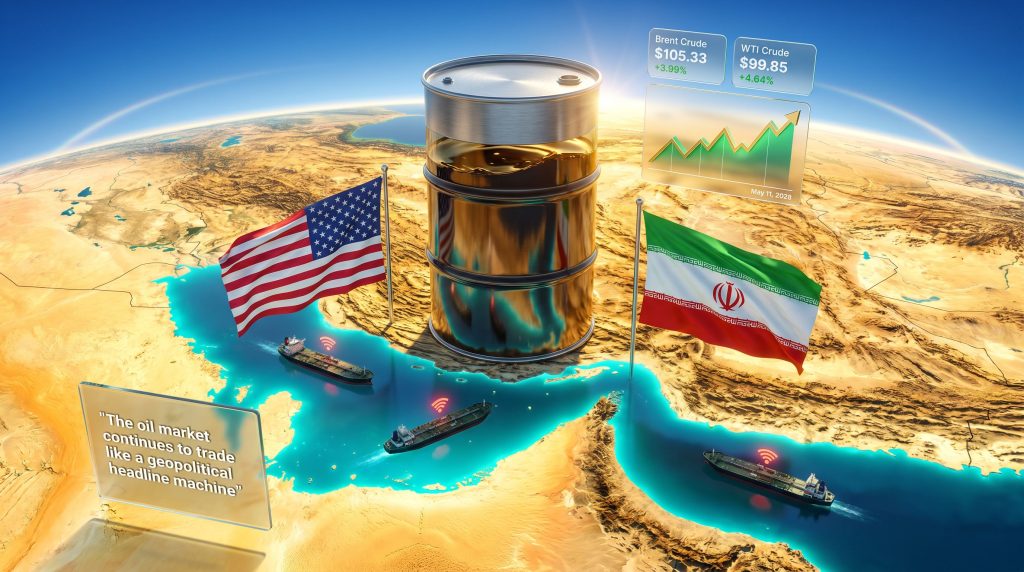
| Brent Crude Futures | $105.33/bbl | +$4.04 | +3.99% |
| WTI Crude | $99.85/bbl | +$4.43 | +4.64% |
| Prior Week Performance | Both contracts | Approx. -$6–7/bbl | -6.0% weekly |
The prior week's six percent decline across both Brent and WTI had reflected genuine market optimism that a negotiated settlement was approaching. The speed of the reversal — essentially erasing that weekly loss within a single Monday session — illustrates precisely how fragile diplomatic-premium pricing is in active conflict environments. Markets that price hope recorrect violently when that hope is extinguished.
Markets had essentially borrowed against a peace scenario that never materialised. The rejection of Iran's response did not create new supply risk so much as it removed an assumed supply relief. That distinction matters enormously for understanding the velocity of the price move.
The Strait of Hormuz: A Geography Lesson in Energy Vulnerability
Why This Narrow Corridor Holds Disproportionate Market Power
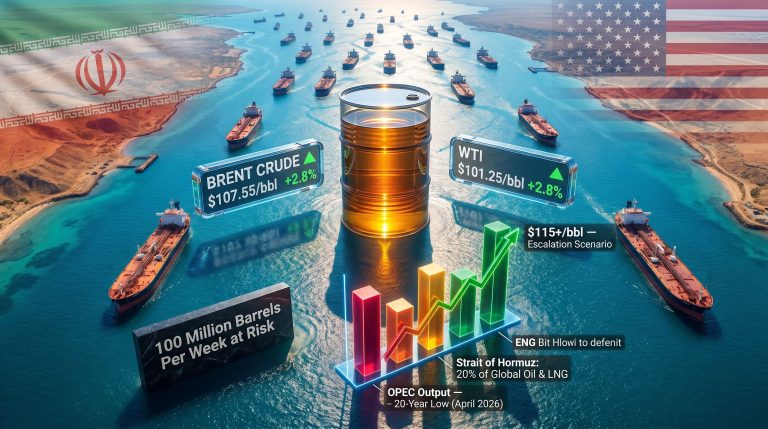
The Strait of Hormuz sits between Iran to the north and Oman and the United Arab Emirates to the south, forming the only maritime exit from the Persian Gulf into the wider Indian Ocean. Under normal operating conditions, approximately 20 percent of the world's total traded oil transits this corridor, making it the single most consequential energy chokepoint on the planet.
What makes the Strait uniquely vulnerable compared to other major maritime corridors is the combination of its geographic narrowness, its proximity to Iranian territorial waters, and the absence of any credible bypass alternative that could handle anything close to comparable volumes at comparable cost. Furthermore, while Saudi Arabia and the UAE maintain limited overland pipeline capacity that bypasses the strait entirely, those pipelines handle only a fraction of the total throughput normally flowing through the waterway.
This structural bottleneck means that any credible signal of Iranian interdiction capability — regardless of whether vessels are actually being stopped — immediately raises the cost and risk profile of every tanker transiting the region. As analysts have noted, this dynamic alone is sufficient to sustain elevated price premiums throughout the duration of diplomatic uncertainty.
The 1 Billion Barrel Deficit: What That Number Actually Means
Saudi Aramco CEO Amin Nasser provided one of the most striking quantitative assessments of the conflict's impact, stating that the world had lost approximately one billion barrels of oil from available supply over the two months preceding 11 May 2026. To contextualise that figure:
- Global oil consumption typically runs at approximately 100 to 103 million barrels per day
- One billion barrels represents roughly 10 days of total global consumption
- This volume cannot be quickly replaced even if physical flows resume immediately
- Strategic petroleum reserves across IEA member countries have historically held approximately 1.5 to 1.6 billion barrels in government-controlled stocks
The implication is significant: the deficit created by 10 weeks of Hormuz disruption is large enough to require months of above-average production to normalise inventory levels, even under an optimistic resolution scenario. This is the structural logic behind ING analysts' forecast that Brent would remain above $90 per barrel through the end of 2026, even if the acute crisis began to resolve.
Tankers Going Dark: The AIS Disabling Trend
One of the most operationally significant data points in the reporting is the Kpler shipping data confirming that three crude-carrying tankers exited the Strait of Hormuz with their Automatic Identification System (AIS) transponders disabled during the preceding week.
AIS transponders are the maritime equivalent of aircraft transponders, broadcasting vessel position, speed, heading, and identification in real time. Vessels that disable these systems are deliberately removing themselves from normal maritime traffic monitoring. In conflict zones, this behaviour typically reflects crew and operator concern about becoming targets of hostile interception.
This trend carries several less-obvious implications:
- It signals that commercial operators have moved from monitoring the conflict risk to actively adapting operations to it, which represents a qualitative escalation in the risk environment
- AIS-dark vessels are harder to track for insurance purposes, typically attracting war-risk premium surcharges that add meaningfully to freight costs
- The rising frequency of this behaviour suggests it is becoming normalised rather than exceptional, pointing to a structural shift in Persian Gulf shipping operations
- Insurers and reinsurers face compounding difficulty pricing risk for vessels they cannot track, which can ultimately restrict tanker availability for the corridor
Oil Price Forecasts: What Analysts Are Saying About 2026 and 2027
The Structural Case for Prices Staying Elevated
ING analysts outlined a two-phase price trajectory in their 11 May 2026 note that reflects both the immediate disruption impact and the longer-term normalisation timeline:
| Period | Brent Forecast | Primary Driver |
|---|---|---|
| Through December 2026 | Above $90/bbl | Geopolitical risk premium, inventory deficit |
| Through 2027 | $80–$85/bbl | Demand recovery, gradual inventory rebuild |
| Pre-conflict baseline (approximate) | $70–$75/bbl | Normal supply-demand balance |
The important analytical insight here is the floor implied by the inventory deficit. Even in a scenario where diplomatic resolution occurs rapidly, the physical oil that did not flow through Hormuz over 10 weeks cannot be retroactively produced. Supply chains rebuild slowly. Refineries that switched to alternative sources face switching costs in reverting. Strategic reserves that were drawn down require years of above-average production to replenish.
ING analysts noted that depleted inventories and weakened policy coordination would sustain a geopolitical risk premium in prices even after the immediate crisis subsides. This creates an asymmetric risk profile for energy markets: the upside scenario produces only partial price relief, while the downside scenario could push prices meaningfully higher than current levels.
Why Last Week's Six Percent Drop Was a Mispricing
The prior week's sharp decline reflected a genuine but premature assessment that ceasefire negotiations were approaching conclusion. This type of peace premium mispricing is a recurring feature of conflict-era energy markets. Traders are incentivised to position ahead of resolution announcements, creating price movements that front-run diplomatic outcomes that ultimately do not materialise.
Senior market analyst Priyanka Sachdeva of Phillip Nova captured this dynamic accurately, describing the market as operating like a geopolitical headline machine, with sharp price swings driven by every statement, rejection, or warning emerging from Washington and Tehran rather than by underlying physical fundamentals.
The lesson for market participants is significant: in active conflict environments, diplomatic-hope rallies and their reversals tend to be faster and more violent than movements driven by fundamental supply-demand shifts. Consequently, positioning strategies that rely on diplomatic optimism carry substantial reversal risk.
China's Role: The World's Largest Oil Importer as a Diplomatic Variable
Beijing's Structural Stake in Hormuz Stability
China's position in this crisis is unique and potentially decisive. As the world's largest crude oil importer, China has a fundamental economic interest in seeing the Strait of Hormuz return to normal operation. Persian Gulf producers — including Saudi Arabia, Iraq, Kuwait, and the UAE — collectively supply a significant portion of China's crude import requirements. Any sustained disruption to Hormuz transit directly compresses China's refinery feedstock availability and forces costly substitution toward alternative supply sources.
Trump's scheduled visit to Beijing on Wednesday, 14 May 2026, created what IG Markets analyst Tony Sycamore described as the next major market catalyst. Sycamore observed that market attention had shifted squarely to the Beijing summit, with the expectation that Trump would attempt to persuade President Xi Jinping to deploy China's diplomatic leverage over Tehran toward achieving a comprehensive ceasefire and Hormuz resolution.
China's Import Data Reveals the Damage Already Done
The depth of supply disruption is quantified by Chinese trade data released over the weekend of 10–11 May 2026: China's inbound crude shipments had fallen to their lowest level in nearly four years during April 2026. This is a remarkable data point that illustrates the systemic reach of the Hormuz disruption beyond the immediate conflict zone.
A collapse in Chinese crude imports of this magnitude cascades through multiple downstream systems:
- Reduced refinery throughput affects domestic fuel availability and pricing
- Petrochemical feedstock constraints compress margins across manufacturing supply chains
- Strategic petroleum reserve drawdowns accelerate inventory depletion
- Alternative source procurement — from West African, Latin American, and Russian crude — strains logistics networks and inflates freight costs
If Beijing successfully facilitates a ceasefire framework acceptable to both Washington and Tehran, the market could unwind a significant portion of the geopolitical risk premium currently embedded in prices. However, the underlying inventory deficit would continue to support prices above pre-conflict baselines for 12 to 18 months regardless of diplomatic outcomes.
Broader Economic Consequences: From Energy Shock to Consumer Prices
How Oil Above $100 Filters Through the Economy
Sustained Brent crude above $100 per barrel does not remain confined to energy markets. The transmission channels to broader consumer economies operate through several interconnected mechanisms:
- Retail fuel costs rise directly, compressing household discretionary spending
- Transportation logistics costs increase, adding to the delivered price of essentially every physical good
- Agricultural input costs rise as diesel-dependent farming and food distribution absorbs higher fuel expenses
- Manufacturing energy costs compress margins or trigger price pass-through to consumers
- Airline operating costs rise, affecting ticket pricing across global travel networks
For central banks managing inflation targets, sustained above-$90 Brent creates a genuine dilemma. Energy-driven inflation is supply-side in origin, meaning interest rate increases cannot directly address it but will slow demand and potentially trigger recessionary dynamics if deployed aggressively. This leaves monetary policymakers with limited effective tools against a geopolitically induced oil shock.
Emerging Market Vulnerability and the Fiscal Pressure Problem
Economies with high energy import dependency face disproportionate exposure to sustained high crude prices. For many emerging market nations, fuel subsidies and energy import bills represent significant fiscal commitments denominated in US dollars. When oil prices surge, these fiscal pressures compound simultaneously with currency depreciation risk, as dollar-denominated energy import costs rise while local currency revenues remain constrained.
This creates a feedback loop where energy-importing emerging markets face simultaneous pressure on trade balances, fiscal positions, and currency stability — all originating from a single geopolitical event in the Persian Gulf.
How Energy Investors Are Repositioning
Energy sector equities have historically demonstrated strong relative performance during periods of geopolitical oil price spikes. The mechanism is straightforward: higher crude prices expand upstream producer margins, improve cash flow generation, and often trigger upward revisions to earnings forecasts. However, broader equity market indices face countervailing headwinds. Higher energy costs compress margins across energy-consuming sectors, raise input costs, and reduce consumer discretionary spending.
Institutional investors are navigating this cross-current by:
- Overweighting upstream energy producers with minimal Hormuz transit exposure
- Increasing allocations to inflation-linked instruments as energy-driven CPI risk rises
- Reducing exposure to energy-intensive industrial and consumer discretionary sectors
- Building positions in tanker operators with diversified routing capabilities
The next major ASX story will hit our subscribers first
Frequently Asked Questions: Oil Rises After Trump Rejects Iran's Response
Why Did Oil Prices Surge After Trump Rejected Iran's Peace Proposal Response?
Markets had spent the prior week pricing in the probability of a near-term ceasefire, producing a six percent weekly decline across Brent and WTI. Trump's public rejection of Iran's counter-demands on 10 May 2026 eliminated that near-term resolution scenario. Because approximately 20 percent of globally traded oil transits the Strait of Hormuz, any credible signal that disruption will continue longer than expected triggers immediate upward repricing of crude futures.
What Was the Strait of Hormuz Situation on 11 May 2026?
The strait had been largely closed for 10 weeks as of 11 May 2026. Saudi Aramco CEO Amin Nasser confirmed that approximately one billion barrels of oil had been removed from global supply during that period. Three tankers had exited the strait during the preceding week with AIS tracking systems disabled, according to Kpler shipping data.
How High Could Brent Crude Go if the Conflict Continues?
ING analysts forecast Brent remaining above $90 per barrel through the end of 2026 under a sustained disruption scenario. In acute escalation scenarios — including the risk of full Hormuz closure — short-term spikes beyond current levels remain possible, though prices significantly above $110 to $120 would typically trigger demand destruction responses and accelerate alternative supply development.
What Role Does China Play in Potential Resolution?
China is both a major crude importer dependent on Persian Gulf supply and a significant diplomatic partner to Iran. The Trump-Xi Beijing summit scheduled for 14 May 2026 was identified by analysts as the most significant near-term catalyst for directional price movement, with the possibility that Beijing could deploy its influence with Tehran toward a ceasefire framework.
What Would Oil Prices Do if a Ceasefire Were Announced?
A ceasefire announcement would likely trigger a sharp short-term decline as the geopolitical risk premium unwinds. However, ING analysts note that depleted inventories and weakened supply chain coordination would sustain prices above pre-conflict baselines. Brent settling in the $80 to $85 range through 2027 remains the consensus expectation even under a resolution scenario.
Why Did Tankers Disable Their Tracking Systems in the Strait of Hormuz?
Vessels that switch off AIS transponders in conflict zones are typically attempting to reduce their targeting profile against hostile interception. Three crude tankers confirmed to have used this tactic in the week prior to 11 May 2026 reflect the degree to which commercial operators have adapted their operations to function within an elevated-risk security environment.
What the US-Iran Oil Shock Reveals About Energy System Fragility
A Systemic Risk That Markets Cannot Fully Hedge
The 10-week Hormuz disruption has exposed a structural vulnerability that optimistic supply-chain planning had largely obscured. The global energy system's dependence on a single narrow maritime corridor — one sitting within range of Iranian military capability — represents a systemic concentration risk that no combination of strategic reserves, diplomatic frameworks, or alternative routing options can fully neutralise.
The removal of approximately one billion barrels from global supply over two months is not simply a headline number. It represents a physical deficit that will shape inventory levels, refinery margins, and price floors for an extended period regardless of what happens diplomatically in the near term.
What Market Participants Should Be Watching
For investors, energy market analysts, and policymakers monitoring the evolving situation, the most actionable indicators include:
- Diplomatic signals from the Trump-Xi Beijing summit as the most immediate catalyst for directional price movement in crude futures
- Weekly crude inventory data from the US Energy Information Administration and International Energy Agency as direct measures of how rapidly the supply deficit is deepening
- AIS tracking activity in the Persian Gulf, particularly data from Kpler and Refinitiv Eikon, as real-time proxies for Hormuz transit conditions and operational risk levels
- OPEC+ production decisions from non-Hormuz-dependent producers regarding whether spare capacity can be credibly deployed to offset disrupted volumes
- Chinese monthly import data as a leading indicator of how the world's largest crude consumer is absorbing the supply shock
- Tanker freight rate indices for Persian Gulf routes as market-based measures of the operational risk premium being applied to corridor transit
The fundamental lesson from this episode is one that energy markets have learned and forgotten repeatedly across modern history: geopolitical risk premiums compress during periods of diplomatic optimism and expand violently when that optimism is extinguished. Oil rises after Trump rejects Iran's response to the US peace proposal represents not simply a trading event, but a signal about the structural fragility of the energy architecture the global economy depends upon every day.
Disclaimer: This article contains forward-looking statements and analyst forecasts that involve inherent uncertainty. Price projections from ING and other analysts represent estimates based on conditions as of 11 May 2026, and may change materially as diplomatic, military, or supply-side conditions evolve. Nothing in this article constitutes financial or investment advice. Readers should consult qualified financial professionals before making investment decisions related to energy markets or commodities.
Want to Position Ahead of the Next Major Commodity Discovery?
While geopolitical shocks reshape energy markets, Discovery Alert's proprietary Discovery IQ model scans ASX announcements in real time, delivering instant alerts on significant mineral discoveries across oil, gas, and more than 30 other commodities — turning complex market data into actionable opportunities for investors at every level. Explore how historic discoveries have generated substantial returns on Discovery Alert's dedicated discoveries page, and begin your 14-day free trial today to secure a market-leading edge.