August 20, 2026
When Geography Becomes Destiny: The Strait That Broke Global Oil Markets
Every few decades, a single waterway reminds the world just how fragile the architecture of global energy supply truly is. The Persian Gulf's narrow exit point has long been identified by energy economists as the single greatest concentration of supply-chain vulnerability on earth. When that vulnerability becomes reality rather than theory, the price consequences are not gradual, they are violent, compounding, and deeply resistant to reversal.
That is precisely the situation commodity markets are navigating as oil prices extend gains amid the US-Iran war deadlock that has kept supply off the market since late February 2026. What began as a military confrontation has evolved into a structural energy crisis with no credible near-term resolution, and the price data makes this brutally clear. Furthermore, the broader implications for oil trade and geopolitics are reshaping how nations think about energy security.
When big ASX news breaks, our subscribers know first
The Price Signal: What the Numbers Are Actually Saying
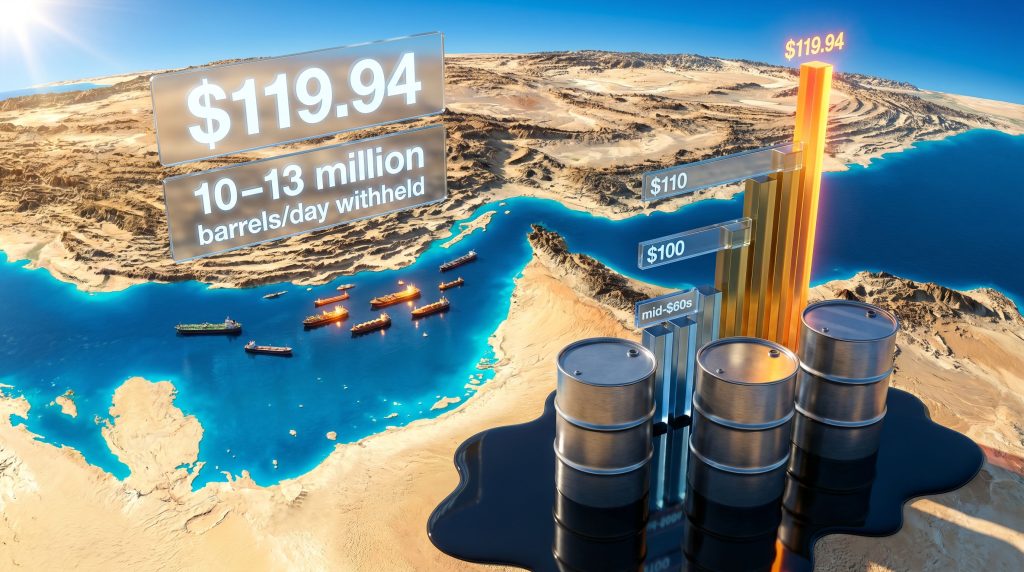
Brent crude futures for June delivery rose $1.91, or 1.62%, to $119.94 per barrel as of early Asian trading on April 30, 2026, following a prior session gain of 6.1%. The June contract marked its ninth consecutive day of gains before expiry. The more actively traded July contract traded at $111.38 per barrel, up $0.94, or 0.85%, after itself gaining 5.8% in the session prior.
US West Texas Intermediate futures for June were not far behind, rising $0.63, or 0.59%, to $107.51 per barrel, having already surged 7% in the previous session and recorded gains in eight of the past nine trading days.
To appreciate the magnitude of this move, consider where prices sat before US and Israeli air strikes commenced against Iran on February 28, 2026: Brent was trading in the mid-$60 per barrel range. The move from that baseline to nearly $120 inside approximately two months represents one of the most compressed and severe geopolitically-driven energy price shocks in the modern era of commodity trading.
| Benchmark | Pre-Conflict Level | April 30 Level | Prior Session Gain |
|---|---|---|---|
| Brent June Futures | Mid-$60/barrel | $119.94/barrel (+1.62%) | +6.1% |
| Brent July Futures | Mid-$60/barrel | $111.38/barrel (+0.85%) | +5.8% |
| WTI June Futures | Mid-$60/barrel | $107.51/barrel (+0.59%) | +7.0% |
This is not speculative momentum. It is a market repricing a world where roughly 20% of global crude oil supply has effectively vanished from international commerce.
The Strait of Hormuz: A Chokepoint Like No Other
To understand why oil prices extend gains as the US-Iran war deadlock keeps supply off the market, it is necessary to understand the physical geography underpinning the crisis. The Strait of Hormuz, a narrow passage between the Persian Gulf and the Gulf of Oman, functions as the single most consequential maritime energy corridor on the planet.
Before the outbreak of hostilities, the Strait facilitated approximately 140 vessel transits per day, carrying crude oil exports from Saudi Arabia, the UAE, Kuwait, Iraq, and Iran itself. That volume represented roughly 20% of global daily crude supply, equivalent to somewhere between 10 and 13 million barrels per day flowing through a waterway only about 33 kilometres wide at its narrowest navigable point.
Since Tehran moved to restrict all non-Iranian commercial shipping through the Gulf following the February 28 air strikes, that throughput has collapsed to approximately 7 vessel passages per 24-hour period. The effective reduction is staggering: a near-95% fall in commercial transit activity. This level of oil market disruption has few precedents in modern energy history.
| Metric | Before February 28, 2026 | As of April 30, 2026 |
|---|---|---|
| Daily vessel transits | ~140 ships | ~7 ships |
| Global crude supply affected | ~20% | Severely restricted |
| Estimated barrels withheld | Negligible | 10-13 million barrels/day |
PVM Oil Associates analyst Tamas Varga articulated the arithmetic plainly: each day that 10 to 13 million barrels fail to reach international buyers, the already-tight global oil balance deteriorates further. This is not a marginal disruption. It represents a supply withdrawal greater than the combined daily output of several major OPEC member nations.
Why There Is No Easy Detour
A common misconception is that alternative shipping routes or pipeline infrastructure could absorb a Hormuz disruption at scale. The reality is considerably more constrained.
- Pipeline capacity is insufficient: While bypass options exist, including Saudi Aramco's East-West Pipeline terminating at Yanbu on the Red Sea, their combined throughput capacity cannot replace the 10 to 13 million barrels per day normally transiting Hormuz.
- Rerouting extends transit times dramatically: Asian importers, particularly those in China, India, Japan, and South Korea, who depend heavily on Middle East crude, face significantly longer and more costly voyages around the Cape of Good Hope if Hormuz remains inaccessible.
- Insurance markets are pricing in the risk: War-risk premiums on vessels operating anywhere near the conflict zone have risen sharply, rendering many voyages commercially unviable regardless of physical route availability. The shipping economics have shifted from challenging to prohibitive for many operators.
This week, the United States added another layer of complexity by introducing a naval blockade of Iranian vessels, creating a dual-layer maritime standoff. Iran restricts others; the US restricts Iran. The result is a near-total commercial freeze on one of the world's most critical energy corridors. For a deeper understanding of how geopolitical trade tensions of this nature reshape global commerce, the scale of disruption here is remarkable.
The Diplomatic Deadlock and the Duration Problem
Energy markets can absorb short-term supply disruptions with relative composure. The oil risk premium that emerges from geopolitical flare-ups typically compresses within weeks as diplomatic channels produce reassurances, partial resolutions, or credible timelines for normalisation.
What makes the current situation categorically different is the absence of any credible resolution pathway. IG market analyst Tony Sycamore assessed the situation clearly in a note to clients: the prospects for near-term resolution to the Iran conflict or any reopening of the Strait of Hormuz appear remote. That assessment is shared across the analyst community.
The conflict has already claimed thousands of lives. The humanitarian toll compounds the political calculus on all sides, making rapid de-escalation harder rather than easier as weeks pass. Ceasefire negotiations have deadlocked, with the structural gap between US-Israeli strategic objectives and Iranian positions proving resistant to diplomatic bridging.
What the market is pricing is not just today's supply shortfall. It is the probabilistic expectation of how long that shortfall persists multiplied across every barrel that fails to clear the Strait each day.
Then came a signal from Washington that further unsettled markets. US President Donald Trump convened a meeting with major oil companies to explore contingency planning for a scenario in which the US blockade of Iranian ports extends for months. Rather than reassuring traders that a resolution was imminent, the consultation telegraphed the opposite: that the US administration is preparing for an extended conflict timeline, not a near-term wind-down.
Goldman Sachs responded to this evolving picture by revising its Q4 2026 price forecasts upward, projecting Brent crude at $90 per barrel and WTI at $83 per barrel as a base case, citing reduced Middle East output as the primary driver. Notably, even the investment bank's Q4 estimate, which represents a significant retreat from current spot levels, is premised on some degree of supply recovery that has not yet materialised.
OPEC+ Finds Itself Structurally Outmatched
The traditional stabilising mechanism for supply shocks of this magnitude has historically been OPEC+ coordination. The alliance has repeatedly demonstrated its capacity to move prices through collective production management. However, the current disruption presents a challenge of a fundamentally different order. Indeed, OPEC's market influence has rarely been tested so severely by physical constraints beyond its control.
OPEC+ is expected to approve a quota increase of approximately 188,000 barrels per day at its upcoming weekend meeting. In isolation, this is a meaningful policy signal. In the context of a 10 to 13 million barrel per day supply withdrawal, it is arithmetically inconsequential. The gap between what the alliance can incrementally add and what the conflict has removed from markets is roughly 70 to 1.
| OPEC+ Response Variable | Detail |
|---|---|
| Planned quota increase | ~188,000 barrels/day |
| Market daily shortfall (Hormuz) | 10-13 million barrels/day |
| Effective offset ratio | Less than 2% of the shortfall |
| Meeting timing | Sunday, May 3, 2026 |
The broader OPEC+ picture is further complicated by the UAE's formal withdrawal from OPEC, effective May 1, 2026. This marks the first departure of a major Gulf producing state from the organisation. Russia has publicly stated its intention to remain within OPEC+ and expressed hope that the UAE's exit does not signal the beginning of a wider unravelling of the alliance.
Analysts at Wood Mackenzie highlighted a critical nuance: while the UAE's independence from OPEC quotas theoretically liberates it to expand production, the physical reality of war-related infrastructure disruption means Gulf countries, including the UAE, will require months to return to pre-conflict production volumes. The policy constraint has been replaced by a physical one, and the outcome for near-term supply availability is the same.
The Ripple Effects: From Oil Markets to the Broader Economy
Sustained crude prices above $100 per barrel do not stay contained within energy markets. The transmission channels into the broader global economy are well-established and are already active.
For inflation and monetary policy:
- Energy costs feed directly into transport, manufacturing, and food supply chain pricing, generating a second-order inflationary pulse across import-dependent economies.
- Central banks face a classic stagflationary dilemma: tightening monetary policy to contain oil-driven inflation risks suppressing growth that is already under pressure from geopolitical uncertainty.
- The US Federal Reserve has flagged elevated inflation concern in this environment. The US dollar has strengthened as a consequence, while gold markets have experienced notable volatility as investors reassess the inflation trajectory amid a broader market volatility reset.
For emerging markets:
Large Asian crude importers, including China, India, Japan, and South Korea, bear a disproportionate share of the cost burden. Each is heavily dependent on Middle Eastern crude and faces the compounding challenge of both higher prices and constrained supply availability. South Africa has responded by extending fuel tax cuts to cushion domestic consumers from the conflict's price impact.
For capital markets across the MENA region:
The financial system stress is visible in the data. Geopolitical tensions have dragged MENA debt issuance down 12% in the first quarter of 2026. GCC corporate issuers, unable to access public bond markets at viable spreads, have pivoted to bilateral bank lending to bridge their funding requirements. Emirates NBD's pricing of a $750 million AT1 bond was notable as the first GCC public debt market transaction since the Iran war began, signalling just how thoroughly normal capital market activity has been disrupted.
The next major ASX story will hit our subscribers first
Scenario Framework: Three Paths Forward
Understanding where oil markets go from here requires thinking in scenarios rather than forecasts, given the inherent uncertainty in conflict duration and diplomatic outcomes.
Scenario 1: Prolonged Deadlock (Base Case)
If diplomatic negotiations remain stalled and both the Hormuz restriction and US blockade persist, Brent likely sustains above $100 per barrel with periodic spikes toward and above $120 on escalation events. OPEC+ quota increases provide marginal comfort but cannot alter fundamental supply arithmetic. This scenario extends well into the second half of 2026.
Scenario 2: Partial De-escalation
Back-channel diplomatic progress producing a partial reopening of the Strait would allow some supply relief. Goldman Sachs's Q4 forecast range of $90 Brent becomes operative under this pathway. The geopolitical risk premium would compress but not disappear, given the unresolved underlying military conflict.
Scenario 3: Full Escalation (Tail Risk)
A broadening of the conflict to involve additional regional actors, or a complete closure of the Strait to all traffic, would introduce price dynamics well beyond current levels. Analysts tracking the ongoing standoff note that emergency strategic petroleum reserve releases by major consuming nations would become likely, but even coordinated reserve drawdowns would provide only temporary relief against a complete Hormuz closure.
A critical and underappreciated dimension of all three scenarios is what Wood Mackenzie's analysts have made explicit: even after a ceasefire is reached, Gulf production recovery will take months. Investors and analysts who anticipate an immediate price collapse upon any diplomatic breakthrough are likely to be disappointed. The infrastructure, logistics, and commercial relationships disrupted by months of conflict do not normalise overnight.
What This Means for Market Participants
The confluence of factors sustaining elevated oil prices is not a temporary alignment of adverse conditions. It reflects a genuine structural withdrawal of significant global supply with no near-term mechanism for restoration. Consequently, oil prices extend gains as the US-Iran war deadlock keeps supply off the market with consequences that ripple well beyond the energy sector.
Several key takeaways stand out for those navigating these markets:
- The 9-session Brent gain streak and the near-doubling of crude prices from pre-conflict levels are not speculative phenomena. They reflect physical supply constraints verified by vessel tracking and production data.
- OPEC+ policy tools are structurally outmatched by the scale of the disruption. The alliance's planned 188,000 barrel per day increase cannot meaningfully offset a 10 to 13 million barrel per day withdrawal.
- The UAE's OPEC exit introduces long-term uncertainty about the alliance's cohesion and price-setting credibility precisely when markets need coordinated supply management most.
- Price normalisation will lag any diplomatic resolution by months, not days, given the physical damage and production disruption accumulated since February 28.
- Downstream financial market stress is already measurable in bond market volumes, corporate funding patterns, and credit spreads across the MENA region, suggesting that second-order economic consequences are well advanced even without further escalation.
In addition, the speed at which this crisis has unfolded underscores just how swiftly supply shocks reorder markets when a critical chokepoint is compromised. For market participants, the lesson is stark: geographical concentration of supply risk is not an abstract concern — it is a live and immediately consequential variable in every energy portfolio.
Disclaimer: This article is intended for informational purposes only and does not constitute financial, investment, or trading advice. Oil market forecasts, scenario projections, and analyst estimates referenced herein are subject to significant uncertainty. Readers should conduct their own due diligence and seek independent professional advice before making investment decisions. All pricing data referenced reflects market conditions as reported on April 30, 2026.
Want to Stay Ahead of the Next Major Resource Discovery Driven by Energy Market Shifts?
When geopolitical shocks reshape commodity markets at this speed, early positioning in significant mineral discoveries can define investment outcomes — Discovery Alert's proprietary Discovery IQ model delivers real-time ASX alerts, turning complex resource data into actionable opportunities the moment they are announced. Explore how historic mineral discoveries have generated substantial returns and begin a 14-day free trial to ensure you are never behind the market when the next major discovery breaks.