June 4, 2026
When Oil Markets Price Fear Before Facts: Understanding the Current West Asia Crisis
Energy markets have a well-documented tendency to price catastrophe before it arrives. The mechanisms behind this behaviour are not irrational — they reflect the structural reality that physical oil supply chains cannot adapt quickly enough to absorb sudden disruptions, so forward-looking pricing becomes the market's primary shock absorber. This dynamic is in full effect right now, as oil gains as West Asia hostilities flare across multiple theatres simultaneously, creating one of the most complex risk environments crude markets have navigated in years.
What makes the current situation analytically distinctive is not any single event, but the convergence of several independent stress factors arriving at the same moment. Active military exchanges, a critically constrained maritime passage, deteriorating diplomatic channels, and historically low global inventory buffers are all present at once. Understanding how each layer interacts with the others is essential for anyone attempting to interpret where crude prices are headed next. Furthermore, the geopolitical oil price drivers at play extend well beyond a single region or incident.
When big ASX news breaks, our subscribers know first
The Architecture of an Oil Risk Premium: How Conflict Translates Into Price
Not all geopolitical events move oil markets with equal force. The determining factor is proximity to critical supply infrastructure. West Asia's unique position in global energy architecture means that armed conflict in this region carries an automatic multiplier effect that conflicts elsewhere simply do not trigger.
The Persian Gulf accounts for a substantial portion of the world's seaborne crude exports. Iran, Iraq, Saudi Arabia, the UAE, and Kuwait collectively represent a concentration of production capacity that has no viable geographic alternative. When hostilities break out within or near this cluster, markets must immediately model whether physical export flows will be interrupted, rerouted, or priced out of competitive reach for certain importers.
The current escalation cycle involves several concurrent pressure points:
| Driver | Category | Market Impact |
|---|---|---|
| Iranian ballistic missile strikes on Kuwait and Bahrain | Kinetic escalation | Immediate risk premium injection |
| U.S. military strikes on Iran's Qeshm Island | Counter-escalation | Supply continuity uncertainty |
| Strait of Hormuz prolonged operational disruption | Infrastructure bottleneck | Sustained upward price pressure |
| Stalled U.S.-Iran diplomatic exchanges | Negotiation breakdown | Prolonged risk premium duration |
| IEA critical inventory warning ahead of peak summer demand | Fundamental tightness | Bullish sentiment amplification |
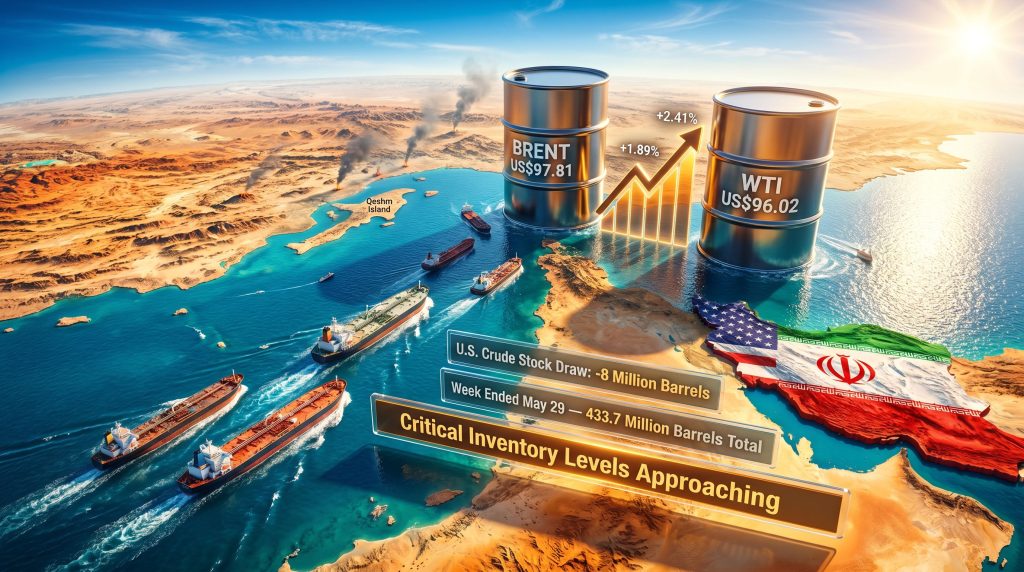
| U.S. crude stockpile draw of 8 million barrels (week ended May 29) | Inventory signal | Demand-side validation |
"What separates this rally from a typical geopolitical spike is that the fundamental picture would support elevated prices even without the conflict. The geopolitical risk premium is sitting on top of an already tightening market, not compensating for a loose one."
Brent and WTI: Reading the Benchmark Price Signals
Both major crude benchmarks registered approximately 2% gains across multiple consecutive sessions, a pattern that signals sustained institutional repositioning rather than reactive retail sentiment. Single-session spikes driven by breaking news tend to mean-revert within 24 to 48 hours. Multi-session rallies of this character reflect deeper structural conviction about the duration of the risk environment.
The specific settlement figures tell a precise story:
- Brent crude settled at US$97.81 per barrel, advancing US$1.81 or 1.89%, marking its highest close across several sessions
- WTI (West Texas Intermediate) settled at US$96.02 per barrel, gaining US$2.26 or 2.41%
- Both benchmarks extended gains from the prior session, confirming sustained rather than reactive buying momentum
For context on how the current repricing fits within historical geopolitical oil events, the pattern becomes instructive. Notably, oil price volatility trends across prior conflict cycles reveal just how distinct the current multi-session rally is:
| Geopolitical Event | Crude Price Response | Duration of Spike |
|---|---|---|
| Gulf War I (1990-1991) | Approximately 100% peak-to-trough | Several months |
| Iraq War commencement (2003) | 15-20% pre-war premium | Weeks |
| Strait of Hormuz tanker incidents (2019) | 4-6% single session | Days |
| Current West Asia escalation cycle | Approximately 2% per session, multi-session | Ongoing |
Note: Historical comparisons are illustrative of risk premium dynamics and directional patterns only. Past price behaviour does not predict future outcomes.
The 2019 tanker incident comparison is particularly instructive. Those incidents produced sharper single-session moves but faded quickly because diplomatic escalation did not follow. The current cycle is producing more measured per-session gains that are persisting for longer, which typically indicates that institutional hedging activity, rather than speculative positioning alone, is driving the price floor higher.
The Strait of Hormuz: A Chokepoint With No Substitute
Why Does Hormuz Drive Such Sustained Price Pressure?
Understanding why oil gains as West Asia hostilities flare requires a precise understanding of what the Strait of Hormuz actually is and why its disruption cannot be easily mitigated by alternative routing.
The strait is a narrow waterway approximately 33 kilometres wide at its narrowest navigable point, connecting the Persian Gulf to the Gulf of Oman. At any given time, roughly 20% of the world's seaborne traded oil transits this corridor. The numbers are staggering when broken down:
- Saudi Arabia exports the majority of its crude through this passage
- Iraq's entire seaborne export volume depends on access to Gulf terminals that feed into Hormuz transit lanes
- Kuwait, the UAE, and Qatar all rely on the strait for liquefied natural gas and crude export continuity
- Iran itself uses Hormuz, which creates the strategic paradox that closing it damages Iranian export revenue alongside that of regional rivals
Why there is no viable alternative at scale:
- Saudi Arabia's East-West pipeline (Petroline) can carry approximately 5 million barrels per day, but total Hormuz traffic reaches roughly 20 to 21 million barrels per day
- The UAE's Abu Dhabi Crude Oil Pipeline provides partial bypass capacity, but again only covers a fraction of the volume requiring transit
- Iraq has no functioning alternative export infrastructure of meaningful scale
- Rerouting tankers around the Arabian Peninsula adds weeks to delivery timelines and dramatically increases freight costs
The prolonged closure of the strait under current conflict conditions is not a short-term logistical inconvenience. It represents a structural compression of global supply availability that compounds daily it continues. Reports from Channel News Asia confirm that these latest flare-ups have already begun affecting trader sentiment across Asian markets.
According to Simon-Peter Massabni, Head of Business Development at XS.com, the acceleration of U.S.-Iran clashes has outrun diplomatic efforts, and the sustained Hormuz disruption is functioning as a continuous price support mechanism rather than a temporary shock. (Source: Reuters, June 2026)
Scenario Modelling: Three Potential Hormuz Outcome Paths
Scenario A: Diplomatic De-escalation (Low Probability, Near-Term)
- Ceasefire framework reached; Strait reopens to full commercial traffic
- Brent likely retreats toward the US$85-88 range as geopolitical premium deflates
- IEA inventory warnings remain relevant but lose near-term urgency
Scenario B: Sustained Conflict, No Infrastructure Escalation (Base Case)
- Intermittent hostilities persist; Strait remains partially disrupted
- Brent consolidates in the US$93-100 range with episodic upward spikes
- Inventory draws accelerate through the peak summer demand season
Scenario C: Full Strait Closure or Major Infrastructure Strike (Tail Risk)
- Severe supply disruption triggers emergency IEA strategic reserve coordination
- Brent price ceiling becomes difficult to model above US$110-120
- Global recession risk escalates as energy import costs surge for net-importing economies, particularly across Asia-Pacific
These scenarios represent analytical projections, not forecasts. Actual outcomes will depend on variables that cannot be reliably predicted, including diplomatic developments, military decisions, and third-party actor behaviour.
Diplomatic Stagnation as a Structural Oil Price Support
One of the less-discussed but analytically critical dynamics in the current cycle is how the breakdown of U.S.-Iran diplomatic engagement functions as an independent bullish factor for crude, separate from the kinetic conflict itself. In addition, the trade war impact on oil markets has further complicated the diplomatic calculus, layering additional uncertainty onto already strained negotiations.
When negotiation channels go dark, markets lose the ability to price in a de-escalation timeline. Without a credible diplomatic pathway to reduced tensions, the duration of the risk premium becomes open-ended, and open-ended risk premiums are more deeply embedded into futures pricing than time-bounded ones.
The current diplomatic picture involves several compounding obstacles:
- Iran's semi-official channels confirmed that text-based exchanges through intermediaries had been suspended
- Iran conditioned resumed engagement on resolution of the Lebanon conflict, introducing a multi-actor dependency
- Israel's military incursion into Lebanon, described as its most extensive in 25 years and active since March 2, adds a third-party variable that neither Washington nor Tehran fully controls
- Public statements from U.S. President Trump suggesting ongoing negotiations have created a credibility gap between official messaging and operational ground-level reality
Bob Yawger, Director of Energy Futures at Mizuho, observed that the trajectory of ceasefire prospects is moving in the wrong direction, with deteriorating de-escalation prospects functioning as the dominant near-term price support factor in crude markets. (Source: Reuters, June 2026)
"When official diplomatic optimism diverges sharply from verifiable ground-level military activity, crude markets systematically discount the optimistic statements and price toward the operational risk scenario. This is not cynicism; it is rational risk-adjusted market behaviour."
Why the Lebanon Variable Matters for Oil Pricing
Multi-theatre conflicts sustain oil risk premiums for qualitatively different reasons than single-theatre conflicts. The logic is straightforward:
- Resolution requires coordinated de-escalation across multiple sovereign actors simultaneously
- Each independent theatre can re-ignite broader tensions even if other fronts temporarily cool
- Ceasefire negotiations become exponentially more complex with each additional party at the table
- Markets must price the lowest common denominator of stability, not the average across theatres
The Hezbollah dimension, active since March 2, introduces exactly this type of multi-theatre complexity. As long as the Lebanon conflict remains unresolved, it functions as Iran's stated precondition for diplomatic re-engagement, which means oil markets cannot credibly price a negotiated resolution on a near-term timeline.
The Inventory Dimension: Why the IEA Warning Changes the Fundamental Calculus
Geopolitical risk premiums alone rarely sustain oil price rallies for extended periods. Historical precedent shows that when physical supply remains abundant, markets absorb geopolitical shocks and mean-revert. However, the current situation is structurally different because fundamental inventory conditions would independently support elevated prices even in a conflict-free environment.
The International Energy Agency's warning that global stockpiles could reach critically low levels ahead of peak summer demand is not a seasonal footnote. It identifies a structural tightness that removes the buffer capacity that would normally absorb supply disruption without triggering severe pricing consequences.
The U.S. inventory data sharpens the picture considerably:
| Metric | Value | Context |
|---|---|---|
| U.S. crude draw (week ended May 29) | -8 million barrels | Double analyst consensus forecast of -4 million barrels |
| U.S. crude total stockpile level | 433.7 million barrels | Below seasonal norms |
| Commercial inventory change | Declined | Reflects strong refinery utilisation and export demand |
| Strategic petroleum reserve change | Also declined | Indicates broad-based drawdown pressure |
Giovanni Staunovo, analyst at UBS, noted that the scale of the weekly draw was particularly significant because both commercial and strategic inventory categories declined simultaneously, signalling a broad-based demand-side strength that compounds the supply anxiety already created by the conflict environment. (Source: Reuters, June 2026)
Emril Jamil, Senior Oil Analyst at LSEG, characterised the combination of stalled U.S.-Iran negotiations and IEA inventory warnings as layering successive risk premium additions into benchmark crude prices, with each factor reinforcing rather than offsetting the other. (Source: Reuters, June 2026)
How Inventory Conditions Amplify Geopolitical Risk Premiums
| Inventory Condition | Geopolitical Tension | Combined Market Effect |
|---|---|---|
| Ample buffers | High | Moderate price spike, rapid mean reversion |
| Moderate buffers | High | Sustained elevated prices, slow de-escalation |
| Critically low buffers | High (current) | Amplified spike, prolonged premium, recession risk |
| Critically low buffers | Low | Gradual price support, demand-driven rally |
The critically low buffer scenario carries a specific systemic risk that the others do not: it eliminates the emergency absorption capacity that energy-importing nations rely upon to bridge supply disruptions without triggering demand destruction. When strategic and commercial reserves are simultaneously under pressure, the resilience of the global energy system to absorb further shocks is materially reduced. Consequently, OPEC's influence on oil supply decisions has come under renewed scrutiny as member nations assess their production posture against tightening inventory signals.
The next major ASX story will hit our subscribers first
Market Psychology After Four Months of Active Conflict
The U.S.-Israeli-Iranian confrontation has now entered its fourth month of active engagement. This duration matters for how crude markets process and embed risk, because trader psychology and institutional positioning shift meaningfully at different conflict timescales.
In the early weeks of a geopolitical shock, price moves are dominated by reactive hedging and speculative positioning. By the fourth month, several structural psychological shifts have typically occurred:
- Risk premium normalisation: The initial shock premium gradually becomes embedded in baseline price expectations rather than being treated as a temporary overlay
- Extended hedging horizons: Producers and large consumers extend their forward hedging programmes, reducing spot market liquidity and increasing price stickiness in either direction
- Progressive long positioning: Net long positions in crude futures contracts tend to build cumulatively as conflict duration extends, as institutional funds increase energy allocation
- Emerging demand destruction signals: At sustained elevated price levels, industrial demand softening begins to introduce a counterbalancing force against supply-side risk premiums
This last dynamic represents the key tension that longer-duration conflict scenarios must navigate. If Brent sustains above the US$100-110 range for an extended period, demand destruction effects in price-sensitive markets could ultimately cap the upward trajectory more effectively than any diplomatic breakthrough. Furthermore, a broader examination of oil trade and geopolitics reveals how these demand destruction thresholds vary significantly across importing economies.
Frequently Asked Questions
Why Do Oil Prices Rise When There Is Conflict in West Asia?
West Asia accounts for a disproportionate share of globally traded crude oil. Conflict in this region threatens physical movement through critical maritime chokepoints, particularly the Strait of Hormuz. Even without confirmed supply disruptions, markets immediately price the risk of disruption into benchmark crude prices.
What Is the Strait of Hormuz and Why Does It Matter So Much?
It is a narrow maritime passage connecting the Persian Gulf to the Gulf of Oman and global ocean trade networks. Approximately one-fifth of the world's seaborne oil transits this corridor daily. Any operational disruption directly threatens supply continuity for oil-importing nations worldwide, with no alternative infrastructure capable of absorbing the volume at comparable speed or cost.
How Much Did Oil Prices Rise During the Latest Escalation?
Brent crude settled at US$97.81 per barrel, up 1.89%, while WTI settled at US$96.02 per barrel, up 2.41%, extending a multi-session rally of approximately 2% per day driven by simultaneous geopolitical and fundamental market pressures. Energy Now's coverage provides additional detail on how these gains extended across successive trading sessions.
What Is the IEA Warning About?
The International Energy Agency cautioned that global oil stockpiles could reach critically low levels ahead of peak summer demand if current inventory draw rates continue, removing the buffer capacity that would normally absorb supply shocks without triggering severe pricing outcomes.
What Drove the Larger-Than-Expected U.S. Crude Inventory Draw?
U.S. crude stockpiles fell by 8 million barrels in the week ended May 29, reaching 433.7 million barrels, double the 4-million-barrel draw that analysts had forecast. The outsized decline reflected strong export demand and elevated refinery utilisation rates, with both commercial and strategic petroleum reserve categories declining simultaneously.
Summary: A Rare Simultaneous Convergence of Risk Factors
| Metric | Value | Significance |
|---|---|---|
| Brent crude settlement | US$97.81/barrel (+1.89%) | Multi-session high; geopolitical premium embedded |
| WTI crude settlement | US$96.02/barrel (+2.41%) | Demand-side strength confirmed |
| U.S. crude stock draw (week ended May 29) | -8 million barrels | Double analyst expectations |
| U.S. crude total stockpile level | 433.7 million barrels | Below seasonal norms |
| Active conflict duration | Four months | Risk premium normalisation underway |
| IEA inventory assessment | Critical levels approaching | Fundamental floor beneath geopolitical premium |
The reason oil gains as West Asia hostilities flare with such persistence in the current cycle is that no single factor is doing the work alone. Active military exchanges, a disrupted maritime chokepoint, suspended diplomatic channels, and historically lean global inventory buffers are each independently supportive of elevated crude prices. Their simultaneous presence creates a compounding dynamic that is considerably more difficult for markets to look through than any individual factor in isolation.
This article is intended for informational and analytical purposes only. It does not constitute financial or investment advice. Oil market price forecasts and scenario projections involve inherent uncertainty and should not be relied upon as the basis for investment decisions. Readers are encouraged to consult qualified financial professionals before making investment choices related to energy markets.
Want to Capitalise on the Next Major ASX Resource Discovery Before the Market Moves?
While geopolitical tensions continue to reshape global energy markets, Discovery Alert's proprietary Discovery IQ model delivers real-time alerts on significant ASX mineral discoveries — instantly translating complex data into actionable opportunities for both short-term traders and long-term investors. Explore Discovery Alert's discoveries page to understand how historic finds have generated substantial returns, and begin your 14-day free trial today to position yourself ahead of the broader market.