May 20, 2026
One Commodity, Two Markets: How the Global Oil Pricing System Is Fracturing in Real Time
When energy economists talk about the "single global oil price," they are describing a system that took decades to construct through interconnected futures markets, shared benchmarks, and a network of maritime chokepoints that physical barrels must pass through to reach their destinations. That architecture is now under simultaneous pressure from two directions at once, and the market response is beginning to reflect something more permanent than a geopolitical risk premium.
The Hormuz disruption and Sino-Russian energy deal that crystallised during the week of May 19–20, 2026, are not isolated events. They represent two components of a single structural transformation — one compressing the Western-facing physical supply system from the outside, the other constructing an alternative Eastern energy corridor from within. Understanding why this matters requires moving past daily price fluctuations and examining what is actually happening to physical barrel flows. The broader geopolitical risk landscape underpinning these shifts has been building for some time across multiple commodity sectors.
When big ASX news breaks, our subscribers know first
The Physical Reality Behind the Wednesday Price Dip
On Wednesday morning, May 20, Brent crude futures eased 1.5% to just below $110 per barrel. Interpreted in isolation, this looks like a market that is relaxing. Interpreted against the underlying physical supply data, however, it is almost entirely misleading.
Before US-Israeli military operations commenced in February 2026, the Strait of Hormuz processed approximately 140 ships per day, making it the single most important maritime energy chokepoint on the planet. Last week, 54 ships transited the strait, representing just 39% of pre-conflict baseline capacity. That figure was double the prior week's count, which explains the price softening — but doubling from a critically constrained baseline is not the same as normalisation.
Critical Distinction: Daily futures price movements during active geopolitical disruptions frequently diverge from physical supply realities. Monitoring Lloyd's List weekly transit publications provides a far more accurate read on actual barrel availability than tracking intraday futures sentiment.
The Wednesday price easing was directly attributable to a specific event: Chinese supertankers Yuan Gui Yang and Ocean Lily, carrying approximately 4 million barrels combined, cleared Hormuz under an Iran-China transit agreement reached during earlier diplomatic negotiations. This single clearance event moved the price. It did not change the structural throughput constraint.
Iran's Selective Transit System: Maximum Leverage Without Maximum Escalation
What Iran has constructed in the Strait of Hormuz is not a blockade in the traditional sense. It is a two-tier transit architecture that functions as a precision coercive instrument:
- Chinese and Korean tankers receive clearance under bilateral transit agreements
- Western carriers face mandatory Cape of Good Hope rerouting
- Cape rerouting adds 10 to 14 additional transit days per voyage
- The freight cost premium on Cape rerouting runs approximately $2 to $4 per barrel
- Western insurers continue applying elevated war-risk premiums to any vessel attempting Hormuz passage
This selective model is strategically superior to full closure from Tehran's perspective. A complete Hormuz shutdown would trigger an immediate, internationally sanctioned military response and remove Iran's primary source of coercive leverage. Selective access maintains maximum diplomatic pressure while keeping the situation below the threshold that would justify a decisive military countermove.
Tehran has effectively turned the world's most critical maritime energy corridor into a bilateral negotiating tool. Furthermore, the trade war oil impact dynamic is compounding these pressures in ways that extend well beyond the strait itself.
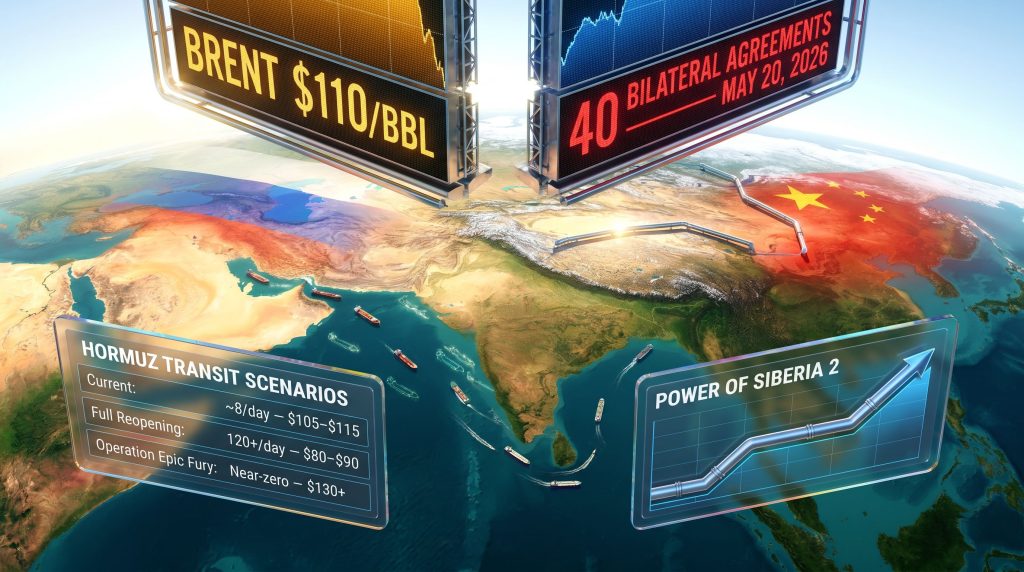
Hormuz Transit Scenarios and Their Market Implications
| Transit Scenario | Weekly Ships | Brent Price Range | Freight Premium | Normalisation Timeline |
|---|---|---|---|---|
| Current (selective access) | 54/week (~8/day) | $105–$115 | +$2–$4/barrel | Active constraint |
| Ceasefire announced | Gradual ramp | $95–$105 | Declining | 3–6 weeks post-signing |
| Full unconditional reopening | 120+/day sustained | $80–$90 | Eliminated | 6+ weeks operational lag |
| Operation Epic Fury restart | Near-zero | $130+ | Extreme/universal | Indefinite |
The Sino-Russian Energy Deal: Building Around Western Exclusion
On May 20, 2026, Russian President Vladimir Putin arrived in Beijing for his 25th visit to China and his first trip since the Iran conflict began. The visit produced 40 bilateral agreements, with 20 signed in the presence of both leaders. Among these was an undisclosed energy deal, with Kremlin spokesman Dmitry Peskov confirming there is now a general understanding on the Power of Siberia 2 pipeline, which carries the weight of a legally binding 30-year supply memorandum signed in September 2025. Pricing formulas, annual volume commitments, and construction timelines remain unresolved.
What the Non-Disclosure Signals: Under Russian and Chinese securities regulations, Gazprom and CNPC are legally required to file specific price agreements within 48 hours of signing. The absence of such a filing confirms that Wednesday's announcement represents a directional commitment rather than a completed commercial transaction. Investors should monitor Russian and Chinese regulatory databases for these filings rather than interpreting summit communiqués as confirmed supply shifts.
Why Power of Siberia 2 Has Transformed from Commercial Negotiation to Strategic Imperative
Power of Siberia 2 existed as a stalled commercial negotiation for years, with China and Russia unable to agree on pricing terms that satisfied both parties. The Hormuz disruption has fundamentally altered Beijing's calculus. What was previously a negotiation about maximising commercial terms has become a question of national energy security architecture.
The pipeline's critical strategic attribute is its routing: it connects Russian Siberian gas fields to Chinese markets via an overland corridor through Mongolia that bypasses every Gulf maritime chokepoint entirely. For Beijing, which imports significant crude and LNG volumes historically routed through Hormuz, Power of Siberia 2 represents a Hormuz-proof energy supply line that functions regardless of how the current crisis resolves. According to Columbia's Energy Policy initiative, the Iran conflict is actively reshaping how both Russia and China approach long-term energy security planning.
The Ruble-Yuan Settlement Architecture
Perhaps the least widely understood component of the Sino-Russian energy relationship is the payment infrastructure that underlies it. Putin confirmed at the May 20 signing ceremony that nearly all Russia-China bilateral trade now settles in ruble-yuan, effectively removing this energy corridor from dollar-denominated benchmark pricing entirely.
This creates a self-reinforcing dynamic:
- Physical energy flows through Russian pipelines and Arctic routes rather than Gulf maritime corridors
- Financial settlement occurs in bilateral currencies outside Western payment mechanisms
- Pricing reflects bilateral negotiation rather than ICE Brent or NYMEX WTI benchmarks
- Western sanctions and financial exclusion mechanisms lose traction over this portion of global energy trade
The long-run implication is a parallel pricing floor for Eastern markets that operates on fundamentally different inputs than the Brent benchmark that Western consumers and refiners use as their reference. This represents a meaningful global monetary shift with consequences well beyond the energy sector alone.
The US Electoral Constraint and Iran's Unchanged Negotiating Position
Understanding the durability of the current supply disruption requires understanding why diplomatic language is not the same as diplomatic progress.
On May 19, President Trump stated publicly that he was approximately one hour away from authorising a restart of Operation Epic Fury. On May 20, Vice President JD Vance described the situation as being in "a pretty good spot." This 24-hour oscillation between near-military authorisation and diplomatic optimism reflects domestic electoral pressure rather than substantive movement in negotiations.
Iran's terms, presented as a new offer to the US, contain every element previously rejected over six weeks of nominal ceasefire:
- Hormuz control retained by Iran
- War damage compensation from the United States and Israel
- Full sanctions removal
- Release of frozen Iranian assets
- Complete US troop withdrawal from the region
Not a single previously contested point has moved in six weeks. At $110 per barrel Brent, consumer-facing margin compression creates genuine political urgency ahead of November congressional elections. This urgency produces diplomatic language — it does not produce the structural concessions Iran requires to reopen the strait unconditionally. Making those concessions would represent a political cost that exceeds the electoral damage from elevated fuel prices.
Three US Policy Paths and Their Energy Market Outcomes
Scenario A: Sustained Diplomatic Stalemate (Base Case)
The nominal ceasefire holds. Selective transit continues at current levels. Brent near $110 becomes an embedded cost structure rather than a crisis premium. If this extends through July, the Q4 heating oil demand cycle absorbs elevated pricing, and recession risk transmits through two primary channels: compressed airline margins on unhedged fuel contracts, and reduced consumer discretionary spending as petrol remains elevated at the pump.
Scenario B: Operation Epic Fury Restart
The binary event that triggers immediate portfolio repricing. Brent moves to $130 or above instantaneously upon authorisation. Cape of Good Hope rerouting becomes universal for all non-Chinese carriers. Energy equity positioning requires complete reconstruction. Supply normalisation timelines extend to 6–12 months minimum.
Scenario C: Unconditional Hormuz Reopening
Defined by a specific threshold: 120 or more ships per day sustained for two consecutive weeks. The supply premium begins unwinding over a 3–6 week operational normalisation lag as vessel repositioning, Lloyd's war-risk reassessment, and refinery scheduling adjustments work through the system. This scenario requires Iran to abandon its core negotiating demands, which current evidence suggests remains a distant prospect.
Why Ceasefire Headlines Are Not Supply Restoration Events
One of the most consistent investor errors during geopolitical supply disruptions is treating diplomatic announcements as equivalent to physical supply restoration. The operational reality of maritime normalisation involves three sequential bottlenecks that must clear before Western refineries see normalised barrel flows:
- Maritime deconfliction: Safe passage confirmation through formal military communication channels between US, Israeli, and Iranian naval commands
- Insurance re-certification: Lloyd's of London syndicates must reassess and reduce war-risk premiums, which requires a sustained period of incident-free transit rather than a one-time announcement
- Vessel repositioning: Tankers currently committed to Cape of Good Hope routing must complete existing voyages and reposition for Hormuz transit, a process that takes weeks given vessel locations at the time of any agreement
Investor Warning: Even if a ceasefire agreement were announced tomorrow, European refiners absorbing Cape rerouting costs would continue paying elevated freight premiums through June at minimum. Physical market data — specifically weekly transit counts from Lloyd's List and Lloyd's war-risk premium movements — provides a more reliable normalisation indicator than diplomatic communiqués.
China's Strategic Dilemma: Reducing One Vulnerability by Building Another
Beijing's energy security calculus in the current crisis is more complex than it might appear. China has significant crude and LNG import volumes historically transiting Hormuz, creating direct exposure to the current disruption despite the bilateral transit agreement that allows Chinese-flagged tankers selective clearance.
The continental pivot toward Russian supply reduces Persian Gulf concentration risk but introduces a different structural dependency: reliance on Russian pipeline infrastructure controlled by a state with its own strategic interests. China is attempting to manage this through a multi-corridor diversification strategy:
- Power of Siberia 2: Overland Russian gas, bypassing maritime chokepoints entirely
- Central Asian pipeline networks: Turkmenistan, Kazakhstan, and Uzbekistan providing buffer diversification across multiple supplier relationships
- Northern Sea Route: A supplementary logistics pathway for Russian LNG exports that gains strategic value as Arctic ice coverage decreases seasonally
- Bilateral transit agreements: Selective Hormuz clearance providing near-term flexibility while longer-term infrastructure is constructed
None of these alternatives can fully substitute for Hormuz volume capacity in the near term. The Saratoga Foundation notes that the Hormuz blockade is actively pushing China towards accelerated continental energy diversification at a pace that purely commercial negotiations would never have achieved. The strait handles an estimated 20% of global oil trade — a figure that no single alternative corridor can replicate within any realistic construction timeline.
The next major ASX story will hit our subscribers first
The Monitoring Framework That Cuts Through Diplomatic Noise
For investors positioning around the Hormuz disruption and Sino-Russian energy deal dynamics, the analytical discipline that matters most is distinguishing between signals and noise. The following indicators provide the clearest read on actual physical and institutional developments:
| Indicator | Source | Frequency | What It Signals |
|---|---|---|---|
| Hormuz transit count | Lloyd's List | Weekly (Friday) | Physical supply constraint severity |
| Brent crude futures | ICE/CME | Daily | Market sentiment (not physical reality) |
| Gazprom-CNPC regulatory filings | Russian/Chinese securities regulators | Event-driven (48hr post-signing) | Confirmed supply architecture shift |
| Lloyd's war-risk premiums | Lloyd's of London syndicates | Weekly | Insurer confidence in normalisation |
| Power of Siberia 2 progress | Kremlin/CNPC official statements | Event-driven | Long-term Eastern corridor development |
The Friday Lloyd's List publication is the single most important weekly data point for anyone tracking the physical supply constraint. It provides verified vessel transit counts that reflect actual barrel availability rather than diplomatic positioning.
The 48-hour Gazprom-CNPC filing requirement creates a built-in transparency mechanism that transforms opaque summit agreements into verifiable regulatory events. If and when Power of Siberia 2 pricing terms are concluded, the filing clock starts immediately. Monitoring Russian and Chinese securities databases for this disclosure is significantly more reliable than parsing Kremlin press releases.
A Structural Regime Shift, Not a Temporary Premium
The tendency to frame the current situation as a supply shock with a finite resolution underestimates the degree to which the underlying architecture of global energy trade is being permanently altered. Previous geopolitical supply disruptions — including the 2019 tanker attacks in the Gulf of Oman, the 2020 Saudi-Russian price war, and various Iranian nuclear-related sanctions episodes — all resolved back toward a unified global pricing system because the institutional infrastructure for an alternative remained underdeveloped.
What is categorically different in the current situation is the simultaneous development of alternative physical, financial, and institutional infrastructure designed to function independently of Western-controlled systems. The ongoing US-China trade war has further accelerated this decoupling, providing both political motivation and practical urgency to construct parallel energy systems.
- Overland pipeline corridors bypass maritime chokepoints physically
- Ruble-yuan settlement bypasses dollar-denominated energy markets financially
- Bilateral transit agreements bypass Western carrier restrictions operationally
- Near-complete Russia-China trade settlement in non-Western currencies bypasses SWIFT-dependent payment infrastructure institutionally
This four-layer architecture is not being constructed as a response to the current crisis. It was already underway. The Hormuz disruption and Sino-Russian energy deal have accelerated its development and given it strategic urgency that commercial negotiations alone could not have produced. The energy market that emerges from this period will not simply revert to pre-conflict configuration when diplomatic conditions allow, because the Eastern corridor is being built to function regardless of how Western-facing supply chains develop.
Structural Implication for Investors: Energy assets with Western-market exposure and those positioned within the emerging Eastern corridor now carry fundamentally different risk and pricing profiles. A bifurcated pricing architecture means correlation assumptions built on a unified global benchmark require reassessment across portfolio construction, hedging strategy, and sector exposure decisions.
Consequently, the frameworks investors use to assess oil trade geopolitics must evolve to account for a world in which two partially disconnected pricing systems operate simultaneously — each responding to different physical, financial, and institutional signals.
The Hormuz disruption and Sino-Russian energy deal are not parallel stories that happen to share a news cycle. They are two forces operating on the same structural transformation from opposite directions — one compressing the existing system, the other constructing its replacement. Markets that continue pricing this as temporary disruption rather than regime shift are, at minimum, carrying an assumption that deserves systematic scrutiny.
This article contains forward-looking analysis, scenario modelling, and speculative projections based on publicly available information as of May 20, 2026. It does not constitute financial advice. Readers should conduct independent research before making investment decisions. Scenario outcomes are illustrative and subject to rapid change given the fluid nature of geopolitical developments.
Want to Stay Ahead of the Next Major Resource Discovery Amid Shifting Global Markets?
As geopolitical fractures reshape global energy and commodity flows, Discovery Alert's proprietary Discovery IQ model delivers real-time ASX mineral discovery alerts, transforming complex market signals into actionable investment insights — explore how historic discoveries have generated substantial returns and begin your 14-day free trial to secure a market-leading edge.