June 8, 2026
The Market Psychology Behind a $100 Oil World
When energy markets face genuine physical disruption, price signals become deeply ambiguous. A barrel trading at $100 could mean scarcity is acute, or it could mean the world has quietly found ways to cope. Right now, crude markets are living in exactly that paradoxical space, where the largest supply disruption in modern history has produced not a price spike, but a plateau. Understanding why oil rebounds on Middle East supply risk in 2026 requires looking past the headline number and examining the competing forces holding this fragile equilibrium together.
When big ASX news breaks, our subscribers know first
The Geopolitical Premium: Fear of Supply Loss, Not Demand Strength
Why the Price Signal Is Being Misread by Many Investors
There is a critical distinction that separates the current crude rally from a conventional demand-driven bull market. When prices rise because consumption is accelerating, the signal is fundamentally optimistic. When prices rise because traders are hedging against the possibility that physical barrels may become unavailable, the underlying message is far more unsettling.
Analysts at Zaye Capital Markets have characterised the current oil price move as a geopolitical risk premium rather than a clean demand recovery. This framing matters enormously for how investors interpret price action. Furthermore, the geopolitical premium reflects several layers of uncertainty that compound each other:
- Physical barrel availability and whether contracted volumes can actually be delivered
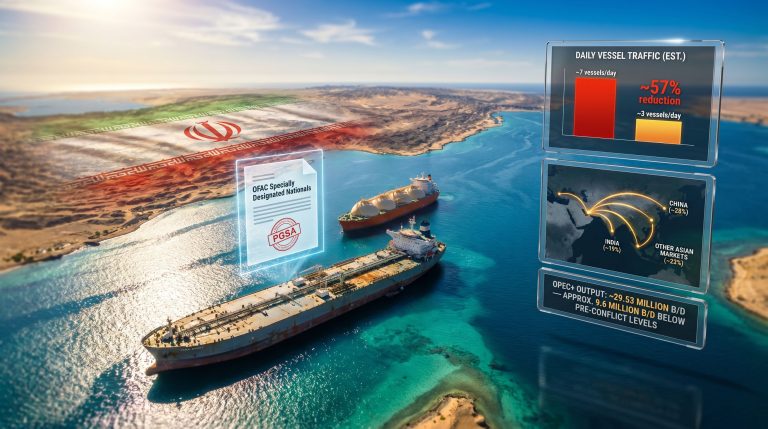
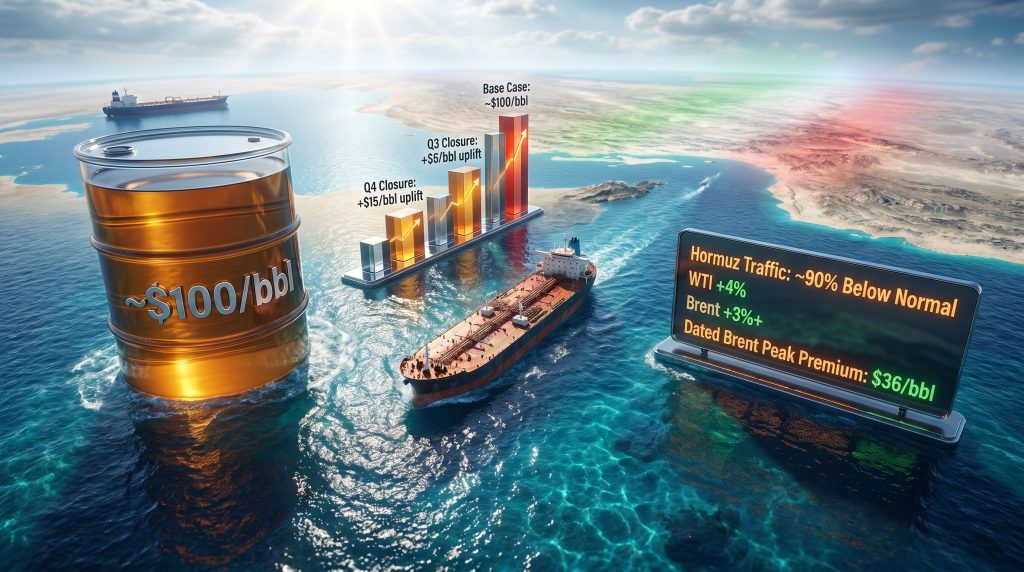
- Shipping route viability across a Strait of Hormuz that has seen traffic collapse to roughly 90% below normal levels
- Insurance and freight cost escalation, where war-risk premiums have materially altered the economics of moving crude from the Persian Gulf
- The probability of military interference with export terminals, pipelines, or tanker convoys that form the physical backbone of global energy supply
This is not a market pricing in growth. It is a market pricing in the cost of uncertainty. For a broader view of how these dynamics intersect, oil trade and geopolitics continue to shape the long-term outlook in ways that go well beyond short-term price swings.
The Strait of Hormuz: Why One Narrow Waterway Holds the World Hostage
The Strait of Hormuz is a roughly 33-kilometre-wide channel separating the Iranian coast from the Sultanate of Oman. At its narrowest navigable point, the shipping lanes are only a few kilometres wide, making it one of the most concentrated chokepoints in global trade. Approximately 20% of the world's seaborne oil transits this passage under normal conditions, servicing refineries across Asia, Europe, and East Africa.
When that flow is interrupted, the consequences cascade across every link in the energy supply chain simultaneously. Refineries in South Korea, Japan, and India that rely on Gulf crude face feedstock shortages. European buyers scramble for alternative supplies. Insurance underwriters reprice war-risk exposure, lifting freight costs for any vessel willing to operate in the region.
The data currently available paints a stark picture of the disruption's scale:
| Disruption Metric | Current Status |
|---|---|
| Hormuz traffic vs. normal | ~90% below average |
| WTI crude price move (recent session) | +4% on renewed strikes |
| Brent crude price move (recent session) | +3%+ on ceasefire doubts |
| Dated Brent premium to futures (April peak) | Record $36/bbl |
| Dated Brent premium to futures (current) | ~$2/bbl |
The sharp retreat of the Dated Brent physical premium from its April peak of $36 per barrel back toward $2 per barrel is one of the most important data points in current markets. It suggests that the immediate cargo scramble has eased, but it does not signal that the underlying disruption has resolved.
A 100-Day Escalation and the Illusion of De-Escalation
Why the Ceasefire Never Really Held
As of June 8, 2026, the Israel-Iran conflict has passed the 100-day mark. Overnight on June 7–8, both nations resumed direct retaliatory strikes, with Iranian missile waves targeting Israel and Israeli forces striking central and western Iran in response. This marks the most significant escalation since an April ceasefire that markets had tentatively begun to price as durable.
SEB Chief EM Strategist Erik Meyersson has described the underlying equilibrium throughout the ceasefire period as inherently unstable, noting that the structural conditions for a return to open conflict were never fully removed. The resumption of strikes has confirmed that assessment. According to recent Reuters reporting, investors are continuing to reassess ceasefire prospects as each new development unfolds.
Critical context for traders: Markets are not pricing peace. Multiple institutional analysts now describe the prevailing sentiment as one of fragile de-escalation, a state in which the absence of active conflict is treated as temporary rather than conclusive.
Contradictory signals from U.S. diplomatic channels have compounded this uncertainty. Statements from Washington suggesting progress toward a lasting agreement have been repeatedly offset by the absence of any binding framework, leaving traders to navigate a noisy information environment where political commentary moves prices without resolving the fundamental supply question.
Saxo Bank has noted that a durable peace settlement appears increasingly out of reach despite repeated expressions of optimism from the U.S. administration. Several major oil companies have publicly warned that the time window before physical shortages become undeniable may be measured in weeks rather than months.
What J.P. Morgan's Framework Reveals About Price Scenarios
The Base Case and Its Assumptions
J.P. Morgan's head of global commodities strategy Natasha Kaneva and her team have outlined a base case in which Hormuz traffic gradually resumes in June 2026. Under this scenario, Brent crude is projected to average approximately $100 per barrel through the remainder of the year, declining below triple digits on a monthly average basis only in December.
This is not a bullish forecast in the conventional sense. It is a projection of what managed disruption looks like when markets absorb shocks through costly but functional workarounds. The trade war oil markets dynamic has added a further layer of complexity, as tariff tensions between major economies have also weighed on the global demand outlook.
The Escalation Scenarios: What Extended Closure Would Mean
Investor warning: J.P. Morgan analysts have outlined that each additional month of Hormuz closure beyond June would add approximately $5 per barrel to average Brent in Q3 2026 and $15 per barrel in Q4 2026, driven primarily by accelerating inventory depletion rather than a spike in demand.
The table below maps the full scenario spectrum:
| Scenario | Brent Outlook | Key Driver |
|---|---|---|
| Hormuz reopens in June (base case) | ~$100/bbl average through 2026 | Gradual supply normalization |
| Closure extends through Q3 | +$5/bbl uplift in Q3 | Inventory drawdown acceleration |
| Closure extends through Q4 | +$15/bbl uplift in Q4 | Severe stock depletion |
| Full recovery timeline (EIA projection) | Late 2026 to early 2027 | Pre-conflict trade pattern restoration |
The EIA's global oil outlook reinforces these projections, suggesting that pre-conflict production and trade patterns may not fully recover until late 2026 or early 2027. Even after the strait reopens, rebuilding depleted inventories, restoring insurance normalisation, and reconnecting disrupted supply chains is a multi-month process.
The Market Psychology Question J.P. Morgan Is Asking
J.P. Morgan analysts have framed the defining question facing oil markets right now as follows: has the worst of the supply shock already been absorbed and priced in, or is the current price calm a sign of dangerous complacency about what extended closure could deliver?
This is not a rhetorical question. It reflects a genuine bifurcation in how institutional investors are positioning across the curve.
Three Mechanisms Preventing a More Severe Price Dislocation
How the Market Has Absorbed the Largest Supply Disruption in Modern History
J.P. Morgan's multi-bank analysis identifies three simultaneous structural adjustment channels that have prevented crude prices from spiking far above $100 despite the scale of the disruption:
- Hidden supply flows through the Strait: An estimated additional 1 million barrels per day of supply is moving through alternative routing and undisclosed channels, suggesting that the headline closure figure overstates the effective supply loss.
- Slower-than-projected inventory draws: Visible stockpiles are declining at a more moderate pace than initial disruption models forecast, partly because demand has also fallen sharply.
- Deeper-than-expected demand destruction: Consumption has contracted more aggressively than pre-crisis models assumed, reducing the effective supply gap and preventing a runaway price move.
These three factors working in combination explain why $100 oil is not signalling that the disruption is manageable in the traditional sense. Rather, it signals that markets have found expensive but functional pathways to keep the system operating.
China, the U.S., and the Strategic Reserve: The Three Pillars of Rebalancing
China's dramatic demand pullback has been one of the most consequential swing factors of the crisis:
- Chinese crude imports fell by more than 3 million barrels per day in April compared to January–February levels
- Further declines are projected for May, freeing up seaborne supply and capping price upside for Atlantic Basin buyers
- The scale of the reduction is difficult to explain through end-demand weakness alone; analysts point to a combination of reduced strategic stockpiling, lower refinery throughput, and draws on opaque product inventories
The US-China oil price impact has consequently become a critical variable in any credible market outlook, as Beijing's consumption decisions ripple outward across the entire global supply chain.
The United States as marginal global supplier:
- U.S. net crude and product exports have risen to record levels, approximately 3 million barrels per day above January–February norms
- European and Asian refiners have pivoted to Atlantic Basin supplies as a substitute for disrupted Middle Eastern barrels
- The U.S. Strategic Petroleum Reserve release programme, currently running at 1.4 million barrels per day, has been the primary enabler of this export surge
The SPR drawdown risk: HSBC analysts have warned that at the current pace of inventory depletion and export volume, U.S. crude stocks could reach the bottom of their five-year historical range by late June or July 2026. This represents a secondary risk layer that markets are not yet fully pricing.
Regional Demand Destruction: A Geography of Adjustment
How Different Regions Have Responded to the Supply Shock
The depth and speed of demand destruction across regions has surprised virtually every pre-crisis model. March preliminary data showed a 1.9 million barrel per day year-on-year decline in global consumption, far exceeding the 0.6 million barrel per day contraction that institutional forecasters had pencilled in.
| Region | March YoY Demand Change | Primary Driver |
|---|---|---|
| Middle East | -1.4 million bbl/day | Petrochemical shutdowns, grounded flights |
| Africa | -200,000 bbl/day (-4%) | Transport fuel price elasticity |
| Europe | -200,000 bbl/day | Naphtha and diesel weakness |
| Asia | Significant decline | Feedstock cost surge, capacity shutdowns |
The regional breakdown reveals important nuances:
Middle East: The initial epicentre of demand destruction. Grounded flights, shelter-in-place measures, and widespread petrochemical shutdowns drove a 1.4 million barrel per day year-on-year decline in March. Regional gasoline demand fell to its weakest level since early 2021, while naphtha demand approached ten-year lows.
Africa: The most notable regional surprise of the crisis. J.P. Morgan analysts described the speed of Africa's adjustment as unexpected, noting that demand fell 200,000 barrels per day (4%) year-on-year, a stark reversal from a prior forecast of +300,000 barrels per day (+5.8% growth). Transport fuels accounted for approximately 65% of the decline, revealing greater price elasticity in African fuel markets than previous modelling had assumed.
Europe: Weaker naphtha and diesel demand contributed an additional 200,000 barrel per day year-on-year decline, consistent with broader petrochemical and industrial slowdowns across the continent.
How Deep Does the Demand Destruction Go?
The unexpected severity of March data has prompted significant downward revisions to subsequent months:
- April projection: A decline of 3.0 million barrels per day year-on-year, corresponding to demand destruction of 4.9 million barrels per day
- May projection: A decline of 4.2 million barrels per day year-on-year, corresponding to demand destruction of 5.6 million barrels per day
These figures suggest that the demand side of the oil market is operating in territory that has no clear modern precedent.
The next major ASX story will hit our subscribers first
The COVID Legacy: A Permanently More Elastic Oil Market
Why the World Adjusts to Supply Shocks Faster Than It Used To
One of the more structurally significant insights to emerge from the current crisis is that the oil demand response has been faster and more pronounced than pre-COVID models would have predicted. J.P. Morgan analysts argue that both the COVID-19 pandemic and the 2022 energy price spike have permanently altered the relationship between economic activity and fuel consumption.
Several structural shifts have contributed to this new baseline:
- Remote work adoption has reduced commuting-related fuel demand across major economies
- Digital communication tools have replaced a meaningful portion of business travel
- Corporate supply chains have been redesigned for greater flexibility and energy efficiency
- Energy efficiency has risen as a formal priority on both corporate governance and policy agendas
The practical consequence is a world where demand responds to price signals more quickly and more deeply than historical models assumed. This weakens the traditional correlation between GDP growth and oil consumption, and it means that supply disruptions of the current scale produce less upward price pressure than equivalent events would have generated a decade ago.
What the U.S. Labor Market Means for Oil Traders
A Strong Jobs Report Cuts in Two Directions
The U.S. nonfarm payrolls report for May 2026 delivered a significant upside surprise, with important but contradictory implications for crude demand:
| Labor Market Metric | Reported Figure | Prior Estimate or Revision |
|---|---|---|
| Nonfarm payrolls (May 2026) | +172,000 | Forecast: +88,000 |
| April payrolls (revised) | +179,000 | Previously reported: +115,000 |
| Unemployment rate | 4.3% | Held steady |
| Average hourly earnings (MoM) | +0.3% | – |
| Average weekly hours | 34.3 | Unchanged |
A resilient U.S. labour market supports gasoline, diesel, aviation, freight, and industrial fuel demand, which is constructive for crude prices. However, stronger labour data also supports higher Treasury yields and a stronger U.S. dollar, which makes oil more expensive for non-dollar buyers globally and can suppress international demand. This dual signal is one reason why the payrolls report has not produced a clean directional move in crude.
Key Risk Scenarios for the Second Half of 2026
Three Pathways and Their Implications for Energy Investors
Disclaimer: The following scenario analysis draws on institutional forecasting frameworks. All projections involve material uncertainty. Readers should not treat price forecasts as investment advice.
Scenario 1: Hormuz Reopens in June (Base Case)
Brent averages approximately $100 per barrel through year-end. Inventory draws slow progressively. Atlantic Basin supply substitution gradually unwinds. Insurance and freight premiums normalise over two to three months. This scenario assumes no further major military escalation and a functioning diplomatic off-ramp.
Scenario 2: Extended Closure Through Q3
An additional $5 per barrel uplift to average Brent in Q3. U.S. SPR reserves approach critical depletion thresholds. Demand destruction deepens further in price-sensitive emerging markets. The fragility of the current equilibrium becomes more visible.
Scenario 3: Closure Persists Into Q4
An additional $15 per barrel uplift to Q4 average Brent. Physical shortages become increasingly difficult to manage through inventory releases alone. Full pre-conflict production and trade recovery is pushed to early 2027 or beyond. Secondary market dislocations in refined products and petrochemicals intensify.
Frequently Asked Questions: Oil Rebounds on Middle East Supply Risk
Why is oil rebounding right now?
Crude prices are rising because traders are repricing the probability that the Strait of Hormuz disruption will persist longer than the market's base case assumes. Renewed military exchanges between Israel and Iran, which passed the 100-day mark on June 8, 2026, have reignited supply uncertainty and pushed both WTI and Brent futures higher in recent sessions.
What is the geopolitical risk premium in oil markets?
A geopolitical risk premium refers to the additional price that buyers pay above what fundamental supply and demand dynamics would imply, reflecting the uncertainty around physical supply availability during periods of conflict or political instability. When prices are elevated by a risk premium rather than demand strength, the move can reverse rapidly if the perceived threat dissipates.
How long will it take for oil markets to fully normalise?
The EIA projects that most pre-conflict production and trade patterns may not fully recover until late 2026 or early 2027, even after Hormuz flows resume, given the depth of inventory depletion, infrastructure disruption, and supply chain reconfiguration involved.
What role is the U.S. playing in replacing Middle East oil supply?
The U.S. has emerged as the world's marginal crude supplier during the crisis. Net exports of crude and products have risen to record levels, approximately 3 million barrels per day above January–February norms. The Strategic Petroleum Reserve release programme, running at 1.4 million barrels per day, has been a key enabler of this export capacity.
Is the current price calm a sign that markets have correctly absorbed the shock?
This is the central debate among institutional analysts right now. J.P. Morgan frames the question as whether current price stability reflects accurate pricing of a manageable disruption, or whether it represents a dangerous underestimation of the risks associated with an extended Hormuz closure. The answer depends heavily on whether the disruption resolves within weeks or stretches into the second half of the year. Furthermore, OPEC market influence remains a critical background factor, as the cartel's response to the crisis could ultimately shape the pace and character of any price recovery.
Key Takeaways for Energy Market Participants
The current episode of oil rebounds on Middle East supply risk carries several layers of insight that go beyond the headline price:
- The crude rebound is a risk premium event, not a demand recovery story, and investors who conflate the two face meaningful positioning risk if geopolitical tensions ease abruptly
- The Strait of Hormuz remains the single most consequential variable for near-term price direction, with traffic still approximately 90% below normal levels
- Three simultaneous adjustment mechanisms, including hidden supply flows, demand destruction, and inventory draws, have kept prices near $100 rather than dramatically higher, but this equilibrium is structurally fragile
- U.S. inventory depletion and SPR drawdown represent a secondary risk that could become the primary market driver if the disruption extends beyond June
- The world's oil demand has become structurally more elastic since COVID-19, meaning supply disruptions produce faster and deeper consumption adjustments than historical models assumed
- Full market normalisation, including rebuilt inventories, restored trade patterns, and normalised insurance markets, is unlikely before late 2026 at the earliest even under an optimistic resolution scenario
This article contains forward-looking statements and scenario analysis based on publicly available institutional research. All price forecasts involve material uncertainty and should not be construed as investment advice. Readers should consult a qualified financial adviser before making investment decisions based on energy market analysis.
Want to Stay Ahead of the Next Major ASX Resource Discovery?
While geopolitical premiums and supply shocks dominate oil markets, significant mineral discoveries on the ASX can deliver extraordinary returns entirely independent of macro volatility — and Discovery Alert's proprietary Discovery IQ model sends real-time alerts the moment these opportunities emerge, as evidenced by historic discoveries like De Grey Mining and WA1 Resources. Explore Discovery Alert's dedicated discoveries page to understand the scale of returns major mineral discoveries have historically generated, and begin a 14-day free trial to position yourself ahead of the broader market.