August 5, 2026
What Is Iran's Persian Gulf Strait Authority and Why Did OFAC Sanction It?
When a government body formed to administer shipping permissions becomes the subject of a US Treasury designation within weeks of its creation, the speed of that response reveals something important about how Washington interprets the line between sovereign maritime administration and coercive extraction. US sanctions on PGSA and shipper engagement became a defining feature of the Strait of Hormuz crisis almost immediately after the Persian Gulf Strait Authority began operations in early May 2026.
The PGSA was created as Iran's mechanism for asserting administrative control over vessel movements through the Strait of Hormuz, a waterway whose effective closure has been in place since the US-Iran conflict began on 28 February 2026. The authority operates through a submission-based permitting model: non-Iranian vessels are required to register information with the PGSA and, in some cases, make toll payments in exchange for safe passage clearance through the strait.
The US Treasury's Office of Foreign Assets Control moved against the PGSA at the end of May 2026, placing it on the Specially Designated Nationals (SDN) list and explicitly framing the authority as an instrument of the Islamic Revolutionary Guard Corps (IRGC). OFAC's designation characterised the PGSA as extorting vessels transiting the Strait of Hormuz through what it described as a government agency designed to impose illegitimate tolls on commercial traffic, rather than functioning as a legitimate maritime regulatory body. That characterisation carries enormous legal weight and practical compliance consequences for any entity worldwide that engages with it.
Key Regulatory Finding: OFAC's designation formally links the PGSA to the IRGC, classifying its toll collection activities as coercive extraction from commercial traffic rather than sovereign port administration. This distinction has profound legal and compliance consequences for any entity that engages with it in any form.
The Geopolitical Architecture Behind the PGSA
The PGSA does not exist in a vacuum. Its creation follows a pattern observable across decades of US-Iranian strategic interaction in the maritime domain, where Iran has repeatedly sought to leverage its geographic position at the Strait's northern shoreline to extract political and economic concessions. What distinguishes the PGSA from previous Iranian disruptive tactics is its administrative character: rather than direct military harassment or vessel seizures, Tehran constructed a formal bureaucratic mechanism that creates legal and compliance ambiguity for international shipping without triggering an immediate military confrontation.
The Strait of Hormuz remains the world's most critical oil chokepoint, with roughly 20 to 30 percent of seaborne global oil trade passing through a passage that narrows to just 21 miles at its tightest point. That geographic reality gives Iran structural leverage that no diplomatic arrangement has permanently neutralised, and the PGSA represents Tehran's latest attempt to monetise and formalise that leverage through an administrative overlay rather than overt military action. Furthermore, the geopolitical landscape in mining and energy sectors globally has been profoundly reshaped by such chokepoint pressures.
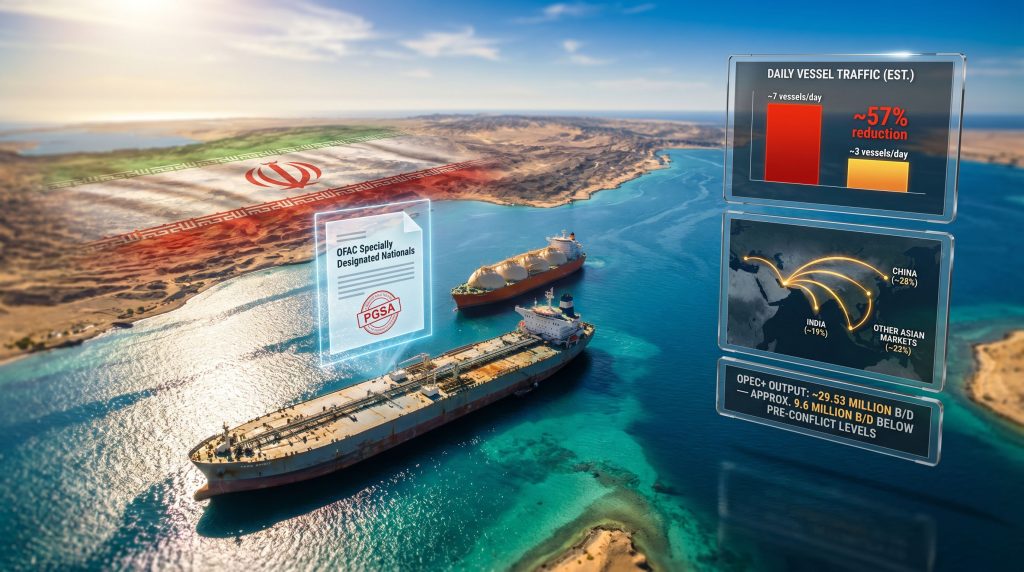
The broader conflict context amplifies the stakes considerably. OPEC+ production data from May 2026 shows total alliance output running at approximately 29.53 million barrels per day, representing a reduction of roughly 9.6 million b/d from pre-war levels. The Mideast Gulf members most directly affected by the Strait's closure, including Saudi Arabia, Iraq, Kuwait, Bahrain, and Iran, have collectively seen output fall by more than 10 million b/d from pre-conflict benchmarks.
Saudi Arabia's theoretical production capacity once the Strait reopens sits at approximately 10.478 million b/d, against an estimated 6.57 million b/d in May 2026. Iraq's capacity stands at roughly 4.431 million b/d versus just 1.55 million b/d during the same period. These figures illustrate the scale of the supply disruption that the PGSA's transit permission system sits at the centre of, and explain why OFAC's intervention carried such immediate geopolitical significance beyond the compliance dimension alone.
When big ASX news breaks, our subscribers know first
How US Sanctions on the PGSA Actually Function: A Compliance Architecture Breakdown
Understanding why US sanctions on PGSA and shipper engagement create such powerful deterrence for mainstream shipping operators requires understanding the mechanics of OFAC designation and secondary sanctions exposure, both of which operate with far greater reach than many non-US entities initially appreciate.
The Legal Mechanics of SDN Designation
When OFAC places an entity on the SDN list, it triggers a prohibition on US persons engaging in transactions with that entity. However, the enforcement reach extends significantly further through what practitioners call secondary sanctions exposure: the risk that non-US entities engaging with designated parties may themselves become subject to US sanctions, lose access to the US financial system, or face asset freezes affecting accounts, vessels, and financial instruments processed through dollar-denominated infrastructure.
For major tanker operators and oil majors, the compliance calculus is straightforward. Virtually all significant financial transactions in global commodity trade are processed through USD-denominated systems with direct SWIFT connectivity, meaning every payment flows through architecture that OFAC monitors. Publicly listed companies face additional layers of constraint: their US-linked financial and legal structures, combined with reporting obligations to shareholders and regulators across multiple jurisdictions, make any PGSA engagement effectively impossible without triggering automatic compliance violations.
Industry sources with direct market exposure have confirmed this position directly, noting that large shipping companies operating as public entities cannot simply make payments to Iran for transit, that every financial transaction is closely monitored, and that the consequences of falling under OFAC sanctions, including the freezing of assets and accounts, make the risks prohibitive. In addition, the US-China trade war impacts have further complicated the financial environment in which these operators must navigate.
What Payment Types Does the PGSA Designation Cover?
One of the most significant regulatory innovations in the PGSA sanctions designation is OFAC's deliberately expansive definition of prohibited payment types. The designation is not limited to US dollar cash transfers. According to the sanctions framework and shipping source analysis, covered payment categories include:
- Fiat currency transfers in any denomination, including yuan, euros, or other non-USD currencies
- Digital assets and cryptocurrency transactions across any blockchain network
- Informal offset arrangements and barter swap structures
- In-kind transfers, including goods, equipment, military aid, or diplomatic concessions from flag states or beneficial states
This breadth is architecturally intentional. Each category represents an evasion pathway that has been exploited in prior sanctioned trade corridors, whether Iranian crude exports, Russian oil under the G7 price cap regime, or Venezuelan petroleum trade. By explicitly extending coverage to in-kind arrangements and alternative value transfers, OFAC pre-empts the most sophisticated circumvention mechanisms before they can be operationalised at scale.
Compliance Alert: The breadth of OFAC's payment definition means that operators cannot assume yuan-denominated settlements, cryptocurrency transfers, or non-monetary exchanges automatically place them outside sanctions exposure. Legal counsel review is essential before any form of engagement with the PGSA, including information submissions.
A particularly notable aspect flagged by shipping consultants is the possibility that Iran may be exploring in-kind payment arrangements where the vessel's flag state or beneficial state provides military equipment or aid rather than currency, specifically because this mechanism makes direct financial tracing by OFAC significantly more difficult. The explicit inclusion of such arrangements within OFAC's covered payment scope suggests US authorities anticipated this exact scenario.
Measuring the Deterrence Effect: Strait of Hormuz Traffic Before and After Designation
Vessel tracking data provides the clearest quantitative evidence of how effectively the PGSA sanctions designation has suppressed mainstream shipping engagement with the Strait of Hormuz transit system.
| Metric | Pre-Sanctions Period | Post-Sanctions Period |
|---|---|---|
| Average daily vessel transits | ~7 vessels/day | ~3 vessels/day |
| Decline in traffic volume | Baseline | ~57% reduction |
| Non-Iranian vessels submitting PGSA requests | 300+ cumulative | Trend slowing post-designation |
| Share of submissions from oil tankers | ~42% | Under review |
| Share of submissions from LNG carriers | ~8% | Under review |
| Vessels seeking to exit the Strait | ~77% of submissions | Declining |
| Vessels seeking to enter the Strait | ~23% of submissions | Declining |
Kpler vessel tracking data cited in contemporaneous market reporting confirms the sharp contraction in Strait traffic following the OFAC designation, with daily transits falling from approximately seven vessels to just over three. This 57% reduction in throughput represents one of the most dramatic short-term disruption events in the waterway's recent history.
The destination profile of vessels that submitted PGSA information requests prior to the sanctions designation provides a clear picture of which supply chains face the greatest ongoing exposure. Of vessels seeking to exit the Strait, approximately 28% were bound for China, 19% for India, and another 23% for other Asian markets, collectively confirming that Asia-Pacific energy supply chains bear the heaviest burden from the Strait's effective closure. Consequently, the supply chain impacts across global commodity markets have been severe and far-reaching.
Why the 300-Vessel Submission Claim Deserves Scrutiny
The PGSA's assertion that more than 300 non-Iranian vessels submitted information to it since operations began has been met with significant scepticism from shipping industry sources. The verification challenge is structural: vessels transiting the Strait of Hormuz routinely disable their AIS transponders to conceal identity and reduce attack risk, making independent confirmation of any PGSA engagement statistics extremely difficult.
Shipping sources with direct oil company exposure have publicly questioned whether the 300-vessel figure reflects genuine operator engagement or constitutes strategic information operations by Tehran designed to project the PGSA's legitimacy and operational reach to a broader diplomatic audience. Iran's institutional interest in projecting broad participation from international shipping, particularly before the OFAC designation, creates a clear incentive to inflate engagement statistics regardless of actual compliance rates.
Credibility Framework: When evaluating Iranian government statements about PGSA engagement levels, analysts should apply a verification filter that accounts for the authority's institutional incentive to project legitimacy and broad participation. Independent vessel tracking data provides a more reliable baseline than PGSA-issued figures.
Cross-referencing PGSA claims against satellite AIS data, Kpler vessel tracking records, and port-of-call confirmation data from destination terminals in China and India remains the most reliable methodology for assessing actual engagement levels, though the transponder deactivation practice creates persistent gaps in even the most sophisticated independent monitoring systems.
Who Is Still Engaging With the PGSA? The Shadow Fleet Compliance Gap
While mainstream operators have effectively withdrawn from any form of PGSA engagement, a structurally distinct category of shipping participants faces a fundamentally different compliance calculus. The so-called shadow fleet, which developed its operational capabilities across years of handling sanctioned crude from Russia, Iran, and Venezuela, possesses precisely the characteristics that reduce OFAC enforcement exposure to manageable levels.
How Shadow Fleet Operators Navigate Sanctions Exposure
Shadow fleet operators differ from mainstream tanker companies across several structural dimensions that collectively reduce their vulnerability to OFAC enforcement:
- Non-USD payment rails: Chinese yuan settlements routed through domestic Chinese financial infrastructure outside SWIFT, barter arrangements, or cryptocurrency transfers avoid the dollar-clearing touchpoints that OFAC monitors most effectively
- Flag-of-convenience registrations: Vessels registered under flags in jurisdictions that do not cooperate with OFAC enforcement create additional layers of procedural complexity for US authorities seeking asset freezes
- Opaque beneficial ownership: Multi-layered corporate structures across multiple jurisdictions obscure the ultimate counterparty identity, complicating the attribution analysis that underpins OFAC enforcement action
- AIS deactivation: Routine transponder shutdowns during Strait transit prevent vessel identification and limit the evidentiary record available to enforcement agencies
Operators from countries less exposed to US financial system leverage, particularly those capable of settling in yuan or through Chinese domestic payment infrastructure, represent the most plausible continuing engagement pool for PGSA toll payments. Chinese-flagged vessels or those with Chinese beneficial ownership can potentially route any payment obligations through the Cross-Border Interbank Payment System (CIPS), which operates outside the SWIFT architecture that OFAC surveillance most effectively penetrates.
Payment Mechanism Analysis: PGSA Toll Settlement Outside US Jurisdiction
The range of payment mechanisms potentially available to shadow fleet operators or state-linked entities seeking PGSA transit permissions reflects the accumulated evasion sophistication developed across multiple prior sanctioned trade corridors:
- Yuan-based settlement through domestic Chinese financial infrastructure, routing entirely outside SWIFT and US correspondent banking networks
- Cryptocurrency transfers offering pseudonymous settlement, though OFAC has demonstrated increasing capacity to trace and sanction digital asset wallets through blockchain analytics
- In-kind arrangements where Iran accepts payment as goods, military equipment, or diplomatic concessions from flag states or beneficial states, making direct financial tracing by OFAC significantly more difficult
- Informal offset structures involving non-monetary reciprocal arrangements between state-linked operators and Iranian counterparties, potentially structured as government-to-government diplomatic exchanges rather than commercial transactions
Analytical Note: The sophistication of available evasion mechanisms reflects the accumulated operational experience of shadow fleet operators across multiple sanctioned trade corridors. However, each mechanism carries residual exposure at intermediary touchpoints, off-ramps, and port-of-call jurisdictions where US enforcement reach remains consequential.
The cryptocurrency evasion pathway warrants particular attention. While crypto transfers offer pseudonymous settlement capabilities, OFAC has progressively expanded its blockchain analytics capabilities and has previously sanctioned specific digital asset wallet addresses linked to Iranian entities. The inclusion of digital assets in OFAC's explicit coverage of PGSA-related payments signals that US authorities are actively monitoring this pathway rather than treating it as outside their enforcement architecture.
Insurance and War Risk Policy Implications: The Independent Deterrent
Beyond OFAC's direct legal sanctions architecture, a parallel deterrent mechanism operates through international insurance markets, creating a dual-layer constraint that affects even operators theoretically willing to accept direct sanctions exposure.
How War Risk Coverage Creates a Second Compliance Barrier
Standard international war risk insurance policies contain explicit warranties prohibiting policyholders from making payments to entities designated as IRGC-linked. Since OFAC's sanctions statement explicitly characterised the PGSA as an IRGC-connected body that extorts commercial traffic, any toll payment to the PGSA would, in the assessment of insurance market sources, almost certainly void a vessel's war risk coverage.
This creates a compliance constraint that operates entirely independently of OFAC's legal sanctions architecture. Even if an operator were prepared to absorb the direct sanctions risk, voiding war risk coverage while transiting an active conflict zone eliminates the insurance protection that makes the voyage commercially viable. The interplay between these two mechanisms effectively forecloses PGSA engagement for any operator dependent on standard international insurance markets.
An important distinction has emerged from insurance market analysis regarding the difference between contacting the PGSA for transit information versus making a toll payment. Industry sources indicate that the former may not automatically void coverage under most war risk policy wordings, while the latter almost certainly would. This nuance creates a narrow operational space where operators might theoretically seek information about transit conditions without triggering an insurance breach, though legal counsel confirmation would be essential before relying on this distinction.
P&I club coverage and hull insurance face analogous constraints, with most clubs having issued guidance consistent with the broader insurance market position on IRGC-linked payment prohibitions. The practical effect is that the mainstream global tanker fleet, which depends on these coverage structures for commercial operability, faces twin barriers to PGSA engagement that reinforce each other structurally. For instance, OPEC's influence on oil markets has similarly demonstrated how institutional frameworks can shape commercial decision-making across the entire industry.
Hypothetical Scenario: A Mainstream Operator Evaluating PGSA Engagement
The decision-making process for a mainstream tanker operator receiving a PGSA transit request notification would likely proceed through the following sequence:
- Legal review: In-house counsel confirms PGSA is on the OFAC SDN list and that any payment constitutes a prohibited transaction under sanctions law
- Insurance check: War risk underwriter confirms that toll payment to the PGSA would void the vessel's war risk coverage while operating in an active conflict zone
- Financial compliance: Treasury department confirms all payment systems are USD-denominated and SWIFT-connected, with no alternative payment rail available without breaching internal compliance policy
- Outcome: The operator declines PGSA engagement and either waits for alternative routing opportunities or diverts the vessel around the Cape of Good Hope, absorbing substantially higher freight costs
The Cape of Good Hope diversion adds approximately 3,500 nautical miles to a voyage from the Persian Gulf to European or Atlantic Basin destinations, representing a significant freight cost premium that nonetheless remains preferable to the sanctions and insurance consequences of PGSA engagement for publicly listed operators.
How PGSA Sanctions Are Reshaping Global Energy Supply Chains
The sanctions episode cannot be evaluated in isolation from the broader supply chain consequences of the Strait's effective closure. The PGSA represents one mechanism within a larger disruption that is reshaping the architecture of Middle East crude and LNG flows in real time. Furthermore, the oil price shock experienced across producing nations has compounded the pressure on already strained energy markets.
OPEC+ Production Under Structural Constraint
The production data from May 2026 illustrates the scale of the disruption with precision. OPEC+ as a whole produced approximately 29.53 million b/d in May, against collective targets considerably higher. The gap between targets and actual output reflects the physical impossibility of exporting production that cannot transit the Strait without either engaging with the PGSA or finding alternative export infrastructure that does not exist at adequate scale.
The following table summarises the production positions of the Mideast Gulf members most directly constrained by the Strait's closure:
| Producer | May 2026 Output | Theoretical Capacity (Post-Unwind) | Shortfall |
|---|---|---|---|
| Saudi Arabia | 6.57 mn b/d | 10.478 mn b/d | ~3.91 mn b/d |
| Iraq | 1.55 mn b/d | 4.431 mn b/d | ~2.88 mn b/d |
| Kuwait | 0.58 mn b/d | 2.676 mn b/d | ~2.10 mn b/d |
| Iran | 2.65 mn b/d | Exempt from targets | Significant |
| Bahrain | 0.03 mn b/d | 0.20 mn b/d | ~0.17 mn b/d |
The seven core OPEC+ members, including Saudi Arabia, Russia, Iraq, Kuwait, Kazakhstan, Algeria, and Oman, agreed on 7 June 2026 to a further 188,000 b/d increase in collective production targets for July, mirroring the June agreement. These target increases are acknowledged within OPEC+ itself as largely theoretical exercises until the Strait reopens, with the increases serving primarily to lay the groundwork for rapid output restoration once transit conditions normalise.
A key point that has received insufficient market attention is Iran's production trajectory specifically. Iranian output fell by 300,000 b/d in May to 2.65 million b/d, with further declines expected as Iranian storage sites approach capacity. The combination of a US blockade of Iranian ports and the inability to export through normal channels creates a compounding constraint that goes beyond the PGSA's transit permission system.
The PGSA as Strategic Leverage, Not Revenue Maximisation
A critical analytical distinction concerns Iran's primary objective in establishing the PGSA. The authority's design as a coercive signalling mechanism rather than a revenue maximisation tool explains several features that would otherwise appear counterproductive, including the willingness to continue issuing transit permits to vessels from so-called non-hostile states even after the OFAC designation.
By establishing a formal permitting authority, Tehran created a mechanism to selectively grant or deny passage on terms that could be calibrated to diplomatic conditions, effectively converting the Strait's strategic geography into a structured negotiating instrument rather than an all-or-nothing military confrontation. The PGSA's claim that over 300 vessels submitted information requests prior to OFAC designation, whether entirely accurate or partially inflated for strategic messaging purposes, served Iran's interest in projecting the authority as a functioning regulatory body with international participation, strengthening Tehran's diplomatic position in ongoing negotiations.
Post-designation Iranian media reporting indicates the PGSA intends to continue operations and issue permits to vessels from states it characterises as non-hostile, suggesting the authority remains operationally active despite the US sanctions designation. This posture reinforces the interpretation that Iran views the PGSA primarily as a diplomatic tool rather than a revenue source.
The next major ASX story will hit our subscribers first
Broader Policy Implications: What the PGSA Designation Means for Global Shipping Regulation
The US sanctions on PGSA and shipper engagement consequences that followed have implications that extend well beyond the immediate operational disruption to Strait of Hormuz traffic. Several dimensions of the designation establish precedents with longer-term significance for how maritime passage rights, sanctions enforcement, and international law interact.
Comparative Policy Framework: PGSA vs. Prior Maritime Sanctions Episodes
| Dimension | PGSA Designation (2026) | Iran Shipping Sanctions (Pre-2026) | Russia Shadow Fleet Measures |
|---|---|---|---|
| Primary enforcement body | OFAC / US Treasury | OFAC / EU | OFAC / EU / G7 |
| Payment scope covered | Fiat, crypto, in-kind, offsets | Primarily USD transactions | Price cap compliance focus |
| Insurance market involvement | War risk policy warranties | P&I club exclusions | P&I club exclusions |
| Shadow fleet workaround potential | High (yuan, crypto, in-kind) | Moderate | Moderate to High |
| Geopolitical leverage dimension | Central to Iran's strategy | Secondary | Secondary |
The most significant precedent-setting dimension concerns OFAC's extension of enforcement reach into maritime passage rights, a domain traditionally governed by international maritime law under UNCLOS provisions affirming the right of transit passage through straits used for international navigation. Article 37 of UNCLOS establishes that coastal states cannot suspend this right, creating a tension with the US sanctions framework that designates the PGSA's exercise of passage control as illegal extraction rather than sovereign regulation.
This legal tension raises a forward-looking question of considerable importance: could similar OFAC designations apply if other state actors in future scenarios attempt to monetise strategic chokepoints through comparable administrative mechanisms? The PGSA designation suggests the answer is yes, establishing a template whereby US authorities can characterise any such mechanism as IRGC-equivalent coercive extraction and sanction it accordingly, regardless of the formal regulatory framing its creators apply.
The breadth of OFAC's payment definition in this designation also represents a maturation of US sanctions architecture. Earlier sanctions regimes, including the 2012–2015 Iran measures, focused primarily on USD transaction flows and SWIFT connectivity. The explicit extension to cryptocurrency, in-kind transfers, and informal offsets reflects lessons learned from observing how prior regimes were circumvented, incorporating those circumvention pathways directly into the prohibited conduct definition before they can be exploited at scale.
Analytical Note: The PGSA designation demonstrates OFAC's institutional evolution toward anticipatory sanctions design, where known evasion pathways are incorporated into the prohibited conduct definition from the outset rather than being addressed reactively after circumvention becomes widespread.
Frequently Asked Questions: US Sanctions on the PGSA and Shipper Engagement
What is the Persian Gulf Strait Authority?
The Persian Gulf Strait Authority is an Iranian government body established in early May 2026 to administer transit permissions for vessels passing through the Strait of Hormuz. It requires non-Iranian ships to submit vessel information and, in certain cases, make toll payments to secure safe passage through the waterway following Iran's severe restriction of Strait access from the start of the US-Iran conflict in late February 2026.
Why did OFAC sanction the PGSA?
OFAC designated the PGSA because it determined the authority functions as an IRGC-linked entity using the guise of maritime regulation to extract coercive payments from commercial shipping. The US government does not recognise the PGSA's toll regime as a legitimate exercise of sovereign maritime authority and treats any engagement with it as dealings with a designated terrorist organisation's financial infrastructure.
Can shipping companies contact the PGSA without violating sanctions?
Insurance market and legal sources draw a distinction between contacting the PGSA for transit information and making actual toll payments. However, any financial transaction with a designated SDN entity carries sanctions exposure regardless of currency or mechanism, and legal counsel review is strongly recommended before any form of engagement, including information submissions.
Which vessels are most likely to continue engaging with the PGSA?
Shadow fleet operators, vessels registered under flags of convenience in jurisdictions that do not cooperate with OFAC enforcement, and operators from countries less exposed to US financial system leverage represent the most likely continuing engagement pool. Those capable of settling obligations through non-USD payment rails, particularly yuan-denominated systems outside SWIFT, face meaningfully lower practical enforcement risk than mainstream Western-aligned operators.
How much has Strait of Hormuz traffic declined since the PGSA sanctions?
Vessel tracking data indicates daily transits fell from approximately seven vessels per day before the OFAC designation to just over three vessels per day following the sanctions, representing a decline of roughly 57% in measurable traffic throughput.
Key Takeaways: What the PGSA Sanctions Episode Reveals About Modern Enforcement
The US sanctions on PGSA and shipper engagement consequences that followed offer a condensed case study in how contemporary US sanctions architecture functions, where it succeeds, and where structural gaps persist.
- The PGSA designation demonstrates OFAC's willingness to sanction state-created regulatory bodies when they are determined to function as coercive instruments of designated entities, regardless of the administrative framing applied to their activities
- The 57% decline in Strait traffic confirms that sanctions are producing real deterrence effects on mainstream operators, even as shadow fleet engagement continues through alternative mechanisms
- The explicitly broad payment definition covering cryptocurrency, in-kind transfers, and informal offsets represents a deliberate evolution beyond prior sanctions regimes, reflecting institutional learning about circumvention pathways
- The insurance market constraint operates as an independent and reinforcing deterrent, creating a dual-barrier structure that closes compliance gaps that OFAC's legal framework alone might leave partially open
- The structural bifurcation between a compliant shipping tier subject to Western financial and insurance system constraints and a shadow tier operating outside those constraints is deepening, with the PGSA episode accelerating rather than resolving this divergence
- OPEC+ output running approximately 9.6 million b/d below pre-conflict levels as of May 2026 confirms that the Strait's effective closure represents one of the most significant supply disruptions in the global energy market's recent history, with production restoration contingent entirely on a diplomatic resolution that remained elusive as of the date of this analysis
This article draws on market intelligence reporting from Argus Media, vessel tracking analysis from Kpler, and OPEC+ production data published in June 2026. Figures relating to production capacity, vessel traffic volumes, and sanctions designations reflect information available as of early June 2026. Forward-looking assessments regarding production restoration timelines, shadow fleet engagement levels, and diplomatic outcomes involve inherent uncertainty and should not be treated as forecasts. Readers should seek independent legal advice before making any decisions regarding Strait of Hormuz transit operations or engagement with entities subject to OFAC designation.
Want to Stay Ahead of Commodity Market Shifts Driven by Geopolitical Disruptions Like the Strait of Hormuz Crisis?
When chokepoint closures and sanctions regimes reshape global energy supply chains overnight, identifying where capital is likely to flow next becomes the critical edge — Discovery Alert's proprietary Discovery IQ model scans ASX announcements in real time, delivering actionable alerts on significant mineral discoveries across more than 30 commodities the moment they hit the market. Start your 14-day free trial at Discovery Alert and position yourself ahead of the next major market move.