June 8, 2026
When Refinery Economics Break Down: Understanding the 2026 Oil Supply Squeeze
Energy markets rarely move on a single variable. The most significant price dislocations in crude oil history have emerged not from isolated shocks but from the intersection of multiple stress systems arriving simultaneously. That dynamic is precisely what is playing out across global fuel markets in mid-2026, where Chinese refinery delays and Middle East oil supply risks are colliding to create compounding pressure across the global refining system.
Understanding why this matters requires looking beneath the daily oil price movements and examining the machinery of the global refining system itself. Crude oil in the ground is not the same as fuel in the market. The conversion process, the refinery, is the critical intermediary, and when that intermediary is under financial stress, the downstream impact on fuel availability can be just as disruptive as a supply interruption at the wellhead.
When big ASX news breaks, our subscribers know first
Two Pressure Systems, One Compounding Crisis
The current stress across oil markets is being generated by two forces that operate through entirely different mechanisms but share a damaging intersection point.
The first is a structural deterioration in Chinese refinery economics. This is not a geopolitical story. It is a capital allocation and cost-margin story rooted in domestic pricing regulation, the erosion of discounted feedstock access, and shifting demand patterns driven by rapid electric vehicle adoption inside China's consumer economy.
The second is a geopolitical risk premium anchored in Middle East conflict escalation. Israeli military strikes on Iranian targets and renewed hostilities in Lebanon have revived supply disruption fears that had partially receded from market pricing. The Strait of Hormuz, through which a significant share of globally traded crude transits, remains the central vulnerability in this scenario.
The intersection point is critical and often underappreciated: China sources a disproportionate volume of its crude imports from Persian Gulf producers, making its refiners acutely exposed when both variables move against them simultaneously. Higher geopolitical risk raises the cost of the very feedstock that Chinese refiners need to improve their economics. Furthermore, the trade war impact on oil adds yet another layer of complexity to an already fragile supply picture.
The Market Snapshot: Where Prices Stand
| Indicator | Level | Context |
|---|---|---|
| Brent Crude (June 8, 2026) | $97.15/bbl | Up $4.42 (+4.47%) on the session |
| US Crude | $94.61/bbl | Tracking Brent higher |
| Brent vs. March 2026 Peak | ~$120/bbl | ~19% below cycle high |
| Brent gain since late Feb 2026 | ~60% | Rapid repricing over ~3.5 months |
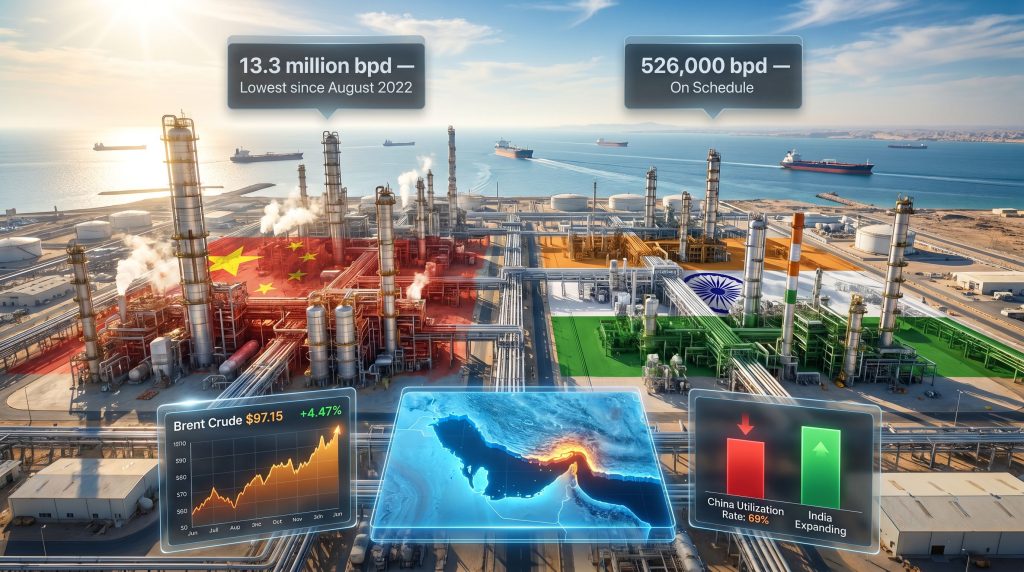
| China Refinery Throughput (April 2026) | 13.3 million bpd | Lowest since August 2022 |
| China Utilization Rate (April 2026) | 69% | Significant spare capacity idled |
| Delayed Chinese Refining Capacity | 500,000 bpd | Two major projects deferred |
The Middle East Risk Premium: How Conflict Reprices Crude Without Interrupting Flow
A common misconception in energy market analysis is that geopolitical risk only matters when physical supply is actually interrupted. In reality, the anticipation of disruption, once credibly established in market pricing, can embed a sustained premium that persists independently of whether any barrels are actually withheld.
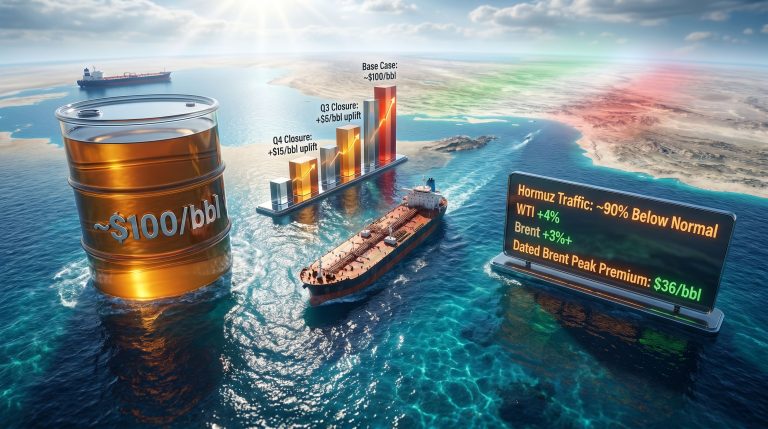
The Strait of Hormuz is the single most consequential chokepoint in the global crude trade. Any credible threat to transit through this corridor affects the pricing of every barrel that moves through it. The June 8 session saw WTI and Brent futures rise sharply following reports of Israeli strikes on Iranian targets and escalating conflict in Lebanon, reversing the previous session's decline in a single trading day. According to the IEA's analysis of Middle East energy markets, the region's strategic importance to global supply cannot be overstated.
Scenario Framework: How a Hormuz Disruption Flows Through the System
The severity of any supply impact depends heavily on duration. A useful framework for thinking through the cascading effects:
-
Short disruption (days to two weeks): Chinese refiners and other major importers draw on existing inventory buffers, including bonded and floating storage. Market impact is primarily psychological, expressed through the risk premium in spot prices rather than physical shortfall.
-
Medium disruption (two to eight weeks): Inventory buffers begin to deplete. Spot procurement pressure intensifies. Refiners face the choice between paying elevated emergency prices or cutting throughput. Refining margins compress further, particularly for operators already under cost pressure.
-
Extended disruption (beyond two months): Feedstock rationing becomes a material operational constraint. Throughput cuts accelerate across the region. Downstream fuel supply tightens across Asian markets. Price signals transmit rapidly into end-user fuel costs.
It is worth noting that Chinese crude stockpiles, including volumes held in bonded and floating storage, provide a meaningful buffer for the short-duration scenario. Analysts covering Chinese energy logistics have estimated that existing reserves could sustain refinery operations for several weeks under normal throughput conditions. However, the vulnerability increases sharply as duration extends.
Why Chinese Refineries Are Delaying Capacity: The Economic Mechanics
The decision to defer refinery commissioning is rarely made lightly. New refining capacity represents multi-billion dollar capital commitments with long payback horizons. When operators delay, it signals a genuine deterioration in the economic conditions needed to justify bringing capacity online.
Three converging forces are responsible for China's 2026 refinery expansion slowdown.
First: Regulated downstream pricing. Chinese refiners operate within a domestic fuel pricing framework that limits their ability to pass elevated feedstock costs through to end consumers. When crude prices rise sharply, the squeeze is absorbed at the refinery level rather than at the pump. This is a structural margin vulnerability that has no short-term resolution.
Second: The disappearance of discounted Russian crude. Following the 2022 sanctions regime, Chinese refiners benefited substantially from access to Russian crude at significant discounts to Brent, which partially offset the margin compression from regulated pricing. According to Reuters reporting on Chinese refinery delays, those discounts have largely evaporated as global competition for available barrels intensified, removing a key economic buffer that had been supporting Chinese refinery viability.
Third: EV-driven demand erosion. China's electric vehicle adoption rate is among the fastest in the world. Domestic gasoline demand growth, which historically justified large-scale refinery expansion, is now structurally weaker. New refining capacity that was sized for a pre-EV demand trajectory now faces a less compelling demand outlook.
The Two Projects That Represent 500,000 bpd of Deferred Capacity
HAPCO Panjin Refinery (300,000 bpd)
The Huajin Aramco Petrochemical Co. joint venture represents one of the most strategically significant refinery projects in China's 2026 pipeline. Beyond the crude processing capacity, the integrated complex includes a 1.65 million tonne per year ethylene cracker and a 2 million tonne per year paraxylene unit, making it a major downstream petrochemicals platform as well as a fuel production asset.
The startup was originally scheduled for mid-2026. It has been pushed back to September or October, according to sources cited by Reuters. Energy Aspects attributed the delay to uncertainty over crude feedstock supplies, a signal that the project's economics hinge significantly on resolving the supply chain question before committing to commissioning costs.
Additionally, Saudi Aramco's planned equity stake in Zhejiang Petroleum and Chemical has faced delays linked to local regulatory approvals and bureaucratic processes. This is relevant because the arrangement was structured to direct up to 60% of that facility's crude feedstock from Saudi Arabia, and delays in finalising the ownership structure have disrupted the supply channel underpinning the refinery's procurement strategy.
PetroChina Dalian Crude Unit (200,000 bpd)
PetroChina has indefinitely postponed the restart of a 200,000 bpd crude processing unit at its Dalian facility. No confirmed timeline for re-entry into service has been provided, making this a genuinely open-ended capacity withdrawal rather than a scheduled deferral.
The combined deferral of these two projects removes the equivalent of a mid-sized national refining system from China's near-term capacity additions, at precisely the moment when the market is most sensitive to supply constraints.
India as a Partial Counterweight: The 526,000 bpd Expansion Pipeline
While China's refinery expansion has stalled, India's capacity addition schedule for 2026 remains on track. The contrast is stark when viewed side by side.
| Metric | China (2026) | India (2026) |
|---|---|---|
| Planned Capacity Additions | 500,000 bpd (delayed) | 526,000 bpd (on schedule) |
| Key Projects | HAPCO Panjin, PetroChina Dalian | HPCL Barmer, IOC Barauni, Gujarat, Panipat |
| Utilization Trend | Declining (69% in April 2026) | Expanding |
| Near-Term Supply Contribution | Reduced | Increasing through H2 2026 |
India's commissioning calendar provides a sequenced set of milestones that investors and market analysts can track as leading indicators of Asian refining capacity recovery:
- Hindustan Petroleum Corp, Barmer: Targeting 60% capacity startup in June 2026
- Indian Oil Corp, Barauni: Expansion completion targeted for August 2026
- Indian Oil Corp, Gujarat: Targeted for November 2026
- Indian Oil Corp, Panipat: Targeted for December 2026
It would, however, be a mistake to treat India's expansion as a direct substitute for China's deferred capacity. The two systems serve fundamentally different regional demand bases and operate under different regulatory and logistics frameworks. India's additions represent a partial offset to the global supply constraint narrative, not a replacement for Chinese throughput growth.
Investment Positioning: Upstream vs. Downstream in a High-Feedstock-Cost Environment
The bifurcation between upstream producers and downstream refiners is one of the most important structural dynamics for energy sector investors to understand in the current environment. Consequently, crude oil price trends remain a critical input for anyone assessing capital allocation across the energy value chain.
Upstream Producers: The Structural Beneficiaries
Elevated crude prices directly expand revenue at the production level, while operating cost bases typically respond more slowly, creating margin expansion that is structurally favourable for upstream operators. The combination of geopolitical risk premium and constrained refinery capacity growth supports a higher-for-longer crude price environment in the near term, reinforcing the investment case for producers with established production profiles and diversified offtake arrangements.
Refiners: Navigating a Compressed Margin Environment
Refiners face the inverse dynamic. Feedstock costs rise in line with crude, while downstream product prices are constrained either by regulatory frameworks (in China) or by demand headwinds from accelerating EV adoption. In this environment, the differentiating factors are:
- Secure, long-term crude supply agreements that reduce spot market exposure
- Flexible logistics infrastructure that allows procurement from multiple origins
- Diversified product slates that reduce dependence on gasoline margins specifically
- Operational execution discipline, particularly around commissioning schedules
Hindustan Petroleum's targeting of 60% capacity at Barmer as early as June 2026 is a useful case study in commissioning discipline. Feedstock access, logistics readiness, and timeline adherence are increasingly where refinery value is being created or destroyed.
Shipping and Transit: The Unresolved Variable
Iranian officials have discussed proposed changes to regional maritime transit conditions, but as of the time of writing, no formal policy changes have been implemented. The impact on shipping costs and crude trade flow economics therefore remains speculative. Furthermore, OPEC market influence continues to shape the broader supply backdrop against which these regional dynamics are unfolding.
Operational data, including actual cargo movements, port activity, and freight rate trends, carries significantly more analytical weight at this stage than commentary derived from geopolitical statements that have not been translated into concrete policy.
The next major ASX story will hit our subscribers first
The Indicators That Will Define H2 2026
Tracking the right data points is essential for anticipating when current supply constraints begin to ease. The following signals carry the highest informational value:
- HAPCO Panjin startup confirmation: A Q3 2026 commissioning would add 300,000 bpd and begin to relieve pressure on China's near-term supply-side constraint
- PetroChina Dalian restart timeline: Any confirmed schedule for the 200,000 bpd unit signals improved refinery economics or feedstock access
- Chinese monthly throughput data: Recovery above 14 million bpd would indicate utilisation normalisation; continued weakness below 13.5 million bpd signals persistent structural pressure
- Brent crude relative to $95 per barrel: Sustained levels below $95 would reduce feedstock cost pressure and potentially accelerate Chinese refinery restarts; sustained levels above $100 would further delay capacity additions
- Indian IOC commissioning milestones: Barauni (August), Gujarat (November), and Panipat (December) provide a sequenced schedule for tracking Asian capacity recovery
- Strait of Hormuz transit volumes: Any reduction in tanker movements through the strait would be an early-warning indicator of physical supply disruption materialising
The bear case for the current supply tightness narrative is relatively well-defined: HAPCO and PetroChina capacity enters service in Q3 2026, Brent retreats sustainably below $95 per barrel, and the geopolitical risk premium begins to decompress. That combination would increase fuel supply while reducing the feedstock cost pressure that has been the central driver of Chinese refinery delays and Middle East oil supply risks.
The Self-Reinforcing Cycle: Why This Is Harder to Break Than It Looks
The current market environment is best understood as a compounding risk system with self-reinforcing properties rather than a straightforward supply-demand imbalance.
The sequence operates as follows:
- Chinese refinery economics were already deteriorating before Middle East tensions escalated, compressed by regulated pricing, eroded Russian crude discounts, and EV-driven demand weakness
- Middle East conflict escalation added a crude price risk premium that directly worsens refinery feedstock economics and introduces supply chain uncertainty
- The combination of higher costs and supply uncertainty delays the capacity additions that would otherwise ease the fuel supply constraint
- Delayed capacity means tighter fuel supply, which sustains elevated crude prices, which further discourages refinery investment
- The cycle becomes self-reinforcing and is difficult to break without a material reduction in either geopolitical risk or crude prices
This is why monitoring refinery commissioning data carries more forward-looking signal value than tracking daily crude price movements. The price is a symptom. The commissioning calendar is the mechanism through which the cycle eventually breaks.
The most consequential question for energy markets in the second half of 2026 is not whether Brent trades above or below $100 on any given session. It is whether Asia's refining capacity pipeline, and China's in particular, can resume its expansion trajectory before inventory buffers are materially depleted and the downstream fuel supply tightness becomes self-evident in end-market data.
This article contains forward-looking analysis and market commentary for informational purposes only. It does not constitute financial advice. Past price movements and stated forecasts are not reliable indicators of future outcomes. Readers should conduct independent research before making any investment decisions.
For additional context on global oil market dynamics and energy sector analysis, visit cruxinvestor.com.
Want To Stay Ahead of Major ASX Resource Discoveries Shaping Energy Markets?
While macro forces like refinery economics and geopolitical risk premiums drive global oil markets, significant wealth has historically been created closer to home through timely identification of major ASX mineral discoveries — Discovery Alert's proprietary Discovery IQ model delivers real-time alerts the moment significant discoveries are announced, turning complex data across 30-plus commodities into actionable insights for investors at every level. Explore how historic discoveries have generated substantial returns and begin a 14-day free trial today to position yourself ahead of the broader market.