June 28, 2026

Global energy markets face unprecedented pressure as commodity price volatility reshapes investment landscapes and monetary policy frameworks worldwide. The interconnected nature of modern financial systems means that supply-side disruptions in critical energy sectors create cascading effects across asset classes, forcing central banks to navigate complex trade-offs between price stability and economic growth. When oil surges to $106 amid West Asia war doubts, understanding these transmission mechanisms becomes essential for investors and policymakers as geopolitical tensions amplify market uncertainty.
Understanding Energy Market Fundamentals During Geopolitical Crises
Energy market disruptions rarely occur in isolation, creating complex feedback loops that challenge traditional economic models. The immediate impact of such disruptions extends far beyond petroleum markets, triggering systematic repricing across government bonds, equities, and currency markets. The March 2026 crisis demonstrates how diplomatic uncertainty translates directly into commodity risk premiums, with crude oil experiencing a 45 percent gain for the month while European natural gas surged 70 percent.
Furthermore, the mechanics of supply-side disruption reveal critical vulnerabilities in global energy infrastructure. Strategic chokepoints become focal points for risk assessment, with market participants pricing in potential supply interruptions based on military deployments and diplomatic developments. Reports of thousands of US troops being deployed to the West Asia region created immediate market reactions, highlighting how geopolitical positioning affects energy pricing models.
Key Supply Chain Disruption Indicators:
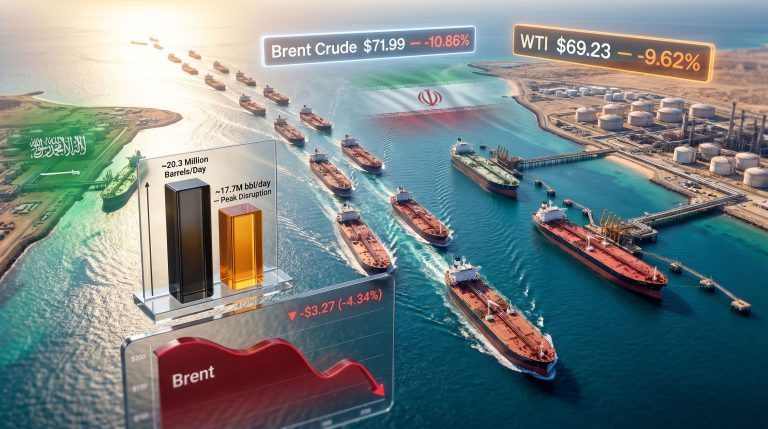
• Brent crude pricing: Just over $106 per barrel as of March 27, 2026
• Natural gas volatility: European gas at 54.5 per megawatt hour, up 3+ percent daily
• Monthly momentum: 45 percent oil gains, 70 percent gas gains demonstrate sustained upward pressure
• Regional impact: West Asia conflict duration approaching one month, creating persistent risk premiums
The simultaneity of crude oil and natural gas price increases suggests market recognition of systemic energy supply vulnerability rather than isolated commodity-specific disruption. This pattern indicates traders are pricing in broader infrastructure risks that could affect multiple energy sectors simultaneously.
Strategic petroleum reserve deployment becomes critical during extended crises, though effectiveness depends on coordination between major consuming nations and the scale of supply disruption. Historical precedents suggest that reserve releases can provide temporary price relief but cannot address sustained geopolitical supply constraints lasting multiple months.
OPEC's market influence production response frameworks face political constraints during regional conflicts, particularly when member nations are directly involved in military actions. The organization's ability to increase production must be balanced against individual member countries' domestic priorities and regional alliance obligations.
When big ASX news breaks, our subscribers know first
Central Banking Response Mechanisms to Energy-Driven Inflation
Energy price shocks create unique challenges for monetary policymakers, forcing difficult decisions between accommodating supply-side inflation and maintaining price stability credibility. The March 2026 crisis illustrates this dilemma perfectly, with central banks across major economies responding differently to the same energy price pressures.
Germany's central bank chief Joachim Nagel articulated the European Central Bank's position with notable clarity, stating that sufficient data would be available by April to determine whether rate action was necessary. His comment that policymakers should not shy away from action simply because it might seem premature reveals the ECB's willingness to respond aggressively to energy-driven inflation concerns.
Global Central Bank Policy Divergence Analysis:
| Central Bank | Current Rate Indicator | Policy Direction | Timeline |
|---|---|---|---|
| ECB | 2.67% (2-year yield) | Rate hike consideration | April 2026 |
| Bank of Japan | 1.33% (10-year yield) | Potential increase | Next month |
| Federal Reserve | ~4.0% (2-year yield) | Data-dependent | Ongoing assessment |
The Bank of Japan faced particularly acute pressure, with the 10-year yield reaching its highest level in 30 years at 1.33 percent. This historic elevation suggests extraordinary monetary policy anticipation, with traders cementing expectations for another rate hike as early as the following month.
Energy Pass-Through Mechanism Analysis
The transmission from energy prices to monetary policy expectations occurred with remarkable speed during the March 2026 crisis. Germany's two-year bond yield rose 6 basis points to 2.67 percent in a single session, directly following oil's surge above $106. This real-time repricing demonstrates how energy shocks immediately affect bond market pricing of central bank policy paths.
In addition, bond yield movements during energy crises reveal the complex relationship between supply-side inflation and monetary policy credibility. When Germany's two-year yield increased 6 basis points after falling 4 basis points the previous day, it illustrated how quickly market sentiment can shift based on energy price developments and central bank communications.
The challenge for central banks lies in distinguishing between temporary energy price spikes and sustained inflationary pressure that requires policy intervention. Pascal Koeppel, chief investment officer at Vontobel SFA, captured this constraint precisely when noting that prolonged disruption in critical shipping lanes could keep energy prices and inflation elevated, forcing central banks to tighten monetary policy despite potential growth impacts.
Regional Policy Response Variations:
• European Central Bank: Moving toward April rate hike consideration based on energy inflation persistence
• Bank of Japan: Experiencing 30-year yield highs, suggesting aggressive policy normalization
• Federal Reserve: Maintaining data-dependent approach while monitoring supply-side inflation
• Emerging Market Central Banks: Philippines held unscheduled meeting due to market turmoil
Market Microstructure Analysis During Energy Price Shocks
Energy sector contagion effects reveal critical vulnerabilities in modern portfolio construction and risk management frameworks. The March 2026 crisis demonstrated how traditional asset class diversification breaks down during supply-side energy shocks, with European stocks and government bond prices dropping simultaneously despite their typical negative correlation.
Global stock markets declined on Thursday as oil surges to $106 amid West Asia war doubts continued to materialise, illustrating the direct transmission mechanism from commodity markets to equity valuations. This reaction pattern suggests investors recognise that sustained high energy prices create margin pressure across multiple sectors, particularly for companies with significant transportation or energy-intensive manufacturing processes.
Cross-Asset Correlation Breakdown
The simultaneous decline in European stocks and government bonds represents a fundamental shift in asset correlation patterns during energy crises. Under normal market conditions, government bonds often provide portfolio protection during equity selloffs. However, when energy-driven inflation threatens monetary policy accommodation, both asset classes face selling pressure simultaneously.
Furthermore, currency market volatility intensifies during energy price shocks, particularly affecting oil-importing economies. While specific currency pair movements require real-time tracking, the general pattern shows emerging market currencies facing pressure as higher energy import costs strain current account balances and fiscal positions.
Energy Crisis Transmission Channels:
• Equity markets: Direct margin impact on energy-intensive sectors
• Bond markets: Inflation expectations driving yield increases
• Currency markets: Current account impacts for energy importers
• Credit markets: Corporate borrowing costs affected by sector-specific risks
Emergency central bank interventions, such as the Philippines' unscheduled meeting due to market turmoil, indicate how rapidly energy price shocks can cascade through regional financial systems. These responses suggest central banks recognise the systemic nature of energy-driven market disruption rather than viewing it as isolated commodity volatility.
The speed of market reaction to Iran's denial of negotiations with the US demonstrates how geopolitical information flow affects energy risk premiums in real time. Conflicting signals over diplomatic contact scope, combined with military deployment reports, created immediate selling pressure across multiple asset classes within hours of news release.
Consumer Market Transmission Mechanisms
Energy price increases translate to consumer markets through multiple channels, with natural gas pricing particularly affecting European residential and commercial costs. The 70 percent monthly gain in European natural gas prices as of March 2026 creates direct input cost pressure for electricity generation, heating systems, and industrial processes.
Transportation cost inflation represents another critical transmission mechanism, though specific retail gasoline price changes require regional analysis based on local refining capacity, distribution networks, and tax structures. The documented 45 percent monthly oil price gain provides the input variable for calculating downstream fuel cost impacts across different geographic markets.
Primary Consumer Impact Channels:
• Residential heating: Direct natural gas cost increases for home heating systems
• Electricity generation: Input cost pressure on power utilities using gas-fired plants
• Transportation fuel: Retail gasoline and diesel price increases based on crude oil inputs
• Supply chain costs: Freight and logistics cost increases affecting final goods pricing
The elasticity of consumer spending response to energy price increases varies significantly by income level and geographic region. Higher-income households typically show greater resilience to energy cost increases, while lower-income segments may reduce discretionary spending to accommodate higher utility and transportation costs.
Industrial energy users face more complex adjustment mechanisms, including potential production scheduling changes, input substitution strategies, and pricing pass-through to final customers. Manufacturing sectors with high energy intensity may experience margin compression if competitive pressures prevent immediate price adjustments.
Energy cost inflation creates a regressive impact pattern, disproportionately affecting lower-income households that spend higher percentages of their income on transportation fuel and utility bills.
Geopolitical Risk Assessment Framework
The near one-month duration of the West Asia war as of March 27, 2026, established a reference timeline for market participants assessing conflict persistence and escalation potential. Iran's denial of talks with the US created explicit uncertainty about ceasefire prospects, with market pricing reflecting extended conflict duration assumptions.
Military deployment scale affects risk premium calculations, with reports of thousands of US troops being sent to the region indicating significant strategic commitment levels. While specific troop numbers remain unquantified in available reports, the scale suggests preparation for extended engagement rather than short-term diplomatic pressure.
Diplomatic Uncertainty Impact Analysis
Information asymmetry plays a crucial role in risk pricing during geopolitical crises. The market's sharp reaction to conflicting signals over negotiation scope demonstrates how diplomatic ambiguity translates directly into commodity price uncertainty. When clear communication channels break down, traders default to pricing higher baseline risk levels.
Moreover, strategic alliance structures affect both conflict duration and energy market impact severity. Regional partnerships determine potential escalation pathways, alternative supply route availability, and international intervention likelihood. The complexity of Middle Eastern alliance networks creates multiple scenario pathways that market participants must price simultaneously.
Key Risk Assessment Factors:
• Conflict duration: Approaching one-month milestone suggests extended timeline
• Military commitment: Thousands of troops indicate substantial strategic investment
• Diplomatic channels: Breakdown in clear communication increases uncertainty
• Regional alliances: Complex partnership structures affect escalation potential
Sanctions regime effectiveness becomes critical for long-term energy market stability, though immediate market impacts often reflect speculation about potential restrictions rather than actual implementation effects. Historical precedent suggests that comprehensive sanctions require international coordination and typically face implementation challenges that limit short-term supply disruption.
Economic Scenario Modelling for Sustained High Energy Prices
Current energy price momentum, with oil surges to $106 amid West Asia war doubts and 45 percent monthly gains, establishes baseline conditions for scenario analysis. The persistence of natural gas at 70 percent monthly increases suggests underlying supply constraints that may continue beyond immediate diplomatic resolution attempts.
GDP Growth Impact Projections
Sustained energy prices above $100 per barrel historically correlate with reduced GDP growth across major economies, though the magnitude depends on each region's energy intensity, import dependence, and policy response effectiveness. Energy-importing economies face particularly acute challenges, as higher import costs strain current account balances whilst domestic inflation pressures limit monetary policy accommodation options.
Consumer discretionary spending typically shows the first significant response to sustained energy cost increases. Household budget reallocation toward transportation fuel and utilities reduces available income for non-essential purchases, creating ripple effects through retail, hospitality, and entertainment sectors.
Regional Economic Vulnerability Analysis:
• Asia-Pacific: High energy import dependence creates significant vulnerability
• Europe: Natural gas substitution challenges following supply disruption
• North America: Mixed impacts from domestic production versus consumption patterns
• Emerging Markets: Currency pressure and fiscal strain from higher import costs
Corporate margin pressure intensifies in energy-intensive manufacturing sectors, including steel production, chemical processing, and aluminium smelting. Companies in these sectors face difficult decisions between accepting reduced profitability or implementing price increases that may reduce demand volumes.
Investment Strategy Implications
Portfolio allocation strategies must account for the dual nature of energy price increases: short-term inflation pressure combined with long-term economic growth headwinds. Energy sector equities may benefit from higher prices, but broader market multiples typically contract as investors price in reduced earnings growth across non-energy sectors.
For instance, current oil price rally analysis suggests that inflation-protected securities become increasingly attractive during sustained energy price increases, though real yield levels must be evaluated against potential central bank policy responses. Furthermore, the effectiveness of traditional inflation hedges depends on whether energy price increases represent temporary supply disruption or structural shifts in global energy markets.
Critical Investment Considerations:
• Energy sector exposure: Balance short-term price benefits against transition risks
• Geographic diversification: Energy-importing versus energy-exporting economy allocation
• Currency hedging: Emerging market exposure requires careful FX risk management
• Duration positioning: Interest rate sensitivity during central bank policy tightening
The next major ASX story will hit our subscribers first
Long-Term Structural Implications for Global Energy Security
The March 2026 energy crisis reveals fundamental vulnerabilities in global energy infrastructure that extend beyond immediate price impacts. Strategic stockpile adequacy across major economies becomes a critical policy consideration, with current reserve levels tested against extended supply disruption scenarios.
Renewable energy investment acceleration patterns may shift significantly following demonstration of fossil fuel supply vulnerability. Policy frameworks that previously balanced climate objectives against energy security concerns now face pressure to prioritise supply diversification and domestic energy production capacity.
Energy Independence Policy Recalibrations
The crisis highlights the strategic importance of domestic energy production capabilities, even for economies committed to renewable energy transitions. Policymakers must balance long-term decarbonisation goals against near-term supply security requirements, potentially affecting investment allocation between traditional and alternative energy infrastructure.
Consequently, critical minerals and energy security supply chain diversification becomes increasingly important as renewable energy infrastructure requires substantial quantities of lithium, cobalt, rare earth elements, and other materials. Energy security considerations now extend beyond petroleum to include the mineral resources essential for battery storage, solar panels, and wind turbine components.
Additionally, lithium industry innovations become crucial as countries seek to reduce dependence on unstable supply routes through domestic battery production capabilities.
Future Geopolitical Energy Alliance Patterns
Regional energy integration projects gain strategic priority as countries seek to reduce dependence on unstable supply routes. Alternative partnership formations may emerge based on energy complementarity rather than traditional political alignments, creating new frameworks for international energy cooperation.
Technology transfer agreements for energy security purposes may accelerate, with countries willing to share renewable energy technologies, storage solutions, and grid management systems to build collective energy resilience. These partnerships could reshape global energy technology development patterns over the coming decade.
However, the crisis demonstrates that energy market volatility remains a persistent feature of global economic systems, requiring sophisticated risk management frameworks at both policy and investment levels. Understanding these dynamics becomes essential for navigating future energy price cycles and their broader economic implications, particularly as US inflation and tariffs continue to affect global commodity pricing mechanisms.
The interconnected nature of modern energy markets means that regional conflicts can trigger global supply disruptions with far-reaching economic consequences. Furthermore, market analysts continue to monitor developments as oil prices surge amid regional tensions, highlighting the ongoing volatility in global energy markets.
Disclaimer: This analysis is based on market conditions and events as of March 2026 and should not be considered as investment advice. Energy markets are highly volatile and subject to rapid changes based on geopolitical developments, policy decisions, and supply-demand dynamics. Investors should conduct their own research and consult with qualified financial advisors before making investment decisions.
Ready to Capitalise on Energy Market Volatility?
As energy price shocks continue to reshape global markets and create substantial trading opportunities, Discovery Alert's proprietary Discovery IQ model delivers instant notifications on significant ASX mineral discoveries, including critical energy transition minerals that become increasingly valuable during supply disruptions. Begin your 14-day free trial today to position yourself ahead of market-moving discoveries and secure your competitive advantage in volatile commodity markets.