August 2, 2026
The Hidden Cost of Administrative Fragmentation in South African Mining
Global mining capital is a restless force. It moves toward jurisdictions that offer geological promise combined with regulatory clarity, and it retreats just as swiftly when approvals become unpredictable, timelines stretch without accountability, and multiple agencies operate in silos with no obligation to coordinate. For South Africa, a country sitting atop one of the most remarkable mineral endowments on the planet, this dynamic has played out with costly consequences. The case for a one-stop mineral rights shop in South Africa is not a new idea, but in 2026, the urgency behind it has reached a threshold that industry can no longer afford to understate.
When big ASX news breaks, our subscribers know first
South Africa's Mineral Wealth vs. Its Administrative Reality
South Africa hosts world-class reserves of platinum group metals, manganese, chrome, gold, coal, iron ore, and a growing suite of battery and critical minerals. Yet the mining sector's contribution to GDP in 2025 stood at 6.2%, barely distinguishable from the 6.3% recorded when the Mineral and Petroleum Resources Development Act (MPRDA) was gazetted in April 2004. Over more than two decades, despite billions in infrastructure investment and successive legislative revisions, the sector has effectively flatlined as a share of the national economy.
That stagnation is not primarily a geological problem. South Africa's ore bodies have not diminished in scale or quality. What has diminished is investor confidence, exploration pipeline depth, and the capacity of the regulatory system to attract and retain long-term mining capital. The structural barriers are well documented:
- Persistent electricity supply shortfalls and above-inflation energy tariff increases compressing operating margins
- Chronic underperformance in rail and port logistics, raising the cost of getting ore to market
- Successive rounds of legislative uncertainty, including four iterations of the Mining Charter since 2004
- Inconsistent and, at times, opaque administration of existing laws
- A digital mineral rights platform that has fallen short of delivering the transparency and accessibility that global investors expect
Each of these factors is individually significant. Together, they have created a compounding deterrent to junior exploration investment that precedes every new mine.
A 22-Year Regulatory Timeline: What Has Actually Changed?
The MPRDA represented a genuine structural transformation when it was introduced. By vesting all unmined minerals under state custodianship, it ended private mineral ownership and created a framework designed to broaden economic participation across one of South Africa's most capital-intensive industries.
The social outcomes have been measurable. Women's representation in the sector has grown from approximately 3% at the time of the MPRDA's introduction to 21% by 2026. Mining companies have broadly met or exceeded economic empowerment ownership targets. Communities that were historically excluded from the benefits of mineral extraction now have structured legal claims on investment, partnership, and development.
What the Act failed to deliver, however, was the internationally competitive administrative and regulatory regime that its architects envisioned. The table below captures the key regulatory milestones that have shaped the current environment:
| Year | Regulatory Event | Sector Impact |
|---|---|---|
| 2004 | MPRDA gazetted | State custodianship of minerals established |
| 2004-2026 | Four Mining Charter versions | Recurring compliance uncertainty for operators |
| 2013 | MPRDA Amendment Bill tabled | Spent over 2,000 days in proceedings before withdrawal |
| 2025 | Draft MRD Bill gazetted | Current revision cycle initiated |
| 2026 | MRD Bill revision expected | Industry and government in active engagement |
The 2013 Amendment Bill episode deserves particular attention as a cautionary precedent. Spending more than 2,000 days in various legislative proceedings before ultimately being withdrawn, it inflicted prolonged uncertainty on a sector that depends on decade-long investment horizons. Exploration decisions made in 2013 were effectively deferred or abandoned as operators waited for regulatory clarity that never arrived.
The incoming Mineral Resources Development (MRD) Bill is now the most consequential piece of mining legislation South Africa has considered in over two decades. Getting it right, and administering it effectively, is a non-negotiable condition for reversing the sector's structural underperformance. Furthermore, the mining claims framework adopted in other jurisdictions offers instructive comparisons for what structured, transparent processes can achieve.
The Economic Stakes: What Mining Actually Delivers
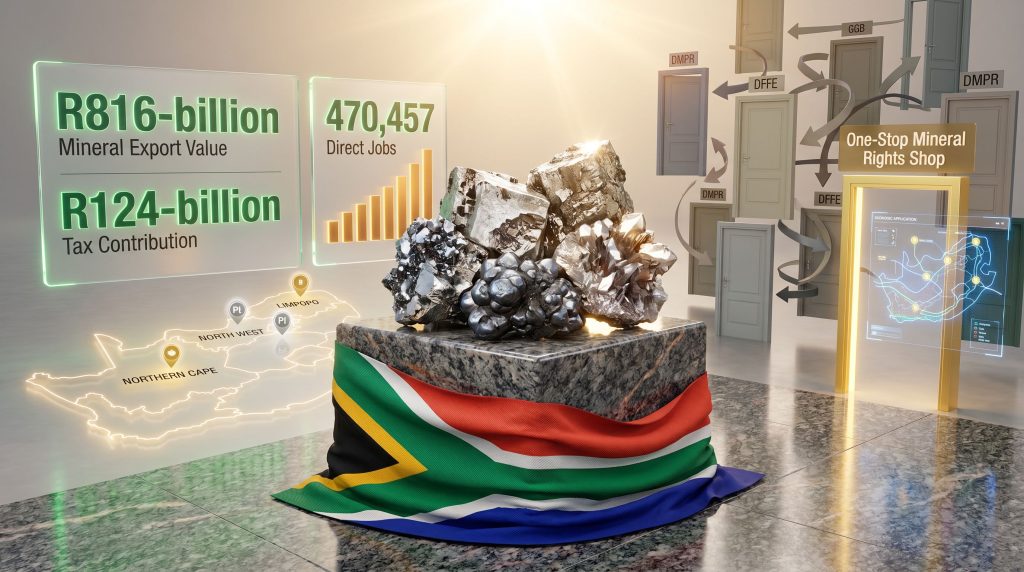
Before examining what a one-stop mineral rights shop would structurally involve, it is worth anchoring the discussion in the economic reality of what is at stake. South Africa's mining sector exported R816-billion worth of minerals in the most recent reporting year and contributed R124-billion in taxes to the national fiscus. Direct employment stands at 470,457 people.
The multiplier effect embedded in those employment numbers is perhaps the most compelling statistic in the entire reform debate. Each of those direct mining jobs supports approximately 10 additional livelihoods across the mineral value chain and ancillary industries, meaning that more than 4.7 million people depend directly or indirectly on the sector's performance.
For a country confronting structural unemployment and deep income inequality, that multiplier is not an abstraction. It represents schools, small businesses, household incomes, and community infrastructure that rise or fall with the sector's fortunes. When regulatory friction suppresses exploration, delays mine development, or drives capital to more permissive jurisdictions, the downstream cost is carried by communities with no direct connection to the mining industry.
The Samrad Problem: When Digital Promise Meets Administrative Reality
South Africa's mineral rights administration system, known as Samrad (South African Mineral Resources Administration System), was designed to deliver transparency and accessibility to the approvals process. In principle, it should allow applicants, investors, and communities to view application status, rights boundaries, and geological data through a single digital interface.
In practice, the system has been characterised by persistent access difficulties and reliability concerns. More critically, a platform that is difficult to navigate creates opportunities for discretionary human intervention in the approvals process, precisely the kind of interference that a world-class mining cadastre should eliminate.
The contrast with leading mineral rights jurisdictions is stark:
| Jurisdiction | Platform Characteristics | Transparency Level |
|---|---|---|
| South Africa | Online portal; reported access and reliability issues | Low to Medium |
| Australia | State-based cadastres with real-time mapping and online lodgement | High |
| Canada | Integrated provincial systems with environmental linkage | High |
| Chile | Digital concession mapping via SERNAGEOMIN | Medium to High |
A genuinely world-class cadastre removes human gatekeeping from the process entirely. Geological data becomes accessible to junior explorers in Toronto, institutional investors in London, and government analysts in Pretoria with equal ease. Application status is trackable in real time. That level of transparency does not just reduce corruption risk; it actively attracts exploration capital by lowering the information costs that precede any investment decision. Indeed, exploration trends in Australia demonstrate how digital-first cadastre systems can materially accelerate discovery pipelines.
Understanding the Current Application Process: Where Delays Are Born
To understand why a one-stop mineral rights shop matters, it helps to trace the path that a mineral rights applicant currently navigates in South Africa:
- Identify the applicable right required, whether a prospecting right for early-stage exploration or a mining right for production-stage operations, and confirm that the target area is not already subject to an existing right or moratorium.
- Lodge the primary application with the Department of Mineral and Petroleum Resources (DMPR), the lead regulatory authority under the MPRDA, along with supporting technical and environmental documentation.
- Initiate the environmental authorisation process separately through the Department of Forestry, Fisheries and the Environment (DFFE), which operates on its own timeline with no structural obligation to align with the DMPR process.
- Notify landowners and surface rights holders of the application, a legal obligation under the MPRDA that, if improperly executed, can invalidate an application entirely and require the process to restart.
- Navigate interdepartmental coordination in the absence of any central coordinating body, meaning an applicant must manage parallel processes across multiple agencies simultaneously with no binding timeline on any individual department.
- Address objections and disputes from landowners, communities, or other interested parties, which in the absence of a structured mediation framework can default to protracted negotiation or litigation.
- Receive the right or permit after demonstrating compliance with empowerment, environmental, and social development obligations across all relevant regulatory tracks.
The absence of a statutory coordination obligation across these steps is not merely an inconvenience. It is the structural source of the delays that consistently characterise South African mineral rights administration. Each department operates on its own timeline, and no applicant has any enforceable mechanism to accelerate a lagging approval from a secondary agency.
The next major ASX story will hit our subscribers first
What a One-Stop Mineral Rights Shop Would Actually Require
The concept of a one-stop mineral rights shop has circulated in South African policy discourse since at least 1998, when the country's Minerals and Mining Policy explicitly called for a centralised information and advisory service for the sector. Nearly three decades later, that vision remains unrealised. What would genuine implementation look like?
A functional integrated gateway would need to incorporate several structural elements:
- A unified application portal that accepts submissions for mineral rights, environmental authorisations, water use licences, and social and labour plan commitments through a single entry point
- Binding interdepartmental service-level agreements that impose enforceable timelines on each participating agency, with escalation protocols for non-compliance and public reporting on processing performance
- A rebuilt digital cadastre capable of delivering real-time, globally accessible visibility of rights boundaries, geological data, application status, and compliance records
- Automated audit trails that eliminate discretionary human intervention and create accountability at every stage of the approvals process
- A structured community engagement module embedded in the application workflow, reducing the risk of post-approval disputes by ensuring landowner and community consultation is documented and verifiable from the outset
The Minerals Council South Africa formally articulated the case for precisely this kind of integrated mechanism at its 136th Annual General Meeting on May 27, 2026, describing the current fragmented approach as a system that produces delays and destroys investment opportunities. The Council emphasised that both it and the DMPR share a stated commitment to revitalising the sector, and that engagements around the draft MRD Bill have been constructive. The concern, however, is that the final revised Bill must demonstrably reflect those engagements.
The Investment Calculus: Why Permitting Speed Moves Capital
Junior exploration companies, the segment of the mining industry responsible for discovering the majority of new mineral deposits globally, are acutely sensitive to permitting timelines. Unlike major mining houses with established cash flows and dedicated regulatory affairs teams, junior operators often work with finite capital raises and board-level pressure to show progress.
A permitting process that consumes eighteen months instead of six does not just delay a project; it can consume a company's entire exploration budget before a drill bit enters the ground. Consequently, mining permits reform in other jurisdictions has demonstrated how streamlining approvals can translate directly into accelerated exploration activity.
South Africa's protracted regulatory uncertainty has suppressed its exploration pipeline relative to peer African jurisdictions that have invested in streamlined digital cadastres and clear permitting frameworks. The MRD Bill represents a genuine inflection point in this dynamic, but the window is not unconditional. If the revised legislation introduces provisions that diverge materially from the outcomes of industry-government negotiations, the 2013 Amendment Bill experience becomes a credible downside scenario.
The upside scenario, however, is equally significant. A revised MRD Bill that delivers administrative clarity, combined with a genuinely functional one-stop mineral rights shop in South Africa and a rebuilt digital cadastre, would represent the most meaningful improvement in the country's exploration investment proposition in a generation.
Frequently Asked Questions: Mineral Rights in South Africa
Who controls mineral rights in South Africa?
Under the MPRDA, all unmined minerals are vested in the custodianship of the South African state. Private landowners do not hold separate mineral rights. Applicants must obtain prospecting or mining rights directly from the DMPR.
What is Samrad?
Samrad is the government's digital platform for administering mineral rights applications, permits, and related information. It has faced sustained criticism for limited accessibility and inconsistent reliability, falling short of the transparency standards that characterise leading international cadastre systems.
Why is a one-stop mineral rights shop needed?
Currently, applicants must navigate separate processes across multiple government departments without any centralised coordination mechanism. This fragmentation generates compounding delays, increases compliance costs, and suppresses exploration investment by making South Africa a more difficult jurisdiction to operate in than its resource endowment warrants.
What is the MRD Bill?
The Mineral Resources Development Bill is the proposed legislative successor to the MPRDA. A draft was gazetted in 2025, with a revised version expected in 2026. It represents the most consequential potential reform of South Africa's mining regulatory framework since 2004. A thorough definitive feasibility study of any major project will hinge significantly on the clarity this Bill ultimately delivers.
Has South Africa previously attempted a one-stop shop for mineral rights?
The concept was formally proposed in the 1998 Minerals and Mining Policy and has been referenced in subsequent legislative discussions. In practice, a fully functional integrated gateway has never been implemented, making the current MRD Bill process a critical opportunity to close that gap.
The Path Forward: What Genuine Reform Requires
South Africa's mineral resource base is not the constraint on its mining sector's growth trajectory. The constraint is administrative, and that makes it solvable in a way that geological limitations are not. Several priorities stand out as essential to translating policy intent into operational reality:
- Legislative precision: the MRD Bill must deliver unambiguous, stable frameworks that reflect the substantive outcomes of industry-government engagement rather than introducing new uncertainties
- Digital infrastructure rebuilding: Samrad must be replaced or fundamentally rebuilt to deliver real-time, globally accessible transparency that removes human gatekeeping from the process
- Statutory coordination mandate: a legally binding obligation for all relevant departments to align timelines and share data within a centralised application framework
- Time-bound dispute resolution: structured mechanisms for landowner and community objections that resolve within defined periods without defaulting to open-ended litigation
- Independent oversight and public reporting: transparent accountability for departmental processing performance, with measurable benchmarks and consequences for persistent non-compliance
The arithmetic of the reform case is straightforward. South Africa exported R816-billion in minerals in a single year, supported more than 4.7 million livelihoods through direct and indirect employment, and contributed R124-billion to the national tax base, all while the sector's GDP share remained essentially unchanged for over two decades. The gap between what South Africa's mineral endowment could deliver and what it currently produces is not a geological problem. It is an administrative one, and establishing a one-stop mineral rights shop in South Africa is among the highest-return regulatory investments the country could make to begin closing it.
This article contains analysis and commentary based on publicly available information, including statements made at the Minerals Council South Africa's 136th Annual General Meeting and regulatory data pertaining to the MPRDA and the draft MRD Bill. References to economic statistics, employment figures, and mineral export values reflect the most recently available reported data as at the time of publication. Readers should not construe any portion of this article as investment advice. Forward-looking statements involve inherent uncertainty, and outcomes may differ materially from those described. Further reporting and analysis on South Africa's mineral rights regulatory environment is available through Mining Weekly at miningweekly.com.
Want To Identify the Next Major ASX Mineral Discovery Before the Broader Market?
Discovery Alert's proprietary Discovery IQ model delivers real-time alerts on significant ASX mineral discoveries, transforming complex geological data into actionable investment insights for both short-term traders and long-term investors. Explore how historic discoveries have generated substantial returns by visiting Discovery Alert's dedicated discoveries page, and begin your 14-day free trial today to position yourself ahead of the market.