August 2, 2026
The Geological Lottery That Argentina Is Still Learning to Cash
Resource wealth and national prosperity rarely arrive together on the same timeline. History is littered with examples of nations sitting atop extraordinary geological endowments while their broader populations remain disconnected from the benefits for years, sometimes decades. Argentina's current moment with Vaca Muerta output and Argentina economy dynamics fits squarely into this pattern, and understanding why requires looking beneath the surface of record-breaking production figures to examine the structural, institutional, and geographic forces that determine who actually benefits from a shale boom.
When big ASX news breaks, our subscribers know first
How Big Is Vaca Muerta? Understanding the Scale of Argentina's Shale Asset
Production Metrics That Demand Attention
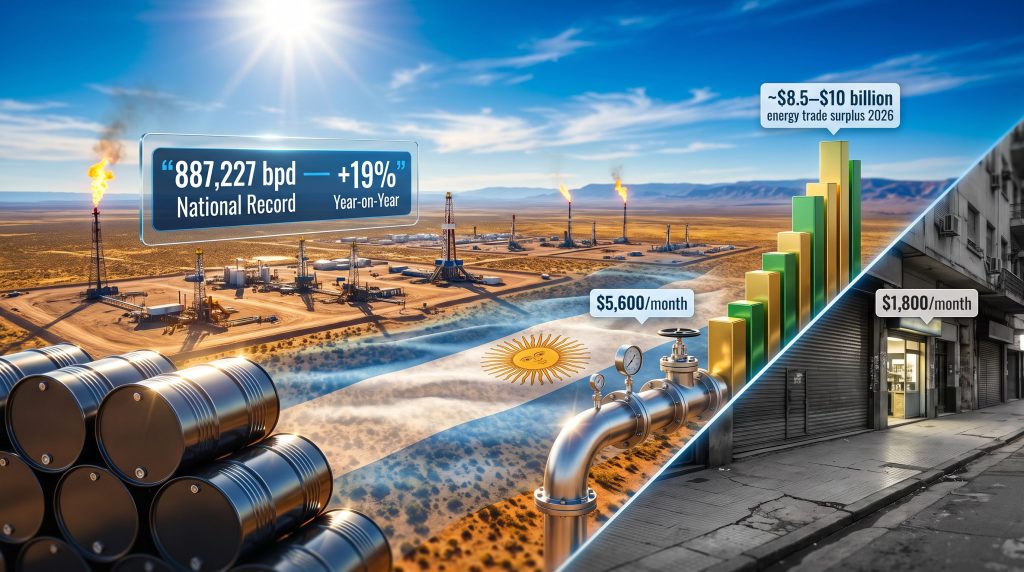
The numbers coming out of Vaca Muerta in 2026 are genuinely remarkable by any global measure. Argentina's total crude oil output reached an all-time national record of 887,227 barrels per day in May 2026, representing a 19% year-on-year increase that few other hydrocarbon provinces anywhere in the world can match at this stage of development.
Natural gas production tells a similarly impressive story, reaching 5.5 billion cubic feet per day in May 2026, just below the record of 5.7 billion cubic feet per day set in July 2025. On a monthly basis, gas output climbed 5.4% from April 2026 and 11% above May 2025 levels, reflecting consistent operational momentum rather than a single anomalous spike.
| Indicator | Figure | Timeframe |
|---|---|---|
| National crude oil output (record) | 887,227 bpd | May 2026 |
| Vaca Muerta share of national oil output | ~58% | 2024 baseline |
| Vaca Muerta share of national gas output | >70% | 2024 baseline |
| Natural gas production | 5.5 billion cf/day | May 2026 |
| Year-on-year oil growth | +19% | May 2026 vs May 2025 |
| Shale oil output | 447,000+ bpd | March 2025 |
| Year-on-year shale growth | +26% | March 2025 vs March 2024 |
The Geology Behind the Numbers
What makes Vaca Muerta particularly significant from a technical standpoint is not simply its size, but the specific characteristics of its rock formation. The formation spans approximately 30,000 square kilometres across Neuquén province in Patagonia, and its depth and thermal maturity vary considerably across the play, creating distinct zones optimised for either oil or gas production.
The formation's organic richness is exceptionally high, with total organic carbon content in premium areas reaching levels comparable to the best zones of the Permian Basin in Texas. This geological quality, combined with relatively thick pay zones that can exceed 300 metres in places, means individual wells in core Vaca Muerta acreage can deliver initial production rates that rival top-tier North American shale wells.
Critically, Vaca Muerta benefits from what geologists describe as overpressured reservoir conditions, where natural formation pressure significantly exceeds hydrostatic pressure. This characteristic improves initial flow rates and can extend the productive life of wells compared to normally pressured shale formations, which partly explains why international operators have been willing to commit capital at scale.
Where Vaca Muerta Stands Globally
Argentina has become the fourth-largest crude oil producer in Latin America as a direct result of Vaca Muerta's development, and the formation is now firmly recognised as the premier shale basin outside North America. Its de-risked geology and established operator relationships distinguish it categorically from all other non-U.S. shale frontiers currently under evaluation. Furthermore, the Argentina copper potential emerging elsewhere in the country suggests that Vaca Muerta is only one dimension of Argentina's broader resource story.
| Basin | Country | Development Stage | Key Advantage | Key Constraint |
|---|---|---|---|---|
| Vaca Muerta | Argentina | Advanced / Accelerating | Proven geology, international operator confidence | Infrastructure capacity |
| Bazhenov | Russia | Early / Constrained | Scale | Geopolitical and sanctions risk |
| Bowland | United Kingdom | Effectively paused | Proximity to European markets | Regulatory opposition |
| Karoo | South Africa | Exploration only | Significant potential | Water access, undeveloped |
A dimension often underappreciated by observers outside the energy industry is Vaca Muerta's geopolitical positioning. Unlike Middle Eastern producers whose export logistics depend on the Strait of Hormuz, Argentine crude can reach Atlantic markets without transiting any contested chokepoint. In a period of elevated geopolitical risk across the Persian Gulf corridor, this characteristic has become a genuine strategic differentiator for buyers seeking supply security. According to recent production analysis from Enverus, this positioning is increasingly factored into long-term offtake agreements.
The Structural Paradox: Record Output and Economic Malaise Coexisting
Two Economies Running on Different Tracks
The central tension in the Vaca Muerta output and Argentina economy story is not difficult to identify, but it is genuinely difficult to resolve. Argentina is simultaneously posting oil production records and experiencing conditions that would be characterised, in most countries, as a period of significant economic stress for ordinary households.
Outside of Neuquén province, the indicators pointing in the wrong direction include:
- Declining total public consumption on a year-to-date basis
- Falling levels of business and household investment
- Reduced consumer spending across major urban centres
- Business closures and employment losses in manufacturing and services
- Intensified import competition following trade liberalisation measures
- Persistent mortgage and commercial debt defaults
The province of Neuquén, by contrast, has been functionally transformed by shale development into one of Argentina's highest-income regions. The average monthly wage in the oil and gas sector within Neuquén sits at approximately $5,600 per month, roughly three times the average monthly salary of approximately $1,800 recorded in Buenos Aires. This wage gap is not a minor statistical footnote; it represents a structural economic divide that is reshaping migration patterns, provincial tax bases, and regional political dynamics simultaneously.
Guido Zack, an economist at the Fundar think-tank in Buenos Aires, described the situation to Reuters in July 2026 by characterising Argentina as two distinct economic realities operating in parallel, one growing and one contracting. This framing captures a phenomenon that economists refer to as a dual economy structure, where a high-productivity enclave and a lower-productivity general economy coexist within the same national borders without sufficient linkages to transmit prosperity between them.
The Trade Balance Transformation
One area where Vaca Muerta's impact on the national picture is measurable and unambiguous is Argentina's energy trade balance. The country recorded a near $7 billion energy trade deficit in 2013, a period when insufficient domestic production forced large-scale hydrocarbon imports that drained foreign currency reserves and amplified macroeconomic fragility.
Analyst projections cited by Reuters point to an energy trade surplus of $8.5 billion to $10 billion in 2026, representing a swing of close to $17 billion in the energy account. For a country with Argentina's history of dollar shortages and balance-of-payments crises, this transformation in the energy trade position is structurally significant, even if its effects on everyday economic conditions remain unevenly distributed. In addition, the Argentina lithium brine market presents a complementary export earnings opportunity that could further reinforce the country's foreign currency position over time.
McKinsey analysis suggests that at full operational scale, Vaca Muerta could contribute up to 5% of Argentina's GDP and generate approximately $30 billion in annual export revenues by 2030. PwC and McKinsey long-run production forecasts point toward a pathway to approximately 1 million barrels per day by around 2030, contingent on sustained infrastructure investment keeping pace with drilling activity.
Why Infrastructure Is the Binding Constraint on Economic Diffusion
The Bottleneck Problem in Quantitative Terms
A critical and often underreported dimension of the Vaca Muerta story is the gap between what the formation can physically produce and what Argentina can currently monetise through export channels. Pipeline takeaway capacity from Neuquén to Atlantic export terminals has consistently lagged behind wellhead production growth, creating a situation where producers are sometimes forced to curtail output or accept domestically discounted pricing rather than realising full international market value.
This bottleneck dynamic has several economic consequences that extend well beyond the shale patch itself:
- Export revenue generation is capped below the theoretical maximum implied by production volumes
- Foreign currency inflows from energy sales are reduced relative to drilling activity levels
- The fiscal multiplier effect of energy investment is diminished when output cannot be fully exported
- Investor confidence in committing to additional drilling programs is tempered by uncertainty over offtake certainty
The construction of new pipeline corridors and, critically, LNG export infrastructure capable of opening Asian and European buyer markets represents the single most consequential infrastructure decision Argentina faces. Expanding the LNG export market reach would translate Vaca Muerta output into broad national economic benefit far more effectively than domestic pipeline expansion alone.
Can the Boom Reach the Rest of Argentina? The Spillover Question
Three Conditions for Economic Diffusion
For energy-sector growth of the kind Vaca Muerta is generating to produce genuine national economic benefits, three structural conditions must be simultaneously satisfied:
- Export revenue retention: Foreign currency earnings need to flow into productive domestic investment rather than being absorbed by external debt servicing obligations, which remain substantial for Argentina
- Supply chain localisation: Oil and gas operations must source goods and services domestically at sufficient scale to create employment multipliers that extend beyond the immediate shale zone
- Fiscal redistribution: Revenue sharing mechanisms between Neuquén and other provinces must be robust enough to fund public services and capital investment in regions not directly connected to the energy boom
Currently, each of these conditions is only partially met. Argentina's external debt obligations absorb a meaningful share of export earnings before they reach the productive economy. Domestic supply chain development in Neuquén is progressing but remains heavily reliant on imported specialised equipment. And provincial revenue sharing arrangements have not yet produced visible improvements in service delivery in lagging regions.
The Political Timeline as an Economic Variable
Fernando Garcia and Lucila Venturi, writing for the Economics Observatory, framed the core challenge in terms of pace and visibility: whether growth driven by the energy sector can become sufficiently broad-based and perceptible to ordinary Argentines before the political cycle creates pressure for policy reassessment. Argentina's next national elections represent a defined horizon against which the economic diffusion of Vaca Muerta's benefits must be measured.
This intersection of economic structure and political timing is not unique to Argentina, however it is particularly acute given the concentration of gains in a single geographic area. Broader resource export challenges observed in comparable commodity-dependent economies suggest that translating enclave growth into national prosperity consistently requires deliberate policy intervention. Furthermore, global recession risks add an additional layer of uncertainty to long-run revenue projections for any commodity exporter.
Risk Matrix: What Could Derail Vaca Muerta's Economic Promise
Macro, Operational, and Market Risks
Macroeconomic Risks
- Persistent inflation eroding real wages and suppressing domestic demand outside Neuquén
- Peso instability creating uncertainty for long-term foreign capital commitments
- External debt servicing obligations capturing export revenues before they enter the productive economy
Operational Risks
- Pipeline and export terminal capacity constraints limiting full monetisation of production growth
- Labour market tightness in Neuquén driving wage inflation that compresses operator margins
- Regulatory and royalty framework changes introducing investor uncertainty
Market Risks
- Global oil price volatility affecting revenue yield per barrel exported
- Competing supply growth from other producers compressing long-run price assumptions
- Energy transition dynamics affecting long-run demand outlook for Argentine crude and LNG
The next major ASX story will hit our subscribers first
Production Scenarios: Argentina's Energy Economy Toward 2030
| Scenario | Oil Output Target | Energy Trade Surplus | Vaca Muerta GDP Contribution |
|---|---|---|---|
| Base Case | 900,000-950,000 bpd by 2028 | $9-$12 billion annually | 3-4% |
| Optimistic Case | ~1 million bpd by 2030 | Approaching $25-30 billion | Up to 5% |
| Constrained Case | Growth continues but below capacity | Below $9 billion | Geographically confined |
The optimistic scenario depends on LNG export infrastructure coming online to open new buyer markets in Asia and Europe, a development that would qualitatively shift Vaca Muerta's economic contribution by bypassing domestic pipeline constraints entirely. As McKinsey's value chain analysis highlights, integrating the full energy value chain at scale is essential to realising this upside. The constrained scenario, however, reflects a world where macroeconomic instability deters the sustained foreign direct investment that underpins continued drilling programs.
Frequently Asked Questions: Vaca Muerta Output and Argentina's Economy
What is Vaca Muerta and why does it matter for Argentina's economy?
Vaca Muerta is a vast shale formation in Neuquén province, Patagonia, spanning approximately 30,000 square kilometres. It accounts for more than 58% of Argentina's total crude oil production and over 70% of its natural gas output. Its development is central to Argentina's strategy for generating foreign currency, improving the trade balance, and reducing the chronic dollar shortages that have historically amplified inflationary and currency crises.
How does Vaca Muerta's geology compare to U.S. shale plays?
Vaca Muerta's reservoir quality in core acreage is considered comparable to premium zones of the Permian Basin, with high organic carbon content, overpressured conditions that improve initial flow rates, and thick pay zones exceeding 300 metres in some locations. These characteristics explain why experienced U.S. shale operators have treated the basin as a credible destination for capital allocation outside North America.
Why hasn't the energy boom lifted Argentina's broader economy?
The core reasons are geographic concentration of benefits in Neuquén, infrastructure bottlenecks limiting full export monetisation, external debt obligations absorbing foreign currency inflows, and insufficient supply chain linkages connecting the shale patch to the rest of the national economy. The average wage gap between Neuquén's oil sector at $5,600 per month and Buenos Aires at $1,800 per month illustrates how stark the economic divide has become.
What is Argentina's long-term production target for Vaca Muerta?
Industry projections from PwC and McKinsey suggest Argentina could reach approximately 1 million barrels per day of total crude output by around 2030, provided that infrastructure investment in pipeline capacity and LNG export facilities keeps pace with the formation's demonstrated drilling productivity.
Disclaimer: This article contains forward-looking projections and analyst estimates sourced from publicly available research by PwC, McKinsey, Reuters, and the Economics Observatory. These projections are subject to significant uncertainty and should not be construed as investment advice. Production forecasts, GDP contribution estimates, and trade balance projections involve assumptions that may not be realised. Readers should conduct independent research before making any financial or investment decisions.
Want to Identify the Next Major Resource Discovery Before the Market Does?
Discovery Alert's proprietary Discovery IQ model delivers real-time alerts on significant ASX mineral discoveries, transforming complex resource data into actionable investment insights — explore historic discoveries that generated extraordinary returns or begin your 14-day free trial today to position yourself ahead of the broader market.