August 2, 2026
The Atlantic Basin's Quiet Power Shift: Why Frontier Producers Are Gaining Ground
When energy analysts talk about supply diversification, the conversation typically gravitates toward shale basins, LNG terminals, or the pivot to renewables. Rarely does attention land on a small South American nation of fewer than 700,000 people sitting quietly between Guyana and Brazil. Yet the geological architecture beneath Suriname's offshore waters is forcing a reassessment of where the next decade's significant crude supply will originate. The Suriname oil boom is no longer a speculative thesis. It is transitioning, methodically and with major capital behind it, into an operational reality.
Understanding why requires stepping back from the project-level details and examining the broader supply mechanics that are reshaping energy geopolitics in 2026.
When big ASX news breaks, our subscribers know first
Why the Atlantic Basin Is Becoming the World's Strategic Reserve
The Strait of Hormuz handles approximately one-fifth of the world's oil and natural gas supply in any given year. When access to that corridor becomes contested, every barrel produced outside its influence gains a geopolitical premium that markets price in almost immediately. The crude oil geopolitics of the current period, driven by escalating tensions involving Iran and affecting shipping routes across the Gulf, has accelerated interest in Atlantic Basin producers that operate entirely outside Hormuz dependency.
South America's offshore frontier has historically been treated as a supplementary source, interesting but not urgent. That calculus is shifting. Non-OPEC producers with deepwater resources, premium crude quality, and credible development timelines are receiving sustained attention from both energy majors and sovereign refiners seeking supply chain resilience.
Suriname sits at the centre of this revaluation for a specific and technically grounded reason. Its offshore acreage forms part of the same geological system that made Guyana one of the most significant upstream discoveries of the past two decades. The Guyana-Suriname Basin is a single, continuous petroleum system divided by a maritime boundary. What ExxonMobil found at Stabroek has a structural analogue across that line.
How Big Is Suriname's Oil Potential? Key Numbers in Perspective
Core Project Metrics at a Glance
| Metric | Figure |
|---|---|
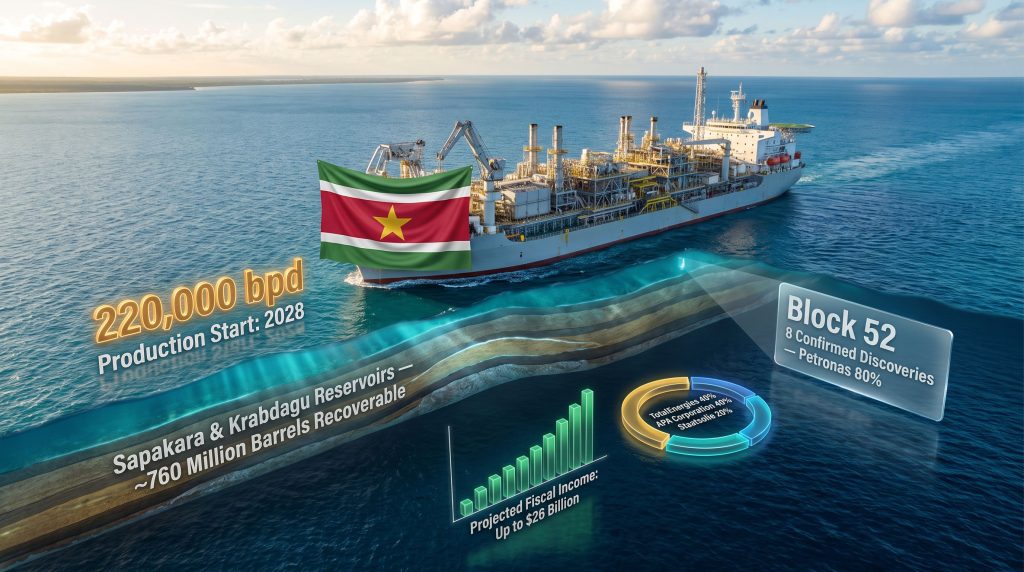
| GranMorgu estimated fiscal income | Up to $26 billion |
| Projected FPSO production capacity | 220,000 barrels per day |
| Estimated recoverable resources (Sapakara & Krabdagu) | ~760 million barrels |
| Planned production start date | 2028 |
| Staatsolie equity stake in GranMorgu | 20% |
| Staatsolie financing package | $1.6 billion loan + March 2025 bond issuance |
| Block 52 discoveries by Petronas (as of June 2026) | 8 confirmed discoveries |
| Petronas working interest in Block 52 | 80% |
One dimension that often escapes mainstream coverage is the satellite field connectivity strategy embedded into GranMorgu's engineering design. TotalEnergies has deliberately built the FPSO with the technical capability to connect to surrounding fields once the primary Sapakara and Krabdagu reservoirs begin to deplete. This is not a standard feature in deepwater FPSO design.
It reflects a long-duration asset philosophy that effectively extends the commercial life of the infrastructure well beyond the initial reservoir's productive years, compressing the cost per barrel over time and improving the project's economics across multiple commodity price cycles.
Suriname's offshore resource base, while smaller than Guyana's Stabroek Block in absolute terms, is structurally analogous. The same geological conditions that made Guyana a breakout producer are now replicating across the maritime boundary, drawing on the same continuous petroleum system.
From Exploration to Execution: How GranMorgu Reached Final Investment Decision
The Discovery Timeline That Changed Everything
The commercial story of Block 58 begins with the Maka Central-1 well, drilled in 2020. That single result transformed Suriname's offshore prospects from theoretical potential into confirmed commercial-scale hydrocarbons. Four additional discoveries followed, each reinforcing the basin's productivity. Yet the path from discovery to development approval was far from linear.
From 2022 onward, progress stalled. Drilling results in certain areas produced data that conflicted with seismic interpretations, and elevated gas-to-oil ratios in some zones created genuine uncertainty about whether the discovered hydrocarbons could be efficiently produced at commercial rates. This technical ambiguity triggered a period of reassessment that delayed momentum for several years and caused significant market scepticism about whether Suriname's offshore ambitions were commercially viable.
What is less commonly understood is that gas-to-oil ratio complications in deepwater carbonate-dominated systems are not uncommon during early appraisal phases. The seismic anomalies encountered in parts of Block 58 reflected the complexity of imaging through deepwater sediment columns where pressure gradients and fluid compositions vary considerably across relatively short distances. Resolving these uncertainties required additional appraisal wells and extended flow testing, both of which take time and capital before a final investment decision can be responsibly sanctioned.
Ownership Structure Before and After the Final Investment Decision
The equity restructuring at FID is a detail that carries significant implications for understanding Suriname's economic exposure to the project.
| Period | TotalEnergies | APA Corporation | Staatsolie |
|---|---|---|---|
| Pre-FID | 50% | 50% | 0% |
| Post-FID | 40% | 40% | 20% |
Staatsolie's entry was not a negotiated concession. It was a contractual right embedded within the Block 58 production-sharing contract from the outset, a standard provision in PSC structures for resource-holding nations that allows the state company to back into a working interest once commercial viability is confirmed. The financial mechanism used to fund this acquisition combined a $1.6 billion loan from a banking consortium with a bond issuance completed in March 2025, reflecting Staatsolie's willingness to carry significant debt in exchange for direct equity participation rather than relying solely on royalty and tax flows.
What the FPSO Design Reveals About Long-Term Strategy
The decision to commission an all-electric FPSO for GranMorgu is worth examining in depth. Electrification of offshore production facilities eliminates the need for gas-turbine-driven generators, which are typically the single largest source of direct emissions on an FPSO. By powering all onboard systems electrically, TotalEnergies has engineered a facility with a projected carbon intensity of fewer than 16 kilograms of CO₂ per barrel produced.
To contextualise that figure:
- GranMorgu (projected): under 16 kg CO₂/barrel
- Global upstream average: 17 to 18 kg CO₂/barrel
- Brazil pre-salt operations: approximately 10 to 12 kg CO₂/barrel
- Guyana's Stabroek operations: as low as 9 kg CO₂/barrel
GranMorgu does not match the best-in-class figures achieved in Guyana and Brazil's pre-salt, but it outperforms the global average. More importantly, the all-electric configuration positions the project against potential future carbon border adjustment mechanisms or ESG-linked financing restrictions that could impair access to capital or refinery markets if emissions intensity exceeds certain thresholds.
What Makes Suriname's Crude Commercially Attractive?
Crude Quality Profile: The Light, Sweet Advantage
Crude quality is often discussed in generalities, but the specific measurements from Suriname's Block 58 reservoirs reveal why the oil has attracted sustained commercial interest.
- Sapakara South-1 well: API gravity of 34 degrees
- Krabdagu flow test (2022): API gravity of 35 to 37 degrees
- Sulfur content: below 1% across tested intervals, with low levels of impurities and contaminants
In refinery economics, API gravity and sulfur content are the two variables that most directly determine processing complexity and yield value. Light crude, generally defined as above 31.1 degrees API, flows more easily through distillation columns and yields higher proportions of valuable light products including gasoline, jet fuel, and diesel without requiring complex secondary conversion units.
Sweet crude, defined as sulfur content below approximately 0.5% in some classifications and below 1% in others, avoids the hydrodesulfurisation processing costs that sour crudes require. Suriname's crude sits comfortably within the premium tier on both dimensions. Furthermore, the commercial parallel with Guyana is exact: Stabroek crude carries API gravity in the 32 to 36 degree range with similarly low sulfur content, and it has generated intense competition among Asian and European refiners seeking feedstock that aligns with increasingly strict clean fuel product specifications.
Suriname's offshore crude is classified as light and sweet, with API gravity ranging from 34 to 37 degrees and sulfur content below 1%. These characteristics make it less expensive to refine into high-grade, low-emission fuels, placing it in the same premium quality tier as Guyana's highly sought Stabroek crude.
Block 52 and the Golden Lane: Suriname's Second Act
Petronas and the Eight-Discovery Streak
While GranMorgu dominates the near-term narrative around the Suriname oil boom, Block 52 is quietly building what could become an equally significant development story. As of the end of June 2026, Petronas had confirmed eight discoveries within a geological zone being referred to as the Golden Lane, a corridor believed to be a direct southward extension of the petroleum-bearing fairway responsible for Guyana's Stabroek productivity. For a broader perspective on how Suriname compares to Guyana in terms of upstream development lessons, the structural parallels are compelling.
The history of Block 52 includes a significant corporate transition that reshaped its development trajectory. ExxonMobil had held a 50% stake in the block alongside Petronas, but divested its interest in November 2024 as part of a strategic reorientation of its South American portfolio toward its dominant position in Guyana's Stabroek Block. Petronas absorbed Exxon's 50% share, lifting its working interest to 80%. Staatsolie subsequently signed a production-sharing contract with Petronas and acquired the remaining 20%.
Key milestones in Block 52's development trajectory include:
- 2020: Sloanea-1 discovery establishes the commercial foundation of the block, made while ExxonMobil was still a partner.
- November 2024: ExxonMobil divests its 50% interest to Petronas.
- November 2025: Declaration of Commerciality for the Sloanea field, a legally significant milestone that triggers formal development planning obligations under the PSC.
- June 2026: Petronas announces its eighth discovery in Block 52, including results from the Caiman-1 wildcat, the SAC-1 wildcat, and the Roystonea-2 appraisal well.
- Target: Final investment decision before the end of 2026.
The Declaration of Commerciality is a technical-legal threshold that is often glossed over in mainstream reporting but deserves attention. Under most production-sharing contract frameworks, a DOC formally converts an exploration discovery into a development asset, triggering specific regulatory timelines, capital expenditure commitments, and government revenue entitlement calculations. Achieving DOC for Sloanea in November 2025 means Block 52's development clock is now running in earnest.
The next major ASX story will hit our subscribers first
Suriname vs. Guyana: How Do the Two Booms Compare?
| Dimension | Suriname | Guyana |
|---|---|---|
| Primary offshore block | Block 58 / Block 52 | Stabroek Block |
| Lead operator | TotalEnergies / Petronas | ExxonMobil |
| First major FID | GranMorgu (post-2022 delays) | Liza Phase 1 (2016) |
| Projected peak output (first project) | ~220,000 bpd | ~400,000+ bpd (Liza phases combined) |
| Crude quality | Light, sweet (~34 to 37 degrees API) | Light, sweet (~32 to 36 degrees API) |
| Carbon intensity | Less than 16 kg CO₂/barrel | ~9 kg CO₂/barrel |
| State company equity | Staatsolie 20% (GranMorgu) | GGMC approximately 15 to 25% (varies by block) |
| Production start | 2028 (planned) | 2019 (Liza Phase 1) |
Guyana's head start of nearly a decade creates a structural advantage in cumulative production volume and fiscal revenue that Suriname cannot replicate in the short term. However, the geological continuity argument cuts both ways. If the Guyana-Suriname Basin is treated as a single petroleum system, Suriname's undiscovered resource potential across its offshore acreage could be substantially larger than what current block-level estimates suggest. The eight discoveries in Block 52's Golden Lane alone imply that appraisal has only scratched the surface of what may exist in the deeper portions of the basin on the Surinamese side of the boundary.
What Does the Oil Boom Mean for Suriname's Economy?
The Fiscal Transformation Case
Suriname's economic context in 2026 is one of recovery from genuine crisis. Beginning in 2021, the country experienced a severe economic contraction driven by currency collapse, unsustainable debt levels, and the exhaustion of COVID-era fiscal buffers. The crisis was deep enough to produce civil unrest, culminating in the storming of parliament by protestors in 2023. Against that backdrop, the projected $26 billion in cumulative fiscal income from GranMorgu alone represents a structural transformation of the country's revenue base.
IMF projections have indicated the potential for real GDP to double by 2030 if offshore production proceeds on schedule. Staatsolie's 20% equity stake functions as a multiplier in this equation. Rather than receiving only royalty payments and corporate tax flows from the operators, Suriname participates directly in project cash flows from the moment production begins, amplifying government revenue beyond what a purely fiscal regime would deliver.
The Resource Curse Risk: Lessons From Regional Peers
Oil wealth has a complicated relationship with economic development across the Americas. Venezuela's energy crisis offers the most sobering example in the region: decades of petroleum-dependent fiscal policy, institutional deterioration, and capital misallocation produced one of the most severe economic collapses in modern Latin American history. Guyana, a more recent and potentially instructive comparison, has made early commitments to a sovereign wealth framework designed to insulate the broader economy from commodity volatility and prevent the kind of Dutch disease effects that have historically accompanied sudden resource wealth in small economies.
The institutional capacity question for Suriname is real and deserves scrutiny rather than assumption. Managing a sudden and sustained capital inflow of the scale GranMorgu implies requires:
- Independent and well-resourced regulatory institutions
- Transparent revenue management frameworks with parliamentary oversight
- Counter-cyclical fiscal rules that prevent overcommitting expenditure against commodity price assumptions
- Investment in economic diversification concurrent with, not subsequent to, the oil production ramp
Whether Suriname's governance architecture can absorb and responsibly deploy the incoming petroleum revenues is arguably the single most important variable in determining whether the Suriname oil boom translates into lasting improvements in living standards. Indeed, how Suriname and Guyana plan to share oil wealth with their citizens remains one of the most closely watched policy questions in the region.
What Are the Risks That Could Derail the Suriname Oil Boom?
Execution and Timeline Risk
Deepwater project execution is among the most technically demanding disciplines in the energy industry. The GranMorgu project has already experienced a multi-year delay between initial discovery and FID, driven by the technical complications encountered during appraisal drilling. While those issues have been resolved to the satisfaction of two major international operators, the path from FID to first oil in 2028 involves fabrication of an all-electric FPSO, subsea infrastructure installation in challenging deepwater conditions, and integration of monitoring and optimisation systems with no direct precedent in the basin.
Globally, deepwater projects have a documented history of cost overruns and schedule extensions. The offshore contractor market is currently operating under pressure from a globally active project pipeline, which creates the possibility of equipment delivery delays and skilled labour competition affecting schedules.
Oil Price Sensitivity
GranMorgu's economics are robust across a range of price scenarios given the premium quality of the crude it will produce. However, the $1.6 billion debt Staatsolie has taken on to fund its 20% equity stake introduces a sensitivity to sustained low oil prices that a royalty-only exposure would not create. Furthermore, the oil market disruption risk from geopolitical events and trade tensions adds an additional layer of price volatility that Staatsolie's balance sheet must be able to absorb. Debt service obligations continue regardless of production revenue, meaning a prolonged period of prices below the project's breakeven threshold would place pressure on government finances.
Environmental and Climate Considerations
The all-electric FPSO design provides a meaningful buffer against near-term emissions-related market access restrictions. Sub-16 kg CO₂ per barrel positions GranMorgu below the global upstream average and within a range that most current ESG screening frameworks would consider acceptable for institutional investment. However, climate regulatory frameworks are evolving. The European Union's Carbon Border Adjustment Mechanism and similar instruments being considered in other jurisdictions could, over time, affect the pricing premium available for higher-carbon crude grades. GranMorgu's engineering decisions suggest TotalEnergies is aware of this trajectory.
Frequently Asked Questions: Suriname Oil Boom
When will Suriname start producing oil from the GranMorgu project?
GranMorgu is currently scheduled to begin production in 2028, subject to project execution milestones being met on schedule.
How much oil will Suriname produce at peak capacity?
The GranMorgu FPSO is designed with a production capacity of 220,000 barrels per day, targeting the Sapakara and Krabdagu reservoir systems, which hold an estimated 760 million barrels of recoverable resources.
Who are the main companies involved in Suriname's offshore oil development?
TotalEnergies operates Block 58 with a 40% working interest, APA Corporation holds 40%, and Staatsolie holds the remaining 20%. In Block 52, Petronas holds an 80% operating interest with Staatsolie holding 20%.
How does Suriname's oil compare in quality to other global crude benchmarks?
Suriname's offshore crude is light and sweet, with API gravity between 34 and 37 degrees and sulfur content below 1%. This places it in a premium quality tier comparable to Guyana's Stabroek crude and above many Middle Eastern medium-sour grades that require more intensive and costly refinery processing.
What is the Golden Lane in Block 52?
The Golden Lane is a geological corridor within Block 52 where Petronas has identified a cluster of eight hydrocarbon discoveries as of June 2026. It is understood to be a continuation of the same petroleum-bearing fairway that underpins Guyana's highly productive Stabroek Block, extending that system across the international maritime boundary into Surinamese waters.
How will Suriname's government benefit financially from the oil boom?
Through Staatsolie's 20% equity stake in GranMorgu, combined with royalties, taxes, and production-sharing revenues, the government is projected to receive up to $26 billion in cumulative fiscal income over the project's life, a figure that would fundamentally alter the country's economic profile.
The Broader Investment Thesis: Is Suriname the Next Frontier Petroleum Story?
Structural Indicators Supporting Long-Term Confidence
Several factors combine to create a credible long-duration case for Suriname's offshore sector. In addition, OPEC market influence on global supply dynamics continues to make non-OPEC frontier producers like Suriname increasingly attractive to refiners and sovereign buyers seeking greater supply chain independence.
- Geological continuity: The Guyana-Suriname Basin is a demonstrated petroleum system, not a speculative frontier. Proven productivity across the maritime boundary provides a geological foundation that few emerging basins can match.
- Diversified operator base: TotalEnergies, APA Corporation, and Petronas bring distinct technical capabilities, risk tolerances, and geographic relationships. This diversification reduces single-operator dependency risk and provides multiple pathways for capital raising, contractor engagement, and offtake arrangements.
- Layered development pipeline: Block 52's anticipated FID before the end of 2026 would create a second major development project overlapping with GranMorgu's production ramp, extending Suriname's growth trajectory well into the 2030s.
- Premium crude characteristics: Light, sweet crude with API gravity between 34 and 37 degrees and low sulfur content aligns with the direction of global refiner demand as clean fuel mandates tighten across major consuming markets.
Structural Risks That Temper the Narrative
- Sovereign capacity constraints: A small economy absorbing a transformative capital inflow faces institutional risks that larger petrostate economies manage through scale and experience.
- Debt-financed state equity: Staatsolie's loan-funded equity position creates price sensitivity that a pure fiscal exposure would not generate, introducing a leverage dynamic into Suriname's government balance sheet.
- Commodity cycle dependency: A development timeline stretching to 2028 and beyond means the fiscal projections are sensitive to oil price assumptions over a multi-year horizon that remains inherently uncertain.
- Deepwater execution risk: Technically complex projects in frontier basins carry inherent schedule and cost variance that no amount of pre-FID engineering can fully eliminate.
Monitoring the current crude prices over the coming years will be essential for assessing whether GranMorgu's fiscal projections remain realistic as the 2028 production start approaches.
The Suriname oil boom represents one of the most structurally grounded frontier petroleum stories in the Atlantic Basin since Guyana's Stabroek discoveries fundamentally reshaped South American energy dynamics. The combination of proven geology, committed major operator capital, and premium crude quality creates a compelling development thesis. Realising that thesis at scale depends on execution discipline through 2028, fiscal governance capable of managing a transformative revenue inflow, and commodity prices that sustain project economics across a multi-year ramp period. All three variables remain subject to meaningful uncertainty.
This article is intended for informational purposes only and does not constitute financial or investment advice. Forward-looking statements regarding production timelines, fiscal projections, and commodity prices involve inherent uncertainty. Readers should conduct independent due diligence before making any investment decisions related to companies or projects referenced herein.
Want to Spot the Next Major Resource Discovery Before the Broader Market Does?
Discovery Alert's proprietary Discovery IQ model delivers real-time alerts on significant ASX mineral discoveries — turning complex resource data into actionable investment insights for both short-term traders and long-term investors. Explore Discovery Alert's dedicated discoveries page to understand how historic finds have generated substantial returns, and begin your 14-day free trial today to position yourself ahead of the market.