
May 15, 2026
Understanding ONGC's Market Position and Strategic Impact
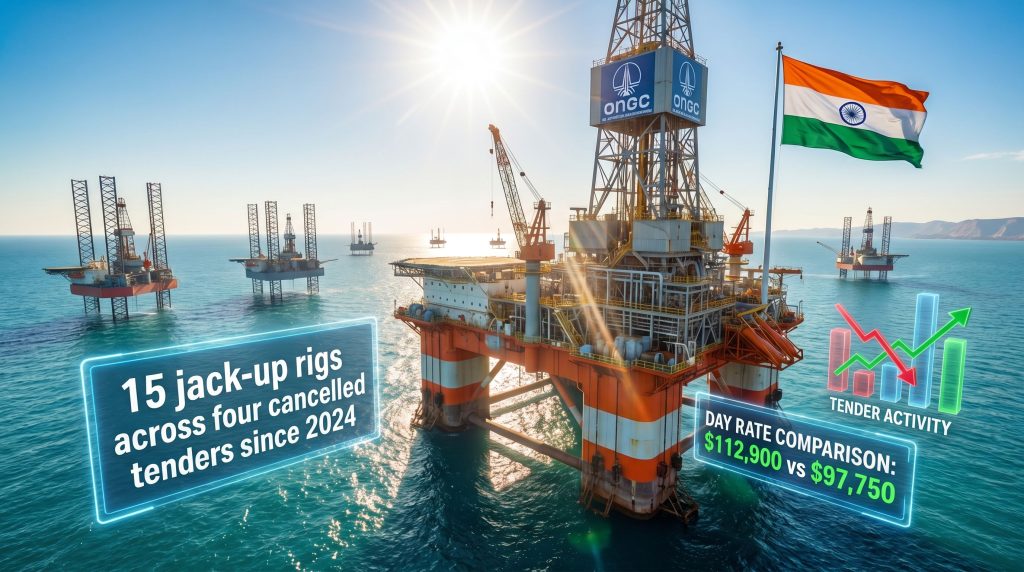
India's offshore drilling landscape centers around Oil and Natural Gas Corporation (ONGC), which functions simultaneously as the country's largest oil and gas producer and its primary rig contractor. This dual role creates unique market dynamics where procurement decisions directly influence national energy output capacity. Since 2024, ONGC rig tender cancellations have encompassed four separate tenders covering 15 jack-up rigs designated for shallow-water drilling operations, establishing a pattern of procurement instability that reverberates throughout the regional drilling ecosystem.
The magnitude of these cancellations becomes apparent when considering the operational scope involved. Three tenders were terminated after price bid opening, while one was cancelled before submission, with the most recent cancellation occurring in March 2026. This systematic approach to tender abandonment suggests strategic cost management rather than isolated procurement errors, indicating ONGC's willingness to sacrifice equipment availability for pricing leverage.
Jack-up rigs represent critical infrastructure for India's offshore production strategy, operating in shallow waters where much of the country's accessible reserves are located. These specialised vessels feature retractable legs that elevate the drilling platform above water level, enabling stable operations in depths typically ranging from 20 to 400 feet. The concentration of cancellations around this equipment category directly threatens India's ability to maintain consistent offshore production levels.
When big ASX news breaks, our subscribers know first
Market Disruption Through Contractor Exodus
The most immediate consequence of ONGC's procurement volatility manifests through international contractor withdrawal decisions. ADES-Shelf Drilling, recognised as the world's largest jack-up rig operator, currently maintains approximately 12 rigs in Indian waters but has initiated evaluation processes for withdrawing up to 5 rigs from the market. This potential 42% reduction in ADES-Shelf Drilling's Indian presence represents more than asset reallocation; it signals fundamental confidence erosion in India's offshore drilling market stability.
Industry executives emphasise that contractor concerns extend beyond pricing disputes to encompass operational predictability. When tenders face repeated cancellations, drilling rigs remain idle while accumulating maintenance costs, insurance premiums, and crew expenses without generating revenue. This idle capacity creates cascading financial pressures that force contractors to evaluate alternative market opportunities where contract visibility provides greater operational certainty.
The deterioration mechanics of unused offshore drilling equipment compound these challenges. Jack-up rigs require continuous maintenance protocols even during idle periods, including regular equipment cycling, corrosion prevention, and regulatory compliance inspections. Extended idle periods accelerate both functional deterioration and market value depreciation, creating additional financial liabilities for contractors already facing revenue uncertainty from ONGC rig tender cancellations.
Global Rate Convergence and Pricing Tensions
India's offshore drilling market has historically operated with significant pricing disparities compared to global benchmarks, but recent data indicates rapid convergence toward international rate levels. According to upstream oil market analysis, the gap between Indian and global day rates has narrowed dramatically within a five-month period, creating new tensions in ONGC's cost-optimisation strategy.
| Rate Category | Q4 2025 | April 2026 | Rate Gap Change |
|---|---|---|---|
| Global JU 300-IC Average | $74,326/day | $112,900/day | +52% increase |
| Indian JU 300-IC Average | $35,565/day | $97,750/day | +175% increase |
| India-Global Differential | -52% below global | -13% below global | 39-point convergence |
This convergence trajectory reveals the underlying tension in ONGC's procurement approach. While the company's March 2026 cancelled tender indicated willingness to pay $55,000 per day, current market rates have escalated to $97,750 daily, representing only a 13% discount to the global average of $112,900. Furthermore, the rapid pace of rate convergence suggests that India's historical cost advantages may be eroding faster than ONGC's procurement strategy can accommodate, particularly when considering the broader US oil production decline affecting global supply dynamics.
What Are the Structural Factors Supporting Indian Rate Disparities?
The historical pricing gap between Indian and global offshore drilling markets stems from several structural advantages that regional contractors maintain over international operators. These factors have contributed to the current ONGC rig tender cancellations crisis as market dynamics shift.
Regional Contractor Cost Advantages:
- Lower labour costs through domestic crew utilisation
- Reduced logistics expenses via established local supply chains
- Streamlined regulatory compliance through familiarity with Indian requirements
- Minimised mobilisation costs from pre-positioned equipment and personnel
Extended Contract Duration Model:
- Three-year standard contracts in India versus one-year global average
- Risk mitigation through longer revenue visibility periods
- Operational setup cost amortisation across extended timeframes
- Reduced vacancy risk between contract cycles
Market Structure Concentration:
- Dominance by regional contractors with minimal international competition
- Limited participation from international firms creates pricing insulation
- Established relationships between domestic operators and Indian regulatory bodies
- Geographic specialisation reduces competitive pressure from global players
These structural elements have historically enabled Indian contractors to offer competitive pricing while maintaining acceptable profit margins. However, the rapid convergence toward global rates suggests that these advantages may be diminishing as international cost pressures and equipment scarcity affect regional markets, similar to broader OPEC production impact trends affecting global energy markets.
ADES-Shelf Drilling's Portfolio Reallocation Strategy
The response from ADES-Shelf Drilling illustrates how international contractors are adapting to India's procurement uncertainty through strategic asset reallocation. As the world's largest jack-up rig operator, the company's decisions carry industry-wide implications that extend beyond individual contract disputes to broader market confidence levels.
Current Indian Operations Analysis:
- 12 jack-up rigs currently deployed in Indian waters
- 5 rigs under consideration for withdrawal
- 7 rigs would remain post-withdrawal (58% of current capacity)
- Operational losses during extended idle periods driving reallocation decisions
The company's strategic evaluation process prioritises contract visibility over absolute day-rate levels, recognising that unpredictable procurement cycles impose higher operational costs than pricing pressure alone. This perspective shift reflects broader industry recognition that emerging market opportunities must provide operational certainty to justify international capital deployment.
Alternative Market Redeployment Options
International drilling contractors like ADES-Shelf Drilling maintain global fleet portfolios that enable strategic reallocation when specific markets become economically unviable. The company's established presence in Middle Eastern markets provides immediate alternatives for withdrawn Indian capacity, whilst Southeast Asian markets offer additional deployment opportunities with more stable procurement environments.
Redeployment Advantages:
- Middle East operations: Established infrastructure and client relationships
- Southeast Asia: Growing offshore development activity with consistent tender processes
- North Sea markets: Mature regulatory frameworks with predictable contract cycles
- Operational efficiency: Reduced idle time through active market participation
The ability to reallocate assets across multiple geographic markets provides international contractors with leverage that regional Indian operators lack. This flexibility enables companies to withdraw from unstable markets without compromising overall fleet utilisation, creating pressure on national oil companies to maintain competitive procurement processes. In addition, global market volatility from factors such as oil price rally analysis influences these strategic decisions.
The next major ASX story will hit our subscribers first
Production Targets Versus Procurement Execution
India's offshore energy development strategy faces internal contradictions between ambitious production targets and procurement execution capabilities. BP Plc's advisory role for ONGC's west coast production enhancement initiatives highlights the disconnect between strategic planning and equipment acquisition processes.
The engagement of international consultants for production optimisation whilst simultaneously implementing ONGC rig tender cancellations creates operational paradoxes that undermine strategic implementation. This approach suggests coordination gaps between long-term energy planning and short-term cost management priorities within India's state-owned enterprise structure.
Policy Framework Gaps
India's offshore drilling sector operates within regulatory frameworks that may inadvertently contribute to procurement instability through several mechanisms:
- Cost optimisation mandates for state-owned enterprises that prioritise short-term savings over operational continuity
- Limited standardisation in tender processes and pricing mechanisms across different procurement cycles
- Regulatory complexity that favours regional contractors whilst creating barriers for international participation
- Contract enforcement mechanisms that provide insufficient protection for suppliers against repeated tender cancellations
These framework elements combine to create an environment where procurement decisions can be reversed without significant consequences for the contracting entity, whilst suppliers bear the full cost of preparation efforts and opportunity losses from cancelled tenders. Moreover, global trade war oil impact factors add additional complexity to procurement planning.
Supply Chain Disruption Modelling
The cumulative impact of ONGC rig tender cancellations creates multiple potential disruption scenarios that could reshape India's offshore drilling landscape over the next 18-24 months. Each scenario carries distinct implications for production capacity, market structure, and international contractor participation.
Scenario 1: Accelerated International Withdrawal
- 20% reduction in available international rig capacity by Q2 2026
- Increased dependence on regional contractors with limited fleet expansion capabilities
- Potential production bottlenecks during peak drilling seasons
- Price pressure intensification as available capacity contracts
Scenario 2: Market Consolidation
- Regional contractor consolidation to capture market share from withdrawing international operators
- Technology transfer limitations reducing operational efficiency improvements
- Enhanced pricing power for remaining domestic suppliers
- Reduced competitive pressure enabling margin expansion for regional players
Scenario 3: Pricing Convergence
- 18-month timeline for Indian rates to reach global parity
- ONGC procurement strategy adjustment to accommodate higher equipment costs
- Stabilisation of contractor participation through improved pricing predictability
- Market maturation toward international standards and practices
Long-Term Competitiveness Implications
India's offshore drilling market disruption carries implications that extend beyond immediate procurement challenges to affect long-term sector competitiveness. The withdrawal of international contractors may limit access to advanced drilling technologies, operational best practices, and global industry standards that contribute to efficiency improvements.
Technology Access Considerations:
- Reduced innovation transfer from international operators with advanced equipment
- Limited exposure to global operational efficiency standards
- Capability gaps in complex drilling operations requiring specialised expertise
- Equipment modernisation delays affecting overall sector productivity
The concentration of drilling capacity among regional contractors may create short-term cost advantages whilst potentially limiting long-term technological advancement and operational sophistication compared to markets with robust international participation. Furthermore, broader market uncertainties related to oil price stagnation factors compound these challenges.
Capital Allocation Efficiency Analysis
ONGC's procurement approach raises broader questions about capital allocation efficiency in India's offshore energy development programmes. The repeated ONGC rig tender cancellations suggest potential misalignment between project planning, budget allocation, and execution timelines that affects overall investment productivity.
Investment Impact Assessment:
- Preparation costs for cancelled tenders create dead-weight losses for suppliers
- Opportunity costs from delayed equipment deployment affect production timing
- Risk premiums increase for future Indian market participation
- Capital efficiency deterioration through procurement process inefficiencies
These inefficiencies compound to create higher overall development costs for India's offshore projects, even when individual contract prices appear competitive compared to global benchmarks.
Alternative Procurement Models
The current procurement challenges suggest opportunities for implementing alternative models that could stabilise market dynamics whilst maintaining cost competitiveness. Framework agreements with pre-qualified suppliers could reduce tender preparation costs whilst providing greater contract visibility for operators.
Potential Improvements:
- Multi-year framework contracts with flexible activation mechanisms
- Standardised pricing methodologies tied to transparent market benchmarks
- Performance-based contracting linking payments to operational efficiency metrics
- Risk-sharing mechanisms that distribute market volatility between contractors and operators
These approaches could restore contractor confidence whilst maintaining ONGC's cost optimisation objectives through improved procurement process efficiency rather than solely through price pressure. Consequently, implementing such measures could provide a sustainable solution to the ongoing challenges.
Contractor Risk Assessment Evolution
The India offshore drilling market has shifted from a growth opportunity to a risk management challenge for international contractors. This psychological transformation affects not only current participants but also potential new entrants evaluating Indian market opportunities.
Risk Perception Changes:
- Contract certainty now prioritised over absolute pricing levels
- Regulatory predictability becomes essential for investment decisions
- Market entry barriers increase through reputational risk concerns
- Exit flexibility requirements affect fleet positioning strategies
Understanding this psychological shift enables stakeholders to develop more effective engagement strategies that address contractor concerns beyond purely financial considerations.
Strategic Recommendations for Market Participants
For International Drilling Companies:
- Implement flexible deployment strategies enabling rapid asset reallocation
- Develop regional partnership models reducing direct exposure to procurement volatility
- Focus on niche market segments with higher barriers to substitution
- Maintain limited capacity commitments until market stability improves
For Policy Makers:
- Establish procurement process standardisation reducing cancellation frequency
- Implement supplier protection mechanisms compensating preparation costs for cancelled tenders
- Develop market stability incentives encouraging long-term contractor participation
- Create regulatory frameworks supporting competitive international participation
For Regional Contractors:
- Invest in capacity expansion to capture market share from withdrawing international operators
- Develop technology partnerships maintaining access to advanced drilling capabilities
- Implement operational efficiency improvements supporting competitive pricing sustainability
- Build financial reserves enabling opportunistic fleet expansion during market consolidation
The resolution of India's offshore drilling procurement challenges requires coordinated efforts addressing both immediate market stability concerns and long-term sector competitiveness objectives. Success depends on balancing cost optimisation with market sustainability to ensure adequate drilling capacity for India's energy security requirements, particularly given ongoing global uncertainties outlined in Economic Times industry analysis.
This analysis is based on publicly available information and industry reports. Investment decisions should consider additional factors including regulatory changes, market developments, and company-specific circumstances. The offshore drilling sector involves significant operational and financial risks that may affect investment outcomes.
Looking to Capitalise on India's Offshore Energy Market Disruption?
Discovery Alert's proprietary Discovery IQ model delivers real-time alerts on significant ASX mineral and energy discoveries, helping subscribers identify actionable opportunities ahead of the broader market. Explore Discovery Alert's dedicated discoveries page to understand how major resource discoveries can generate substantial returns, then begin your 14-day free trial to position yourself ahead of market movements.