June 17, 2026
OPEC+ agrees to keep oil output unchanged decisions represent critical inflection points in global energy markets, where sophisticated production coordination mechanisms balance market stability against geopolitical uncertainty. The March 2026 framework demonstrates how regulatory structures adapt to volatile international environments while maintaining operational flexibility across major hydrocarbon-producing regions.
Understanding OPEC+ Production Frameworks and Regulatory Mechanisms
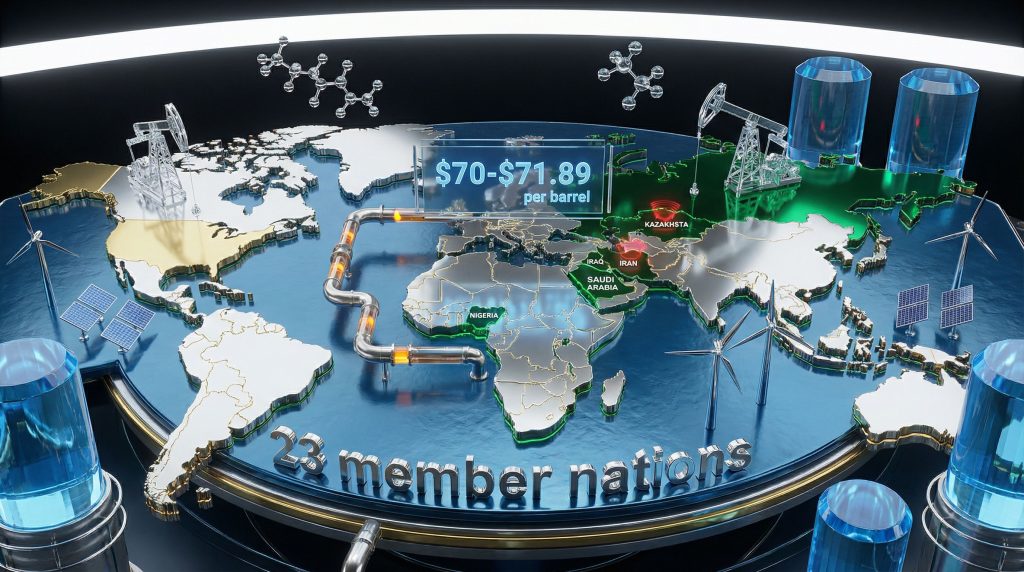
The Organization of the Petroleum Exporting Countries Plus (OPEC+) represents one of the most significant energy coordination mechanisms in global markets, encompassing 23 member nations that collectively influence approximately half of worldwide oil production. This extended alliance operates through sophisticated quota allocation systems and monitoring protocols designed to balance market stability with member nation economic objectives.
Furthermore, these production frameworks intersect with broader energy transition policies affecting global investment patterns. Recent Saudi exploration licenses demonstrate how member nations balance quota compliance with capacity expansion requirements.
Production Quota Architecture and Compliance Systems
OPEC+ agrees to keep oil output unchanged through a dual-tier institutional structure where policy decisions emanate from core producer meetings while oversight responsibilities fall under specialised monitoring committees. The Joint Ministerial Monitoring Committee (JMMC) serves as the primary compliance oversight body, though it operates without direct decision-making authority on production policy matters.
The organisation's quota methodology centres on proportional allocation systems that account for individual member production capacity, historical output levels, and regional market dynamics. Current frameworks demonstrate this through the eight-country production coordination mechanism involving Saudi Arabia, Russia, the United Arab Emirates, Kazakhstan, Kuwait, Iraq, Algeria, and Oman, which collectively managed approximately 2.9 million barrels per day in coordinated adjustments during 2025.
Integration with Global Energy Governance Structures
OPEC+ decisions intersect with broader international energy regulatory frameworks through multiple channels. Climate policy integration increasingly influences production planning timelines, particularly as carbon pricing mechanisms and renewable energy transition mandates create long-term demand uncertainty. In addition, member nations face growing energy transition challenges that require balancing environmental commitments with production objectives.
Strategic Petroleum Reserve coordination represents another critical governance intersection. When OPEC+ agrees to keep oil output unchanged, as occurred in March 2026, these decisions directly influence how consuming nations manage their emergency reserve policies and inventory management protocols.
| Institutional Framework Element | Function | Authority Level |
|---|---|---|
| Eight-Country Producer Group | Production policy decisions | Primary decision-making |
| Joint Ministerial Monitoring Committee | Compliance oversight | Monitoring and advisory |
| Individual Member Quotas | Output allocation | Binding agreements |
| Seasonal Adjustment Protocols | Demand-based modifications | Flexible implementation |
When big ASX news breaks, our subscribers know first
Current Production Policy Analysis: March 2026 Framework
The March 2026 OPEC+ production framework reflects sophisticated risk management approaches that prioritise market stability over aggressive output expansion. Current policy structures demonstrate how regulatory mechanisms adapt to volatile geopolitical environments while maintaining operational flexibility.
Price Corridor Maintenance and Market Signals
Brent crude performance during early 2026 illustrates the effectiveness of coordinated production policies. Oil prices achieved a six-month high of $71.89 per barrel on January 30, 2026, before settling near $70 per barrel by February 1, representing what industry analysts characterise as a sustainable price corridor despite underlying oversupply projections.
These price levels occurred against market expectations of supply gluts pushing prices downward, suggesting that OPEC+ production coordination successfully counteracted bearish fundamentals through strategic output management. However, global production dynamics remain influenced by US oil production decline trends that affect overall market balance calculations.
Forward Guidance Absence as Policy Tool
The March 2026 decision framework notably excluded forward guidance beyond the immediate monthly commitment, representing a departure from traditional OPEC+ communication patterns. Reuters reports that this strategic ambiguity serves multiple regulatory functions:
• Geopolitical Risk Buffer: Maintaining optionality during U.S.-Iran tension escalation
• Demand Uncertainty Management: Avoiding commitments during seasonal consumption variability
• Market Psychology Control: Preventing speculative positioning based on predetermined schedules
• Policy Flexibility Preservation: Enabling rapid response to supply disruption scenarios
Jorge Leon, head of geopolitical analysis at Rystad Energy and former OPEC official, emphasised that this approach reflects rising uncertainty around Iran and U.S. tensions, with the group maintaining all strategic options available for immediate deployment.
Seasonal Demand Integration Protocols
OPEC+ agrees to keep oil output unchanged through explicit incorporation of quarterly consumption patterns via established seasonal adjustment mechanisms. The November 2025 decision to freeze planned increases for January through March 2026 specifically cited seasonally weaker consumption as the primary rationale, demonstrating systematic integration of demand cyclicality into regulatory frameworks.
This seasonal approach contrasts with rigid annual planning models, allowing for responsive adjustment to consumer market dynamics while maintaining overall production discipline across member nations.
Geopolitical Risk Assessment and Energy Security Frameworks
Contemporary energy governance operates within increasingly complex geopolitical landscapes where diplomatic tensions, sanctions regimes, and military considerations directly influence production policy formulation. The March 2026 OPEC+ framework exemplifies how energy regulators integrate political risk assessment into market stabilisation strategies.
U.S.-Iran Diplomatic Dynamics and Market Impact
The escalation of U.S.-Iran tensions during early 2026 created significant market volatility that required immediate regulatory response. President Donald Trump's administration considered targeted military strikes against Iranian security forces and leadership structures, aiming to inspire domestic protests while maintaining diplomatic channels for potential negotiation.
Washington's extensive sanctions regime on Tehran specifically targets oil revenue streams as crucial state funding sources, creating artificial supply constraints that OPEC+ must account for in production calculations. Consequently, these sanctions effectively reduce Iranian export capacity, requiring other member nations to evaluate whether compensatory production increases serve market stability objectives.
Supply Disruption Management Protocols
Kazakhstan's energy sector disruptions during late 2025 and early 2026 demonstrate how OPEC+ frameworks address member nation infrastructure challenges. The Tengiz oilfield restart procedures, implemented in staged phases, required coordination with broader production planning to prevent market oversupply during recovery periods.
Furthermore, policy developments such as the Venezuela policy shift create additional complexity for OPEC+ coordination mechanisms.
Critical Supply Chain Vulnerabilities: Infrastructure disruptions in major producing regions create cascading effects across global energy markets, requiring adaptive production policies that balance immediate supply gaps with longer-term market stability objectives.
Bilateral Engagement Signals and Market Psychology
Both the United States and Iran signalled willingness for diplomatic engagement during the height of military option considerations, though Iran's position excluded defence capabilities from potential negotiation frameworks. These diplomatic communications create market uncertainty that OPEC+ must navigate through flexible production policies rather than rigid commitment structures.
The absence of forward guidance in March 2026 directly reflects this diplomatic volatility, with production regulators preferring monthly decision cycles over quarterly or semi-annual commitments that might constrain response capabilities during rapidly evolving geopolitical scenarios.
Regulatory Compliance and Market Oversight Mechanisms
OPEC+ operational effectiveness depends on sophisticated compliance monitoring systems that balance member nation sovereignty with collective market objectives. The organisational structure separates decision-making authority from oversight functions to maintain policy coherence while enabling enforcement mechanisms.
Institutional Separation of Powers
The Joint Ministerial Monitoring Committee operates as an independent oversight body without production policy decision-making authority, creating institutional checks and balances within the OPEC+ framework. This separation enables objective compliance assessment while maintaining political decision-making within the core producer group structure.
The JMMC's emphasis on achieving full compliance with output agreements, as stated in February 2026, demonstrates ongoing regulatory prioritisation of member adherence to agreed quotas despite broader geopolitical uncertainties affecting forward planning.
Quarterly Monitoring and Assessment Cycles
OPEC+ compliance monitoring operates on established quarterly cycles with specific meeting schedules that provide predictable oversight intervals. The April 5, 2026 JMMC meeting represents the next formal compliance assessment following the March production freeze decision, enabling systematic evaluation of member performance against agreed targets.
Compliance Communication Protocols
Formal compliance communications through official OPEC statements serve both internal coordination and external market signalling functions. The February 2026 statement emphasising compliance importance indicates that internal adherence challenges may require enhanced monitoring attention despite public commitments to quota maintenance.
Investment and Infrastructure Policy Implications
OPEC+ production policies create significant implications for capital expenditure planning, technology deployment, and infrastructure development across member nations. The coordination of investment decisions with production quotas requires sophisticated financial planning that balances immediate market objectives with long-term capacity requirements.
Capital Expenditure Coordination Challenges
Member nations must align their upstream investment strategies with OPEC+ production frameworks to avoid creating excess capacity during periods of coordinated output restraint. The 2.9 million barrels per day production increase capacity from April through December 2025 represents approximately 3% of global demand, requiring substantial infrastructure investment that must be coordinated with quota policies.
Various oil price rally factors influence investment timing decisions across member nations, creating complex interactions between market signals and production capacity development.
Technology Integration and Environmental Standards
Contemporary OPEC+ operations increasingly incorporate environmental compliance requirements and carbon footprint reduction technologies. Member nations face growing pressure to demonstrate sustainable production practices while maintaining competitive cost structures and meeting quota obligations.
The integration of methane emission reduction technologies, carbon capture systems, and renewable energy components in oil production facilities requires coordination with OPEC+ planning cycles to ensure investment efficiency and operational compatibility across different production environments.
Risk Assessment and Policy Scenario Analysis
OPEC+ strategic planning operates through multiple scenario frameworks that account for geopolitical developments, demand variations, and technological disruptions. Current policy structures demonstrate sophisticated risk assessment capabilities that enable adaptive responses to various market conditions.
Scenario Planning Frameworks
High-Tension Escalation Scenario: Military confrontation between the U.S. and Iran could remove significant Iranian production capacity from global markets, requiring immediate compensatory increases from other OPEC+ members to prevent supply shortages and price spikes.
Diplomatic Resolution Scenario: Successful U.S.-Iran negotiations could restore Iranian oil exports to full capacity, necessitating production quota reallocation across OPEC+ members to maintain market balance and price stability.
Accelerated Energy Transition Scenario: Rapid deployment of renewable energy technologies and electric vehicle adoption could reduce long-term oil demand growth, requiring OPEC+ to develop frameworks for managed production decline while maintaining member nation revenue stability.
Economic Recession Scenario: Global economic downturn could reduce energy consumption significantly, requiring coordinated production cuts beyond current freeze mechanisms to support price floors and member nation fiscal stability.
Regulatory Risk Assessment Matrix
Contemporary OPEC+ operations face multiple regulatory challenges that require ongoing policy adaptation:
• Antitrust Scrutiny: Increasing legal challenges to coordinated production policies from consuming nation governments
• Climate Litigation: Legal pressures related to carbon emissions and environmental impact assessments
• Sanctions Compliance: Navigation of complex international sanctions regimes affecting member nation participation
• Trade Policy Integration: Coordination with broader international trade agreements and dispute resolution mechanisms
The next major ASX story will hit our subscribers first
Future Policy Development and Strategic Planning
OPEC+ policy evolution requires anticipating long-term energy market transformations while maintaining short-term market stability. According to Economic Times analysis, the organisation faces fundamental challenges in adapting production coordination mechanisms to rapidly changing energy landscapes driven by climate policies, technological innovation, and geopolitical realignments.
Adaptation to Energy Transition Timelines
International climate commitments and renewable energy deployment schedules create predictable long-term demand pressures that OPEC+ must incorporate into strategic planning. The organisation requires flexible frameworks that can manage both peak oil demand scenarios and gradual decline phases while maintaining member nation economic stability.
Carbon border adjustment mechanisms implemented by major consuming regions will increasingly influence OPEC+ production decisions as environmental compliance costs affect competitive positioning among different oil sources.
Technology Integration Requirements
Digital technologies, artificial intelligence, and advanced monitoring systems enable more sophisticated production coordination and compliance verification. Future OPEC+ frameworks will likely incorporate real-time production monitoring, automated quota adjustments, and predictive demand modelling to enhance policy effectiveness.
Market Stabilisation Tool Evolution
Traditional production quota systems may require supplementation with financial instruments, strategic reserve coordination, and technology sharing agreements to maintain market influence as global energy systems diversify. The development of hybrid coordination mechanisms combining physical production management with financial market tools represents a potential evolution pathway.
Frequently Asked Questions: OPEC+ Policy and Regulatory Framework
How binding are OPEC+ production agreements under international law?
OPEC+ agreements operate as voluntary coordination mechanisms rather than legally binding treaties, relying on economic incentives and diplomatic pressure for compliance rather than formal legal enforcement structures.
What regulatory oversight exists for OPEC+ market influence?
Multiple jurisdictions monitor OPEC+ activities through antitrust frameworks, though enforcement varies significantly between regions and political contexts, with limited international coordination on oversight mechanisms.
How do climate policies affect OPEC+ long-term planning?
Climate regulations increasingly influence production timelines, investment decisions, and transition planning, requiring adaptive policy frameworks that balance environmental pressures with member nation economic objectives.
What happens if major producers violate production agreements?
Violations trigger diplomatic consultations, potential compensation requirements, and possible quota adjustments, though enforcement mechanisms remain limited and primarily depend on peer pressure and economic incentives.
How does OPEC+ coordinate with consumer nation energy policies?
Coordination occurs through informal diplomatic channels, industry consultations, and international energy forum participation, though no formal institutional mechanisms exist for producer-consumer policy alignment.
Disclaimer: This analysis is based on publicly available information and should not be considered investment advice. Energy markets involve significant risks and volatility. Policy developments and geopolitical events can rapidly change market conditions and regulatory frameworks.
Are You Missing Critical Market Movements in Energy Exploration Stocks?
Discovery Alert's proprietary Discovery IQ model delivers real-time alerts on significant ASX mineral discoveries, instantly empowering subscribers to identify actionable opportunities ahead of the broader market. Understand why major mineral discoveries can lead to significant market returns by exploring Discovery Alert's discoveries page, showcasing historic examples of exceptional outcomes, and begin your 14-day free trial today to position yourself ahead of the market.