July 16, 2026
The Invisible Architecture Behind Oil Demand Forecasts
Most casual observers treat a commodity demand forecast revision as a dry statistical exercise. In reality, when the world's most influential producer group trims its own consumption outlook, it functions more like a seismic reading than a spreadsheet update. The number itself is secondary. What matters is what the revision reveals about the structural conditions underneath global energy markets.
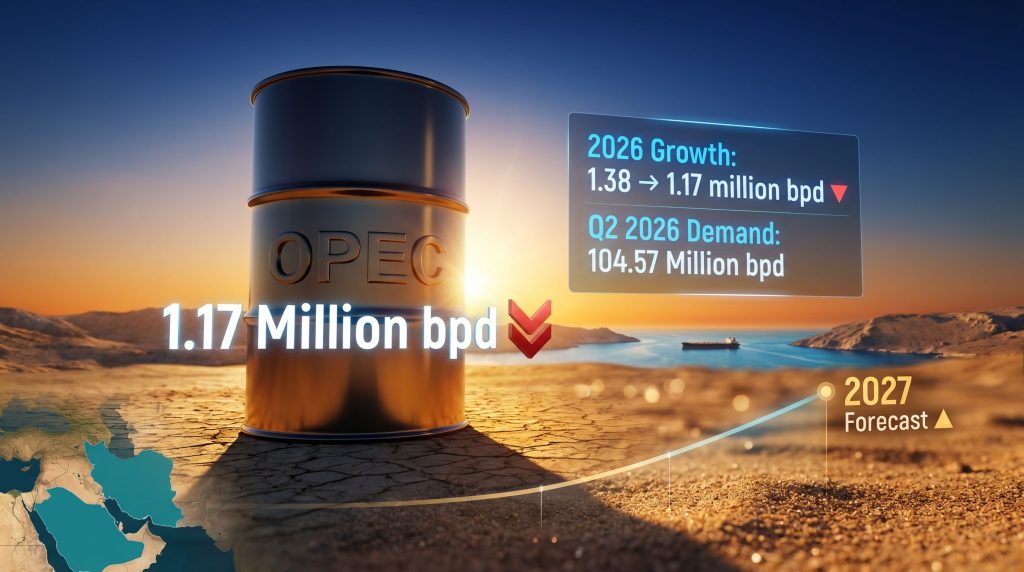
OPEC cuts global oil demand growth forecast in its May 2026 Monthly Oil Market Report, reducing the 2026 projection from 1.38 million barrels per day to 1.17 million barrels per day, a reduction of roughly 210,000 bpd. Taken alone, that figure looks modest. However, placed within the context of compounding revisions, Middle East conflict, and a fracturing producer alliance, it tells a far more consequential story.
When big ASX news breaks, our subscribers know first
Breaking Down the Revision: What the Numbers Actually Say
The May 2026 downgrade did not arrive in isolation. The previous monthly report had already slashed the Q2 2026 demand estimate by 500,000 bpd, signalling that near-term consumption conditions were deteriorating faster than earlier models had anticipated. The latest report then reinforced this trend by revising average Q2 2026 global demand down to 104.57 million bpd, compared with the prior projection of 105.07 million bpd.
What makes this sequence notable is the cumulative weight of successive downward adjustments. Two consecutive reports, each carrying meaningful reductions, suggest that the underlying conditions driving the revisions are not temporary noise. They reflect a durable deterioration in near-term demand visibility.
Summary of OPEC's Key Forecast Revisions (May 2026)
| Metric | Previous Forecast | Revised Forecast (May 2026) | Change |
|---|---|---|---|
| 2026 Demand Growth | 1.38 million bpd | 1.17 million bpd | ▼ 210,000 bpd |
| Q2 2026 Average Demand | 105.07 million bpd | 104.57 million bpd | ▼ 500,000 bpd |
| 2027 Demand Growth | ~1.34 million bpd | 1.54 million bpd | ▲ 200,000 bpd |
| 2026 Full-Year Demand | ~106.33 million bpd | ~106.33 million bpd | Broadly maintained |
At the same time, OPEC raised its 2027 demand growth projection to 1.54 million bpd, an upward revision of 200,000 bpd from its prior estimate. This creates an unusual narrative split within the same report: deteriorating near-term outlook alongside upgraded medium-term optimism. Furthermore, understanding the tension between these two signals is central to interpreting what OPEC is communicating to markets.
The Hormuz Factor: Why a Waterway Shapes a Global Forecast
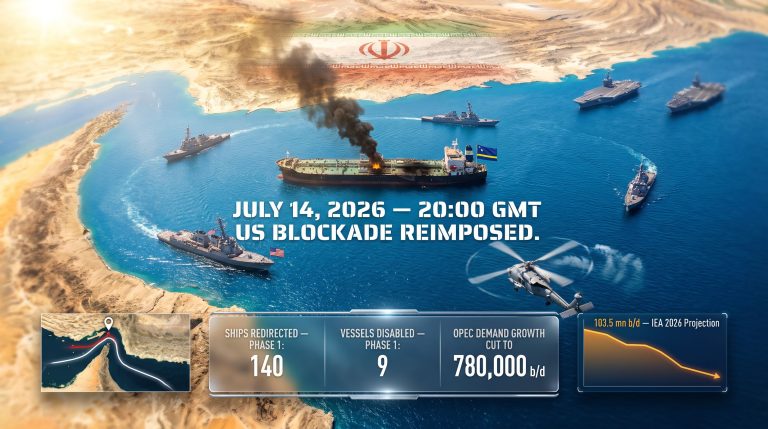
The Strait of Hormuz is arguably the single most consequential piece of maritime infrastructure in global energy. Approximately 20% of the world's seaborne oil trade passes through this narrow corridor connecting the Persian Gulf to the Gulf of Oman. When disruptions occur here, the consequences are not limited to physical supply volumes. They extend into price signal distortions, insurance premium surges, shipping route diversions, and, critically, demand-side uncertainty.
The closure or partial restriction of Hormuz does not just affect how much oil reaches the market. It fundamentally undermines downstream buyers' willingness to commit to consumption planning, forcing demand-side forecasters to widen their uncertainty bands significantly.
OPEC's May 2026 report explicitly acknowledged that OPEC production decisions to gradually restore output from April had been complicated by disruptions tied to the Hormuz closure. The group also noted that oil output declined further during April, compounding the supply-demand calculation at precisely the moment when markets needed clarity.
This dynamic introduces a lesser-discussed feedback loop in oil market modelling. Supply disruptions at chokepoints like Hormuz do not simply reduce supply. They also suppress demand projections because uncertainty around delivery reliability causes industrial buyers, refiners, and end consumers to adjust consumption behaviours preemptively. Consequently, demand forecasters must account for both the physical reduction in available barrels and the behavioural response to that scarcity signal.
How OPEC Compares to Other Major Forecasters
One of the most analytically productive ways to interpret any single OPEC revision is to examine it against the positions held by other major forecasting bodies. OPEC's market influence and the International Energy Agency have maintained structurally different demand methodologies for years, rooted in fundamentally different assumptions about the pace of energy transition.
Comparative Forecaster Positioning (2026 Demand Growth)
| Forecasting Body | 2026 Demand Growth Estimate | Key Assumption Differences |
|---|---|---|
| OPEC | 1.17 million bpd | Higher long-run demand; geopolitical disruption factored in |
| IEA | Lower structural estimates | Accelerated energy transition weighting |
| EIA (U.S.) | Mid-range estimates | U.S.-centric consumption modelling |
The IEA applies heavier weighting to structural demand-reduction forces, including electric vehicle penetration, renewable energy substitution, and efficiency gains across industrial sectors. OPEC's models, by contrast, have historically embedded higher long-run demand assumptions, reflecting the organisation's view that fossil fuel consumption in emerging economies will sustain aggregate growth for decades.
What is significant about the May 2026 report is that OPEC's downward revision brings it directionally closer to the IEA's more conservative posture, even if the absolute numbers remain different. When multiple forecasters with divergent methodologies converge on a downward trajectory, it signals something more than routine modelling variance. According to the EIA's short-term energy outlook, broader demand uncertainty is increasingly shaping global consumption models, pointing toward a shared recognition that conditions have shifted materially.
GDP Assumptions and the China Variable
Embedded within any demand forecast is a set of macroeconomic assumptions that determine how consumption growth is modelled across geographies. OPEC's May 2026 report provides a window into these assumptions, and several are worth examining carefully.
OPEC's 2026-2027 GDP Growth Assumptions
| Economy | 2026 Forecast | 2027 Forecast | Demand Implication |
|---|---|---|---|
| United States | 2.2% | 2.0% | Moderate consumption growth; efficiency gains offsetting volume |
| China | 4.6% | 4.5% | Largest marginal demand contributor; industrial and transport recovery |
| Global Average | Moderate | Stable | Broadly supportive but below pre-2020 trend rates |
OPEC projects U.S. economic growth at 2.2% in 2026 and 2.0% in 2027, a trajectory that implies stable but decelerating consumption. More strategically important is the China revision. OPEC upgraded its China GDP growth forecast to 4.6% for 2026, up from a prior estimate of 4.5%, while holding its 2027 projection steady at 4.5%.
This matters disproportionately because China remains the world's largest marginal oil importer, and incremental shifts in its industrial output, refining activity, and transportation fuel consumption have outsized effects on global demand balances. A modest upward revision to China's growth assumption does not offset the overall demand downgrade, but it does explain why OPEC's 2027 recovery projection carries some analytical credibility rather than appearing entirely disconnected from fundamentals.
A key insight often overlooked in public analysis is the difference between GDP growth and oil-intensive GDP growth. China's economic expansion increasingly incorporates electric vehicles, renewable industrial power, and high-technology manufacturing sectors that consume less oil per unit of output than traditional heavy industry. This structural composition shift means that even an upgraded Chinese growth forecast may not translate linearly into proportional demand increases for crude.
Does the 2027 Recovery Forecast Hold?
OPEC's decision to simultaneously cut 2026 demand growth while raising 2027 projections deserves scrutiny beyond face value. The 1.54 million bpd growth estimate for 2027 represents a meaningful acceleration from the revised 2026 figure. Three conditions would need to materialise for this recovery trajectory to hold:
- Hormuz normalisation: A resolution or significant de-escalation of the disruptions affecting the Strait of Hormuz, restoring supply chain confidence and reducing uncertainty premiums embedded in buyer behaviour.
- OPEC+ output restoration: The gradual production increases that were delayed by April disruptions would need to recommence and proceed without further interruption, tightening the market in a controlled manner.
- China demand materialisation: OPEC's upgraded Chinese growth assumption would need to translate into measurable petroleum product consumption increases, particularly in transport fuels and petrochemical feedstocks, during the second half of 2026.
Historically, multi-year demand forecasts from any producer organisation carry significant uncertainty. Research examining OPEC's past forecasting accuracy suggests that medium-term projections issued during periods of elevated geopolitical disruption have tended to overestimate recovery timelines. This does not make the 2027 figure meaningless, but it does argue for treating it as a directional signal rather than a precise target.
If the Iran conflict extends further into the second half of 2026 and Hormuz constraints persist, OPEC's 2027 recovery projection of 1.54 million bpd becomes increasingly difficult to substantiate. A prolonged disruption scenario would likely require further downward revisions in subsequent Monthly Oil Market Reports, potentially pushing 2027 demand growth estimates below 1.3 million bpd.
The UAE's OPEC Departure and What It Means for Market Governance
Layered beneath the demand figures is a structural shift within OPEC itself that compounds the organisation's ability to manage market signals with a unified voice. The UAE confirmed its departure from OPEC effective May 1, 2026, marking one of the most significant membership changes in the cartel's modern history.
The UAE is not a peripheral member. It has ranked consistently among the top-five producers within the group, with production capacity that has been central to OPEC's collective output management. Its exit reduces the group's aggregate production ceiling, complicates quota compliance calculations, and potentially creates a competitive dynamic outside the formal OPEC structure.
Several implications flow from this departure:
- OPEC's ability to present coordinated supply management strategies to global markets is weakened when one of its highest-capacity members operates independently.
- Saudi Arabia's position as the dominant voice within OPEC is effectively amplified, concentrating decision-making authority but also concentrating the reputational risk when forecasts miss.
- Independent UAE production decisions could introduce additional supply variability that demand modellers struggle to anticipate within existing frameworks.
The UAE's exit should not be read as merely an administrative change. In addition, it reflects deeper tensions within the producer alliance about output strategies, market share priorities, and long-term positioning in a world where the energy transition is reshaping the competitive landscape for hydrocarbon exports.
The next major ASX story will hit our subscribers first
Price Implications: Reading the Demand Signal Through a Supply Lens
A common misconception when OPEC cuts global oil demand growth forecast projections is that lower demand growth automatically translates into lower prices. The relationship is considerably more nuanced. Supply-side management by OPEC+ has consistently acted as a counterweight to demand weakness, and the current period is no exception.
Price Sensitivity Framework
| Demand Growth Scenario | Implied Market Balance | Price Pressure Direction |
|---|---|---|
| Below 1.0 million bpd | Oversupply risk | Bearish |
| 1.17 million bpd (current OPEC estimate) | Broadly balanced with supply constraints | Neutral to mildly bearish |
| Above 1.5 million bpd | Tightening market | Bullish |
At the revised 1.17 million bpd demand growth level, and factoring in the supply-side disruptions that have constrained OPEC+ output, the market is operating in a broadly balanced condition. The supply reductions that resulted from Hormuz-related disruptions have partially offset the demand weakness, preventing the kind of aggressive surplus accumulation that would drive benchmark prices sharply lower.
However, what traders and energy analysts are closely monitoring is whether the supply disruption proves temporary or structural. Recent oil price movements have reflected this uncertainty, with markets struggling to price in the combined effect of demand revisions and supply volatility. If Hormuz normalises and OPEC+ resumes planned output restoration, the supply cushion disappears at the same time demand recovery remains uncertain. That combination would represent a genuinely bearish confluence for price.
How Do Trade Dynamics Factor In?
The broader context of trade and geopolitics also plays a meaningful role in shaping how these demand revisions translate into real-world pricing outcomes. For instance, shifts in tariff regimes and bilateral trade tensions have already complicated the oil price rally that many had anticipated entering 2026. Furthermore, as Reuters reports, OPEC's downward revision reflects a broader acknowledgement that demand-side headwinds are now being compounded by external macro pressures beyond the organisation's direct control.
Frequently Asked Questions: OPEC's 2026 Oil Demand Forecast Cut
What is OPEC's current forecast for global oil demand growth in 2026?
OPEC's May 2026 Monthly Oil Market Report projects global oil demand growth of 1.17 million barrels per day in 2026, revised down from the prior estimate of 1.38 million bpd. This represents a cumulative downward revision of more than 200,000 bpd from OPEC's earlier baseline projections for the year.
Why did OPEC cut its 2026 demand forecast?
The primary drivers include geopolitical disruption caused by the Iran conflict, the partial closure of the Strait of Hormuz affecting supply chain confidence, and broader macroeconomic uncertainty weighing on consumption projections across both OECD and non-OECD economies.
What is OPEC's forecast for Q2 2026 global oil demand?
OPEC now projects average global oil demand of 104.57 million barrels per day in Q2 2026, down from the prior estimate of 105.07 million bpd, representing a reduction of 500,000 bpd.
Did OPEC raise or lower its 2027 demand forecast?
OPEC raised its 2027 demand growth forecast to 1.54 million bpd, an upward revision of 200,000 bpd from its previous projection, signalling expectations of a demand recovery once near-term disruptions stabilise.
How does the OPEC forecast compare to the IEA's outlook?
OPEC and the IEA maintain structurally divergent methodologies, with the IEA typically applying greater weighting to energy transition factors. In 2026, both organisations have revised demand growth downward, but OPEC maintains a more bullish long-run demand trajectory than the IEA's structural models suggest.
What is OPEC's GDP growth assumption for China in 2026?
OPEC raised its China GDP growth forecast to 4.6% for 2026, up from 4.5% previously, reflecting modest optimism about industrial and consumer demand recovery in the world's largest oil-importing nation.
Key Takeaways for Analysts, Investors, and Policymakers
The May 2026 OPEC cuts global oil demand growth forecasts carry implications that extend well beyond a single revised number. They represent a composite picture of a market navigating simultaneous pressures: geopolitical disruption at a critical chokepoint, a fracturing producer alliance, macroeconomic uncertainty in the world's largest consuming economies, and structural questions about the long-run trajectory of petroleum demand in a decarbonising world.
Three metrics will ultimately determine whether OPEC's 2027 recovery forecast holds:
- The pace of Hormuz normalisation and the trajectory of the Iran conflict through H2 2026.
- Whether OPEC+ can recommence and sustain its planned output restoration schedule without further disruption.
- Whether China's upgraded growth assumptions translate into measurable consumption increases that show up in trade data and refinery throughput figures.
For investors and energy analysts, the current report is best understood not as a definitive assessment but as a snapshot of a market in transition. The credibility of OPEC's 2027 optimism will be stress-tested by events that are, by definition, difficult to model. That uncertainty is itself the most important variable to carry into any energy market positioning decision made in the months ahead.
This article contains forward-looking analysis and forecast references that are inherently subject to uncertainty. Nothing in this article constitutes financial advice. Readers should conduct their own independent research before making any investment or commercial decisions based on commodity market outlooks.
Want To Stay Ahead of Major ASX Mineral Discoveries Shaping Energy Markets?
While global oil demand forecasts shift under the weight of geopolitical disruption and producer alliance fractures, Discovery Alert's proprietary Discovery IQ model delivers real-time alerts on significant ASX mineral discoveries — instantly translating complex market data into actionable opportunities for both short-term traders and long-term investors. Explore historic discoveries and their extraordinary returns on Discovery Alert's dedicated discoveries page, and begin your 14-day free trial today to position yourself ahead of the market.