July 16, 2026
The Legal Architecture of Naval Blockades and Why the Strait of Hormuz Changes Everything
Few geographic features carry as much strategic weight as a maritime chokepoint. Throughout modern history, control over narrow waterways has shaped the outcomes of conflicts, redirected commodity flows, and exposed the limits of international law when military force intersects with global trade. The Strait of Hormuz, a waterway roughly 33 kilometres wide at its narrowest navigable point, is the most consequential of these passages. When the US restarts enforcement of the Iran blockade, as it formally did on 14 July 2026, the ripple effects extend far beyond the Persian Gulf.
Understanding what is actually happening in the strait requires moving past the headlines and examining the legal, operational, and economic machinery beneath them.
When big ASX news breaks, our subscribers know first
What Is the Legal and Strategic Basis for a Naval Blockade of Iranian Ports?
Defining Naval Blockades Under International Maritime Law
A naval blockade, in its classical legal form, is an act of war designed to cut off an adversary's maritime access to trade and resupply. Under customary international law and the San Remo Manual on International Law Applicable to Armed Conflicts at Sea, a blockade must be declared, notified to neutral states, and applied impartially to all vessels regardless of flag. It cannot be used to starve a civilian population.
The Strait of Hormuz introduces a layer of legal complexity that conventional blockade doctrine struggles to accommodate. Under the United Nations Convention on the Law of the Sea (UNCLOS), the strait qualifies as an international waterway subject to the right of transit passage, a stronger protection than innocent passage that cannot be suspended even in peacetime. This means that in theory, all vessels retain the right to transit the strait in continuous and expeditious navigation, regardless of military activity in the surrounding area.
The tension arises because:
- Iran claims sovereign jurisdiction over the northern corridor of the strait, which runs through its territorial waters
- The US argues that military enforcement applies only to vessels trading with Iranian ports, not to neutral transit traffic
- International legal scholars have questioned whether a naval blockade can be legally maintained in a waterway governed by transit passage rights without constituting a breach of UNCLOS obligations
- Iran's Persian Gulf Strait Authority (PGSA) has established a parallel permitting regime, creating a situation in which two competing authorities are each claiming legal jurisdiction over the same waterway
This dual-authority environment has no clean historical precedent and represents one of the most legally contested maritime situations in the post-UNCLOS era.
How the 2026 US Blockade Was Constructed: A Regulatory Timeline
The current enforcement operation did not emerge overnight. It developed through a sequence of escalatory steps, a short-lived ceasefire, and a breakdown that returned the strait to a near-zero-traffic state.
| Milestone | Date | Key Action |
|---|---|---|
| Initial blockade imposed | 13 April 2026 | US naval forces begin redirecting vessels to and from Iranian ports |
| Ceasefire MoU signed | 18 June 2026 | Blockade suspended; PGSA transit fees waived for 60 days |
| Hostilities resume | 11-12 July 2026 | Iran declares strait closed; US-Iran exchanges of fire restart |
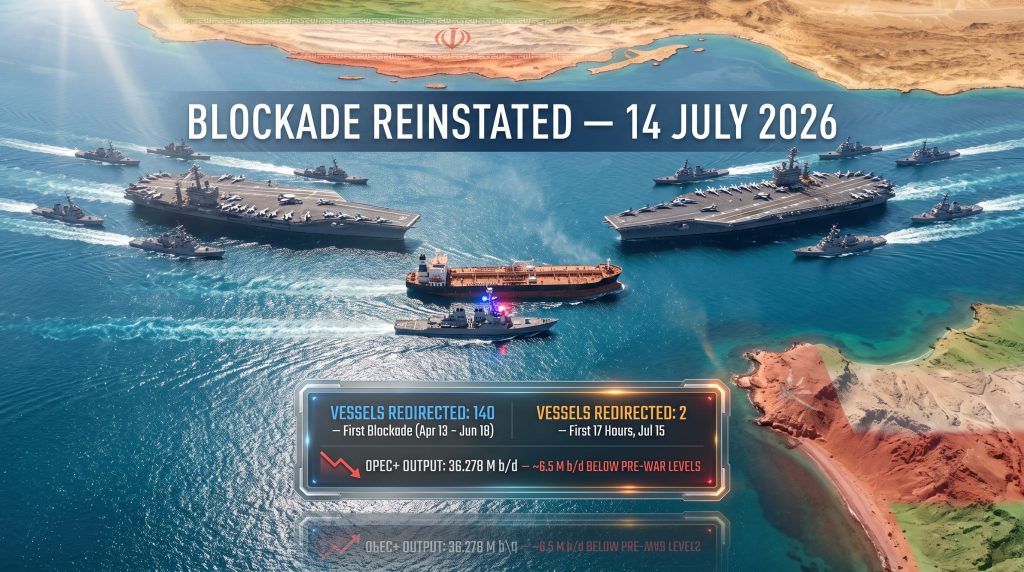
| Blockade reinstated | 14 July 2026, 4:00 PM ET | Trump administration formally reimposed naval enforcement |
| First vessels redirected | 15 July 2026 | US Central Command confirms two commercial vessels turned back within 17 hours |
The Ceasefire Collapse: What Broke the June 18 Agreement?
The memorandum of understanding signed on 18 June 2026 was, in retrospect, built on ambiguities that neither party had genuinely resolved. Its core clause required Iran to make arrangements for the safe passage of commercial vessels through the strait. Tehran interpreted this language as granting it full administrative authority over both vessel selection and approved routes. Washington interpreted it as a commitment to restore unrestricted commercial transit.
The route dispute crystallised this divergence. Iran prescribed a northern corridor running close to its own coastline, arguing that the southern route remained dangerous due to uncleared naval mines. The US promoted the southern route along Oman's coast, which it characterised as safer and neutral. Iran's position was that permitting traffic along the southern route without PGSA authorisation represented a direct challenge to its sovereignty over the waterway.
Between 18 June and 10 July, the brief window of partial normalisation saw 380 million barrels of crude exit the Mideast Gulf via the southern route, with more than 800 commercial vessels transiting the strait during the same period. Then, over the weekend of 11-12 July, Iranian attacks on commercial vessels resumed, US forces conducted further strikes on Iranian military targets, and the IRGC declared the strait closed. The ceasefire had effectively collapsed before it was formally declared dead. Al Jazeera's reporting documented the lifting and subsequent reimposition of the blockade in detail.
How Does the Reimposed Blockade Actually Work? Enforcement Mechanics Explained
US Military Force Structure Supporting the Operation
The enforcement operation is underpinned by a substantial naval deployment. As of July 2026, 19 US Navy vessels are positioned in the northern Arabian Sea, forming an interception perimeter around the primary approach routes to Iranian ports. The force includes:
- Two aircraft carrier strike groups providing air cover and long-range strike capability
- More than 10 destroyers forming the primary vessel interception layer
- Supporting logistics and command vessels operating from the Gulf of Oman
- US Central Command (Centcom) maintaining overall operational authority from its Middle East headquarters
The Gulf of Oman and the northern Arabian Sea function as the primary interception zones, allowing US forces to intercept vessels before they enter the strait itself. US Central Command confirmed that within 17 hours of the blockade's reinstatement, naval forces had already intercepted and redirected vessels attempting to breach the perimeter.
What Happens to Vessels That Attempt to Run the Blockade?
Key Policy Mechanism: The Joint Maritime Information Center (JMIC) has formally notified shipping operators that non-compliant vessels, regardless of the flag they fly, are subject to interception, diversion, and in circumstances where necessary, disabling action. Vessels in neutral transit through the strait bound for non-Iranian destinations are explicitly exempted from enforcement.
For a vessel that attempts to reach an Iranian port, the enforcement sequence broadly follows these steps:
- Identification via maritime surveillance, AIS monitoring, and aerial reconnaissance
- Hailing and warning through standard maritime radio channels
- Interception by a US naval vessel with orders to redirect the ship
- Diversion back toward non-Iranian waters, or detention pending further instruction
- Disabling action authorised if a vessel refuses to comply and attempts to force passage
The flag-state neutrality problem is a significant legal complication. Vessels registered in countries not party to the conflict face potential exposure to both US enforcement and Iranian retaliation depending on which instructions they follow. Insurers and flag-state regulators have been struggling to provide clear guidance.
One of the less-discussed vulnerabilities in the first blockade was the penetration of the perimeter by ballast vessels, ships travelling without cargo. Because these vessels presented a lower economic profile and were harder to identify as blockade runners on the basis of cargo manifests alone, some successfully reached Iranian ports during the April-June period. Enhanced rules of engagement in the reinstated blockade are reportedly designed to close this gap.
Comparing First Blockade vs. Reinstated Blockade Effectiveness
| Metric | First Blockade (Apr 13 – Jun 18) | Reinstated Blockade (Jul 14 onwards) |
|---|---|---|
| Duration | ~66 days | Ongoing as of July 2026 |
| Vessels redirected | 140 ships | 2 confirmed within first 17 hours |
| Vessels disabled | 9 | To be confirmed |
| Enforcement consistency | Uneven; ballast vessels penetrated perimeter | Enhanced rules of engagement applied |
| Strait traffic levels | Partially constrained | Near-zero visible AIS traffic |
What Are the Economic Consequences of Blocking Iranian Ports?
The Strait of Hormuz as a Global Energy Chokepoint: Scale of Exposure
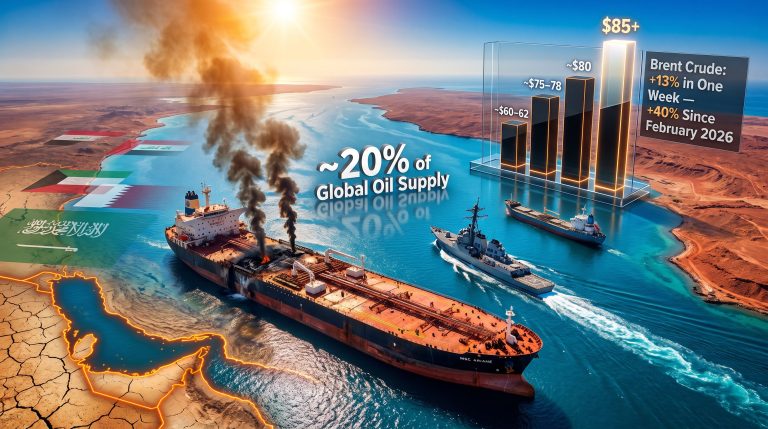
The strait's importance to global energy markets cannot be overstated. Historically, it has handled approximately 20% of globally traded seaborne crude oil, along with significant volumes of LNG and refined products. When it closes, even partially, the consequences propagate through commodity markets, freight rates, and refining margins within days. The broader dynamics of oil prices and geopolitics have long demonstrated how swiftly disruptions to this waterway translate into global price volatility.
The data from the ceasefire window illustrates the scale of what is now being withheld from global supply chains. During the roughly three-week period between 18 June and 10 July, 380 million barrels of crude transited the southern route alone, alongside more than 800 commercial vessel movements. The abrupt return to near-zero AIS-visible traffic following the reimposed blockade represents an immediate withdrawal of that supply from accessible markets.
OPEC+ Production and the Supply Deficit Risk
Critical Data Point: OPEC+ crude output, including Mexico, rose by approximately 2.999 million b/d to reach 36.278 million b/d in June 2026, according to secondary source estimates published by OPEC. Despite this monthly gain, total output remains roughly 6.5 million b/d below pre-war production levels, creating a structural supply shortfall with direct price implications.
The demand-side picture adds another layer of complexity. OPEC has revised its 2026 global oil demand growth forecast downward for a third consecutive month, cutting projections by 190,000 b/d to leave the growth figure at 780,000 b/d, implying total consumption of 105.94 million b/d for the year. Furthermore, OPEC's market influence over production decisions has become increasingly difficult to exercise coherently when the strait itself is compromised. The primary drivers of the downgrade were:
- China: consumption forecast reduced by 110,000 b/d
- India: consumption forecast cut by 60,000 b/d
The International Energy Agency takes a more pessimistic view of demand, projecting that global oil consumption will actually decline by 1 million b/d to reach 103.5 million b/d in 2026, largely attributable to the economic disruption caused by the US-Iran conflict. The divergence between OPEC and IEA demand forecasts matters considerably for how the supply gap is interpreted. Under OPEC's own demand figures, if Mideast Gulf production remains constrained near current levels, the arithmetic implies a substantial supply deficit for the remainder of 2026.
Iraq's Oil Sector: Collateral Damage and Strategic Pivot
Iraq's position within this conflict is one of the most structurally revealing case studies in the current crisis. Estimated crude output of 2.15 million b/d as of June 2026 represents less than half of Iraq's OPEC+ allocation of 4.35 million b/d, a shortfall driven almost entirely by constraints on seaborne export capacity through a strait that Iraq itself relies on for the vast majority of its export revenues.
In response, Baghdad has moved aggressively to diversify its commercial relationships:
- Agreements with Chevron, Halliburton, and other international energy operators to accelerate upstream development
- Extension of the northern export pipeline to Turkey for an additional year, providing a Hormuz-independent export route
- Active courtship of US investment, framed politically as a complement to the scheduled withdrawal of remaining US military forces by 30 September 2026
At a broader infrastructure level, the conflict is accelerating investment in Hormuz-bypass supply chains globally. Canada's proposed West Coast Oil Pipeline (WCOP), estimated to cost up to C$44 billion, represents one of the most significant indirect responses to Hormuz instability. The scale of this potential oil price shock has prompted energy executives and planners worldwide to reconsider infrastructure priorities, offering buyers in Asia-Pacific an alternative supply corridor that does not depend on Gulf transit at all.
The 20% Cargo Fee Proposal: Is the US Attempting to Monetise the Strait of Hormuz?
Unpacking Trump's Guardian of the Strait Declaration
Perhaps the most legally novel aspect of the current US posture is the proposal to levy a fee equivalent to 20% of commercial cargo value on vessels transiting the strait under US protection. The framing positions Washington as a security guarantor entitled to financial compensation for services rendered, a construct that has no established precedent in international maritime law.
The legal problem is significant. The right of transit passage through internationally recognised straits under UNCLOS is explicitly non-conditional. Charging fees for transit would constitute a restriction incompatible with freedom of navigation principles, and the US administration has acknowledged internally that the proposal may conflict with international obligations. If implemented, the precedent implications for global shipping governance would be far-reaching.
How Shipping Markets Are Responding to Dual-Authority Risk
The emergence of competing permitting frameworks has created a structurally novel risk environment for commercial shipping operators. Vessels now face a binary compliance problem: follow US enforcement directives or co-ordinate with Iran's PGSA, with the alternative approach in each case carrying potential military, legal, and financial consequences. This kind of supply chain disruption is proving particularly disruptive for operators with complex multi-port itineraries across the region.
The PGSA data from the ceasefire period offers a window into how the market responded when Iran's permitting regime was briefly operational:
| Vessel Type | Share of PGSA Permit Applications |
|---|---|
| Oil tankers | 41% |
| Bulk carriers | 27% |
| Container ships | 18% |
| LNG carriers | 2% |
| Other vessel types | 12% |
Additional operational data from the PGSA:
- Average permit processing time: 50 hours
- Share of applicants still awaiting permits at time of reporting: 14%
- Share of vessels that also purchased insurance from the PGSA: 79%
- Directional split: 53% eastbound (exiting the Gulf), 47% westbound (entering the Gulf)
- Top eastbound destinations: China (21%), India (20%), broader Asia-Pacific (29%)
The insurance dimension is particularly noteworthy. With 79% of PGSA-co-ordinated vessels purchasing coverage from the Iranian authority itself, a parallel financial ecosystem has developed around strait access, one that exists entirely outside the London market's traditional war risk frameworks and creates its own accountability questions.
What Are the Human and Humanitarian Costs of Enforcing the Blockade?
Civilian Mariner Casualties: A Contested Record on Both Sides
The human cost of this dispute over maritime jurisdiction has fallen disproportionately on civilian mariners from nations with no direct stake in the US-Iran conflict. According to US Central Command, Iranian attacks on seven commercial vessels have resulted in close to a dozen crew members killed, missing, or injured.
Yet the casualty record runs in both directions. The US attack on the tanker Settebello during June 2026 resulted in the deaths of three Indian crew members, drawing condemnation from the International Maritime Organization and India's Ministry of Foreign Affairs. The Cyprus-flagged containership GFS Galaxy was struck nine nautical miles east of the Omani coast while transiting the southern route, forcing its crew to abandon ship by lifeboat.
The GFS Galaxy incident highlights a painful paradox. The southern route, actively promoted by the US as the safer and neutral passage option, has itself become a target of Iranian military action. For mariners, following US guidance has not reduced their exposure to physical risk; in measurable terms, it may have increased it.
The UK Maritime Trade Operations authority acknowledged in its 14 July 2026 advisory that US-assisted transits were continuing despite an elevated threat environment, a statement that implicitly confirms the deterioration of safety conditions on the very corridor the US is promoting.
The Competing Accountability Frameworks
The moral and legal framing of the blockade involves genuine tension between two narratives:
- US Central Command's position: Iran is deliberately targeting civilian vessels and crew members, and US enforcement operations are designed to degrade Iran's capacity to do so
- Counter-argument: US military actions have produced their own civilian casualties, the Settebello deaths being the most documented example, which complicates any straightforward humanitarian justification for the blockade
The IMO, as the primary international body responsible for mariner safety, has limited enforcement tools against states engaged in armed conflict and has been unable to compel either party to establish a genuine safety corridor.
The next major ASX story will hit our subscribers first
How Are Regional Powers Navigating the US-Iran Confrontation?
Iraq's Geopolitical Tightrope: Between Washington and Tehran
Iraqi Prime Minister Ali al-Zaidi's meeting with President Trump at the White House on 14 July 2026 illustrated the extraordinary political balancing act Baghdad is attempting. Al-Zaidi's government represents the Shiite Co-ordination Framework, a political bloc aligned with Tehran. Yet his administration has simultaneously approved a series of agreements with American oil companies and is preparing for the departure of remaining US troops on 30 September 2026.
The implicit framing from Washington is that US oil investment and military presence are being traded in sequence: troops out, energy companies in. Trump characterised the influx of US corporate interest in Iraq as evidence of the success of military pressure on Iran, while al-Zaidi's public statements carefully avoided endorsing that narrative, focusing instead on economic recovery and Iraq's sovereign future. The geopolitical mining risks that have emerged alongside this conflict are, furthermore, reshaping investment calculus across the broader resource sector throughout the Middle East.
Oman's Exposure: Caught Between Competing Naval Strategies
Oman's geographic position makes it uniquely vulnerable. Drone strikes have been reported across the Musandam governorate, Oman's northernmost territory and the landmass closest to the strait. The IRGC claimed strikes on logistics and refuelling facilities at Duqm port, a significant naval and commercial facility on Oman's southeastern coast that has historically served as a staging point for Western naval operations in the region.
Oman condemned the attacks through its state news agency. This is significant because Oman has traditionally maintained a unique diplomatic role as an unofficial backchannel between Washington and Tehran, a function that becomes considerably harder to perform when its own territory is being targeted by one of the parties.
What Are the Plausible Escalation Scenarios From Here?
Scenario Modelling: Three Pathways for the Strait of Hormuz in H2 2026
Scenario A: Negotiated De-escalation (Low Probability, Near-Term)
A revised agreement with explicit route administration language and clearly defined permitting responsibilities reduces the immediate military confrontation. The PGSA regime is recognised as a transitional mechanism, the 20% fee proposal is shelved, and AIS-visible traffic through the strait recovers to 60-70% of pre-war levels within 30-45 days. This scenario requires both parties to accept the ambiguities of the June 18 MoU as lessons rather than pretexts.
Scenario B: Sustained Blockade With Sporadic Enforcement (Base Case)
The blockade remains formally in place but enforcement mirrors the uneven pattern seen between April and June 2026. Ballast vessels and flag-of-convenience ships continue to test the perimeter with mixed outcomes. Oil markets price in a persistent 10-20% supply disruption premium. Iraqi, Saudi, and UAE producers accelerate investment in alternative export infrastructure. This scenario involves ongoing elevated risk for mariners without a decisive resolution.
Scenario C: Full Strait Closure and Expanded Military Conflict (Tail Risk)
Iran successfully sustains a closure of the strait to all traffic for an extended period. The OPEC+ supply deficit widens significantly beyond the current 6.5 million b/d gap versus pre-war levels. Global crude prices spike materially; London and international war risk markets suspend or price Hormuz coverage at prohibitive levels. Broader regional actors, potentially including Gulf Cooperation Council members, are drawn into the conflict either directly or through proxy actions.
Frequently Asked Questions: US Enforcement of the Iran Naval Blockade
What is the US naval blockade of Iranian ports?
A military enforcement operation in which US naval forces intercept, redirect, or disable commercial vessels attempting to enter or exit Iranian ports, targeting Iran's maritime trade and energy export capacity.
When did the US restart enforcement of the Iran blockade in 2026?
Enforcement was formally reimposed on 14 July 2026 at 4:00 PM Eastern Time, following the breakdown of a ceasefire memorandum of understanding signed on 18 June 2026. Within 17 hours, US forces had redirected two commercial vessels attempting to breach the perimeter.
Does the blockade affect all ships transiting the Strait of Hormuz?
No. Vessels in neutral transit bound for non-Iranian destinations are explicitly exempt from enforcement. The blockade specifically targets ships travelling to or from Iranian ports and coastal facilities.
How many US naval vessels are enforcing the blockade?
As of July 2026, 19 US Navy ships are deployed in the northern Arabian Sea, including two aircraft carrier groups and more than 10 destroyers.
What happened during the first blockade from April to June 2026?
US forces redirected 140 ships and disabled nine vessels between 13 April and 18 June 2026. Enforcement was inconsistent, with some ballast vessels successfully reaching Iranian ports. A ceasefire MoU paused the operation on 18 June before hostilities resumed in early July.
What is the proposed 20% cargo fee?
The Trump administration proposed charging commercial shipping companies a fee equal to 20% of cargo value for transit security services through the Strait of Hormuz. Legal analysis suggests this conflicts with UNCLOS provisions governing freedom of navigation through internationally recognised straits.
Key Takeaways: What the Reimposed Iran Blockade Means for Global Energy Markets
- The decision to have the US restart enforcement of the Iran blockade on 14 July 2026 marks a significant escalation with immediate consequences for global crude supply, freight markets, and energy security planning
- Near-zero AIS-visible traffic through the Strait of Hormuz indicates an effective collapse of the corridor's commercial utility in the immediate term
- OPEC+ output sits approximately 6.5 million b/d below pre-war levels, while OPEC's own demand projections of 105.94 million b/d for 2026 imply a large supply deficit if Mideast Gulf constraints persist
- The competing permitting regimes operated by US naval enforcement and Iran's PGSA create a dual-authority risk environment with no clear legal resolution under existing international maritime law
- Civilian mariner casualties have been recorded on both sides of the enforcement line, complicating the humanitarian justification for the blockade and drawing condemnation from international bodies including the IMO
- Regional energy investment flows are already being redirected: Iraq is accelerating US oil company partnerships, Canada is advancing the C$44 billion WCOP pipeline, and global commodity buyers are building Hormuz disruption risk into long-term supply planning
This article is intended for informational and analytical purposes only. It does not constitute financial, legal, or investment advice. Projections, scenario analyses, and demand forecasts referenced herein are drawn from publicly available institutional sources and carry inherent uncertainty. Readers should conduct independent analysis before making decisions based on the information presented.
Want Real-Time Alerts When Geopolitical Shocks Create ASX Mineral Discovery Opportunities?
When energy market disruptions like the Strait of Hormuz blockade reshape global commodity flows, the ripple effects can unlock significant opportunities across ASX-listed resource stocks — and Discovery Alert's proprietary Discovery IQ model ensures subscribers receive instant notifications the moment a significant mineral discovery hits the exchange, cutting through the noise to deliver actionable insights ahead of the broader market. Explore how major discoveries have historically generated substantial returns on Discovery Alert's dedicated discoveries page, and begin your 14-day free trial today to position yourself at the forefront of the next major find.