July 16, 2026
The Architecture of a Chokepoint: Why the Strait of Hormuz Defines Global Energy Risk
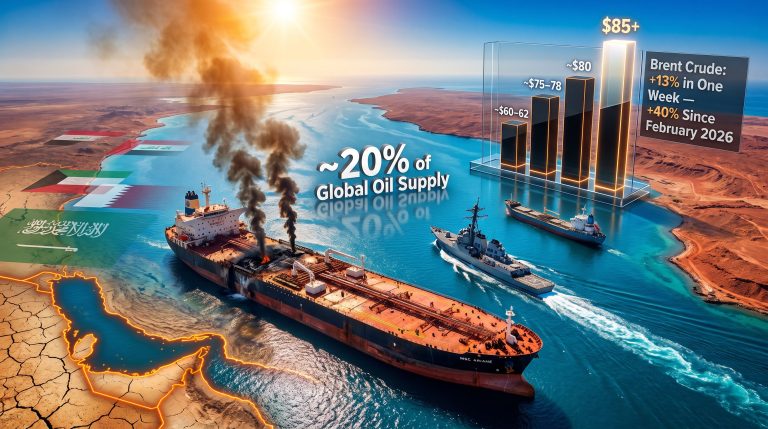
Energy markets have long accepted a peculiar vulnerability at their core: the movement of roughly one-fifth of the world's seaborne oil passes through a corridor barely 33 kilometres wide at its narrowest navigable point. The Strait of Hormuz is not merely a geographic feature — it is the load-bearing column of the global crude oil supply chain, and when the US restarts enforcement of Iran blockade measures, the reverberations reach every refinery, every fuel pump, and every commodity trading desk on the planet.
What makes the strait uniquely fragile is the absence of commercially viable alternatives for most Gulf exporters. Saudi Arabia's East-West pipeline and the UAE's Abu Dhabi Crude Oil Pipeline offer partial relief, but their combined capacity falls well short of what transits the strait on any given day. For Iran specifically, Kharg Island's loading terminals are entirely dependent on Hormuz access, which is precisely why the waterway has become the central instrument of US enforcement pressure.
When military operations enter this corridor, the cascading effects extend far beyond oil volumes. War risk insurance premiums spike almost immediately. Freight rates reprice to reflect the elevated probability of vessel damage or seizure. The oil price geopolitical factors at play here are considerable, as the narrowness of the passage means that even a partial disruption to vessel traffic creates disproportionate market consequences.
When big ASX news breaks, our subscribers know first
A Conflict in Two Acts: The Blockade Timeline
The current enforcement environment did not materialise overnight. It is the product of a sequence of escalation, negotiation, and collapse that has been building since early 2026. Understanding the chronology is essential to assessing where the situation is heading.
| Milestone | Date | Significance |
|---|---|---|
| Initial blockade imposed | April 13, 2026 | Following breakdown of Islamabad negotiations |
| MOU signed, blockade suspended | June 18, 2026 | 60-day diplomatic window opened |
| Iranian attacks resume on commercial vessels | July 11-12, 2026 | Iran declares strait closed |
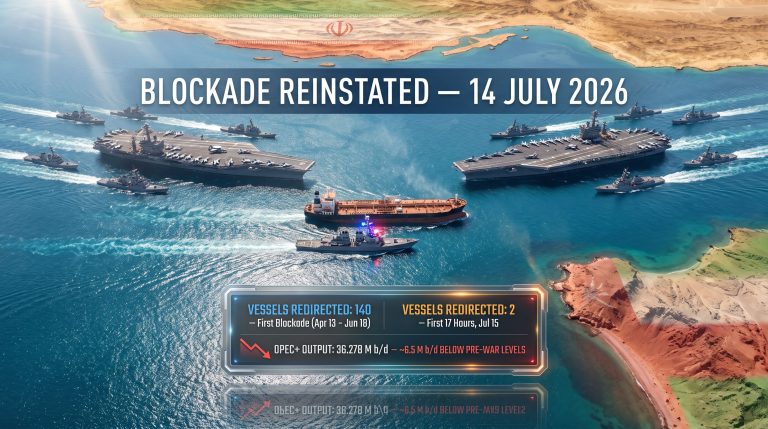
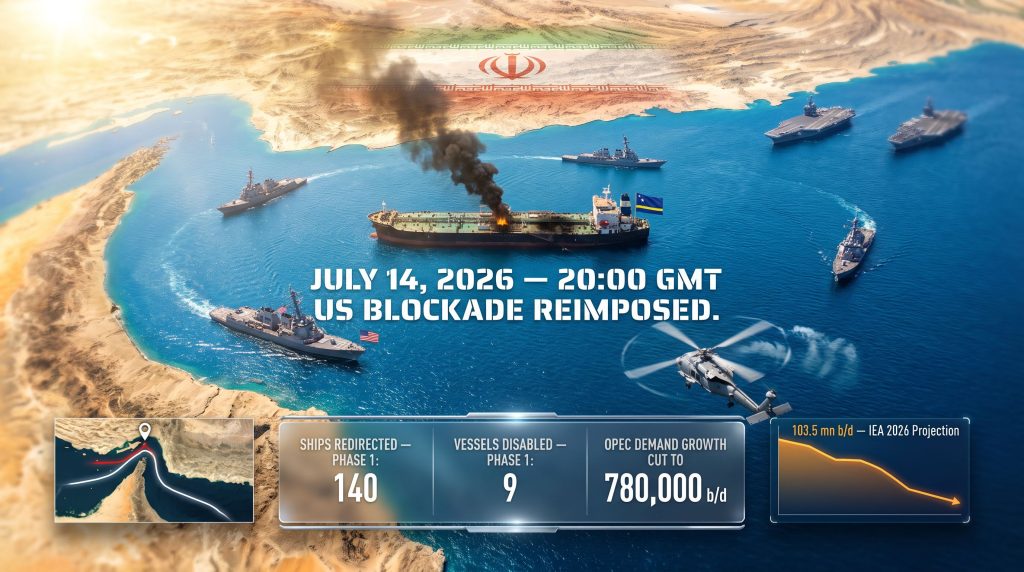
| US reimposed blockade | July 14, 2026, 20:00 GMT | Second enforcement phase begins |
| Tanker Belma disabled by Hellfire missile | July 15, 2026 | First kinetic action of Phase 2 |
The June 18 memorandum of understanding was designed to create breathing room for a broader peace framework. It included a fee waiver for vessels coordinating with Iran's Persian Gulf Strait Authority, a deliberate confidence-building mechanism. When the 60-day window expired without a successor agreement, that incentive structure dissolved.
Iran's resumption of attacks on commercial vessels over the July 11-12 weekend, combined with its declaration that the strait was once again closed, gave Washington the trigger it needed to restart enforcement. Consequently, the US reimposed the naval blockade at 20:00 GMT on July 14, 2026.
What the Reinstated Naval Enforcement Actually Covers
Scope, Mechanisms, and the 20% Cargo Fee
The blockade targets all vessels attempting to enter or exit Iranian ports, oil terminals, and coastal areas, regardless of their flag state. Critically, the stated scope does not extend to neutral commercial transit through the strait itself, though the practical distinction has become increasingly difficult to maintain given competing route mandates and active military operations on both sides.
Enforcement follows a graduated escalation framework:
- Initial interception and warning via bridge-to-bridge communications on Channel 16
- Diversion orders directing vessels away from Iranian ports
- Capture or compelled compliance for non-responsive vessels
- Use of force as a final option, now operationalised through Hellfire missile deployment
President Trump also announced a 20% cargo value fee applicable to commercial shippers operating in the enforcement zone, framed as a contribution to US safety and security operations in the region. This levy introduces a financial friction layer on top of the physical enforcement mechanism, effectively raising the cost of any attempt to circumvent the blockade through commercial means.
The Military Footprint Behind the Enforcement
The scale of the US naval presence in the northern Arabian Sea is substantial. More than 10,000 US personnel are deployed in support of the operation, alongside 19 US Navy vessels including two aircraft carriers and more than 10 destroyers. Aerial surveillance and strike capability is provided by dozens of aircraft operating across the region.
This force posture represents a materially larger and more capable enforcement architecture than was present during the initial April blockade phase. Furthermore, this expanded presence signals Washington's intent to maintain a more consistent and credible deterrent throughout Phase 2.
Phase 1 vs. Phase 2: A Comparative Assessment
The first blockade phase (April 13 to June 18, 2026) redirected 140 ships and disabled 9 vessels across approximately 66 days. Yet enforcement was demonstrably uneven. Ballast vessels continued to reach Iranian loading terminals in a number of instances, indicating that the blockade's practical effectiveness fell short of its strategic ambition in Phase 1.
| Metric | Phase 1 (Apr 13 – Jun 18) | Phase 2 (From Jul 14) |
|---|---|---|
| Duration | ~66 days | Ongoing |
| Ships redirected | 140 | 2 (first 17 hours) |
| Vessels disabled | 9 | 1 (Belma, Jul 15) |
| Enforcement consistency | Uneven | Early stages, TBD |
| Kinetic method | Varied | Hellfire missile to smokestack |
The Phase 2 opening posture is notably more aggressive. Within the first 24 hours of reimposition, US Central Command had already deployed Hellfire missiles against the Belma, a Curacao-flagged empty oil tanker that ignored multiple warnings while transiting international waters toward Kharg Island. The vessel was disabled rather than sunk, with missiles directed at the smokestack. This targeted methodology signals an intent to incapacitate rather than destroy, preserving escalatory headroom while sending an unambiguous deterrence signal to other potential violators.
Iran's Counter-Strategy: The PGSA and the Battle for Administrative Sovereignty
A Permit System as Institutional Power
Iran's response to the blockade has not been purely kinetic. Tehran has pursued a parallel governance strategy through the Persian Gulf Strait Authority, established to assert administrative control over Hormuz transit. The PGSA requires vessels to apply for transit permits in advance, a process that during the MOU period attracted genuine commercial participation.
Between June 18 and early July 2026, more than 200 non-Iranian vessels submitted transit coordination requests to the PGSA. A breakdown of those applications reveals the commercial stakes involved:
| Vessel Type | Share of PGSA Applications |
|---|---|
| Oil tankers | 41% |
| Bulk carriers | 27% |
| Container ships | 18% |
| LNG carriers | 2% |
| Other | 12% |
Of the vessels coordinating with the PGSA, 79% also took out insurance coverage from the authority, indicating that Iran's parallel governance structure was developing meaningful commercial traction. The PGSA reported an average processing time of 50 hours per permit application, a friction cost that nonetheless appeared acceptable to shipping operators given the alternatives. Notably, 14% of applicants were still awaiting permits at the time the data was published, suggesting the system was under strain even during the relative calm of the MOU period.
The Northern vs. Southern Route: A Jurisdictional Flashpoint
At the heart of the renewed conflict is a fundamental disagreement over which route vessels should use to transit the strait. Iran mandates a northern passage along its coastline, citing the ongoing presence of uncleared naval mines on alternative corridors. The US promotes a southern route along the Omani coastline, and has stated that between June 18 and July 10, 380 million barrels of crude and more than 800 ships used this corridor.
Tehran's position is that any vessel using the southern route without PGSA coordination is violating the MOU and challenging Iranian sovereignty over the waterway. The UK Trade Maritime Information Center's advisory note published on July 14 confirmed that US-assisted transits continued through this corridor despite elevated threat conditions.
The southern route paradox is particularly acute: US authorities are directing commercial vessels toward the same corridor that Iranian forces have been actively targeting. Mariners following official US guidance are, in practice, navigating toward the higher-risk zone rather than away from it.
The Human Cost: Mariner Safety in a Contested Waterway
Casualties on Both Sides of the Enforcement Divide
Both the enforcing power and the sanctioned state have now generated civilian mariner casualties, a dual accountability dynamic that significantly complicates the legal and diplomatic framing of the blockade. The commodity market volatility generated by this instability further compounds the humanitarian dimension of the crisis.
Iran's attacks on seven commercial vessels resulted in nearly a dozen crew members killed, missing, or injured. US Central Command cited this toll as the primary justification for reimposing enforcement, characterising Iranian actions as deliberate targeting of civilian mariners across the region.
However, US enforcement during Phase 1 also produced casualties. The June 2026 attack on the tanker Settebello resulted in the deaths of three Indian crew members, an action that drew formal condemnation from both the International Maritime Organization and India's Ministry of Foreign Affairs. The Belma incident on July 15 added another data point, with the vessel disabled by Hellfire fire after ignoring multiple warnings.
Risk Warning: The emerging pattern of dual-attribution casualties elevates pressure on major consuming nations, particularly India, to take formal positions on the blockade's legitimacy under international maritime law. India's status as both a major Gulf crude importer and a nation with direct mariner casualties creates a particularly complex diplomatic exposure.
Global Oil Markets: Diverging Forecasts Under Supply Shock Conditions
OPEC and the IEA: A Widening Analytical Gap
The market intelligence picture emerging from major forecasting bodies is one of significant disagreement, which itself signals the depth of uncertainty now embedded in global oil supply projections. OPEC's market influence remains a key variable in how quickly the global supply picture can stabilise.
The OPEC demand forecast revisions tell a particularly revealing story. OPEC's July 2026 Monthly Oil Market Report downgraded its 2026 global oil demand growth forecast for the third consecutive month, cutting the projection by 190,000 b/d to 780,000 b/d, which would place total consumption at 105.94 million b/d. The downgrade was driven primarily by reduced expectations for China (-110,000 b/d) and India (-60,000 b/d), the two largest consumers of Gulf crude.
Notably, OPEC simultaneously upgraded its 2027 demand growth forecast by 210,000 b/d to 1.73 million b/d, implying that the group views the current disruption as cyclical rather than structural. The IEA's assessment is considerably more bearish, projecting a 1 million b/d demand decline to 103.5 million b/d in 2026. A gap of more than 2.4 million b/d between the two institutions' demand projections reflects fundamentally different views on how long and how severely the Hormuz disruption will constrain economic activity.
The Supply Deficit Scenario
OPEC+ crude output, including Mexico, rose by approximately 2.999 million b/d to 36.278 million b/d in June, according to secondary source estimates. However, this remains roughly 6.5 million b/d below pre-war production levels, a deficit of extraordinary magnitude by historical standards. If Mideast Gulf production remains constrained at anything approaching current levels, even OPEC's own demand projections imply a substantial supply shortfall through the remainder of 2026.
Iraq as a Medium-Term Supply Variable
Iraq's position within this supply equation deserves particular attention. Iraqi Prime Minister Ali al-Zaidi's July 14 White House meeting with President Trump produced signals of accelerated US oil investment in Iraq, with agreements involving Chevron, Halliburton, and other international partners recently approved. Iraq's estimated crude output of 2.15 million b/d as of June 2026 sits dramatically below its OPEC+ target of 4.35 million b/d.
A planned northern pipeline extension to Turkey offers one potential pathway to diversifying Iraq's export infrastructure. However, the scheduled departure of US troops from Iraq by September 30, 2026 introduces a significant political variable, with Baghdad simultaneously welcoming new US commercial partners while preparing for the end of the US military presence.
The next major ASX story will hit our subscribers first
Shipping, Insurance, and Trade Route Stress Indicators
The broader trade war economic impact of this standoff is visible across several key market indicators. For market participants tracking the real-time impact of the blockade, the following metrics warrant continuous monitoring:
- War risk insurance premiums for Hormuz-adjacent voyages, which typically move faster than physical cargo flows in response to security events
- Vessel traffic data through the strait, with MarineTraffic reporting minimal flows as of July 14-15, 2026
- Tanker rerouting economics via the Cape of Good Hope, which adds significant voyage time and cost for Asian buyers and effectively prices in a structural supply lag
- PGSA permit processing times, rendered operationally moot under the reimposed blockade but relevant as a precedent for any future diplomatic framework
Three Scenarios for the Next 90 Days
Scenario A: Rapid De-escalation (Low Probability)
A new diplomatic framework emerges within weeks, enforcement is suspended, and partial commercial flows resume through the southern corridor. Oil markets partially recover, freight premiums compress, and insurance markets re-engage with the region. This scenario requires a level of diplomatic movement that the failed 60-day MOU window suggests is structurally difficult to achieve quickly.
Scenario B: Sustained Enforcement Stalemate (Base Case)
The blockade holds but replicates the unevenness of Phase 1. Iranian crude continues to move through non-conventional means, including ship-to-ship transfers and third-country intermediary routing. Persistent supply uncertainty maintains a geopolitical risk premium in crude benchmarks without triggering a full market rupture. This outcome preserves US enforcement optics while allowing a degree of Iranian revenue flow, potentially creating conditions for eventual diplomatic re-engagement.
Scenario C: Escalatory Spiral (Tail Risk)
Additional kinetic incidents involving civilian vessels trigger formal third-party diplomatic interventions. A major consuming nation, whether India or China, challenges the blockade's legality under international maritime law. Insurance market withdrawal from the region forces a broader shipping shutdown, removing the ambiguity that has so far allowed partial flows to continue. This scenario carries the highest consequence for global energy markets and the lowest current probability, but the dual-casualty dynamic described above makes it less remote than it might otherwise appear.
Frequently Asked Questions
What is the current status of the US naval blockade on Iran?
The United States reimposed its naval blockade on Iranian ports and coastal areas on July 14, 2026, at 20:00 GMT. This represents the second phase of enforcement — the US restarts enforcement of Iran blockade measures — first activated in April 2026 and temporarily suspended under a bilateral MOU in June 2026.
Can commercial ships still transit the Strait of Hormuz?
The blockade's stated scope covers vessels entering or leaving Iranian ports rather than neutral transit through the strait. However, competing route mandates, active military operations, and elevated attack risk on the southern corridor have effectively collapsed normal commercial traffic through the waterway, as confirmed by MarineTraffic vessel flow data from July 14-15.
What happened to the tanker Belma?
The Curacao-flagged empty oil tanker Belma was disabled by US forces on July 15, 2026, after ignoring multiple warnings while transiting international waters toward Iran's Kharg Island oil terminal. A US aircraft fired Hellfire missiles into the vessel's smokestack, disabling rather than sinking it.
How many ships did the US redirect or disable during Phase 1?
Between April 13 and June 18, 2026, US naval forces redirected 140 commercial vessels and disabled 9 ships as part of the initial enforcement phase. Furthermore, enforcement during this period was notably inconsistent, with some ballast vessels still reaching Iranian terminals.
Why did the MOU break down?
The June 18 memorandum of understanding established a 60-day window for negotiating a final agreement. That window expired without a successor deal. Iran simultaneously resumed attacks on commercial vessels and declared the waterway closed over the July 11-12 weekend, triggering the US decision to reimpose the blockade.
What commercial fee applies to shippers in the region?
President Trump announced a 20% cargo value fee applicable to commercial shippers operating in the enforcement zone, framed as a contribution to US safety and security operations. In addition, this fee compounds the existing friction created by elevated war risk insurance premiums and rerouting costs, making the overall cost environment for regional shipping considerably more challenging.
This article contains forward-looking scenario analysis and market projections drawn from publicly available institutional sources including OPEC's Monthly Oil Market Report and IEA forecasts. All scenario projections are speculative in nature and should not be construed as investment advice. Readers are encouraged to conduct independent analysis before making decisions based on geopolitical risk assessments.
Want to Stay Ahead of the Next Major Commodity Disruption?
When geopolitical shocks like the Strait of Hormuz blockade send commodity markets into turmoil, Discovery Alert's proprietary Discovery IQ model scans the ASX in real time, delivering instant alerts on significant mineral discoveries before the broader market reacts — explore the historic returns major discoveries have generated and begin your 14-day free trial to secure a market-leading edge.