August 5, 2026
The Institutional Forecast Divide Reshaping Global Oil Markets in 2026
When two of the world's most authoritative energy institutions look at the same market and reach conclusions separated by nearly 1.6 million barrels per day, the disagreement itself becomes the story. The divergence between OPEC and the International Energy Agency on the trajectory of global oil consumption is not simply a matter of differing methodologies. It reflects fundamentally incompatible assumptions about geopolitical durability, economic resilience, and the cascading mechanics of supply shock transmission through the global industrial system.
Understanding the OPEC oil demand growth forecast for 2026 and beyond requires more than reading the headline numbers. It demands a forensic examination of why the two agencies diverge, what each is betting on, and which scenarios carry the most weight for producers, traders, and long-term energy planners. For broader context, the oil geopolitics analysis of recent years offers valuable background on how these structural fault lines developed.
OPEC vs. IEA: A Side-by-Side Forecast Comparison
The contrast between OPEC's and the IEA's current positions could hardly be more stark:
| Metric | OPEC Projection | IEA Projection |
|---|---|---|
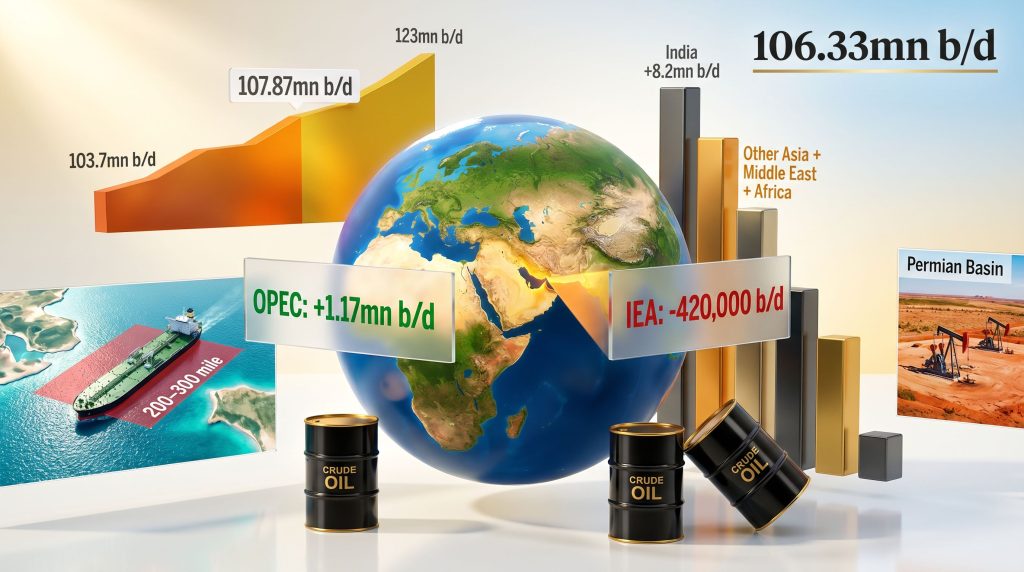
| 2026 Demand Growth | +1.17mn b/d | -420,000 b/d (contraction) |
| 2026 Total Demand | ~106.33mn b/d | ~104mn b/d |
| 2027 Demand Growth | +1.54mn b/d | +1.5mn b/d (to 105.6mn b/d) |
| Primary Risk Framing | Geopolitical disruption (temporary) | Strait of Hormuz closure (structural near-term) |
| Non-OPEC+ Supply Growth (2026) | +630,000 b/d | Higher US/Kazakhstan/Russia offset noted |
| Inventory Trajectory | Stable absorption | Drawdown of ~900mn bl by September 2026 |
The IEA's May 2026 Oil Market Report projects global demand at 104mn b/d for the full year, representing a contraction of 420,000 b/d year-on-year. Before the conflict with Iran began, the IEA had been projecting demand growth of 640,000 b/d. Its most recent prior monthly estimate was a contraction of just 80,000 b/d, meaning the agency's bearish revision accelerated sharply in May as the effects of the Strait of Hormuz closure deepened.
OPEC, by contrast, characterises the demand backdrop as fundamentally healthy. The secretariat's position rests on a conviction that the global economy is large and resilient enough to absorb geopolitical shocks of this nature, and that Middle East disruptions are transient rather than structural headwinds. This framing anchors OPEC's market influence on long-run demand optimism even as its near-term quarterly estimates are revised downward.
How Each Agency Models Geopolitical Risk
The technical roots of the OPEC-IEA divergence lie in how each institution models the duration and downstream consequences of supply disruption:
- OPEC treats the Hormuz closure primarily as a temporary logistical event that suppresses short-cycle demand without altering structural growth trajectories in non-OECD economies.
- The IEA models the closure as a structural supply shock whose effects ripple through feedstock availability, industrial production, and ultimately consumer demand across multiple quarters.
- The divergence intensifies in the petrochemical and aviation sectors, where the IEA identifies cascading feedstock constraints and below-normal activity levels, while OPEC's framework gives more weight to demand rebound potential once shipping normalises.
- Both agencies converge more closely on 2027, suggesting the disagreement is primarily about the speed of recovery rather than the long-run destination of global oil demand.
When big ASX news breaks, our subscribers know first
What OPEC's Monthly Oil Market Report Actually Forecasts for 2026 and 2027
Decoding the 2026 Demand Revision
OPEC's May 2026 Monthly Oil Market Report (MOMR) contained its first annual demand growth downgrade since the Iran conflict began, but the framing of that downgrade matters as much as the number itself:
- Full-year 2026 demand growth revised to 1.17mn b/d, a reduction of 210,000 b/d from both the prior monthly estimate and OPEC's pre-war baseline.
- Total global consumption for 2026 now projected at 106.33mn b/d.
- The April-June quarterly estimate was cut by 500,000 b/d in the May MOMR, representing the second consecutive quarterly downgrade for that period.
- Cumulative quarterly demand downgrades for Q2 2026 since the onset of the Iran conflict have now reached 1mn b/d in total.
- Despite these revisions, OPEC's secretariat describes the overall demand environment as healthy, a characterisation that reflects its institutional tendency to anchor forecasts in long-cycle fundamentals rather than short-run volatility.
Key Insight: The distinction between a downgrade and a pessimistic outlook is central to interpreting OPEC's position. A revised growth rate of 1.17mn b/d still represents meaningful expansion in absolute terms. The group's framing implies the revision is a recognition of near-term friction, not a reassessment of structural demand drivers.
The 2027 Upgrade and What It Signals
The more strategically significant element of OPEC's May MOMR is arguably not the 2026 downgrade but the simultaneous upgrade to its 2027 outlook:
- OPEC raised its 2027 demand growth forecast by 200,000 b/d to 1.54mn b/d.
- Total 2027 consumption is now projected at 107.87mn b/d, a figure consistent with OPEC's pre-conflict baseline projections.
- Non-OPEC+ supply growth for 2027 was held steady at 620,000 b/d, bringing total non-OPEC+ output to 55.45mn b/d.
- The 2026 non-OPEC+ supply growth forecast was also maintained at 630,000 b/d, reaching 54.83mn b/d in aggregate.
The upgrade to 2027 carries a clear strategic message. OPEC is positioning any 2026 softness as a cyclical dip within a structurally expansionary demand environment, not as evidence of a permanent peak or inflection point. Furthermore, this stance has direct implications for OPEC production decisions and price floor management through the second half of the decade.
How the Strait of Hormuz Closure Reshapes Global Supply Dynamics
Quantifying the Production Losses
The physical supply impact of the conflict has been severe. According to secondary source estimates published in OPEC's MOMR, including data from Argus Media:
- Combined OPEC+ production, including Mexico, fell by 1.74mn b/d month-on-month to 33.19mn b/d in April 2026.
- Six Mideast Gulf producers, specifically Saudi Arabia, Iraq, Iran, Kuwait, the UAE, and Bahrain, collectively lost nearly 1.9mn b/d in April alone.
- Cumulative production losses for these six nations since pre-conflict February levels now total approximately 10mn b/d.
- Net lost global supply since February stands at 12.8mn b/d, with 14mn b/d of shut-in Mideast Gulf production only partially offset by increased exports from the US, Kazakhstan, Russia, and Venezuela, according to the IEA.
These figures contextualise the scale of disruption. For reference, the roughly 20% of global oil supply that previously transited the Strait of Hormuz has been effectively removed from normal distribution channels for over two months.
The IRGC's Expanding Operational Zone
A development with significant long-term implications for tanker routing and maritime insurance is the progressive expansion of what Iran's Islamic Revolutionary Guard Corps defines as its operational area within the Hormuz region. The IRGC announced on 12 May 2026 that it had significantly widened this definition:
- The operational area previously centred on the narrow strait itself, defined as a corridor of approximately 20 to 30 miles around Hormuz and Hengam islands.
- The new definition extends the zone from the coast of Jask on Iran's southern coastline to Siri Island in the Mideast Gulf.
- This represents an expansion from roughly 20-30 miles to more than 200-300 miles, described by IRGC Navy deputy political director Mohammad Akbarzadeh as a complete crescent-shaped footprint.
- Iran's Siri Island sits approximately 70km west of the UAE emirate of Umm al-Quwain, while the port of Jask is located on Iran's coast east of the strait.
- This is the second such expansion the IRGC has announced since the conflict began. On 4 May, a set of maps showed an area under IRGC management and control extending from the western tip of Qeshm Island to Umm al-Quwain in the west and Fujairah in the east. The 12 May definition extends beyond even those expanded borders.
The practical consequences for global oil shipping are material. A broader IRGC operational zone elevates insurance premiums, complicates flag-state risk assessments, and forces tanker operators to make route decisions across a far larger area of potential interdiction. Even without active interdictions, the threat zone expansion alone reshapes the risk calculus for vessels transiting the broader Mideast Gulf.
Non-OPEC+ Supply: Who Is Filling the Gap?
The non-OPEC+ supply response to the disruption has been real but limited in scale and speed:
- US shale producers have been selective in their acceleration. Diamondback Energy stands out as one of the first independents to respond meaningfully, drawing down its inventory of drilled-but-uncompleted (DUC) wells to sustain output above 520,000 b/d, a 3% increase over original 2026 guidance.
- Diamondback expects the Permian Basin to add only 20 to 30 rigs in response to the price surge, compared to approximately 100 rigs added during the 2022 Ukraine-driven rally. This reflects the structural consolidation of the US shale sector over the intervening period.
- ExxonMobil's Permian output was already on track for 12% growth to 1.8mn boe/d before the conflict began, and the company has not announced any acceleration of that pace.
- Chevron's Permian production is just above 1mn boe/d, with management prioritising asset reliability and cash generation over volume growth.
- Latin America's three fastest-growing producers, Brazil, Guyana, and Argentina, collectively produce approximately 6mn b/d, with Brazil alone recording a record 4.2mn b/d in March 2026. Guyana produces more than 900,000 b/d and Argentina is approaching the same level.
Latin America's Strategic Moment in the Global Oil Shift
The Hormuz disruption has created a rare window of competitive advantage for producers whose export routes bypass strategically sensitive chokepoints. Brazil's oil regulator, the ANP, has been actively highlighting that Brazilian crude exports travel directly to market without transiting any contested waterway, a logistical attribute that carries genuine commercial value when Hormuz is effectively closed.
However, structural constraints limit how quickly Latin America can capitalise:
- Brazil faces a potential production plateau after 2030 unless reserve replacement investment accelerates now.
- Argentina's vast Vaca Muerta formation remains significantly underdeveloped relative to its geological potential.
- Guyana seeks additional investment partners beyond the ExxonMobil-led consortium currently operating its sole producing block at Stabroek.
All three nations are competing for upstream capital in an environment where Baker Hughes forecasts a low single-digit decline in global upstream investment in 2026. Furthermore, two-thirds of total energy investment globally is flowing toward renewable energy according to IEA projections. The Latin American opportunity is real, but it requires sustained capital commitment that is not guaranteed in a market where investor discipline post-2022 has hardened.
OPEC's Long-Term Oil Demand Projections Through 2050
Medium-Term Growth: The Non-OECD Engine
OPEC's World Oil Outlook frames the 2026 disruptions within a much longer structural growth trajectory. In the medium term, from 2024 to 2030, global oil demand is projected to expand by 9.6mn b/d:
- Total consumption rises from 103.7mn b/d in 2024 to 113.3mn b/d by 2030.
- Non-OECD nations account for 8.6mn b/d of this growth, reaching a combined 66.7mn b/d.
- OECD demand grows by a comparatively modest 1mn b/d to 46.6mn b/d.
- Key growth engines are India, Other Asia, the Middle East, and Africa, all regions where vehicle ownership penetration, industrial development, and per-capita energy consumption remain well below OECD norms.
Long-Term Demand Architecture to 2050
| Region or Driver | Projected Demand Change (2024 to 2050) |
|---|---|
| Non-OECD Total | +28mn b/d |
| India | +8.2mn b/d |
| Other Asia, Middle East, and Africa (combined) | +22.4mn b/d |
| China | Below +2mn b/d (mostly medium-term) |
| OECD Total | -8.5mn b/d |
| Global Net | +19mn b/d (to approximately 123mn b/d) |
The long-run arithmetic is straightforward: OECD demand decline, driven by electrification, efficiency improvements, and demographic maturity, is more than offset by the sheer scale of non-OECD consumption growth. India's projected +8.2mn b/d alone exceeds the entire OECD decline.
Sectoral Demand Drivers: Where the Barrels Go
| Sector or Fuel Type | Projected Growth (2024 to 2050) |
|---|---|
| Road Transport | +5.3mn b/d |
| Petrochemicals | +4.7mn b/d |
| Gasoil and Diesel | +4.4mn b/d |
| Aviation (jet and kerosene) | +4.2mn b/d |
| LPG and Ethane | +3.6mn b/d |
| Gasoline | +3.1mn b/d |
| Naphtha | +2.7mn b/d |
Transportation accounts for more than 57% of global oil demand through 2050 in OPEC's baseline. Notably, petrochemicals, aviation, LPG, and naphtha, the four sectors hardest hit by the current Hormuz disruption, collectively account for a substantial share of projected long-run growth. This creates an asymmetric vulnerability: the sectors most important to OPEC's long-term demand thesis are precisely those bearing the sharpest near-term losses from the supply shock.
US Policy Response: Gasoline Taxes, Defence Laws, and Production Incentives
The price impact of the Hormuz closure has generated significant domestic political pressure in the United States. US consumers paid an average of $4.45 per US gallon for regular-grade gasoline in the week ending 4 May 2026, according to the US Energy Information Administration, approaching a four-year high. In addition, the trade war impact on oil markets has compounded broader pricing pressures throughout this period.
President Trump publicly backed a suspension of the federal excise tax on gasoline in May 2026, describing it as relief for consumers amid surging prices. Key fiscal details include:
- The federal excise tax on gasoline stands at 18.4 cents per US gallon; diesel is taxed at 24.4 cents per US gallon.
- Suspending both taxes would cost approximately $39 billion per year, according to the nonprofit Committee for a Responsible Federal Budget.
- A full one-year tax holiday would cause the US Highway Trust Fund to exhaust its funding by June 2027, approximately 14 months ahead of schedule.
- Any tax suspension requires Congressional approval, introducing legislative uncertainty into the timeline.
The administration has also invoked a Korean War-era defence law to encourage expanded domestic oil production and refining capacity, reflecting the administration's view that the supply disruption represents a national security challenge requiring extraordinary measures.
The next major ASX story will hit our subscribers first
Is the Global Economy Resilient Enough to Absorb This Supply Shock?
OPEC's Macro Resilience Framework
OPEC's response to the supply disruption rests on what might be characterised as a global economic buffer thesis. The secretariat argues that the overall scale and underlying adaptive capacity of the world economy is sufficient to absorb energy market shocks of this type without permanent demand destruction. From this perspective, Middle East geopolitical developments and related trade challenges are classified as temporary friction costs rather than structural impediments to long-run growth.
This framing is consistent with OPEC's historical approach to demand forecasting, which tends to prioritise long-cycle fundamental drivers, population growth, urbanisation, industrialisation, and rising per-capita income in developing economies, over short-cycle disruption signals.
The IEA's Demand Destruction Assessment
The IEA's framework produces sharply different conclusions for the near term:
- The IEA forecasts a 2.45mn b/d demand contraction in Q2 2026 alone, the steepest single-quarter decline in its current modelling cycle.
- Of this quarterly contraction, 1.5mn b/d falls in non-OECD countries, concentrated in the Middle East and Asia-Pacific.
- Approximately 700,000 b/d of total demand downgrade from pre-war levels is attributable to LPG, ethane, and naphtha, reflecting feedstock scarcity cascading through petrochemical supply chains.
- Jet fuel demand has been reduced by 210,000 b/d from pre-war projections.
- Global oil stocks drew by 129mn barrels in March and a preliminary 117mn barrels in April 2026.
- Total inventory drawdown, incorporating industry stocks and coordinated IEA release activity, could approach 900mn barrels by September 2026.
- Rebuilding that buffer would require approximately 1mn b/d of additional supply sustained over three years beyond underlying demand growth, assuming shipping through Hormuz resumes by June 2026.
Three Scenarios for Global Oil Demand Through 2027
The range of plausible outcomes in the current environment is unusually wide. Consequently, three scenarios capture the principal pathways, and monitoring current crude oil prices remains essential for gauging which scenario is materialising in real time.
Scenario 1: OPEC's Base Case, Resilient Demand and Temporary Disruption
- Hormuz disruption resolves within H2 2026; demand rebounds sharply in Q3 and Q4.
- Full-year 2026 growth lands near 1.0 to 1.2mn b/d; 2027 accelerates to 1.5mn b/d.
- Inventory rebuild supports sustained price support above $80 per barrel through 2027.
Scenario 2: IEA's Stress Case, Prolonged Closure and Structural Demand Loss
- Hormuz remains effectively closed through mid-2026; global stocks draw by 900mn barrels.
- 2026 demand contracts by 400,000 to 500,000 b/d; petrochemical and aviation sectors sustain lasting damage.
- Non-OPEC supply responses accelerate but cannot bridge the near-term gap.
Scenario 3: Hybrid Outcome, Partial Reopening and Uneven Recovery
- Partial Hormuz resumption in June 2026 allows gradual supply restoration.
- Full-year 2026 demand growth settles between zero and +600,000 b/d.
- Non-OECD demand, particularly in India and Southeast Asia, outperforms; OECD demand stays suppressed by elevated prices and efficiency responses.
Analytical Note: The spread between these scenarios, roughly 1.6mn b/d at the full-year level, reflects a genuine and unresolved uncertainty about geopolitical trajectory rather than a modelling dispute. Investors and producers navigating this environment should treat both OPEC's and the IEA's current projections as endpoints of a probability distribution, not point forecasts with conventional confidence intervals. All forward-looking scenarios discussed in this article involve significant uncertainty and should not be interpreted as investment advice.
Frequently Asked Questions: OPEC Oil Demand Growth Forecast
What is OPEC's current oil demand growth forecast for 2026?
OPEC projects global oil demand to grow by 1.17mn b/d in 2026, bringing total consumption to approximately 106.33mn b/d. This represents a downward revision of 210,000 b/d from prior estimates, reflecting Q2 disruptions linked to the Middle East conflict, though OPEC continues to characterise the overall demand environment as healthy.
How does OPEC's 2026 forecast compare to the IEA's?
The two agencies hold sharply divergent views. OPEC projects growth of 1.17mn b/d, while the IEA forecasts a contraction of 420,000 b/d, a gap of approximately 1.6mn b/d. The IEA's bearish position is driven by assumptions around sustained Strait of Hormuz disruption and demand destruction in petrochemicals and aviation.
What is OPEC's oil demand forecast for 2027?
OPEC has upgraded its 2027 demand growth forecast by 200,000 b/d to 1.54mn b/d, projecting total consumption of 107.87mn b/d, consistent with pre-conflict baseline projections. The upgrade reflects OPEC's expectation of demand recovery once near-term geopolitical disruptions subside.
What is OPEC's long-term oil demand forecast to 2050?
OPEC's World Oil Outlook projects global demand reaching approximately 123mn b/d by 2050, representing a net increase of over 19mn b/d from 2024 levels. Non-OECD nations, led by India, Other Asia, the Middle East, and Africa, drive virtually all of this growth, more than offsetting an 8.5mn b/d decline in OECD consumption.
Which sectors drive the most oil demand growth according to OPEC?
Transportation accounts for more than 57% of global demand through 2050. Road transport (+5.3mn b/d), petrochemicals (+4.7mn b/d), and aviation (+4.2mn b/d) are among the three largest sectoral contributors to long-run demand expansion.
Why has OPEC+ production fallen so sharply in early 2026?
Combined OPEC+ output fell by 1.74mn b/d to 33.19mn b/d in April 2026, driven by production losses across six Mideast Gulf members totalling nearly 1.9mn b/d in a single month. Cumulative production losses for these nations since pre-conflict February levels now stand at approximately 10mn b/d, primarily attributable to the effective closure of the Strait of Hormuz.
Want to Stay Ahead of the Commodity Market Shifts Reshaping Global Energy?
While macroeconomic forces like the OPEC-IEA demand divide play out across global oil markets, significant opportunities continue to emerge in ASX-listed resource and energy companies — and Discovery Alert's proprietary Discovery IQ model delivers real-time alerts the moment major mineral discoveries are announced, ensuring subscribers can act before the broader market catches on. Explore historic discovery returns on Discovery Alert's dedicated discoveries page and begin your 14-day free trial to gain an immediate market-leading edge.