June 11, 2026
The Architecture of a Supply Crisis: How Geopolitical Engineering Broke OPEC's Output Floor
Global oil markets have long operated under a deceptively simple assumption: that supply disruptions are temporary, demand-driven, and correctable through coordinated cartel policy. The OPEC oil output lowest since 2000 represents a profound challenge to this assumption. History has reinforced this view repeatedly, from the Asian financial crisis of the late 1990s to the COVID-19 demand collapse of 2020. Each shock arrived, compressed output, and eventually reversed as market forces reasserted themselves.
What unfolded across Gulf energy markets in mid-2026 belongs to an entirely different category of disruption, one where geopolitical engineering replaced market mechanics as the dominant price signal. The convergence of a U.S. naval blockade targeting Iranian crude exports and Iran's subsequent restriction of Strait of Hormuz maritime traffic created a dual-shock mechanism with no direct precedent in the modern era of OPEC production management. Understanding why this matters requires examining the structural architecture of the disruption itself, including the trade and geopolitical oil risks that informed the broader market environment.
When big ASX news breaks, our subscribers know first
Why the OPEC Oil Output Lowest Since 2000 Reading Is Structurally Unprecedented
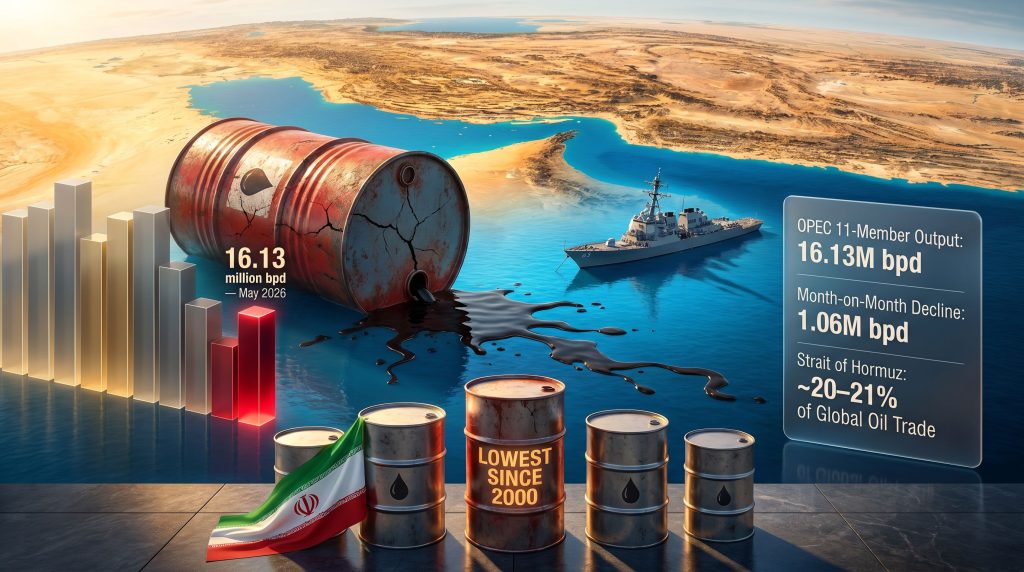
According to a Reuters survey published in June 2026, OPEC's collective output across its 11 active members fell to 16.13 million barrels per day (bpd) in May 2026, representing a month-on-month contraction of 1.06 million bpd. This figure, compiled using flow data from LSEG alongside tracking intelligence from providers including Kpler and information from oil company and consultant sources, represents the lowest monthly OPEC output reading since at least 2000 based on Reuters' survey methodology.
To appreciate the full weight of that figure, consider the comparison table below:
| Period | Approx. OPEC Output | Primary Driver | Shock Type |
|---|---|---|---|
| 1998 Asian Financial Crisis | ~26 million bpd | Demand weakness | Demand-side |
| Gulf War (1990-91) | ~20-21 million bpd | Kuwait/Iraq conflict | Geopolitical, supply-side |
| COVID-19 Peak (April 2020) | ~22-24 million bpd | Demand collapse | Demand-side, temporary |
| May 2026 | 16.13 million bpd (11-member) | U.S.-Iran conflict + Hormuz restriction | Geopolitical, supply-side |
The COVID-19 comparison is particularly instructive. During the pandemic's peak disruption in 2020, demand destruction was so severe that OPEC output fell sharply, yet the 2026 figure sits materially below those pandemic-era lows. The Middle East Economic Survey (MEES) applies a slightly different measurement framework, placing the 2026 trough at approximately 17.04 million bpd, a figure some analysts align with output levels last recorded in August 1990 during the Gulf War.
Bloomberg's broader OPEC definition produced a figure closer to 20.55 million bpd, but even under this wider lens the reading represents a multi-decade low. The methodological variance across survey providers reflects a rarely discussed complexity in OPEC output reporting: different organisations apply different definitions of what counts as output versus exports, treat condensate inclusion inconsistently, and apply varying member compositions. For traders and analysts, this creates a data interpretation challenge where the headline figure can vary by several million barrels per day depending on the source.
The Dual-Shock Mechanism: How One Conflict Became a Multilateral Supply Event
The U.S. Naval Blockade and Its Direct Impact on Iranian Production
The U.S. naval blockade on Iran commenced on April 13, 2026, immediately suppressing Iranian crude and condensate export flows. According to the Reuters survey, Iran recorded the single largest country-level production decline within OPEC during May 2026, with exports of crude oil and condensate falling to their lowest point in at least six years. This is a categorically different kind of supply withdrawal from a voluntary production cut or quota-based restraint.
It operates entirely outside OPEC's internal governance architecture and cannot be modulated through cartel decision-making. Furthermore, a critical and often underappreciated dynamic here is the nature of Iran's condensate production. Iran operates some of the world's largest natural gas condensate fields, and condensate exports have historically been a significant revenue stream that sits in a grey zone between crude oil and refined product classification.
The Strait of Hormuz Chokepoint and the Cascade Effect
Iran's effective restriction of Strait of Hormuz traffic transformed what began as a bilateral U.S.-Iran confrontation into a regional supply event affecting Gulf-based OPEC members simultaneously. The Strait handles an estimated 17 to 21 million bpd of crude oil, refined products, and LNG under normal operating conditions, representing roughly 20 to 21 percent of global oil trade. No viable alternative routing exists for the majority of Gulf export volumes at scale.
The Strait of Hormuz is not simply a shipping lane. It is the single point through which Saudi Arabia, Kuwait, Iraq, and the UAE channel the overwhelming majority of their hydrocarbon export revenue. Any sustained restriction converts a bilateral conflict into a fiscal crisis for multiple sovereign economies simultaneously.
This chokepoint multiplier effect explains why the aggregate OPEC output decline extended far beyond Iran's individual production numbers. Consequently, Saudi Arabia recorded a further output decline during May 2026, a consequence of export logistics being compressed by Strait restrictions rather than any voluntary production decision by Riyadh. These geopolitical and logistical factors proved far more influential than any cartel-level decision-making in shaping the final output figures.
Member-Level Divergence: Not All OPEC Producers Were Equally Exposed
The geographic architecture of the disruption created stark asymmetries across OPEC membership, with Gulf-based producers absorbing the full impact while West African and Latin American members partially offset the collective decline.
| OPEC Member | Output Direction (May 2026) | Primary Driver |
|---|---|---|
| Iran | Sharp decline | U.S. naval blockade; export embargo |
| Saudi Arabia | Further decline | Strait of Hormuz export disruption |
| Iraq | Modest increase | Elevated domestic consumption; partial routing alternatives |
| Venezuela | Increase | Geographically insulated from Gulf chokepoint |
| Nigeria | Increase | West African production unaffected by Gulf conflict |
| UAE | Excluded from survey | Departed OPEC effective May 1, 2026 |
Iraq's ability to modestly increase supply reflected a combination of elevated domestic crude utilisation reducing net export pressure, and partial access to pipeline and southern terminal logistics that bypassed the most acute Strait constraints. Venezuela and Nigeria, geographically removed from the Gulf entirely, faced no operational impediment and were able to raise output volumes, providing a partial but insufficient cushion against Gulf losses.
The UAE's exclusion from the May 2026 survey data deserves particular attention. The UAE formally departed OPEC effective May 1, 2026, meaning its production volumes are no longer captured within the cartel's collective figures. This structural exclusion mechanically reduces the OPEC headline number independent of any production change, adding a statistical dimension to the apparent output collapse that is distinct from the conflict-driven declines affecting Iran and Saudi Arabia.
When Cartel Policy Meets Operational Reality: The OPEC+ Coordination Failure
Perhaps the most revealing dimension of the May 2026 data is what it exposes about the limits of cartel-based supply management under geopolitical stress. Prior to the escalation of the U.S.-Iran conflict, eight OPEC+ member nations had formally committed to raising collective output during May 2026. That agreement became operationally undeliverable for Gulf-based members the moment the Strait of Hormuz was effectively closed to normal traffic.
This creates a governance vulnerability that OPEC+ has never fully resolved. Indeed, OPEC's market influence depends fundamentally on member states retaining sovereign operational capacity, a condition that geopolitical conflict can rapidly eliminate:
- Production quota agreements presuppose baseline operational sovereignty across all member states
- External military conflict or naval interdiction eliminates that baseline condition without triggering any formal OPEC+ policy response mechanism
- Non-Gulf OPEC+ members, including Russia and Kazakhstan, face no equivalent operational constraint, producing asymmetric compliance outcomes that are structurally misleading when aggregated at the cartel level
- The credibility gap between agreed targets and actual output widens market uncertainty, forcing traders and importers to develop independent supply scenario models rather than anchoring on OPEC+ forward guidance
When geopolitical disruption severs the link between agreed production policy and physical delivery capability, OPEC+ forward commitments lose their function as reliable market signals. This is not a governance failure in the traditional sense but rather a structural limitation of any cartel operating across sovereign entities with divergent security exposures.
Three Forward Scenarios for Global Oil Markets
Scenario 1: Prolonged Disruption and Structural Supply Deficit
If U.S.-Iran tensions and Strait of Hormuz restrictions persist through Q3 2026 and beyond, global markets face a supply deficit that non-OPEC producers cannot rapidly bridge. U.S. shale operators can respond incrementally within 60 to 90 days given sufficient rig count deployment and capital authorisation, but investor capital discipline constraints limit the scale of response. Brazilian pre-salt and Guyanese deepwater production, while structurally insulated from Gulf disruption, operates on development lead times measured in years rather than weeks.
Scenario 2: Rapid De-escalation and Delayed Normalisation
A negotiated resolution between the U.S. and Iran, or a bilateral ceasefire, could restore Iranian export capacity and reopen Strait traffic relatively quickly in physical terms. However, war risk insurance repricing, tanker routing recalibration, and cargo financing disruption would delay full market normalisation by weeks to months even after a political agreement is reached. Kuwait's KPC resuming spot fuel cargo offerings in the aftermath of the Iran conflict represents an early indicator of normalisation activity already testing market readiness in Gulf energy corridors.
Market analysis referenced by Zawya suggests Saudi Arabia's oil sector is positioned for a strong 2027 rebound, with normalised output potentially restored by September 2026, implying a recovery window of approximately three to five months from peak disruption under a constructive scenario. This projection carries significant uncertainty and should be treated as an indicative estimate rather than a confirmed timeline.
Scenario 3: Structural OPEC Realignment
The UAE's departure from OPEC on May 1, 2026 may prove to be a leading indicator rather than an isolated event. If additional high-capacity Gulf producers assess that OPEC membership offers diminishing strategic value in a world where collective output is repeatedly vulnerable to external geopolitical shocks, the cartel's market share representation and price-setting authority could erode structurally over a multi-year horizon.
This scenario accelerates a transition toward bilateral sovereign energy agreements and sovereign wealth fund-mediated supply diplomacy as functional alternatives to collective quota management. In addition, revised OPEC demand forecasts may further complicate the cartel's ability to present unified forward guidance to global markets.
The next major ASX story will hit our subscribers first
Regional Vulnerability and Sovereign Credit Resilience
The distributional impact of the OPEC output shock is highly uneven across consuming regions:
| Region | Exposure Level | Key Risk Factor |
|---|---|---|
| East Asia (Japan, South Korea, India) | Very High | Heavy Gulf crude import dependency via Strait of Hormuz |
| Europe | Moderate to High | Diversified supply but elevated LNG and refined product costs |
| United States | Low to Moderate | Domestic production buffers; strategic reserve access |
| Sub-Saharan Africa | Moderate | Import dependency; limited strategic reserve capacity |
| GCC Non-Conflict States | High (short-term) | Export infrastructure disruption; fiscal revenue pressure |
Despite the severity of the output shock, GCC sovereign credit profiles have demonstrated notable resilience. Sovereign wealth fund buffers, diversified fiscal frameworks, and reserve depth provide short-to-medium-term insulation against disruption. A disruption of three to six months does not immediately threaten the creditworthiness of major Gulf sovereigns, though an event extending beyond twelve months would stress budget assumptions built on normalised production volumes. Reporting from Zawya confirmed that GCC credit profiles remained resilient despite the prolonged nature of the U.S.-Iran conflict.
What the 2026 Event Reveals About the Future of Energy Security Architecture
The OPEC oil output lowest since 2000 reading ultimately functions as more than a data point in a monthly survey. It represents a stress test of every assumption embedded in contemporary global energy security planning: that cartel coordination provides a reliable supply floor, that the Strait of Hormuz remains a managed risk rather than an active vulnerability, and that geopolitical disruptions are short-duration events with predictable recovery trajectories.
None of those assumptions survived May 2026 intact. Furthermore, the broader oil market disruption context reinforces how interconnected trade tensions and energy security vulnerabilities have become in this era. According to EIA data on OPEC supply dynamics, the structural capacity constraints now facing Gulf producers represent a categorically different challenge from any previous supply management cycle.
Strategic Petroleum Reserve mechanisms provide a buffer measured in weeks to months, not the duration required to absorb a multi-month Gulf supply disruption. Non-OPEC swing capacity is constrained by capital discipline, lead times, and investor mandates in ways that prevent rapid large-scale compensation. And OPEC+ coordination frameworks, however sophisticated in design, cannot override the physical reality of a militarised maritime chokepoint.
Disclaimer: This article contains forward-looking projections, scenario analysis, and market commentary drawn from publicly available sources including Reuters and Zawya. All production forecasts and recovery timelines represent estimates subject to significant geopolitical uncertainty and should not be construed as investment advice. Readers are encouraged to consult primary data sources and independent financial advisors before making investment or procurement decisions based on energy market analysis.
Want to Capitalise on the Market Volatility Created by Major Supply Disruptions?
When geopolitical shocks reshape global commodity markets, identifying actionable opportunities quickly becomes critical — Discovery Alert's proprietary Discovery IQ model delivers real-time alerts on significant ASX mineral discoveries, turning complex market signals into clear, actionable insights for investors at every level. Explore how historic mineral discoveries have generated substantial returns and begin your 14-day free trial today to position yourself ahead of the next major market move.