August 6, 2026
The Strategic Chess Game: Understanding OPEC Production Cuts 2026 in Today's Energy Landscape
Global energy markets face unprecedented complexity as supply chains evolve and geopolitical tensions reshape traditional production strategies. The delicate balance between maintaining market stability and preserving long-term competitive positioning has never been more critical for oil-producing nations. Understanding these underlying forces requires examining how international energy coalitions navigate between immediate revenue needs and strategic market share preservation, particularly as OPEC production cuts 2026 become a focal point for market participants.
When big ASX news breaks, our subscribers know first
What Drives OPEC+ Production Decisions in a Volatile 2026 Market?
The fundamental mechanics of oil market management centre on sophisticated supply-demand calculations that extend far beyond simple production quotas. Energy analysts consistently point to the mathematical precision required in balancing global output levels against consumption patterns, particularly when considering seasonal variations and economic growth projections across major consuming regions.
Furthermore, the OPEC meeting impact continues to resonate throughout global markets, influencing both short-term trading patterns and long-term investment strategies.
Supply-Demand Fundamentals Reshaping Oil Strategy
Market dynamics reveal a complex interplay between established production capabilities and emerging supply sources worldwide. Traditional oil-producing regions must now account for significant output from unconventional sources, including shale formations and deepwater developments that have fundamentally altered global supply patterns over the past decade.
The economic principle of elasticity plays a crucial role in production planning, as different crude oil grades respond variably to price fluctuations. Heavy crude varieties require substantial infrastructure investments and processing capabilities, making them less responsive to short-term market signals compared to lighter, more easily refined products.
Moreover, oil price movements demonstrate the intricate relationship between geopolitical developments and energy market stability across different regional markets.
IEA Projections vs. Current OPEC+ Output Levels
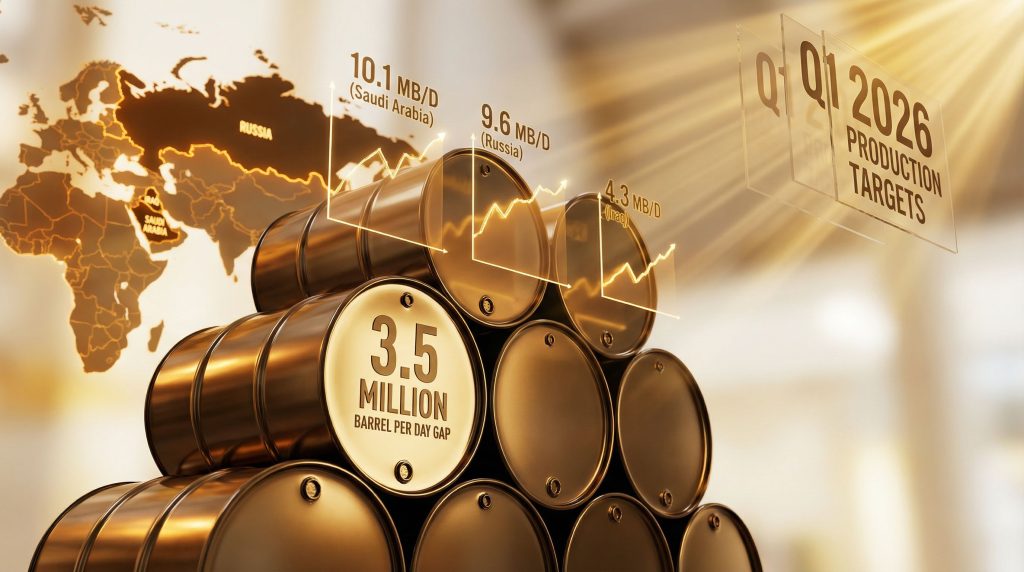
International Energy Agency assessments indicate the world requires approximately 25.6 million barrels per day from OPEC members during 2026, contrasting sharply with November production levels of 29.1 million barrels per day. This mathematical discrepancy creates a potential oversupply scenario of 3.5 million barrels per day that could significantly impact global pricing mechanisms.
The gap between projected demand and current production capacity highlights the challenge facing energy policymakers in maintaining price stability while preserving market share against non-OPEC competitors. This balance becomes particularly complex when considering the seasonal nature of refinery maintenance and varying regional consumption patterns.
The 3.5 Million Barrel Per Day Gap Analysis
The substantial production surplus presents multiple strategic options for market management. Historical precedent suggests that sustained oversupply conditions typically result in coordinated production adjustments, though the timing and magnitude of such changes depend on numerous geopolitical and economic factors.
Market participants recognise that managing this excess capacity requires careful coordination among diverse national interests, each with distinct fiscal requirements and domestic political considerations. The challenge lies in achieving consensus while maintaining operational flexibility to respond to unexpected market developments.
How Will Q1 2026 Production Freeze Impact Global Oil Prices?
Production policy decisions implemented during early 2026 demonstrate the strategic approach to market management through controlled supply adjustments. The decision to maintain unchanged output levels reflects confidence in demand recovery patterns while acknowledging the need for price stability in volatile trading environments.
According to recent reports from Reuters, OPEC+ members are maintaining their current production levels despite ongoing market volatility, signalling a strategic commitment to OPEC production cuts 2026 policies.
Eight-Nation Coalition Production Targets Through March
The coordinated approach involving Saudi Arabia, Russia, Iraq, United Arab Emirates, Kuwait, Kazakhstan, Algeria, and Oman represents a significant portion of global production capacity. These nations collectively control substantial market influence, making their production decisions critical for international price formation and supply chain stability.
Key Coalition Members Production Overview:
• Saudi Arabia: Maintains leadership role with extensive spare capacity
• Russia: Contributes significant volume despite ongoing geopolitical challenges
• Iraq: Balances reconstruction needs with production capacity
• UAE: Leverages strategic geographic positioning
• Kuwait: Focuses on maintaining consistent output levels
• Kazakhstan: Manages pipeline access and export logistics
• Algeria: Coordinates with European market demands
• Oman: Optimises production from mature field developments
Brent Crude Price Trajectory Under Current Policy
Price formation in international markets reflects the complex interaction between production policies and global economic conditions. Current policy frameworks suggest potential movement toward lower price levels unless demand patterns strengthen significantly or geopolitical factors create supply disruptions.
Market analysts anticipate that sustained production levels without corresponding demand increases could pressure Brent crude pricing toward the $50-60 per barrel range. This price environment would likely trigger reassessment of production strategies, particularly among nations with higher fiscal break-even requirements.
In addition, WTI & Brent insights provide valuable context for understanding how different crude benchmarks respond to production policy changes and market sentiment shifts.
Market Share vs. Price Stability Trade-offs
The fundamental tension between maintaining market share and supporting price levels creates ongoing strategic dilemmas for producing nations. Higher prices benefit revenue generation but may accelerate market share losses to competitive suppliers, while lower prices preserve market position at the cost of immediate fiscal returns.
This trade-off becomes particularly complex when considering long-term investment requirements for field development and infrastructure maintenance. Sustained low-price environments can undermine future production capacity through delayed capital expenditure programmes.
Why Non-OPEC Supply Growth Forces Strategic Recalibration
The emergence of significant production capacity outside traditional OPEC+ frameworks fundamentally alters global market dynamics. These developments require established producers to reassess their strategic positioning while maintaining competitive advantages in cost structure and market access.
US Shale Production Impact on Global Market Dynamics
American unconventional oil production has introduced unprecedented flexibility into global supply patterns. Unlike traditional conventional developments, shale operations can respond rapidly to price signals, creating a more dynamic supply response that complicates traditional market management approaches.
The technological advancement in horizontal drilling and hydraulic fracturing has enabled production from previously uneconomical formations, effectively adding millions of barrels per day to global supply potential. This technological revolution continues evolving, with efficiency improvements reducing break-even costs and shortening development timelines.
Guyana and Brazil's Rising Output Influence
South American production developments represent significant additions to Atlantic Basin supply, particularly important for refining centres in the United States and Europe. These projects benefit from modern technology and infrastructure, enabling competitive cost structures and high-quality crude production.
The strategic importance of these developments extends beyond volume considerations to include geopolitical diversification for consuming nations seeking to reduce dependence on traditional Middle Eastern suppliers. This diversification trend influences long-term market positioning for all major producers.
Seasonal Refinery Maintenance Patterns Affecting Demand
Understanding seasonal demand fluctuations requires detailed analysis of global refining operations and their maintenance schedules. Spring maintenance seasons traditionally reduce crude oil demand temporarily, while summer driving seasons and winter heating demands create predictable consumption patterns.
These cyclical patterns interact with economic growth rates and policy changes affecting fuel consumption across major markets. Climate policies promoting alternative energy sources add additional complexity to demand forecasting and production planning.
What Role Does Venezuelan Oil Play in 2026 Market Calculations?
Despite possessing the world's largest proven crude oil reserves, Venezuela's current market impact remains limited due to infrastructure constraints and production challenges. The country produced approximately 960,000 barrels per day in November, with domestic consumption of 400,000 barrels per day, resulting in net exports of only 560,000 barrels per day.
However, US–Venezuela relations continue evolving, potentially creating new opportunities for production capacity expansion and infrastructure investment.
Current Venezuelan Production Capacity vs. Reserve Potential
Venezuela holds approximately 303 billion barrels of proven crude oil reserves, representing roughly 17 percent of global reserves. However, the country contributes only 0.8 percent of total global crude oil production, highlighting the substantial gap between reserve potential and current operational capacity.
Historical production levels reached 2.4 million barrels per day in 2015, demonstrating the significant capacity decline over recent years. This production degradation results from infrastructure deterioration, technical expertise emigration, and sustained underinvestment in field development and maintenance operations.
The massive disparity between Venezuela's 17% share of global reserves and its 0.8% share of current production represents one of the most significant underutilised resource positions in the global energy sector, requiring substantial capital investment and technical expertise to realise meaningful production increases.
Infrastructure Investment Requirements for Production Recovery
Venezuelan crude oil grades rank among the world's heaviest, requiring 10-15 percent diluent additions for pipeline transportation. This technical characteristic substantially increases production costs and infrastructure complexity compared to lighter crude varieties produced elsewhere.
The deteriorated state of existing production, storage, and transportation infrastructure necessitates comprehensive rehabilitation before meaningful output increases become feasible. Industry specialists suggest that achieving 1.5 million barrels per day production levels remains technically possible within reasonable timeframes and costs, potentially adding 500,000 barrels per day to global supply.
Geopolitical Risk Assessment for International Capital
International investment in Venezuelan oil infrastructure faces substantial political and economic risks that complicate capital allocation decisions. Previous investments by Chinese entities reportedly suffered significant losses due to corruption and operational challenges, creating precedent concerns for future international partnerships.
The economic justification for major capital investments becomes questionable when oil prices trade around $60 per barrel, particularly considering the additional costs associated with heavy crude processing and transportation. American energy companies face complex decisions balancing potential returns against political risks and infrastructure requirements.
How Do Geopolitical Developments Influence OPEC+ Strategy?
International relations significantly impact energy market strategies, as producing nations must balance domestic interests with broader geopolitical considerations. These factors often override purely economic calculations in production decision-making processes.
Furthermore, OPEC's global influence extends beyond simple production decisions to encompass broader market management and strategic positioning initiatives.
US-Venezuela Relations Impact on Western Hemisphere Supply
Recent developments in US-Venezuela diplomatic relations create potential for significant changes in Western Hemisphere energy supply patterns. American officials indicate readiness for substantial infrastructure investments to rebuild Venezuelan production capacity, though implementation timelines and actual investment commitments remain uncertain.
The potential involvement of major American energy companies in Venezuelan operations could accelerate infrastructure rehabilitation and production recovery, though such developments depend on sustained political cooperation and favourable investment frameworks.
China-Venezuela Energy Partnerships Under Pressure
Chinese infrastructure investments in Venezuelan energy sector have faced substantial challenges, with reported losses due to corruption and operational difficulties. These experiences influence future international investment decisions and partnership structures in Venezuelan energy development.
The complex relationship between Chinese capital, Venezuelan resources, and American technology creates multiple scenarios for future development patterns, each with distinct implications for global supply balances and market competition.
Middle East Stability Factors in Production Planning
Traditional Middle Eastern producing regions maintain strategic advantages in production costs and infrastructure maturity, though regional stability concerns require careful risk management in long-term planning processes. These factors influence both production capacity development and market share strategies.
The interconnection between regional security conditions and energy infrastructure requires sophisticated risk assessment and contingency planning to maintain consistent supply capabilities under various geopolitical scenarios.
The next major ASX story will hit our subscribers first
What Economic Scenarios Could Trigger Production Policy Changes?
Economic modelling for energy markets requires consideration of multiple variables affecting both supply and demand dynamics. These models help predict potential trigger points for policy adjustments and strategic shifts in production management.
Price Threshold Analysis for Cut Implementation
Market analysis suggests that sustained Brent crude prices in the low $50s could trigger coordinated production reductions as producing nations seek to support revenue generation and maintain fiscal stability. These price levels typically fall below many nations' budget requirements, creating pressure for supply management actions.
The specific price thresholds vary among producing nations based on their individual fiscal requirements and production costs, though collective action typically occurs when broader consensus emerges regarding unsustainable price levels.
Market Share Recovery vs. Revenue Optimisation Models
Strategic decision-making involves complex calculations weighing immediate revenue needs against long-term market positioning. Revenue optimisation may favour production cuts to support prices, while market share preservation may require maintaining output levels despite temporary price weakness.
These competing priorities create ongoing tension within producing coalitions, requiring sophisticated negotiation and compromise to achieve coordinated policies that balance diverse national interests and economic requirements.
Global Economic Growth Projections and Oil Demand
Economic growth patterns across major consuming regions directly influence oil demand projections and production planning. Stronger economic performance typically correlates with increased energy consumption, while economic slowdowns reduce demand growth and pressure pricing levels.
Key Economic Indicators Influencing Oil Demand:
• Asian manufacturing activity and export volumes
• European industrial production and transportation demand
• North American economic growth and consumer spending
• Emerging market development and infrastructure investment
• Global trade volumes and shipping activity
Which Market Indicators Will Determine Mid-2026 Production Decisions?
Production policy adjustments typically respond to multiple market signals rather than single indicators, requiring comprehensive analysis of supply-demand balances, inventory levels, and forward market conditions.
According to industry analysis from Argus Media, the eight-nation coalition has reconfirmed its decision to maintain steady output through Q1, emphasising the strategic nature of current OPEC production cuts 2026 policies.
Inventory Level Monitoring Across Key Storage Hubs
Global crude oil inventory levels provide critical information about supply-demand balances and market tightness. Storage capacity utilisation rates at major hubs including Cushing, Rotterdam, and Singapore influence market sentiment and pricing dynamics.
Inventory trends often precede price movements, making them valuable leading indicators for production policy decisions. Sustained inventory builds typically signal oversupply conditions requiring potential production adjustments.
Asian Demand Recovery Patterns Post-Economic Slowdown
Asian markets represent the largest growth potential for global oil consumption, making regional demand patterns critical for production planning. Economic recovery rates in major consuming nations directly influence global demand projections and market balance calculations.
Industrial activity levels, transportation demand, and petrochemical consumption across the region provide important signals about underlying demand strength and future consumption trends.
European Energy Security Considerations
European energy policies balancing security concerns with environmental objectives create complex demand patterns affecting global oil markets. Policy changes promoting alternative energy sources or modifying supply diversification strategies influence long-term demand projections.
The interaction between energy security requirements and climate policy objectives continues evolving, creating both challenges and opportunities for traditional oil suppliers seeking to maintain market positions.
How Does OPEC+ Balance Long-term Market Share vs. Short-term Revenue?
Strategic planning for energy-producing nations requires careful consideration of time horizons and competing objectives, as short-term revenue maximisation may conflict with long-term market positioning goals.
Historical Precedents for Production Strategy Pivots
Historical analysis reveals multiple instances where producing nations adjusted strategies based on changing market conditions, competitive pressures, and economic requirements. These precedents provide valuable insights for current strategic planning and decision-making processes.
Previous market cycles demonstrate the importance of maintaining flexibility in production policies while preserving coalition cohesion and market credibility. Successful strategic pivots typically require careful communication and coordination among diverse stakeholder interests.
Member Nation Fiscal Break-even Price Analysis
Individual producing nations maintain distinct fiscal requirements based on their economic structures, government spending commitments, and production costs. These break-even calculations influence collective decision-making and policy coordination within producing coalitions.
Typical Fiscal Considerations for Producing Nations:
• Government budget requirements and social spending commitments
• Infrastructure development and maintenance costs
• Economic diversification investment needs
• Foreign currency reserve management
• Debt service and financing obligations
Competitive Response to Non-OPEC Supply Growth
The emergence of significant non-OPEC supply capacity requires strategic responses that preserve market relevance and competitive positioning. These responses may include cost reduction initiatives, technology adoption, or strategic partnership development.
Competitive strategies must balance immediate market share considerations with long-term sustainability and profitability requirements, creating complex optimisation challenges for producing nation policymakers.
What Are the Investment Implications of Extended Production Management?
Production policy decisions significantly influence capital allocation patterns and investment timing across global energy markets. Extended periods of managed production create both opportunities and challenges for various market participants.
Capital Allocation Strategies Under Uncertain Output Policies
Investment planning requires careful consideration of production policy stability and potential changes affecting project economics. Uncertainty regarding future output levels complicates long-term capital commitment decisions and project development timelines.
Strategic capital allocation must account for multiple scenarios regarding production policies, price environments, and competitive dynamics affecting project returns and risk profiles.
Upstream Development Timeline Adjustments
Extended production management periods may delay or accelerate upstream development projects depending on long-term strategic objectives and market positioning goals. These timing adjustments influence global supply capacity and competitive dynamics.
Project development decisions require sophisticated analysis of market conditions, technology advancement, and regulatory environments affecting implementation success and economic returns.
Energy Transition Considerations in Long-term Planning
Climate policy developments and energy transition trends increasingly influence traditional oil and gas investment decisions, requiring integrated analysis of environmental regulations and market evolution patterns.
Long-term planning must balance current market opportunities with evolving energy demand patterns and technological advancement affecting future market structures and competitive positioning.
Conclusion: Navigating the 2026 Oil Market Balancing Act
The complex interplay between supply management, geopolitical considerations, and economic pressures creates an intricate decision-making environment for global oil producers. Understanding these dynamics requires appreciation for both immediate market conditions and longer-term strategic positioning requirements, particularly as OPEC production cuts 2026 policies continue evolving.
Key Factors Shaping Production Policy Evolution
Market management success depends on maintaining flexibility while preserving coalition cohesion and credibility. The ability to respond effectively to changing conditions while maintaining strategic objectives represents a critical capability for sustained market influence.
Technological advancement, geopolitical development, and economic policy changes continue creating new challenges and opportunities requiring adaptive strategies and sophisticated analysis capabilities.
Strategic Priorities for Market Stability
Achieving sustainable market stability requires balancing multiple competing interests and maintaining effective communication among diverse stakeholders. This balance becomes increasingly complex as global energy markets evolve and new participants influence traditional dynamics.
The integration of environmental considerations, technological innovation, and economic development needs creates additional complexity requiring comprehensive policy frameworks and strategic planning capabilities.
Forward-Looking Risk Assessment Through 2026
Risk management for energy markets requires continuous monitoring of multiple variables affecting supply, demand, and pricing dynamics. Successful navigation of these challenges depends on maintaining analytical capabilities and strategic flexibility to respond to unexpected developments.
The evolving global energy landscape presents both significant challenges and substantial opportunities for market participants willing to adapt their strategies and maintain focus on long-term sustainability and competitive positioning requirements.
Disclaimer: This analysis is based on publicly available information and industry reports. Oil market projections and production forecasts involve significant uncertainty and should not be considered as investment advice. Market conditions, geopolitical factors, and economic circumstances can change rapidly, affecting actual outcomes differently than projected scenarios.
Looking for Trading Opportunities in the Energy Sector?
Discovery Alert's proprietary Discovery IQ model delivers real-time alerts on significant ASX mineral discoveries, instantly empowering subscribers to identify actionable opportunities ahead of the broader market. Begin your 30-day free trial today and secure your market-leading advantage.