July 9, 2026
The Quiet Unraveling of a Cartel: What the Numbers Behind OPEC+'s June Decision Actually Reveal
Oil market coordination has never been a straightforward exercise. Since the formation of the original OPEC cartel in 1960, the fundamental tension within any producer alliance has remained constant: individual nations pursue maximum revenue and capacity utilisation, while the collective framework demands restraint and shared sacrifice. For decades, that tension was manageable. In May 2026, however, it became structurally irreversible.
The OPEC+ production increase after UAE departure has generated considerable market commentary, but most analysis has focused on the headline figure rather than the deeper architecture of what the decision represents. Understanding the June 2026 output adjustment requires stepping back from the 188,000 barrel-per-day number and examining the institutional forces, capacity gaps, and geopolitical windows that made this moment inevitable. Furthermore, oil market geopolitics have been shifting steadily, making this development part of a broader structural story.
When big ASX news breaks, our subscribers know first
The Capacity Gap That Changed Everything
For years, the UAE operated within an OPEC+ quota framework that bore increasingly little relationship to its actual production capabilities. By the time Abu Dhabi announced its formal departure on April 28, 2026, the arithmetic had become unsustainable.
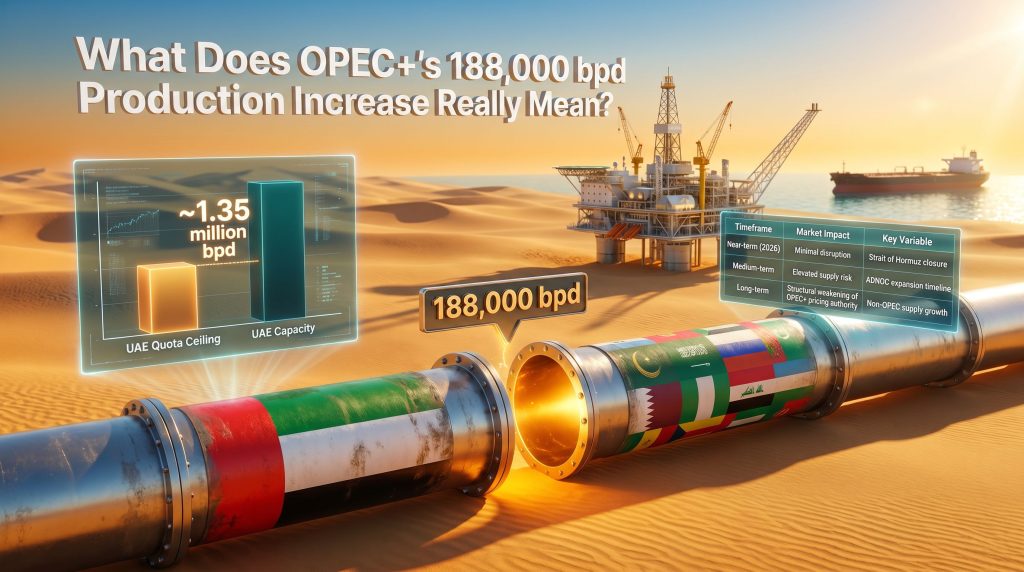
The UAE had developed production capacity of approximately 4.85 million barrels per day, with ADNOC's infrastructure investments targeting a ceiling of 5 million bpd by 2027. Against that operational reality, the country's OPEC+ quota ceiling sat at roughly 3.5 million bpd, a constraint that effectively left 1.35 million bpd of production capacity idle due to alliance obligations rather than geological or commercial limitations.
To put that gap in perspective: the unutilised capacity representing Abu Dhabi's OPEC+ sacrifice was equivalent to roughly 38% of the UAE's total production capability. For a national oil company with explicit expansion mandates and a government treasury dependent on hydrocarbon revenues, sustaining that level of self-imposed constraint required extraordinary institutional loyalty. That loyalty, accumulated over decades of alliance membership, finally exhausted itself.
The UAE's departure was not a spontaneous decision. It was the endpoint of a long-running calculation about whether the benefits of OPEC+ membership continued to outweigh the cost of suppressed output. The Iran conflict simply provided the geopolitical cover to act.
The UAE formally withdrew from OPEC+ on May 1, 2026, simultaneously announcing its departure from the Organisation of Arab Petroleum Exporting Countries (OAPEC), a body that groups Arab OPEC members alongside a handful of others including Egypt and Syria. The dual withdrawal signalled a comprehensive strategic repositioning rather than a narrow oil policy dispute.
Breaking Down the 188,000 bpd OPEC+ Production Agreement
Within hours of the UAE's formal exit, the remaining OPEC+ membership convened via video conference and confirmed a production adjustment that had been broadly anticipated before Abu Dhabi's departure announcement. The agreement finalised a 188,000 bpd increase in collective June output, driven by seven nations led by Saudi Arabia and Russia.
The Structure of the June Agreement
| Country Group | Role in June Agreement | Key Consideration |
|---|---|---|
| Saudi Arabia | Lead coordinator | Quota restoration continuity |
| Russia | Co-anchor of alliance | Geopolitical and economic signalling |
| Five additional members | Supporting the increase | Subject to Hormuz export infrastructure |
The agreement represents a continuation of OPEC+'s multi-year output restoration process, a process that had been underway before regional conflict escalated. This context is crucial: the June adjustment was not a reactive policy shift triggered by the UAE's exit. Rather, it was a pre-existing restoration trajectory that the alliance chose to maintain as-is, deliberately excluding the UAE from the calculation.
Consequently, accelerated OPEC output hikes in recent months had already established a pattern of incremental increases that this latest decision simply continued. OPEC's official statement made no reference to the UAE's departure whatsoever. That omission was deliberate. By treating the production decision as routine business, the organisation communicated institutional continuity to markets without acknowledging the scale of the membership loss.
Why Implementation Remains Largely Theoretical
The June production increase faces a critical physical constraint that transforms it from a supply-market mechanism into something closer to an organisational statement of intent. The Strait of Hormuz, the waterway through which Persian Gulf crude exports must transit, remains effectively closed due to the ongoing U.S.-Israeli conflict with Iran.
The practical consequences are significant:
- Any quota increase allocated to Middle Eastern producers cannot physically reach global markets until the strait reopens
- The June increase mirrors the same implementation barrier that constrained the May output decision, creating consecutive months of nominal policy adjustments that lack delivery infrastructure
- Even if member nations technically produce additional barrels in line with the quota adjustment, those volumes have no export pathway under current geopolitical conditions
- The conditionality embedded in the agreement effectively defers real supply impact to an undefined future point tied to conflict resolution
Jorge Leon, head of geopolitical analysis at Rystad Energy and a former OPEC secretariat employee, characterised the alliance's approach as a deliberate strategy of projecting normalcy. His assessment, reported by Bloomberg on May 1, 2026, framed OPEC+'s decision as institutional messaging designed to downplay internal fractures rather than a genuine supply management intervention. By proceeding with the same production path minus the UAE, the group communicated that its policy framework remained intact regardless of membership changes.
How the UAE's Exit Structurally Weakens OPEC+'s Pricing Authority
The June OPEC+ production increase after UAE departure carries implications that extend well beyond the immediate quota numbers. The departure removes a nation with nearly 5 million bpd of production capacity from the collective quota framework, reducing the proportion of coordinated global supply that OPEC+ can effectively manage.
This matters because OPEC's global influence over oil prices is a function of its share of global production. As non-OPEC supply, particularly from US shale, has grown substantially over the past decade, the cartel's capacity to act as a price floor mechanism has progressively diminished. The UAE's exit accelerates this structural erosion.
The post-exit supply dynamics create an asymmetric risk scenario:
- OPEC+ members remain bound by quota ceilings and face political costs for non-compliance
- The UAE operates with zero quota obligations the moment the Strait of Hormuz reopens
- ADNOC's announced 200 billion UAE dirhams ($55 billion) in project awards spanning upstream and downstream operations signals aggressive capacity expansion, not a gradual ramp-up
- The $55 billion commitment represents an acceleration of a larger pre-existing capital programme, indicating that ADNOC's expansion trajectory was already funded and planned before the OPEC+ exit
Once export infrastructure reopens, the UAE will face a unique combination of circumstances: maximum production readiness, zero quota constraints, and a fully funded expansion programme. That convergence creates genuine potential for supply acceleration that OPEC+ has no mechanism to counterbalance.
The Geopolitical Architecture Behind Abu Dhabi's Calculated Exit
The UAE's departure was the culmination of long-running policy friction between Abu Dhabi and Riyadh, tensions rooted not only in oil strategy but in broader regional competition for economic and political influence. Saudi Arabia, as OPEC's de facto leader, has historically prioritised collective output discipline. The UAE, in contrast, has increasingly prioritised production growth aligned with ADNOC's international expansion ambitions.
These divergent strategic orientations created persistent friction within the alliance's quota negotiation processes. The capacity-to-quota gap described above was not a recent development; it had been widening for years as ADNOC invested heavily in capacity expansion while OPEC+ quotas constrained monetisation of that investment.
The Iran conflict created what Abu Dhabi explicitly characterised as a geopolitical window for departure. With Persian Gulf exports already disrupted by Strait of Hormuz restrictions, the UAE could exit the alliance without adding materially to immediate market volatility. The timing transformed a potentially disruptive defection into a strategically managed withdrawal. In addition, the trade war impact on oil markets had already introduced considerable price uncertainty, further complicating the alliance's cohesion calculus.
One OPEC+ delegate raised the UAE's withdrawal directly during the May 1 video conference. The broader group responded by emphasising collective cohesion, a response pattern that itself reveals the fragility underlying the alliance's public messaging. When the primary response to a major membership departure is reasserting unity rather than substantively addressing the cause, it signals that internal consensus is more managed narrative than operational reality.
Near-Term vs. Long-Term Market Impact: A Framework for Assessment
Analysts at Wood Mackenzie assessed that the UAE's departure carries minimal immediate disruption to supply fundamentals through 2026. This assessment aligns logically with the physical constraints: if Hormuz remains closed, neither OPEC+ members nor the UAE can meaningfully increase market supply regardless of their quota positions.
The more consequential market dynamics emerge in the post-conflict environment:
| Timeframe | Market Impact Assessment | Key Variable |
|---|---|---|
| Near-term (2026) | Minimal disruption to fundamentals | Strait of Hormuz closure limits export capability |
| Medium-term (post-conflict) | Elevated supply risk from UAE production ramp-up | ADNOC expansion timeline and capital deployment |
| Long-term | Structural weakening of OPEC+ pricing coordination | Non-OPEC supply growth compounding quota erosion |
Three Scenarios for UAE Production After Hormuz Reopening
When Strait of Hormuz access does restore, the UAE's unconstrained production position creates distinct market pathways:
- Gradual ADNOC expansion aligned with the existing $55 billion capital expenditure timeline, where output increases incrementally as infrastructure investments become operational
- Accelerated production targeting 5 million bpd by 2027, the trajectory implied by ADNOC's own stated capacity goals, which could function as a de facto price war trigger if OPEC+ members simultaneously attempt supply restoration
- Coordinated non-OPEC+ supply convergence, where UAE expansion coincides with recovery in US shale output and other non-aligned producers, creating a simultaneous supply surge that overwhelms any remaining OPEC+ price management capacity
The precedent dimension is also significant. If the UAE successfully expands output and revenues increase relative to its OPEC+ period, other high-capacity members facing similar quota constraints may reassess whether continued membership serves their national interests. Iraq and Kazakhstan, both of which have struggled with OPEC+ compliance due to domestic fiscal pressures, represent potential pressure points in the alliance's long-term cohesion.
The next major ASX story will hit our subscribers first
OPEC+'s Institutional Messaging Strategy: Projecting Stability Under Pressure
The deliberate exclusion of any UAE reference from OPEC's official statement represents a calculated communications decision. Acknowledging the departure would require explaining its causes, its implications for quota architecture, and the alliance's response framework. By treating the June production decision as routine, the organisation avoids that explanatory burden entirely.
This strategy has historical precedent within commodity producer alliances. When membership fractures occur, the institutional response frequently prioritises narrative coherence over transparency, in part because markets reward stability signals and punish uncertainty. OPEC+ leadership understands that any visible internal disarray translates directly into oil price volatility, which undermines the revenue interests of all remaining members.
The June 7, 2026 meeting will provide the clearest signal of whether this messaging strategy has genuine operational backing. If Saudi Arabia and Russia can maintain compliance among remaining members and prevent further defection discussions, the institutional framework may stabilise despite the UAE's absence. However, if the meeting surfaces additional compliance disputes or departure considerations, it would suggest the UAE's exit has triggered a recalibration of membership calculations across the alliance.
Furthermore, concerns about oil prices amid trade war conditions add yet another layer of complexity, as demand-side pressures compound the supply-side uncertainties that the UAE's exit has introduced. Gulf News also reported that OPEC's first production decision post-UAE exit was explicitly framed around projecting stability, reinforcing the institutional messaging strategy described above.
Maintaining a pre-scheduled production increase, even one constrained by physical logistics, allows OPEC+ to project institutional continuity. The decision communicates that the alliance's policy framework remains intact regardless of membership changes. Whether markets continue accepting that framing depends on how long the gap between policy announcements and actual deliverable barrels persists.
FAQ: OPEC+ Production Increase and UAE Departure
Why did the UAE leave OPEC+ in 2026?
The departure reflected years of accumulated tension between Abu Dhabi's production growth ambitions and the quota ceiling constraints imposed by OPEC+ membership. With production capacity reaching approximately 4.85 million bpd against a quota ceiling of roughly 3.5 million bpd, the UAE was sacrificing roughly 1.35 million bpd of monetisable output. The Iran conflict provided geopolitical cover for a strategically timed exit with limited immediate market disruption.
What is the 188,000 bpd production increase and who does it apply to?
The increase represents a collective quota adjustment across seven nations, led by Saudi Arabia and Russia, implemented for June 2026 production. It continues a pre-existing restoration process that was underway before regional conflict began, and does not represent a new expansionary policy.
Will the June 2026 OPEC+ output increase actually reach global markets?
Under current conditions, no. The Strait of Hormuz blockade prevents Persian Gulf producers from exporting incremental production. The June increase is largely nominal until export infrastructure is restored through conflict resolution.
How does the Strait of Hormuz closure affect OPEC+ quota implementation?
The strait functions as the primary export corridor for Persian Gulf crude. Its closure by the U.S.-Israeli conflict with Iran creates a physical barrier between quota decisions and market delivery, meaning production increases remain theoretical regardless of alliance commitments.
What does ADNOC's $55 billion investment programme mean for future oil supply?
The capital commitment signals ADNOC's intention to expand production capacity independently of OPEC+ constraints. Spanning upstream and downstream operations, the programme represents an acceleration of a larger pre-existing plan, indicating that UAE output growth was always the strategic objective regardless of alliance membership.
Is OPEC+ at risk of further member departures following the UAE's exit?
The risk is real but uncertain. Members with significant capacity-to-quota gaps, fiscal pressures, or strategic growth ambitions may reassess membership value if the UAE's post-exit production expansion generates superior revenue outcomes. The June 7 meeting will provide early signals of internal cohesion.
When does OPEC+ next meet to reassess production policy?
The alliance's next formal meeting is scheduled for June 7, 2026.
Key Takeaways: What the June Decision Actually Represents
| Theme | Core Insight |
|---|---|
| Quota decision | 188,000 bpd increase across seven nations, largely symbolic under current logistics |
| UAE capacity gap | Approximately 1.35 million bpd between quota ceiling and production capability |
| ADNOC investment | $55 billion capital programme signals post-OPEC+ unilateral expansion |
| Hormuz constraint | Physical export blockage limits near-term implementation for all Middle Eastern producers |
| Alliance cohesion | Internal fractures actively managed through deliberate institutional messaging |
| Long-term risk | UAE's unconstrained ramp-up potential creates significant future price coordination challenges |
The OPEC+ production increase after UAE departure is best understood not as a supply event, but as an institutional communication. The 188,000 bpd figure communicates continuity. The exclusion of UAE references communicates organisational stability. The June 7 meeting date communicates forward planning. None of these signals, however, address the structural reality: an alliance that once coordinated output representing a majority of global supply is progressively losing its capacity to function as an effective price management mechanism.
Disclaimer: This article is intended for informational purposes only and does not constitute financial or investment advice. Oil market conditions, geopolitical developments, and production forecasts are subject to rapid change. Readers should conduct independent research and consult qualified advisors before making investment decisions. Forward-looking statements and scenario projections involve inherent uncertainty and should not be interpreted as predictions of specific market outcomes.
Want to Stay Ahead of the Next Major Commodity Market Shift?
While oil market dynamics and OPEC+ structural changes command attention, significant commodity discoveries on the ASX can offer equally compelling opportunities — and Discovery Alert's proprietary Discovery IQ model delivers real-time alerts the moment major mineral discoveries are announced, ensuring subscribers can act before the broader market catches on. Explore historic discovery returns on Discovery Alert's dedicated discoveries page and begin a 14-day free trial to position yourself ahead of the next significant market move.