May 17, 2026
OPEC+ Production Strategy Shifts Focus to Market Stability
The OPEC+ production pause 2026 represents a calculated response to deteriorating market fundamentals rather than a strategic pivot toward higher prices. Global energy markets face unprecedented complexity as supply-demand dynamics undergo fundamental restructuring, with traditional oil market cycles evolving beyond simple production adjustments. This three-month supply freeze for the first quarter of 2026 reflects the alliance's acknowledgment that rapid production recovery has created oversupply conditions that threaten price stability.
When big ASX news breaks, our subscribers know first
What Does OPEC+'s 2026 Production Freeze Signal for Global Energy Markets?
The decision, confirmed through video conferences in late November 2025, demonstrates how the 22-nation group now prioritises market equilibrium over aggressive market share recapture. This strategic recalibration acknowledges that booming Americas supply combined with their own output increases has exceeded global demand growth.
Understanding the Strategic Shift from Growth to Stability
The production pause signals OPEC+'s recognition that booming Americas supply combined with their own output increases has exceeded global demand growth. This strategic recalibration acknowledges that the alliance's earlier market share reclamation strategy, initiated in April 2025, achieved its objective of competing with U.S. shale producers but at the cost of significant price deterioration.
Oil futures declined 15% during 2025, trading near $63 per barrel by late November. Furthermore, this oil price stagnation reflects broader market concerns about oversupply conditions.
Market analysts interpret this shift as risk-averse positioning during a period of rapid market outlook deterioration. The alliance has demonstrated that stability now outweighs ambition when facing structural oversupply conditions. This strategic evolution reflects lessons learned from the market share wars of previous cycles, where aggressive production increases often resulted in prolonged price weakness that strained producer budgets.
Key Economic Indicators Driving the Decision
Several converging economic pressures influenced the OPEC+ production pause 2026 decision:
• Supply surplus projections: The International Energy Agency forecasts record glut conditions in 2026
• Financial institution consensus: Goldman Sachs and JPMorgan Chase project continued futures price declines
• Seasonal market weakness: Q1 typically experiences reduced demand from winter-to-spring transition
• Production capacity constraints: Some members struggle to achieve announced output targets
• Compliance variations: Monthly increases have been smaller than advertised volumes due to overproduction compensation
The decision reflects OPEC+'s assessment that seasonal market conditions will remain weak through the first quarter, requiring production restraint to prevent further price deterioration. This represents a more sophisticated approach to supply management that considers both cyclical demand patterns and structural market changes.
Timeline and Implementation Framework
The production freeze timeline spans January through March 2026, affecting approximately 1.1 million barrels per day of previously announced production recovery. This represents the remaining volumes from two layers of production cuts that were halted since 2023.
OPEC+ has already revived approximately 70% of these production cuts, leaving the final portion subject to market condition assessments. The implementation framework maintains another 2 million barrels per day of deeper cutbacks across the wider OPEC+ group through the end of 2026.
This multi-layered approach provides the alliance with flexibility to adjust supply based on evolving market conditions while maintaining baseline production discipline across all members.
How Will Market Fundamentals Shape Oil Pricing Through 2026?
Global oil pricing mechanisms face structural pressures as supply-demand imbalances create persistent oversupply conditions. The intersection of accelerating Americas production, OPEC+ output recovery, and modest demand growth has established a surplus trajectory that traditional pricing models struggle to accommodate.
This market structure requires analysing both immediate price discovery mechanisms and longer-term equilibrium scenarios. Moreover, concerns about an oil price crash analysis suggest deeper structural challenges ahead.
Global Inventory Projections and Surplus Calculations
| Quarter | Supply Surplus (MMbpd) | Global Inventories | Regional Demand Growth |
|---|---|---|---|
| Q1 2026 | 1.5-2.0 | Above 5-year average | Asia +2.1%, Americas +1.3% |
| Q2 2026 | 1.2-1.8 | Continued accumulation | Europe +0.8%, Middle East +1.9% |
| Q3 2026 | 0.8-1.4 | Peak surplus conditions | Global driving season impact |
| Q4 2026 | 0.5-1.1 | Gradual rebalancing | Winter heating demand recovery |
The International Energy Agency's prediction of record 2026 glut represents the most severe surplus projection in recent years, indicating structural rather than cyclical imbalances. These projections incorporate both OPEC+ production decisions and non-OPEC+ supply growth, particularly from U.S. shale formations and Canadian oil sands operations.
Strategic petroleum reserve movements will significantly influence inventory dynamics throughout 2026. Major consuming nations maintain flexibility to either release additional reserves to suppress prices or suspend releases to support market stability, depending on geopolitical and economic priorities.
Price Discovery Mechanisms in Oversupplied Markets
Oversupplied markets typically experience contango pricing structures, where near-term contracts trade at discounts to forward contracts as storage economics influence price formation. This creates several market dynamics:
• Storage arbitrage opportunities: Traders can profit from storing oil when storage costs are below the contango spread
• Refinery optimisation shifts: Processing facilities adjust crude purchasing strategies to maximise margins
• Financial market positioning: Investment funds and commodity trading advisors adjust portfolio exposures based on futures curve shapes
• Producer hedging behaviour: Oil companies increase forward sales to lock in prices above current spot levels
The current market structure suggests sustained contango through the first half of 2026, with potential backwardation emerging only if geopolitical disruptions or demand surprises alter supply-demand balances significantly.
Futures Curve Analysis and Contango Implications
Financial institutions' positioning for lower oil prices reflects expectations that current surplus conditions will persist longer than previous market cycles. Goldman Sachs and JPMorgan Chase's bearish forecasts incorporate both fundamental analysis and technical market factors that suggest limited upside price potential absent major supply disruptions.
Futures curve analysis indicates that market participants price minimal geopolitical risk premium into forward contracts, suggesting confidence that current supply diversification provides adequate security margins. This pricing dynamic could change rapidly if geopolitical tensions escalate or if major producing regions experience unexpected supply interruptions.
Which Economic Forces Are Reshaping OPEC+ Strategy?
The economic pressures driving OPEC+ strategic evolution extend far beyond traditional price optimisation models. Member nations face competing priorities between fiscal sustainability, market share preservation, and long-term revenue maximisation that create complex decision-making frameworks.
These pressures have fundamentally altered how the alliance approaches production coordination and quota management. In addition, the OPEC meeting impact demonstrates how these decisions ripple through global markets.
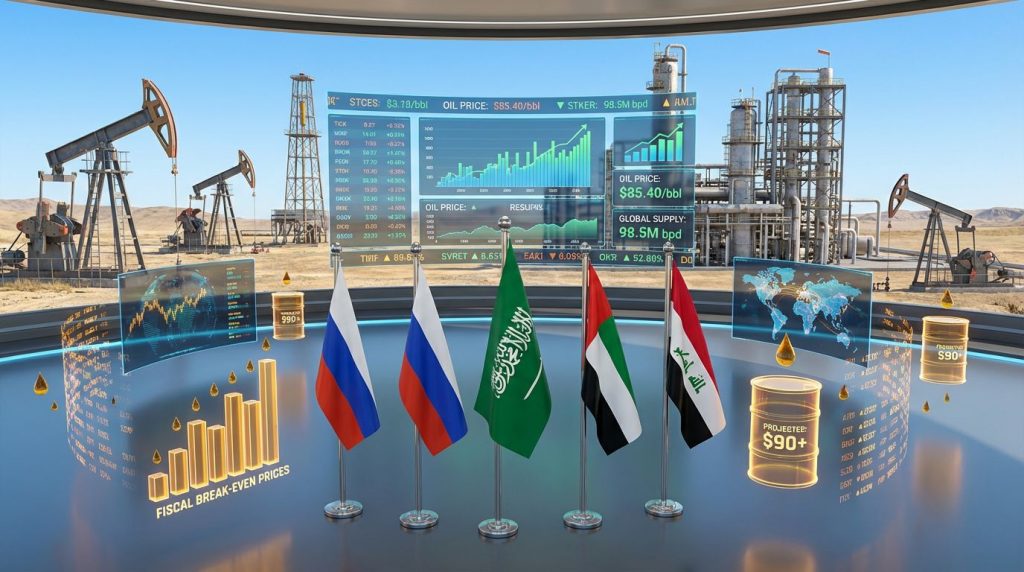
Fiscal Break-Even Analysis Across Member Nations
| OPEC+ Member | Fiscal Break-Even ($/barrel) | 2026 Budget Status | Diversification Progress |
|---|---|---|---|
| Saudi Arabia | $70-75 | Deficit widening | Vision 2030 projects scaled back |
| UAE | $60-65 | Marginal surplus | Tourism/finance sectors growing |
| Kuwait | $65-70 | Moderate deficit | Limited diversification progress |
| Iraq | $85-90 | Significant deficit | Heavy oil revenue dependence |
| Russia | $45-50 | Surplus conditions | Sanctions impact assessment |
| Kazakhstan | $55-60 | Moderate surplus | Mining/agriculture expansion |
The kingdom's widening budget deficit has forced significant scaling back of flagship Vision 2030 projects as oil revenues decline below fiscal requirements. This fiscal pressure directly influences Saudi Arabia's leadership role in OPEC+ production decisions, creating tension between market share objectives and revenue optimisation needs.
Saudi Arabia's experience illustrates the broader challenge facing OPEC+ members: successful market share reclamation came at the cost of substantial revenue reduction. The kingdom's strategy to compete with US oil production decline achieved its market share objectives but strained government finances.
Geopolitical Risk Premium Calculations
Current geopolitical risk assessments reflect multiple pressure points across OPEC+ member regions:
• Ukraine conflict dynamics: Renewed diplomatic efforts could reduce Russian energy sanctions
• Middle East regional tensions: Iranian nuclear negotiations and Saudi-Iran relations affect market sentiment
• Venezuela policy uncertainty: Trump administration's airspace warnings signal potential supply disruptions
• African producer stability: Libya and Nigeria face ongoing security challenges affecting production consistency
The Trump administration's contradictory signals regarding oil prices create additional uncertainty for OPEC+ planning. While calling for lower fuel prices to address voter concerns about living costs, the administration simultaneously approved Saudi Arabia's purchases of F-35 fighter jets and artificial intelligence technology during Crown Prince Mohammed bin Salman's White House visit.
Market Share vs. Revenue Optimisation Trade-offs
The eight key OPEC+ nations that accelerated production return in April 2025 demonstrated the complexity of balancing market share and revenue objectives. While Saudi Arabia successfully reclaimed market share from U.S. shale producers and disciplined quota-violating members, the resulting price decline challenged the strategy's financial effectiveness.
This experience has informed OPEC+'s current approach to production management, emphasising gradual adjustments rather than aggressive output changes. The alliance now recognises that rapid production increases can trigger price responses that negate revenue benefits, requiring more sophisticated coordination mechanisms.
What Are the Broader Macroeconomic Implications of Supply Management?
OPEC+'s production coordination strategies generate far-reaching macroeconomic consequences that extend beyond petroleum markets into inflation dynamics, currency flows, and global economic stability. The alliance's supply management decisions influence central bank monetary policies, energy security assessments, and international trade balances across both producing and consuming nations.
Impact on Global Inflation and Central Bank Policy
Oil price stability through OPEC+ production management provides central banks with greater monetary policy flexibility by reducing energy-driven inflation volatility. The production pause strategy helps maintain oil prices within ranges that support economic growth without triggering aggressive central bank responses to commodity-driven inflation spikes.
Federal Reserve, European Central Bank, and other major central banks incorporate oil price forecasts into their inflation targeting frameworks. OPEC+'s emphasis on stability rather than price maximisation supports central bank efforts to maintain inflation near target levels while managing broader economic uncertainties.
Key macroeconomic transmission mechanisms include:
• Consumer price index impacts: Energy costs directly affect headline inflation measures
• Producer cost structures: Oil price changes cascade through manufacturing and transportation sectors
• Exchange rate effects: Oil price stability influences currency valuations, particularly for major producers
• Investment flow dynamics: Energy price predictability affects capital allocation decisions across sectors
Energy Security Considerations for Major Economies
Major oil-importing economies view OPEC+ production coordination through energy security frameworks that balance supply reliability with price stability. The alliance's commitment to market stability provides importing nations with greater predictability for economic planning and strategic reserve management.
European Union energy security assessments particularly value OPEC+ supply coordination as a counterbalance to geopolitical supply risks from other regions. The alliance's production discipline helps maintain global supply buffers that reduce vulnerability to regional supply disruptions.
Asian economies, led by China and India, benefit from OPEC+ price stability that supports industrial competitiveness while allowing gradual energy transition planning. Predictable oil price ranges facilitate long-term infrastructure investment decisions and energy mix optimisation strategies.
Currency Market Effects and Petrodollar Flows
OPEC+ production decisions significantly influence international currency markets through petrodollar recycling mechanisms. The alliance's revenue optimisation strategies affect dollar-denominated oil transaction volumes, influencing global dollar demand and emerging market currency stability.
Lower oil prices resulting from oversupply reduce petrodollar flows, potentially weakening the U.S. dollar's international reserve currency status over time. Conversely, OPEC+ production restraint that supports higher prices strengthens dollar demand through increased oil trade settlement volumes.
These currency effects create feedback loops that influence OPEC+ strategy formation, as member nations must consider how their production decisions affect their own currency stability and international purchasing power. Furthermore, the US economy tariffs implications add another layer of complexity to these calculations.
How Does Production Capacity Assessment Affect Long-Term Market Structure?
The OPEC+ commitment to comprehensive production capacity assessment represents a fundamental shift toward evidence-based quota allocation that could reshape global oil market structure. This technical evaluation process, led by Dallas-based consultant DeGolyer and MacNaughton Corp., addresses longstanding credibility issues with production agreements by establishing objective capacity baselines for future quota calculations.
Technical Evaluation Process and Methodology
| Assessment Component | Evaluation Criteria | Timeline | Verification Method |
|---|---|---|---|
| Reservoir capacity | Geological analysis | 6-12 months | Independent technical review |
| Infrastructure limits | Processing/transport bottlenecks | 3-6 months | Field inspection/audit |
| Financial capability | Investment requirements | Ongoing | Economic modelling |
| Environmental compliance | Regulatory constraints | 6 months | Legal/regulatory review |
| Historical performance | Production track record | Immediate | Data verification |
The capacity assessment process addresses fundamental problems with previous OPEC+ quota allocations that often reflected political negotiations rather than technical realities. Some member nations consistently struggled to meet assigned production targets due to infrastructure constraints, while others possessed unused capacity that quota systems failed to recognise.
DeGolyer and MacNaughton Corp.'s involvement provides third-party credibility to capacity determinations, reducing political tensions that historically complicated quota negotiations. Their technical assessment methodology incorporates reservoir engineering, infrastructure analysis, and economic viability studies to establish sustainable production levels for each member.
Quota Redistribution Scenarios for 2027
The capacity assessment results will inform 2027 quota allocations that could significantly alter OPEC+ production distribution among members. Several redistribution scenarios emerge from preliminary capacity analysis:
• Capacity recognition scenario: Members with proven reserve additions receive quota increases
• Infrastructure constraint scenario: Members with processing bottlenecks face quota reductions
• Investment capability scenario: Quotas align with members' ability to maintain production levels
• Political stability scenario: Production allocations consider security and regulatory risks
These redistribution scenarios will influence member investment strategies, as quota allocations directly affect revenue potential and economic planning. Nations with expansion opportunities may accelerate infrastructure development, while those facing quota reductions may focus on efficiency improvements or economic diversification.
Investment Implications for Upstream Development
Capacity-based quota allocation creates stronger incentives for upstream investment by ensuring that production capability translates into market access. This alignment between investment and quota allocation should improve capital efficiency across OPEC+ members while reducing free-rider problems that plagued previous systems.
Member nations face strategic decisions about optimal investment levels given capacity assessment outcomes. Countries with significant unused capacity may delay major projects, while those approaching capacity limits must choose between expansion investments or accepting constrained quota allocations.
The assessment process also influences international oil company investment decisions in OPEC+ member countries, as capacity determinations affect long-term production outlook and commercial viability of development projects.
The next major ASX story will hit our subscribers first
What Market Scenarios Could Emerge from Current Policy Decisions?
The OPEC+ production pause 2026 creates multiple potential market trajectories that depend on demand recovery patterns, geopolitical developments, and the alliance's response to changing conditions. Understanding these scenarios requires analysing both baseline economic projections and potential disruption factors that could alter fundamental market dynamics.
Base Case: Managed Supply Growth Scenario
Price Range Projections: $55-75/barrel through 2026
The most probable scenario involves OPEC+ gradually resuming production increases beginning in Q2 2026, contingent on demand recovery and inventory normalisation. This managed approach would restore approximately 1.1 million barrels per day over six to nine months, allowing markets to absorb additional supply without triggering severe price declines.
Key characteristics of this scenario include:
• Gradual production restoration: Monthly increases of 100,000-200,000 barrels per day
• Market balance timing: Supply-demand equilibrium achieved by Q4 2026
• Price stability maintenance: Volatility contained within $10-15 trading ranges
• Member compliance improvement: Capacity assessments reduce quota violations
This scenario assumes moderate global economic growth, continued U.S. shale production expansion, and absence of major geopolitical disruptions. Success depends on OPEC+ maintaining coordination discipline while managing member fiscal pressures effectively.
Downside Risk: Extended Oversupply Scenario
Extended oversupply conditions could emerge if demand recovery disappoints or if non-OPEC+ supply growth exceeds projections. This scenario would pressure OPEC+ to extend production pauses beyond Q1 2026 or implement additional cutbacks to prevent sustained price weakness below $50 per barrel.
Factors contributing to extended oversupply include:
• Slower economic recovery: Reduced industrial and transportation fuel demand
• Accelerated energy transition: Electric vehicle adoption and renewable energy deployment
• Non-OPEC+ supply surprises: Unexpectedly strong production from Brazil, Guyana, or North American shale
• Inventory overhang: Persistent above-average global stockpile levels
This scenario would test OPEC+ cohesion as members face prolonged revenue pressure and potential budget crises. The alliance would need to consider deeper production cuts or extended freeze periods, potentially straining member relationships and policy coordination.
Upside Potential: Geopolitical Disruption Scenarios
Geopolitical disruptions could rapidly alter oversupply projections by removing significant production capacity from global markets. Several potential disruption sources could trigger price spikes above $100 per barrel:
• Middle East regional conflict: Iranian nuclear crisis or Saudi-Iran tensions escalation
• Russian sanctions expansion: Energy sector restrictions affecting 2-3 million barrels per day
• African producer instability: Libya, Nigeria, or other key producers facing security challenges
• Venezuela supply interruption: U.S. policy actions affecting remaining Venezuelan production
Such scenarios would fundamentally change OPEC+ strategy from managing oversupply to potentially increasing production to moderate price increases and maintain market stability. The alliance maintains approximately 3 million barrels per day of spare capacity that could partially offset major supply disruptions.
How Should Energy Investors Position for 2026 Market Dynamics?
Energy investment strategies for 2026 must navigate the complex interplay between OPEC+ supply management, evolving demand patterns, and structural market changes. The production pause creates both opportunities and risks that require sophisticated portfolio positioning and risk management approaches tailored to different market scenarios.
Sector Rotation Opportunities in Energy Markets
The OPEC+ production pause 2026 creates distinct investment opportunities across energy market segments:
Upstream positioning strategies:
• Low-cost producers: Companies with break-even costs below $45-50/barrel maintain profitability across scenarios
• Shale operators: U.S. unconventional producers benefit from OPEC+ restraint and market share gains
• International integrated companies: Diversified portfolios provide resilience during price volatility
• Emerging market producers: Brazil, Guyana, and other non-OPEC+ growth regions offer expansion exposure
Downstream opportunities:
• Refining margins: Oversupply conditions typically improve processing spreads
• Product demand growth: Transportation and petrochemical sectors benefit from stable input costs
• Storage and logistics: Infrastructure investments capitalise on inventory management needs
Regional Production Cost Curve Analysis
Understanding regional cost competitiveness becomes crucial as OPEC+ supply management reshapes global production economics:
| Production Region | Breakeven Cost ($/barrel) | Market Position | Investment Attractiveness |
|---|---|---|---|
| Saudi Arabia (conventional) | $20-25 | Lowest cost, swing producer | Moderate (fiscal pressure) |
| U.S. Shale (Permian) | $40-50 | Technology-driven efficiency | High (market share gains) |
| Russian conventional | $25-35 | Sanctions-constrained | Low (geopolitical risk) |
| Brazilian deepwater | $35-45 | Growth trajectory | High (pre-salt expansion) |
| Canadian oil sands | $45-55 | High cost, steady production | Moderate (ESG concerns) |
| North Sea offshore | $50-60 | Mature province, decline | Low (cost/depletion issues) |
This cost structure analysis suggests investment flows toward lower-cost regions that benefit from OPEC+ supply restraint, particularly U.S. shale formations and Brazilian offshore developments.
Infrastructure and Logistics Investment Themes
The oversupply environment created by OPEC+ strategy generates specific infrastructure investment opportunities:
• Storage capacity expansion: Tank farm construction and underground storage development
• Pipeline networks: Midstream infrastructure connecting new production to markets
• Export terminals: LNG and crude oil export facility construction
• Transportation logistics: Tanker fleet expansion and port facility upgrades
• Processing capacity: Refinery construction in demand growth regions
These infrastructure investments provide exposure to energy market growth while offering more stable returns than volatile production assets.
What Are the Long-Term Strategic Implications Beyond 2026?
The OPEC+ production pause 2026 reflects deeper structural changes in global energy markets that extend far beyond immediate supply-demand balancing. These strategic implications encompass energy transition acceleration, technological disruption of traditional production models, and evolution of producer alliance coordination mechanisms that will shape petroleum markets through the 2030s.
Energy Transition Impact on Demand Projections
Peak oil demand scenarios increasingly influence OPEC+ long-term strategy as electric vehicle adoption, renewable energy deployment, and industrial electrification accelerate globally. The alliance must balance short-term revenue optimisation with longer-term market share preservation as petroleum demand growth plateaus in key consuming regions.
Demand trajectory analysis suggests several critical inflection points:
• Transportation sector transformation: Electric vehicle market penetration reaching 15-20% globally by 2030
• Industrial process electrification: Steel, cement, and chemical industries reducing oil-based feedstock dependence
• Power generation displacement: Natural gas and renewable energy replacing oil-fired power plants
• Petrochemical demand sustainability: Plastics and chemical feedstock representing growing share of oil demand
These trends require OPEC+ to develop more sophisticated demand forecasting that incorporates technology adoption rates and policy implementation across major consuming nations.
Technology Disruption and Production Efficiency Gains
Advanced extraction technologies, artificial intelligence optimisation, and digital transformation continue reducing production costs across all major oil-producing regions. OPEC+ members must invest in technological advancement to maintain cost competitiveness while managing production capacity more efficiently.
Key technological developments affecting long-term market structure include:
• Enhanced recovery techniques: Artificial intelligence-driven reservoir management increasing recovery rates
• Autonomous operations: Unmanned production facilities reducing operational costs
• Carbon capture integration: Technologies enabling lower-carbon oil production
• Predictive maintenance: IoT sensors and analytics optimising equipment reliability and costs
The capacity assessment programme provides opportunities for OPEC+ members to incorporate these technologies into official production capability calculations, potentially altering quota distributions based on technological advancement rather than traditional geological assessments.
Alliance Cohesion and Future Coordination Mechanisms
The OPEC+ model faces long-term sustainability challenges as member economic priorities diverge and alternative energy sources reduce petroleum market influence. Maintaining alliance cohesion requires evolving coordination mechanisms that address fiscal sustainability, investment requirements, and energy transition strategies.
Future coordination frameworks may incorporate:
• Dynamic quota adjustment: Automatic production changes based on predetermined market indicators
• Investment coordination: Shared infrastructure projects and technology development initiatives
• Revenue sharing mechanisms: Fiscal transfers supporting member economic diversification
• Environmental collaboration: Joint carbon reduction and sustainability programmes
The success of current capacity assessment and production pause strategies will determine whether OPEC+ can adapt its coordination model to address these longer-term challenges effectively.
Frequently Asked Questions About OPEC+ Production Strategy
Why Did OPEC+ Choose to Pause Rather Than Cut Production?
The production pause strategy reflects OPEC+'s assessment that current market conditions require stability rather than aggressive intervention. Unlike production cuts that signal market weakness, the pause maintains existing supply levels while allowing demand recovery to absorb previous production increases naturally.
This approach provides several strategic advantages:
• Market psychology management: Avoids signalling panic about demand conditions
• Member flexibility preservation: Maintains ability to resume increases when conditions improve
• Fiscal pressure balance: Prevents further revenue reduction while addressing oversupply
• Coordination simplicity: Easier to implement than complex cutback negotiations
The pause also acknowledges that some OPEC+ members have struggled to achieve announced production targets, making freeze implementation more realistic than additional increases.
How Does This Decision Affect Global Energy Security?
The OPEC+ production pause enhances energy security by maintaining production capacity buffers while preventing excessive price volatility that could destabilise consuming economies. The alliance's approximately 3 million barrels per day of spare capacity provides crucial insurance against geopolitical supply disruptions.
Energy security implications include:
• Supply reliability: Demonstrated commitment to market stability reduces uncertainty
• Price predictability: Managed supply changes prevent extreme price swings
• Strategic reserve coordination: OPEC+ decisions influence consuming nation stockpile strategies
• Investment security: Stable supply outlook encourages continued upstream investment
What Metrics Will Determine Future Production Adjustments?
OPEC+ production decisions will increasingly rely on quantitative metrics rather than political considerations, reflecting lessons learned from previous market cycles. Key decision-making indicators include:
| Metric Category | Specific Indicators | Decision Threshold | Monitoring Frequency |
|---|---|---|---|
| Market Balance | Global inventory levels | ±5% of 5-year average | Monthly |
| Price Stability | Volatility measures | <15% monthly variation | Daily |
| Demand Growth | Consumption trends | <2% annual growth | Quarterly |
| Member Compliance | Production accuracy | >95% quota adherence | Monthly |
| Geopolitical Risk | Supply threat assessment | Regional risk scoring | Ongoing |
The capacity assessment programme will establish baseline metrics for individual member production capabilities, creating objective frameworks for future quota adjustments that reduce political tensions and improve market credibility.
Key Takeaways for Energy Market Participants
Strategic Positioning Recommendations
Market participants should prepare for extended period of supply management coordination that prioritises stability over price maximisation. The OPEC+ production pause 2026 signals sophisticated alliance evolution that balances member fiscal needs with market share preservation objectives.
Portfolio Diversification: Energy investments should span multiple production regions and cost curves to capture benefits from OPEC+ supply restraint while hedging against geopolitical risks. Hedging Strategies: Forward price protection becomes crucial as oversupply conditions create contango market structures that may persist through mid-2026. Timeline Awareness: Production policy reassessments occur quarterly, requiring active monitoring of OPEC+ communications and market condition changes.
Investment allocation strategies:
• 25-30%: Low-cost conventional producers in stable jurisdictions
• 20-25%: U.S. shale operators benefiting from OPEC+ restraint
• 15-20%: Infrastructure and logistics assets capturing storage/transport premiums
• 15-20%: International integrated companies with refining exposure
• 10-15%: Emerging market producers in Brazil, Guyana, and similar growth regions
Monitoring Framework for Policy Changes
| Indicator Type | Key Metrics | Warning Signals | Action Triggers |
|---|---|---|---|
| Market Balance | Inventory levels, demand growth | >2 MMbpd surplus | Production cut discussions |
| Price Dynamics | Futures curves, volatility | <$50 or >$85 sustained | Emergency meeting calls |
| Member Compliance | Individual production data | <90% quota adherence | Capacity reassessment |
| Geopolitical Factors | Regional tensions, sanctions | Supply threat emergence | Emergency production protocols |
| Economic Indicators | GDP growth, inflation | Recession signals | Demand adjustment strategies |
Timeline for policy reassessment:
• Monthly: Production data review and compliance monitoring
• Quarterly: Comprehensive market condition assessment
• Semi-annually: Capacity evaluation and quota adjustment consideration
• Annually: Long-term strategy review and alliance coordination framework updates
The OPEC+ production pause 2026 represents a critical test of the alliance's ability to manage complex market dynamics while maintaining member cohesion. Success will depend on balancing immediate fiscal pressures with longer-term strategic positioning as global energy markets undergo fundamental transformation. Market participants who understand these dynamics and position accordingly will be best equipped to navigate the evolving energy landscape through 2026 and beyond.
Ready to Navigate the Energy Market Volatility Ahead?
With OPEC+ production decisions creating complex investment opportunities across different energy sectors, Discovery Alert's proprietary Discovery IQ model delivers real-time notifications about significant ASX mineral discoveries, helping investors identify actionable opportunities in the resources sector while broader commodity markets face uncertainty. Begin your 30-day free trial today to position yourself ahead of market shifts and capitalise on discovery-driven opportunities that could deliver substantial returns regardless of oil price volatility.