
June 30, 2026
Understanding OPEC+ Strategic Production Framework
Energy markets operate through complex decision-making frameworks where geopolitical risk assessment intersects with technical production capacity management. The petroleum industry's supply dynamics depend on sophisticated coordination mechanisms that balance market fundamentals with operational constraints and strategic positioning.
What Drives OPEC+ Output Decisions in 2026?
OPEC+ operates through an eight-member core group comprising Saudi Arabia, the United Arab Emirates, Kuwait, Iraq, Algeria, Russia, Kazakhstan, and Oman. These nations collectively manage production adjustments through systematic evaluation protocols that incorporate multiple risk factors and market indicators.
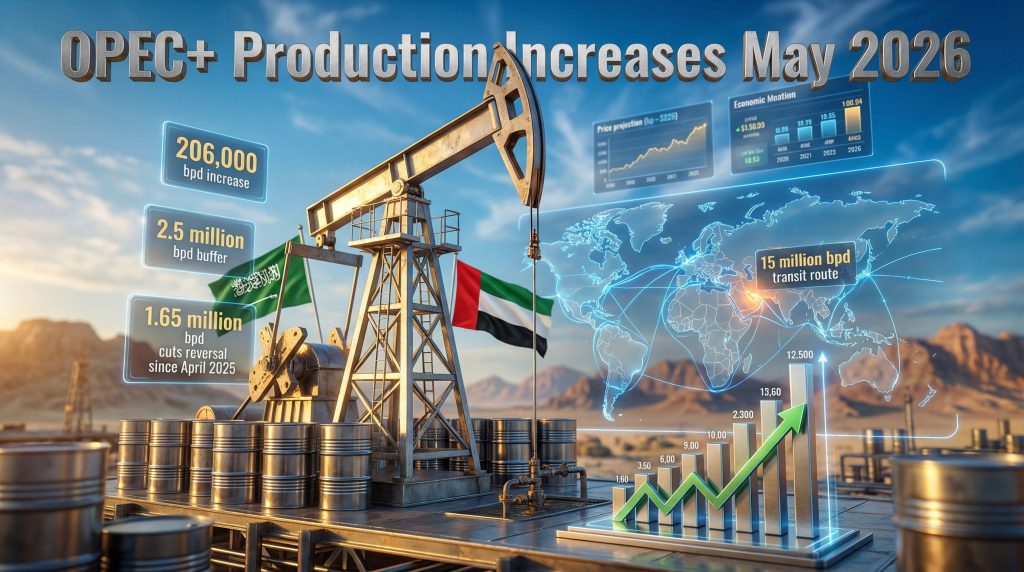
The OPEC+ output increase May 2026 represents a 206,000 barrels per day increment, maintaining consistency with April 2026 levels. This standardized monthly adjustment mechanism suggests a calculated approach to production management rather than reactive policy changes.
Market rebalancing methodology within OPEC+ integrates real-time supply disruption assessment with longer-term strategic planning. Furthermore, the OPEC meeting impact demonstrates how the organisation formally acknowledges infrastructure vulnerability concerns, noting that energy asset restoration requires substantial time and financial investment following damage incidents.
Key Production Management Statistics:
• Monthly increase volume: 206,000 bpd for May 2026
• Core member nations: 8 countries driving policy decisions
• Cumulative unwinding timeline: 1.65 million bpd cuts being reversed since April 2025
• Meeting frequency: Monthly review cycles with next session scheduled May 3, 2026
Spare capacity utilisation strategy represents a critical component of OPEC+ decision-making frameworks. Saudi Arabia and the UAE maintain significant production buffers that provide flexibility during supply disruption scenarios. This strategic reserve management allows for rapid output adjustments when market conditions require intervention.
The organisation maintains operational flexibility through its adjustment mechanisms, retaining authority to pause, accelerate, or reverse production increases based on evolving market conditions. This adaptive capacity becomes particularly significant during periods of regional instability or infrastructure disruption.
How Does the 206,000 bpd Increase Fit Into Broader Production Strategy?
The May 2026 production increase operates within a comprehensive unwinding process that began in April 2025. At the current monthly increment rate, the complete reversal of 1.65 million bpd in production cuts would theoretically require approximately eight months of sustained implementation.
However, the elapsed timeline from April 2025 to May 2026 represents thirteen months, indicating either non-linear adjustment patterns or variable monthly increments throughout the unwinding process. This suggests OPEC+ employs dynamic pacing mechanisms rather than rigid mathematical progressions.
Compensation Framework Analysis:
| Metric | Value | Context |
|---|---|---|
| Total unwinding volume | 1.65 million bpd | Production cuts being reversed |
| Implementation start | April 2025 | Begin date for cut reversals |
| Current monthly rate | 206,000 bpd | May 2026 increment |
| Overproduction baseline | January 2024 | Reference point for compensation calculations |
The compensation framework addresses systematic overproduction that occurred from January 2024 onwards. This retrospective correction mechanism distributes adjustment obligations across multiple monthly tranches, creating structured accountability for previous quota violations.
Moreover, monthly adjustment mechanisms provide OPEC+ with tactical flexibility to respond to changing market conditions. The scheduled review process enables rapid policy modifications when external factors affect implementation feasibility or market stability requirements.
When big ASX news breaks, our subscribers know first
Global Energy Security Implications
Energy security frameworks in 2026 operate under heightened complexity due to infrastructure vulnerability and regional instability factors. OPEC market influence extends beyond simple production decisions to encompass maritime chokepoint management, particularly through critical transit routes, which significantly influences global supply availability and pricing mechanisms.
Will Middle East Tensions Disrupt Implementation Plans?
The Strait of Hormuz typically facilitates approximately 15 million barrels per day of crude oil transit, representing one of the world's most critical energy transportation corridors. Disruption of this maritime route creates cascading effects across global petroleum markets.
Regional production impact assessment reveals substantial output reductions across key Gulf producers. Iraq, Kuwait, Saudi Arabia, and the UAE collectively reduced production by an estimated 9.15 million barrels per day compared to February 2026 levels, representing 61% of typical Strait of Hormuz throughput volumes.
Infrastructure Targeting and Recovery Assessment:
Kuwait experienced multiple energy facility attacks within a seven-day period:
• April 5, 2026: Kuwait Petroleum Corporation headquarters and oil ministry building struck by drone, causing significant fire damage
• April 5, 2026: Two power and water desalination plants targeted, shutting down electricity generation units
• April 3, 2026: Additional power and desalination infrastructure attacked
• March 30, 2026: Doha West facility near Doha port targeted
Force majeure declarations provide formal recognition of supply disruption impossibility. Kuwait's declaration on oil exports establishes legal framework acknowledging that contractual obligations cannot be fulfilled due to infrastructure damage and maritime route blockades.
Consequently, the conflict duration, entering its sixth week as of April 2026, demonstrates sustained operational disruption rather than temporary market volatility. Multiple drone strikes on Gulf energy infrastructure indicate systematic targeting of petroleum sector capabilities.
Regional Energy Infrastructure Impact:
• Bahrain: Bapco Energies storage tank fires; GPIC petrochemicals facility operational unit strikes
• UAE: Borouge petrochemicals facility fires from intercepted drone debris
• Iraq: Buzurgan oil field storage facility attack (300,000 bpd capacity)
• Kuwait: Multiple power, desalination, and petroleum facilities targeted
Iran has implemented conditional maritime traffic management through the Strait of Hormuz, allowing select vessels while restricting others. Iraq-based tankers received explicit exemptions, with Suezmax class vessels successfully transiting the waterway in early April 2026.
How Are Non-OPEC Producers Responding to Market Dynamics?
Non-OPEC production response mechanisms operate through different frameworks compared to cartel-managed output coordination. US shale producers demonstrate particular flexibility in responding to price signals through drilling activity adjustments and completion timing modifications.
Strategic reserve deployment represents a government-level response tool during supply disruption scenarios. National stockpile management strategies provide temporary market stabilisation capacity whilst longer-term supply restoration occurs.
Furthermore, alternative supply route development has gained importance as maritime chokepoint vulnerabilities become apparent. Pipeline diversification and shipping route flexibility enable reduced dependence on single transit corridors during regional instability periods.
Market Psychology and Price Discovery Mechanisms
Petroleum futures markets incorporate forward-looking supply expectations through derivative pricing structures that reflect both immediate constraints and anticipated resolution timelines. Market sentiment indicators reveal trader positioning patterns and volatility premium assessments.
What Do Oil Futures Markets Signal About Supply Expectations?
Forward curve analysis provides insight into market expectations regarding supply restoration timelines and production increase implementation feasibility. WTI/Brent futures analysis shows that contango versus backwardation patterns through 2026 indicate whether markets expect current constraints to persist or resolve.
Volatility premium assessment in derivative markets quantifies uncertainty levels and risk pricing for various supply disruption scenarios. Options pricing patterns reveal market participant expectations regarding price movement ranges and timeline assumptions.
Market Structure Analysis:
| Indicator | Baseline Scenario | Successful Implementation | Disrupted Implementation |
|---|---|---|---|
| Brent Crude Price | $85-95/barrel | $75-85/barrel | $105-120/barrel |
| Volatility Premium | Elevated | Moderate | Extreme |
| Forward Curve Shape | Mixed signals | Contango | Deep Backwardation |
Inventory management strategies reflect commercial and strategic stockpile optimisation decisions. Companies adjust storage levels based on supply availability expectations and cost-carry calculations that incorporate storage fees and opportunity costs.
How Will Refiners Adjust to Changing Crude Availability?
Refinery utilisation optimisation requires processing capacity allocation decisions that balance crude slate availability with product demand patterns. Refiners modify operational parameters to accommodate available feedstock qualities and volumes.
Crude slate diversification becomes critical when traditional supply sources experience disruption. Alternative feedstock sourcing strategies enable continued operations whilst primary crude supplies remain constrained or unavailable.
In addition, margin protection mechanisms include crack spread hedging and operational flexibility enhancements. Refiners employ derivative instruments to lock in processing margins whilst maintaining operational adaptability for varying crude input scenarios.
Economic Impact Modelling Scenarios
Macroeconomic implications of energy supply disruption extend beyond petroleum sector effects into broader economic performance indicators. Central bank policy responses, inflation pressures, and consumer spending patterns all respond to energy cost fluctuations.
Scenario 1: Successful Production Increase Implementation
Energy cost reduction benefits across sectors create positive economic spillover effects when production increases materialise as planned. Lower energy input costs enhance manufacturing competitiveness and transportation efficiency across supply chains.
Economic Scenario Projections:
• Global GDP impact: Potential 0.3% upward revision with successful implementation
• Inflation pressure relief: Central banks gain flexibility for accommodative monetary policies
• Consumer spending power: Household energy cost reductions enable discretionary spending increases
• Industrial competitiveness: Lower input costs support manufacturing sector expansion
Central bank policy implications include reduced pressure for inflation-fighting measures when energy costs stabilise or decline. This creates policy space for supporting economic growth through lower interest rates or expanded monetary accommodation.
Scenario 2: Geopolitical Disruption Prevents Increases
Supply shortage amplification creates cascading effects across global energy markets when planned production increases fail to materialise. Emergency response protocols become necessary to maintain minimum supply levels for critical economic functions.
Strategic petroleum reserve releases provide temporary supply augmentation but deplete government stockpiles that serve as long-term security buffers. The effectiveness and duration of reserve deployment depends on disruption severity and alternative supply development.
Crisis Response Mechanisms:
• Emergency stockpile deployment: Government strategic reserve releases
• Demand management: Industrial allocation and rationing protocols
• Alternative energy acceleration: Expedited renewable capacity development
• Transportation adaptation: Modal shifts and efficiency improvements
Alternative energy acceleration potential emerges during sustained supply disruptions as economic incentives favour rapid renewable investment. High fossil fuel prices create favourable economics for wind, solar, and battery storage deployment.
Investment Strategy Framework
Energy sector investment decisions require evaluation of multiple scenario outcomes and risk-adjusted return calculations. Portfolio positioning strategies must account for both immediate supply constraints and longer-term structural market changes.
How Should Energy Investors Position for May 2026 Changes?
Upstream equity valuation models require careful analysis of production growth potential versus price volatility trade-offs. Companies with spare capacity and operational flexibility command premium valuations during supply-constrained periods.
Midstream infrastructure opportunities include pipeline and storage capacity investments that benefit from supply route diversification needs. Transportation and storage assets gain strategic value when traditional routes face disruption risks.
Investment Positioning Framework:
• Upstream focus: Companies with spare capacity and geographically diversified assets
• Midstream opportunities: Pipeline, storage, and transportation infrastructure
• Downstream optimisation: Refiners with operational flexibility and diverse crude slate capabilities
• Alternative energy: Renewable projects with accelerated development timelines
Downstream margin optimisation analysis focuses on refining sector profit potential during crude availability fluctuations. Refiners with flexible processing capabilities and diverse crude sourcing networks maintain competitive advantages.
What Are the Long-term Portfolio Implications?
Energy transition timeline adjustments reflect how OPEC production boost strategy impacts renewable energy adoption rates. Sustained high fossil fuel prices accelerate alternative energy investment and deployment schedules.
Commodity correlation analysis examines relationships between oil prices and other asset classes including metals, agriculture, and currency markets. Understanding these correlations enables portfolio diversification and hedging strategy development.
Portfolio Risk Management:
| Risk Factor | Mitigation Strategy | Implementation Timeline |
|---|---|---|
| Supply disruption | Geographic diversification | Immediate |
| Price volatility | Derivative hedging | Ongoing |
| Transition acceleration | Alternative energy allocation | Medium-term |
| Currency exposure | Multi-currency positioning | Immediate |
Currency hedging considerations become important as petrodollar recycling patterns change during supply disruption periods. Exchange rate impacts affect international energy investment returns and operational cash flows.
Regulatory and Policy Response Mechanisms
Government energy security policies require adaptation when traditional supply patterns face disruption. Strategic reserve expansion, domestic production incentives, and international cooperation frameworks provide policy tools for managing supply constraints.
How Will Consuming Nations Adapt Energy Security Policies?
Strategic reserve expansion programmes represent long-term policy responses to demonstrated supply vulnerability. Government stockpile capacity increases provide greater buffer against future disruption scenarios whilst supporting market stability during crises.
Domestic production incentives include tax policy adjustments and regulatory framework modifications designed to encourage indigenous energy development. These policies reduce import dependence and enhance supply security through local resource development.
Policy Response Framework:
• Strategic reserves: Expanded government stockpile programmes
• Domestic incentives: Tax advantages for local production development
• International coordination: Enhanced IEA emergency protocols
• Infrastructure resilience: Hardened energy facility protection measures
International cooperation frameworks facilitate coordinated emergency responses and information sharing during supply disruption events. The International Energy Agency provides mechanisms for collective action and strategic reserve coordination amongst member nations.
What Role Will Carbon Pricing Play in Production Decisions?
Environmental cost integration through carbon pricing mechanisms affects production economics and investment decisions. Carbon border adjustments create additional cost factors for high-emission production sources whilst favouring cleaner alternatives.
Transition pathway optimisation requires balancing current supply needs with longer-term climate goals. Policymakers must weigh immediate energy security requirements against decarbonisation objectives and technology deployment timelines.
Technology investment priorities reflect the tension between maintaining current energy supply reliability and developing clean energy infrastructure. Investment allocation decisions determine the pace of energy system transformation and resilience building.
The next major ASX story will hit our subscribers first
Operational Excellence and Risk Management
Supply chain resilience optimisation becomes critical when traditional energy supply patterns face systematic disruption. Companies must balance cost efficiency with redundancy and flexibility requirements for maintaining operational continuity.
How Can Market Participants Optimise Supply Chain Resilience?
Diversification strategies encompass geographic distribution and supplier risk management to reduce concentration vulnerabilities. Multiple sourcing options provide flexibility when primary supply channels experience disruption or constraint.
Inventory management protocols require balancing just-in-time efficiency with strategic stockpiling for contingency scenarios. Optimal inventory levels account for supply disruption probability, storage costs, and working capital requirements.
Resilience Enhancement Strategies:
• Geographic diversification: Multiple source regions and supply routes
• Supplier redundancy: Alternative vendor relationships and contract terms
• Inventory optimisation: Strategic buffer stocks for critical operations
• Transportation flexibility: Multi-modal logistics and backup routing options
Transportation route optimisation includes development of alternative logistics pathways and backup planning for primary route disruption scenarios. Modal flexibility enables continued operations when specific transportation methods become unavailable or uneconomical.
What Early Warning Systems Should Monitor Implementation Success?
Real-time production tracking utilises satellite monitoring technology and field-level data analysis to verify actual output versus announced production targets. These systems provide independent verification of production increase implementation success.
Market sentiment indicators include trading volume patterns, positioning data, and options market activity that reveal trader expectations regarding supply restoration timelines and probability assessments.
Monitoring System Components:
• Satellite surveillance: Independent production verification
• Market data analysis: Trading patterns and sentiment indicators
• Intelligence gathering: Geopolitical risk assessment and scenario planning
• Infrastructure monitoring: Damage assessment and restoration tracking
Geopolitical risk assessment requires continuous intelligence gathering and scenario planning capabilities to anticipate potential disruption sources and timeline expectations. Early warning systems enable proactive risk management and contingency preparation.
Technology and Innovation Acceleration
Energy sector technology investment patterns respond to supply security concerns and operational efficiency requirements. Innovation funding cycles reflect changing priorities between conventional sector optimisation and renewable energy development acceleration.
Will Production Increases Affect Energy Technology Investment?
Innovation funding cycles demonstrate how supply constraints influence capital allocation between conventional and renewable energy technologies. Sustained supply disruption accelerates alternative energy technology development and deployment.
Venture capital allocation patterns shift toward energy security solutions and supply chain resilience technologies when traditional energy systems demonstrate vulnerability. Investment priorities reflect both immediate operational needs and longer-term strategic positioning.
Technology Investment Trends:
• Enhanced oil recovery: Digital optimisation and efficiency technologies
• Supply chain monitoring: Real-time tracking and verification systems
• Alternative energy: Accelerated renewable capacity development
• Storage solutions: Battery and hydrogen storage infrastructure
Efficiency improvement drivers include enhanced oil recovery technologies and digital optimisation systems that maximise output from existing infrastructure. These technologies become particularly valuable during capacity-constrained periods.
However, US-China trade impact considerations may affect technology transfer and supply chain dynamics. Grid modernisation requirements increase when energy supply sources become more variable or uncertain. Power system flexibility improvements enable integration of diverse energy sources and enhance overall system resilience.
Recent OPEC+ agreeing to symbolic production increases suggests that production adjustments may have more diplomatic than market significance. Furthermore, official OPEC statements confirm the organisation's careful approach to production management during periods of geopolitical uncertainty.
Investment Considerations: The analysis presented reflects current market conditions and regulatory frameworks as of May 2026. Energy market investments involve substantial risks including geopolitical events, regulatory changes, and commodity price volatility. Readers should conduct independent research and consult financial advisors before making investment decisions.
Strategic Positioning Summary: The OPEC+ output increase May 2026 represents a critical inflection point where production policy intersects with regional security dynamics. Market participants must evaluate both immediate supply restoration potential and longer-term structural changes in global energy systems. Success metrics include actual output verification, infrastructure restoration progress, and alternative supply source development timelines.
Seeking Exposure to Energy Sector Opportunities?
Discovery Alert's proprietary Discovery IQ model delivers real-time alerts on significant mineral discoveries across energy-related commodities, including uranium and critical minerals essential to the energy transition. While OPEC+ navigates complex production decisions, savvy investors can position themselves ahead of the market by accessing Discovery Alert's comprehensive discoveries page to understand how major mineral discoveries have historically generated substantial returns, then begin your 14-day free trial today.