July 30, 2026
The Architecture of Cartel Loyalty: Why OPEC Members Stay, and What Happens When They Don't
Energy cartels do not collapse in a single moment. They erode through a sequence of individual calculations, each member quietly reassessing whether the institutional constraints they accept produce returns greater than the freedom they surrender. For most of OPEC's history, that calculation favoured membership. The disciplined management of collective supply translated into price premiums that individual producers could not reliably replicate on their own.
However, that logic rests on a foundational assumption: that every major producer values coordinated pricing over unconstrained volume. When a producer with the second-largest liquids capacity in the group reaches the opposite conclusion, the entire architecture of cartel loyalty comes into question. The UAE withdrawal from OPEC, effective May 1, 2026, is precisely that kind of test.
When big ASX news breaks, our subscribers know first
Fifty-Nine Years of Membership Dissolved in a Single Announcement
The UAE's Ministry of Energy and Infrastructure posted its withdrawal statement to its official X page on April 30, 2026, translated from Arabic. The announcement formalised a separation from an organisation the UAE had participated in since 1967, representing nearly six decades of continuous membership. The timing, the scale of the departing producer, and the geopolitical context surrounding the decision make this structurally distinct from previous OPEC exits.
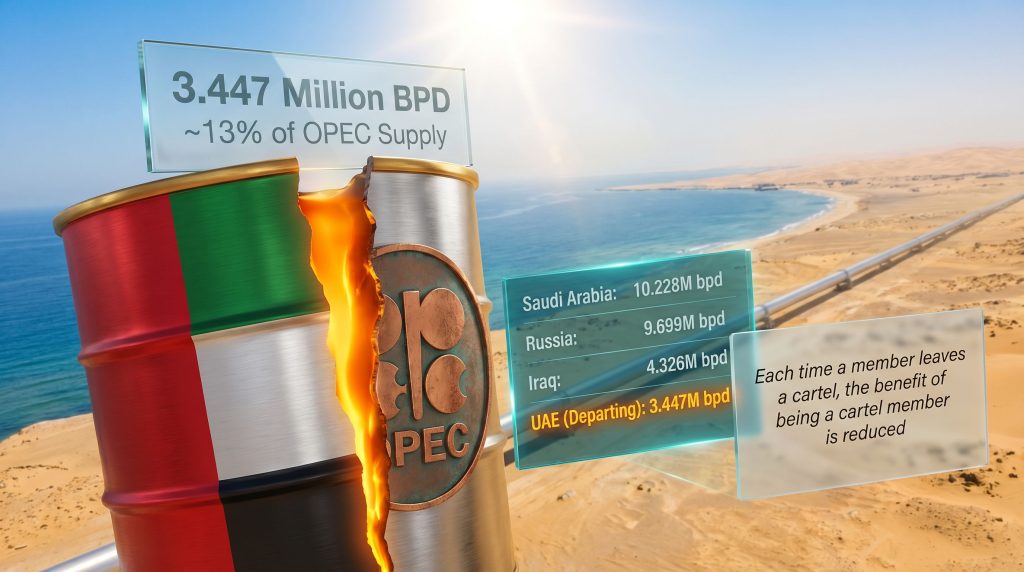
The most instructive comparison is Qatar's 2019 departure. Qatar exited OPEC citing governance frustrations, but its production footprint at the time was relatively marginal within the group's supply architecture. The UAE's situation is categorically different. According to Emily Ashford, Energy Research Head at Standard Chartered Bank, the UAE's production represents approximately 13% of OPEC's total supply and around 9% of OPEC+ combined production (Standard Chartered Bank, quoted in Rigzone, April 30, 2026). Qatar's exit was an inconvenience. The UAE's departure is a structural rupture.
Simon Flowers, Chairman and Chief Analyst at Wood Mackenzie, described the exit as momentous specifically because of the UAE's position as the second-largest liquids capacity holder in the group behind only Saudi Arabia (Wood Mackenzie, quoted in Rigzone, April 30, 2026). That capacity distinction matters enormously. The difference between a small producer leaving and a major capacity holder leaving is the difference between losing a peripheral spoke and removing a load-bearing pillar.
The Production Numbers Behind the Headlines
The OPEC Secretariat's April 5, 2026 statement quantifies the scale of what is formally departing the quota framework. The UAE's required production allocation for May 2026 was set at 3.447 million barrels per day. For context, the table below shows required production levels across the eight major OPEC+ producers for May 2026:
| Member Country | Required Production (May 2026) |
|---|---|
| Saudi Arabia | 10.228 million bpd |
| Russia | 9.699 million bpd |
| Iraq | 4.326 million bpd |
| UAE (departing) | 3.447 million bpd |
| Kuwait | 2.612 million bpd |
| Kazakhstan | 1.589 million bpd |
| Algeria | 983,000 bpd |
| Oman | 821,000 bpd |
Source: OPEC Secretariat, April 5, 2026, as reported by Rigzone
These figures illustrate why the UAE's departure carries institutional weight beyond its percentage share. The UAE's allocation exceeds Kuwait, Kazakhstan, Algeria, and Oman combined. Its removal from the compliance framework does not simply reduce the cartel's output management capacity by 13%; it eliminates a co-anchor of the spare capacity buffer that gave OPEC its market stabilisation credibility.
The Convergence of Forces That Made Departure Inevitable
Analysts across multiple institutions converge on a consistent diagnosis: the UAE's withdrawal was not a spontaneous reaction but the culmination of pressures accumulating over several years. Understanding those pressures separately is important, because they operated across economic, institutional, and geopolitical dimensions simultaneously.
Economic Logic: Were Quota Frameworks Suppressing UAE Reserves?
The UAE's reserve base is large, low-cost, and increasingly underleveraged within the constraints of OPEC's quota system. Joshua Aguilar, Equity Director at Morningstar, noted that the UAE's calculus around pursuing a different production policy and monetising its reserves had likely been developing for years (Morningstar, quoted in Rigzone, April 30, 2026). This framing captures the fundamental tension: a producer with structural cost advantages and substantial remaining reserves faces a meaningful opportunity cost when production caps prevent full exploitation of those advantages.
This dynamic is well understood in cartel theory. Low-cost producers generally benefit most from unconstrained volume strategies, while high-cost producers benefit more from administered pricing. When a cartel's major low-cost producers begin to perceive their cost advantages as suppressed rather than rewarded by collective discipline, the economic logic of membership weakens considerably.
Aguilar further highlighted that outside of Saudi Arabia, the UAE represents one of the few remaining OPEC members with meaningful spare capacity, describing this as the core mechanism by which the group exerts influence over global oil prices. Furthermore, understanding how OPEC influences oil markets helps explain precisely why the UAE's spare capacity was essentially the cartel's pricing leverage — suggesting it was providing a collective good without receiving proportionate returns.
Institutional Frustration: The Quota Mechanism's Slow Erosion of Trust
The OPEC+ eight meeting's April outcome produced only a 206,000 barrel per day collective increase for May, a figure widely viewed as incremental rather than meaningful (OPEC Secretariat, April 5, 2026). Ashford noted in a Standard Chartered report that this gathering represented a missed opportunity to signal genuine supply responsiveness to markets, and that the decision to implement only a minor adjustment may have contributed to the UAE's frustration with the group's cautious approach.
In addition, OPEC production decisions of this kind have historically created internal tension among members seeking greater flexibility. The compensation plan framework provides an additional data point on the UAE's disengagement trajectory. The OPEC Secretariat's April 7, 2026 statement detailed updated compensation obligations across the group:
- March 2026: Total compensation plans of 1.214 million bpd; UAE contribution: 178,000 bpd
- April 2026: Total plans of 789,000 bpd; UAE contribution: zero
- May 2026: Total plans of 895,000 bpd; UAE contribution: zero
- June 2026: Total plans of 899,000 bpd; UAE contribution: zero
The UAE had already exited the compensation compliance framework for the three months following its only March obligation. The formal withdrawal announcement on April 30 formalised what the compensation schedule had already suggested: the UAE's operational commitment to OPEC's shared management architecture had concluded before the official membership departure.
Geopolitical Catalysts: Iran, the Strait of Hormuz, and a Realigning Region
Aguilar identified Iranian missile and drone attacks on UAE territory and on maritime shipping as the probable final catalyst in the UAE's decision calculus (Morningstar, quoted in Rigzone, April 30, 2026). Flowers similarly noted that political tensions between the UAE and Saudi Arabia had been building for years and intensified amid the ongoing conflict involving Iran (Wood Mackenzie, quoted in Rigzone, April 30, 2026).
The strategic significance of the Strait of Hormuz in this context is substantial. The UAE operates a pipeline connecting its oil fields to the Gulf of Oman, providing an export route that bypasses Hormuz dependency. This existing infrastructure reduces, though does not eliminate, the UAE's vulnerability to Hormuz disruptions. However, the broader regional security environment created by Iranian hostilities fundamentally altered the UAE's geopolitical risk calculation within OPEC's Saudi-centric framework.
Consequently, geopolitical oil price pressures of this nature have repeatedly forced Gulf producers to reconsider their strategic alignments. Aguilar characterised the withdrawal as a foreign policy outcome that strengthens U.S.-UAE bilateral alignment while undermining OPEC's collective influence, positioning the UAE's departure within a broader regional realignment where Gulf states with closer U.S. relationships are reassessing the strategic value of OPEC membership under Saudi-Russian co-leadership.
What OPEC Loses Beyond the Production Numbers
Saudi Arabia: More Dominant, More Exposed
On the surface, Saudi Arabia's relative weight within OPEC increases following the UAE's exit. With Saudi Arabia's 10.228 million barrels per day allocation representing a larger proportional share of a smaller group, Riyadh's policy decisions carry greater authority. Ashford confirmed this dynamic, noting that the departure increases Saudi Arabia's importance in collective policy decisions (Standard Chartered Bank, quoted in Rigzone, April 30, 2026).
However, this is a double-edged development. Greater centrality means greater exposure. Saudi Arabia's ability to credibly influence global oil prices previously rested partly on the shared spare capacity buffer it maintained alongside the UAE. With that dual-anchor structure dissolved, Saudi Arabia's price management tools are reduced. OPEC's capacity to act as a meaningful stabilisation mechanism in a supply shock scenario diminishes accordingly.
Ashford noted directly that OPEC's spare capacity cushion, already near zero given current conditions, was primarily supported by Saudi Arabia and the UAE jointly, and the UAE's exit reduces this buffer even further. The oil market disruption risks this creates are compounded by a cartel that can no longer credibly threaten supply discipline or respond to supply shortfalls, effectively losing its primary policy instruments simultaneously.
Compliance Architecture Under Pressure
The UAE's departure also removes a relatively disciplined compliance actor from the overproduction compensation framework. Iraq, Kazakhstan, and Algeria have demonstrated persistent overproduction histories relative to their quota obligations. With the UAE outside the compensation structure, the remaining compliance burden concentrates among members with weaker track records.
Whether OPEC+ can sustain meaningful enforcement absent the UAE's participation is an open question that will define the group's policy credibility over the next two years.
Three Trajectories: How the Post-UAE OPEC Story Could Unfold
The UAE withdrawal from OPEC does not have a single inevitable consequence. Three distinct scenarios describe the plausible range of outcomes across a multi-year horizon.
Scenario 1: Contained Departure, Stable Architecture
The UAE operates as a fully independent producer but scales output gradually over several years. OPEC adjusts internal quota mechanics, Saudi Arabia maintains institutional cohesion, and no immediate contagion effect emerges. Ashford's observation that the UAE's additional production volumes from new ventures are several years away supports this contained timeline. The key variable is whether other members calculate that cartel benefits still outweigh exit costs.
Scenario 2: Progressive Erosion Through Precedent
The UAE's departure normalises major-producer exit as a viable strategic option. Producers with low-cost reserves and external geopolitical alignments, particularly Kazakhstan and Iraq, begin reassessing their quota obligations and compensation commitments. E.J. Antoni, Chief Economist for the Thomas A. Roe Institute for Economic Policy Studies and Richard Aster Fellow at the Heritage Foundation, described this mechanism precisely: each member departure reduces the benefit of remaining, creating conditions for further defection that could escalate into cartel dissolution.
Scenario 3: Structural Bifurcation into Core and Independent Blocs
OPEC evolves into a smaller, ideologically coherent coordination group centred on Saudi Arabia, Russia, and Iraq, while increasingly independent Gulf producers, led by the UAE, coordinate production policy through bilateral or regional mechanisms outside the cartel framework. The group transitions from a supply-control mechanism to a coordination forum, losing its administered pricing function while retaining informational value.
Antoni acknowledged at the time of the announcement that full cartel dissolution remains a distant prospect, but one now within the plausible range of outcomes. As he noted in his assessment shared with Rigzone, the snowball effect of cascading exits is a genuine risk, even if still far from materialising.
Moreover, oil prices and trade war dynamics could further accelerate any of these scenarios, depending on how global demand evolves in parallel with OPEC's internal restructuring.
Near-Term Calm, Medium-Term Complexity
For immediate market watchers, the supply picture is constrained by factors entirely separate from OPEC quota mechanics. Flowers was direct on this point: the UAE's withdrawal will have minimal impact on market fundamentals in 2026, even if the Strait of Hormuz reopens, because Gulf producers including the UAE will require months to return to pre-conflict production volumes (Wood Mackenzie, quoted in Rigzone, April 30, 2026).
The more consequential supply dynamic emerges beyond 2026. Flowers identified this explicitly: losing the UAE compounds OPEC's challenge to balance the market and increases the risk of oversupply weakening prices over the medium term. When the UAE eventually scales production without quota constraint, potentially adding substantial incremental supply in conjunction with recovering Gulf output, the group's reduced ability to offset that volume creates a structural oversupply vulnerability.
Aguilar was confident that long-term reverberations will produce a structurally weaker OPEC, even while acknowledging that immediate market impacts remain muted by Hormuz-related disruptions. The demand refill cycle following reserve depletion may absorb early incremental UAE supply, but this represents a temporary buffer rather than a structural offset. According to the ABC, the UAE's decision to prioritise national interest over collective cartel discipline reflects a broader shift in how Gulf states assess institutional loyalty.
The next major ASX story will hit our subscribers first
Is OPEC's Institutional Role Permanently Diminished?
The analytical community is genuinely divided on whether this marks a turning point or another episode in OPEC's long history of weathering membership challenges.
The institutional resilience argument centres on exactly the precedent Ashford raised: warnings about OPEC's terminal decline have accompanied nearly every significant disruption in the cartel's history, and the organisation has consistently adapted. Saudi Arabia's dominance provides a stable policy anchor. The cartel's value as a coordination forum persists even when enforcement mechanisms weaken.
The structural change argument is more compelling precisely because the UAE is not a marginal actor. The departure follows years of deliberate strategic divergence, not a sudden political rupture, suggesting the decision is both calculated and likely irreversible. The security environment created by Iranian hostilities makes near-term OPEC re-entry structurally implausible. Furthermore, the precedent effect, as Antoni's cascade model suggests, now extends to major producers rather than being confined to smaller members.
What is not in dispute is that OPEC's spare capacity architecture has been permanently altered, its compliance framework weakened, and its credibility as a supply-control mechanism reduced. Whether the organisation adapts to that new reality or continues eroding depends substantially on whether Saudi Arabia can sustain coalition discipline among members with increasingly divergent interests.
FAQ: UAE Withdrawal from OPEC
When did the UAE's OPEC withdrawal take effect?
The withdrawal became effective May 1, 2026, following an official announcement by the UAE Ministry of Energy and Infrastructure on April 30, 2026.
How long was the UAE an OPEC member?
The UAE held OPEC membership for approximately 59 years, having joined in 1967.
What share of OPEC production does the UAE represent?
Approximately 13% of OPEC's total supply and around 9% of OPEC+ combined production, with a May 2026 required allocation of 3.447 million barrels per day.
Will global oil prices fall immediately?
Near-term impacts are expected to be limited given ongoing Strait of Hormuz disruptions constraining actual export volumes. Medium-to-long-term oversupply risk increases as UAE production scales without quota constraints.
Could other OPEC members follow the UAE's exit?
Analysts are divided. No immediate departures are anticipated, but the precedent creates structural pressure, particularly for members with low-cost reserves, external geopolitical alignments, or persistent quota grievances.
Does the UAE's departure benefit the United States?
Morningstar's Joshua Aguilar characterised the move as a foreign policy outcome that strengthens U.S.-UAE bilateral ties and undermines OPEC's collective pricing influence (Morningstar, quoted in Rigzone, April 30, 2026).
Disclaimer: This article is intended for informational purposes only and does not constitute financial or investment advice. Forward-looking statements, scenario projections, and analyst commentary reflect views at the time of publication and are subject to change as market and geopolitical conditions evolve. Readers should conduct independent research before making any investment decisions related to energy markets or commodity prices.
Want to Stay Ahead of the Next Major Commodity Shift?
Discovery Alert's proprietary Discovery IQ model delivers real-time alerts on significant ASX mineral discoveries, instantly transforming complex commodity data into actionable investment insights — whether you're tracking energy sector realignments or emerging resource opportunities. Explore how historic mineral discoveries have generated extraordinary returns and begin your 14-day free trial today to position yourself ahead of the broader market.