
July 3, 2026
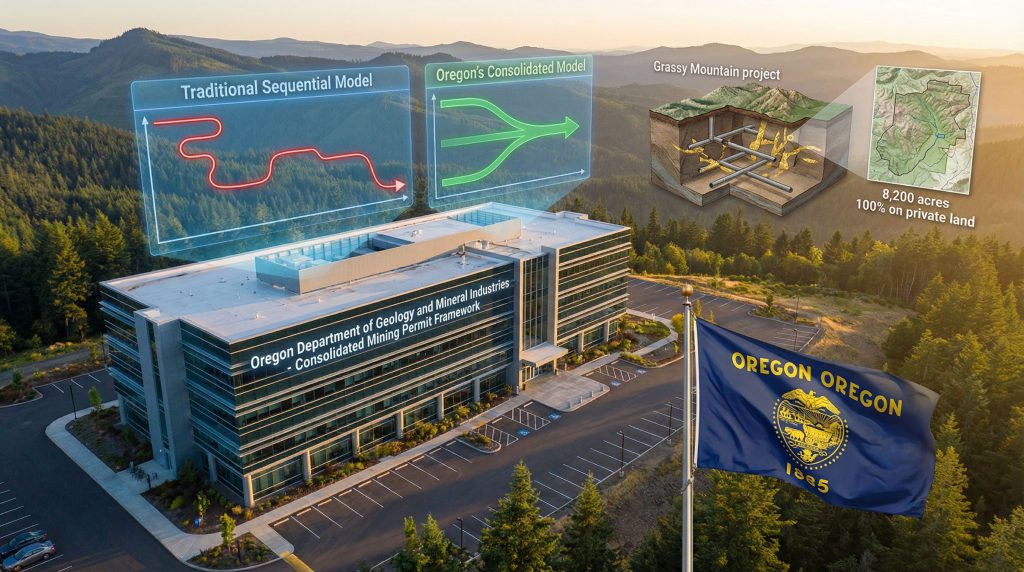
Understanding Oregon's Revolutionary Mining Permitting Model
Western states have traditionally struggled with fragmented mining permitting processes that create regulatory bottlenecks and investment uncertainty. Mining companies often navigate complex multi-agency review systems where sequential approvals can extend project timelines by years while increasing compliance costs. This regulatory complexity has historically positioned western jurisdictions at a competitive disadvantage compared to mining-friendly regions with streamlined frameworks.
The emergence of consolidated permitting approaches represents a fundamental shift in how state governments balance resource development with environmental protection. Rather than maintaining isolated agency silos, progressive jurisdictions are implementing coordinated review mechanisms that maintain rigorous oversight while improving process efficiency.
Oregon's Department of Geology and Mineral Industries (DOGAMI) has developed what may become the most significant regulatory innovation in western mining permitting through its consolidated framework approach. This system enables parallel agency coordination while preserving environmental standards and community engagement protocols.
When big ASX news breaks, our subscribers know first
Oregon's Groundbreaking Consolidated Framework Architecture
The consolidated mining permit framework developed by DOGAMI represents the first comprehensive attempt by any western state to coordinate multiple agency reviews through a single administrative process. This innovative approach eliminates the sequential bottlenecks that have traditionally plagued mining permitting in Oregon and other western jurisdictions. Furthermore, the framework draws from basic permitting insights to streamline complex regulatory requirements.
Key Framework Components:
• Unified coordination point through DOGAMI as lead agency
• Parallel review processes across participating state agencies
• Integrated environmental assessment methodology
• Coordinated public participation protocols
• Synchronized decision-making timelines
The framework's innovation lies in its ability to maintain regulatory rigor while reducing administrative redundancy. Rather than requiring project proponents to navigate separate agency processes sequentially, the consolidated approach enables simultaneous review and coordination among all relevant state permitting authorities.
Participating Agency Coordination:
Under the consolidated framework, DOGAMI publishes permit packages on behalf of all state permitting and cooperating agencies, creating a single point of regulatory interface for project developers. This represents a significant departure from traditional approaches where each agency maintains independent review processes and timelines. Additionally, recent changes through the executive order on permits have further influenced permitting coordination strategies.
The Paramount Gold Grassy Mountain Project as Regulatory Pioneer
The Paramount Gold Grassy Mountain project serves as the inaugural test case for Oregon's consolidated permitting system, establishing precedents that will influence future mining development across the Pacific Northwest. Located in Malheur County, Oregon, this gold-silver mining operation represents the first project to advance through the state's revolutionary regulatory framework.
| Project Attribute | Specification | Regulatory Significance |
|---|---|---|
| Total Area | 8,200 acres | Multi-jurisdictional coordination required |
| Land Ownership | Private and BLM land | Federal-state coordination protocols |
| Ore Body Location | 100% on private land | Reduced federal oversight complexity |
| Operation Design | Small footprint underground | Minimised surface impact profile |
| Deposit Type | Gold-silver deposit | Established commodity regulatory pathway |
The Grassy Mountain project has completed a positive feasibility study, positioning it as an ideal candidate for testing Oregon's innovative permitting approach. According to Rachel Goldman, CEO of Paramount Gold Nevada Corp., the draft consolidated permit package reflects extensive technical analysis, coordinated agency review, and community input processes.
Timeline and Process Milestones:
• December 10, 2025: DOGAMI released draft consolidated permit package
• January 29, 2026: Public hearing scheduled in Vale, Oregon
• February 6, 2026: Public comment period closes
• Post-February 2026: Agency revision and final permit issuance
This timeline demonstrates the framework's ability to provide predictable review schedules while maintaining comprehensive stakeholder engagement opportunities. The Paramount Gold Grassy Mountain project thus serves as both a commercial mining venture and a regulatory experiment with implications for the broader western mining industry.
Comparative Analysis: Consolidated vs. Traditional Sequential Permitting
Traditional mining permitting in western states typically follows a sequential agency review model that creates significant process inefficiencies and timeline uncertainties. Each regulatory authority conducts independent assessments, often requiring project modifications that trigger additional review cycles across multiple agencies. Moreover, jurisdictions like British Columbia have developed their own approaches, as seen in the BC permitting framework.
Traditional Sequential Model Characteristics:
• Individual agency reviews conducted in isolation
• Sequential dependencies creating cumulative timeline delays
• Limited inter-agency coordination mechanisms
• Fragmented public input processes across agencies
• Inconsistent decision criteria between regulatory authorities
Oregon's Consolidated Model Innovations:
• Simultaneous multi-agency review processes
• Coordinated timeline management across all participating agencies
• Integrated environmental analysis methodology
• Unified public participation framework
• Harmonised decision criteria and evaluation standards
The consolidated approach theoretically reduces regulatory uncertainty while maintaining environmental protection standards. By enabling parallel processing rather than sequential review, the framework can significantly compress permitting timelines without compromising oversight quality.
Regulatory Innovation Insight: Oregon's consolidated framework represents the first comprehensive state-level attempt to eliminate inter-agency coordination delays while preserving rigorous environmental review standards.
Process Efficiency Comparison:
Traditional sequential permitting often requires 18-36 months for complex mining projects, with timeline extensions common when agencies require additional studies or modifications. Oregon's consolidated approach aims to provide greater timeline predictability through coordinated review scheduling and integrated decision-making processes.
Economic Development and Investment Implications
Oregon's consolidated permitting framework could position the state as a competitive jurisdiction for responsible mining investment, particularly compared to neighbouring states with more complex regulatory processes. The Grassy Mountain project demonstrates the framework's potential to attract capital while maintaining environmental standards.
Direct Economic Impact Categories:
• Specialised mining employment creation in rural Oregon communities
• Regional economic multiplier effects through local procurement and services
• State and local tax revenue generation over mine life cycles
• Supply chain development opportunities for Oregon-based businesses
According to project executives, the Paramount Gold Grassy Mountain project is designed to create high-quality local employment while supporting regional economic activity. The underground operation design minimises surface footprint while potentially generating significant local economic benefits.
Investment Decision-Making Factors:
The regulatory clarity provided by Oregon's consolidated framework addresses several key investment risk factors:
• Timeline predictability reduces financing uncertainty
• Coordinated agency oversight minimises conflicting regulatory requirements
• Streamlined approval processes lower development costs
• Established precedent framework reduces regulatory risk for future projects
Regional Competitive Positioning:
Oregon's innovative approach could attract mining investment that might otherwise flow to Nevada, Idaho, or other western mining jurisdictions. The framework's emphasis on environmental responsibility while improving regulatory efficiency appeals to both industry investors and community stakeholders. In contrast to broader industry evolution trends, Oregon's approach focuses specifically on regulatory coordination rather than technological disruption.
Structured Public Participation and Community Engagement
Oregon's consolidated framework incorporates comprehensive public participation mechanisms designed to maximise stakeholder input while maintaining process efficiency. The Grassy Mountain project demonstrates this approach through structured engagement protocols and defined comment periods.
Public Engagement Timeline:
| Phase | Date | Activity | Duration |
|---|---|---|---|
| Draft Release | December 10, 2025 | Permit package publication | Ongoing |
| Public Hearing | January 29, 2026 | Vale, Oregon community meeting | Single day |
| Comment Period | Through February 6, 2026 | Written submission window | 57+ days |
| Agency Review | Post-February 2026 | Response and revision phase | TBD |
The hearing location in Vale, Oregon positions the engagement process within the immediate project impact zone, facilitating meaningful local community participation. This geographic accessibility demonstrates the framework's commitment to affected community involvement.
Stakeholder Engagement Components:
• Technical presentations explaining project design and environmental safeguards
• Oral testimony opportunities for community members and organisations
• Written comment submission mechanisms for detailed input
• Agency response obligations requiring formal consideration of public input
Community Engagement Innovation: The consolidated framework provides structured public participation that balances comprehensive stakeholder input with regulatory process efficiency.
Tribal Consultation Requirements:
Oregon's framework maintains tribal consultation protocols as an integral component of the consolidated review process, ensuring Indigenous community concerns receive appropriate consideration throughout permitting decisions.
The next major ASX story will hit our subscribers first
Environmental Standards Integration and Compliance
The consolidated permitting approach maintains Oregon's environmental protection standards while improving coordination between agencies responsible for different aspects of environmental oversight. This integration prevents regulatory gaps while eliminating duplicative review processes. Furthermore, the framework incorporates modern approaches to mine reclamation innovation within its environmental compliance requirements.
Environmental Review Categories:
• Water resource impact assessment and protection protocols
• Wildlife habitat evaluation and mitigation requirements
• Air quality monitoring and emission control standards
• Waste management protocols and disposal requirements
• Closure and reclamation planning with financial assurance mechanisms
The Grassy Mountain project's underground design minimises surface disturbance, potentially reducing environmental impact compared to open-pit alternatives while maintaining economic viability.
Integrated Assessment Benefits:
Rather than conducting separate environmental reviews across multiple agencies, the consolidated framework enables coordinated impact assessment that identifies potential synergies and conflicts between different environmental protection requirements.
Compliance Monitoring Framework:
The consolidated approach includes coordinated monitoring protocols that track environmental performance across all regulated parameters through unified reporting mechanisms, reducing compliance burden while maintaining oversight effectiveness.
Potential Regional Adoption and Policy Implications
Oregon's consolidated permitting experiment is attracting attention from other western states seeking to balance resource development opportunities with environmental protection requirements and regulatory efficiency objectives.
States Monitoring Oregon's Framework:
• Nevada: Existing mining leadership seeking efficiency improvements
• Idaho: Growing mineral development interest
• Montana: Copper and gold resource development potential
• Utah: Diverse mineral portfolio requiring streamlined permitting
• Washington: Considering similar coordination mechanisms
The success or failure of Oregon's approach could influence broader western regional policy discussions about mining regulation modernisation and state-federal coordination improvements.
Federal Policy Interface:
Oregon's consolidated framework may serve as a model for enhancing the federal FAST-41 program, which aims to improve infrastructure project permitting efficiency. The state-level innovation could inform federal efforts to coordinate multi-agency review processes.
Policy Innovation Potential: Oregon's framework demonstrates how state governments can maintain environmental standards while improving regulatory efficiency through administrative innovation rather than regulatory relaxation.
What Implementation Challenges Does Oregon Face?
Despite its innovative design and potential benefits, Oregon's consolidated permitting framework faces several implementation challenges that could affect its long-term viability and replication potential across other western states.
Coordination Complexity Factors:
• Inter-agency communication protocols requiring cultural and procedural alignment
• Resource allocation coordination across participating agencies with different funding sources
• Technical expertise integration from agencies with varying specialisations
• Decision-making synchronisation among agencies with different approval authorities
Stakeholder Management Challenges:
• Environmental organisation expectations regarding consolidated review rigour
• Industry timeline expectations versus realistic coordination requirements
• Community engagement capacity in rural Oregon locations
• Tribal consultation integration within consolidated framework timelines
Performance Measurement Requirements:
The framework's success will ultimately be measured by its ability to maintain environmental standards while improving process efficiency, creating measurable benchmarks for evaluation and continuous improvement.
Long-term Implications for Oregon's Mining Sector
The successful implementation of Oregon's consolidated permitting framework through the Paramount Gold Grassy Mountain project could establish the state as a model jurisdiction for responsible mining development, potentially transforming Oregon's position within the western mining industry.
Success Indicators:
• Permitting timeline achievements meeting framework objectives
• Environmental compliance outcomes demonstrating protection standard maintenance
• Stakeholder satisfaction metrics across community, industry, and environmental constituencies
• Economic development results validating regional benefit projections
• Replication potential assessment by other western states
Industry Transformation Potential:
Oregon's consolidated approach could catalyse broader mining industry modernisation by demonstrating how regulatory innovation can address traditional permitting challenges while maintaining environmental protection and community engagement standards.
The Grassy Mountain project thus represents more than a single mining development; it serves as a regulatory experiment with implications for the future of western mining governance and sustainable resource development practices.
Investment Climate Implications:
Successful framework implementation could position Oregon to compete with established mining jurisdictions like Nevada and Arizona by offering regulatory certainty, environmental responsibility, and community engagement excellence within a consolidated permitting structure.
Future Outlook: Oregon's consolidated mining permitting framework may establish new industry standards for balancing resource development efficiency with environmental stewardship and community participation requirements.
Looking to Capitalise on Mining Regulatory Changes?
Discovery Alert's proprietary Discovery IQ model delivers real-time notifications on significant ASX mineral discoveries, empowering investors to identify actionable opportunities as regulatory frameworks evolve across global mining jurisdictions. Explore how historic discoveries have generated exceptional returns and begin your 30-day free trial today to secure your competitive edge in the mining sector.