August 26, 2026
The Mineralogical Crossroads: When Drill Core Stops Whispering and Starts Shouting
In porphyry copper-gold exploration, the most consequential moment rarely arrives with fanfare. It tends to appear quietly, in a core tray, when a geologist's eye catches the unmistakable purple-bronze lustre of bornite sitting alongside the brassy gleam of chalcopyrite and the iron-black density of magnetite. That combination, compounded by the presence of red garnet, is not random. It is the mineralogical language of heat, and heat in a porphyry system means proximity to the source.
Understanding why that matters, and what it means for the Oreterra Trek South drill hole TS26-06 porphyry copper gold program unfolding in British Columbia's Golden Triangle, requires stepping back from the headline and into the geological machinery driving the entire exploration thesis.
When big ASX news breaks, our subscribers know first
British Columbia's Golden Triangle: A Structural Corridor Built for Giant Systems
The northwestern corner of British Columbia has long attracted serious exploration capital, and for reasons that extend well beyond promotional geography. The Golden Triangle occupies a segment of the Canadian Cordillera where deep-crustal fault systems have channelled vast quantities of metal-bearing hydrothermal fluids toward the surface over tens of millions of years. The result is a concentration of world-class copper, gold, and silver deposits that rivals almost any comparable jurisdiction on Earth.
What has changed in recent decades is accessibility. Accelerating glacial retreat across the region has progressively exposed mineralised bedrock that was previously buried beneath ice sheets for thousands of years. This is not a trivial development for exploration geologists. Ice-covered terrain is geochemically invisible, and the gradual unveiling of fresh, unweathered bedrock has opened an entirely new generation of early-stage targets that simply did not exist on any exploration map a generation ago.
The Teck-Newmont Galore Creek copper-gold-silver project anchors the commercial credibility of the district. With a resource base measured in billions of pounds of copper equivalent, Galore Creek represents the scale of system that the Golden Triangle's geology is capable of producing. Porphyry systems are well-documented to occur in structural clusters, meaning that geological adjacency to a deposit of that magnitude carries genuine exploration significance rather than mere marketing convenience. Furthermore, understanding IOCG deposit features helps contextualise the broader spectrum of iron-oxide copper-gold systems found across comparable mineralised corridors globally.
How BC Alkalic Porphyry Systems Actually Work
The Carrot-Shaped Intrusion and Its Alteration Fingerprint
The exploration framework guiding work at Trek South is the UBC Mineral Deposit Research Unit (MDRU) model for BC-style alkalic porphyry copper-gold deposits. This model, developed through decades of research on producing and advanced-stage deposits across the province, describes how a cooling intrusive body generates a predictable, concentrically zoned pattern of hydrothermal alteration and mineralisation in surrounding host rocks.
The geometry is often described as carrot-shaped: a central porphyry intrusion fractures upward and outward into surrounding volcanic or sedimentary sequences, driving hot, metal-charged fluids along these fracture networks. As the fluids migrate away from the heat source, they cool and chemically equilibrate with the host rock, depositing different mineral assemblages at different temperatures and distances.
The resulting zonation, from innermost to outermost, follows a broadly consistent pattern:
- Potassic core: High-temperature minerals including bornite, magnetite, biotite, and K-feldspar; typically the highest-grade copper-gold zone and the primary economic target
- Phyllic/sericitic overprint: Intermediate-temperature alteration with pyrite and sericite, sometimes superimposed on the potassic zone
- Propylitic halo: Lower-temperature outer zone characterised by epidote, chlorite, calcite, and minor garnet; typically lower-grade or sub-economic in isolation
In BC alkalic porphyry systems, the presence of bornite alongside magnetite and high-temperature calc-silicate minerals such as garnet is widely interpreted by exploration geologists as a proximity indicator pointing toward the intrusive core, the zone most likely to host economic copper-gold grades.
This zonation is not merely academic. It is a practical vectoring tool that allows geologists to use the mineralogy of each drill hole to assess whether they are getting closer to or further from the economic target. In addition, understanding the broader context of mineral deposit tiers is valuable when assessing where a system like Trek South might ultimately sit on the scale of significance.
Trek South: Scale, Setting, and Geophysical Architecture
A Recently Revealed Ice-Age Target Adjacent to Galore Creek
The Trek South prospect sits directly adjacent to the southeastern boundary of the Galore Creek project, placing it within one of the most geologically validated copper-gold corridors in North America. Critically, Trek South is among the newer generation of ice-revealed targets, with its mineralised bedrock only recently becoming accessible as glacial cover has retreated.
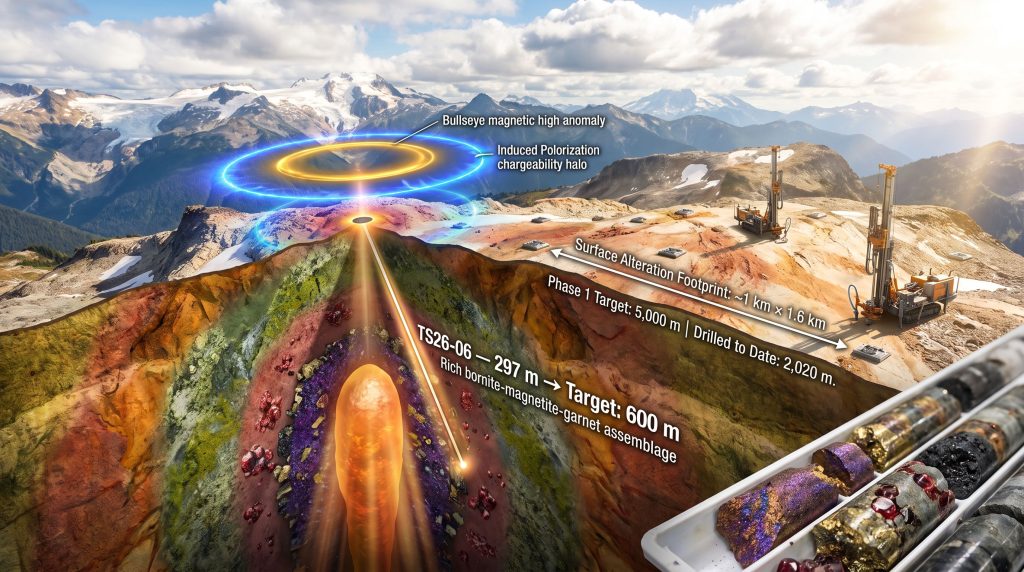
The surface expression of the system is substantial. An alteration footprint measuring approximately 1 kilometre by 1.6 kilometres defines the mapped extent of porphyry-style surface modification, a scale consistent with significant BC alkalic porphyry deposits at discovery stage. Surface sampling across this footprint has returned values in copper, gold, silver, tellurium, and tungsten, a multi-metal signature that is characteristic of alkalic porphyry systems in the region.
Three Independent Geophysical Datasets Converging on One Target
What distinguishes the Trek South geophysical picture from many early-stage exploration targets is the convergence of three independent datasets over the same spatial zone:
- Magnetic high anomaly: A bullseye-shaped magnetic high at the centre of the alteration zone, interpreted as the geophysical expression of magnetite-bearing, potassically altered rock at depth
- Induced Polarization (IP) chargeability high: A wrap-around IP anomaly surrounding the magnetic bullseye, indicating the presence of disseminated sulphide minerals concentrated around the magnetic core
- Magneto-telluric data: A third geophysical layer providing additional constraint on the depth and geometry of the conductive and resistive units beneath the target
The intersection of these three independent signals over the same area substantially reduces the ambiguity that plagues many single-method geophysical targets. In porphyry exploration, the convergence of magnetics and IP alone is considered a meaningful exploration vector; the addition of magneto-telluric data adds a layer of depth constraint that is relatively uncommon at such an early stage. 3D geological modelling of these overlapping datasets can further sharpen spatial targeting for subsequent drill holes.
Phase 1 Drilling at Trek South: Structure, Progress, and the Strategic Pivot
Program Parameters and Hole-by-Hole Logic
The Phase 1 drill program at Trek South targets 5,000 metres of total drilling. As of the most recent update, according to Oreterra Metals, 2,020 metres have been completed across five finished holes, with a sixth hole, TS26-06, actively advancing.
| Parameter | Detail |
|---|---|
| Phase 1 Target | 5,000 metres |
| Metres Drilled | 2,020 metres |
| Completed Holes | 5 (TS26-01 through TS26-05) |
| Current Hole | TS26-06 (at 297 m, targeting 600 m) |
| Next Hole | TS26-07 (commencing) |
| Drill Pads In Place | 8 |
| Drilling Continuation | Expected well into September |
| Regulatory Status | Tahltan Nation approved; BC Ministry of Mining and Critical Minerals authorised all 8 pads to remain over winter |
The program was designed around Drill Fence A-A', a longitudinal transect bisecting an 850-metre-long corridor of intensely altered bedrock. The opening four holes tested the western and eastern flanks of this corridor simultaneously, with the strategic intent of using contrasting mineralogical responses to triangulate the position of the intrusive root.
What the First Four Holes Revealed
All four early holes, TS26-01 and TS26-02 at the western end and TS26-03 and TS26-05 at the eastern end, intersected broadly similar propylitic alteration assemblages. The mineralogy logged included:
- Epidote, chlorite, and calcite as the dominant alteration minerals
- Accessory garnet and albite
- Sulphide species including pyrite, pyrrhotite, minor chalcopyrite, molybdenite, sphalerite, and scheelite
A critical observation unified all four holes: alteration and mineralisation intensity diminished systematically with depth, rather than intensifying. In porphyry exploration, this pattern is a classic distal halo response, signalling that the drill holes were testing the outer margins of the system rather than its productive core. The logical implication was clear: the source intrusion lay elsewhere, most probably beneath the magnetic bullseye at the centre of the anomaly field.
This systematic diminishment provided the geological vector that redirected the program. Hole TS26-04 was the first to pivot toward the magnetic anomaly centre. Hole TS26-06 continues and deepens that strategy.
Drill Hole TS26-06: Reading the Mineralogical Shift
A Different Assemblage Signals a Different Domain
What separates TS26-06 from its predecessors is not merely a change in drill orientation, it is a measurable change in the mineralogical character of the intersected rock. At 117 metres downhole, core from TS26-06 displays a co-occurrence of bornite, chalcopyrite, magnetite, and red garnet alongside what has been described as some of the strongest alteration encountered anywhere in the program to date.
This assemblage shift carries significant interpretive weight. Bornite (Cu₅FeS₄) is a copper-iron sulphide that forms under elevated temperature and pressure conditions, typically within the potassic alteration zone or immediately adjacent to it. Its presence alongside magnetite and calc-silicate garnet indicates that TS26-06 is sampling a thermal domain considerably hotter than the propylitic environments encountered in the four earlier holes.
Oreterra Metals Corp. CEO Kevin Keough described the team's reaction to the bornite identification as generating genuine excitement among geologists on site, noting that the alteration strength observed in TS26-06 was the most compelling seen across the entire program. The assessment from the exploration leadership was that the source intrusion could be deeper within the same hole, or positioned laterally, with holes TS26-07 and TS26-08 being repositioned specifically to triangulate its location.
The Nine Vein Styles and What They Mean
A minimum of nine distinct mineralised vein types have been catalogued across the Trek South program. This diversity is itself geologically informative. Multi-stage vein systems in porphyry environments reflect repeated pulses of hydrothermal fluid from a long-lived magmatic source, a characteristic more consistent with large, economically significant systems than with smaller, single-pulse occurrences.
| Vein Type | Key Minerals | Exploration Significance |
|---|---|---|
| Epidote-garnet ± calcite-quartz | Bornite, chalcopyrite | High-temperature; proximal to intrusion |
| Quartz with sulphides at centreline | Pyrite, chalcopyrite | Classic porphyry stockwork |
| Quartz with sulphides on selvages | Pyrite, scheelite | Multi-metal; tungsten enrichment |
| Chalcopyrite-bearing quartz veins | Chalcopyrite | Direct copper mineralisation |
| Pyrite-molybdenite veins | Molybdenite | Diagnostic porphyry indicator |
| Quartz-pyrrhotite-pyrite ± chalcopyrite | Illite + chlorite selvages | Later cross-cutting hydrothermal stage |
| Pyrrhotite-pyrite-quartz ± scheelite | Scheelite | Tungsten-bearing multi-metal |
| Calcite-only veinlets | Calcite | Distal carbonate flooding |
| Sulphide veinlet swarms | Pyrite, pyrrhotite (up to 3% disseminated) | Broad sulphide saturation in host rock |
The presence of tungsten-bearing scheelite and tellurium in the surface sampling is also worth noting. These trace elements are not typically abundant in shallow, oxidised porphyry environments and may reflect the preservation of primary mineralisation beneath the ice-protected surface, a potential advantage of the deposit's recently glaciated setting.
The next major ASX story will hit our subscribers first
Stratigraphy, Host Rocks, and the Eocene Intrusion Question
The primary host lithology throughout the Trek South drill program consists of andesitic lapilli tuffs with intermittent andesitic breccia intervals. Several metres of porphyritic and granodiorite dykes have also been intersected, consistent with a multi-phase intrusive history commonly associated with productive porphyry systems.
One geological detail deserves particular attention. Hole TS26-04 intersected a small Eocene-age granodiorite pluton that cross-cuts the earlier propylitic alteration. This body carries disseminated pyrite and quartz-pyrite-molybdenite veins. However, based on its limited size and peripheral position relative to the 1.6-kilometre-wide epidote-garnet alteration zone, it is interpreted as unrelated to the main porphyry system. This distinction matters because attributing the Eocene body's mineralisation signature to the primary target would misrepresent the exploration model and potentially misdirect future drill targeting.
QA/QC Standards and NI 43-101 Compliance
The analytical protocols applied to the Trek South program reflect industry-standard rigour for regulated Canadian exploration:
- Core is sawn lengthwise, with one half submitted for analysis and the reference half retained
- Maximum sample interval: 1.5 metres
- Gold analysis: fire assay method
- Multi-element analysis: four-acid digestion followed by ICP-MS
- Sample preparation: ALS facility in Terrace, BC
- Laboratory analysis: ALS Vancouver, BC
- QA/QC insertion: blanks, Certified Reference Material standards, and pulp or coarse reject duplicates at every 10th sample position
NI 43-101 compliance requires all technical disclosures to be reviewed by an independent Qualified Person. John Biczok, P.Geo., Vice President of Exploration for Oreterra Metals Corp., fulfils this role, a standard that distinguishes regulated Canadian junior exploration reporting from unverified promotional material.
Key Risks and the Distance Between a Vector and a Discovery
What Remains Unconfirmed
It is essential to distinguish between what has been established and what remains speculative at this stage of the Oreterra Trek South drill hole TS26-06 porphyry copper gold program. For investors keen on interpreting drill results from exploration-stage programs, this distinction is particularly consequential.
Confirmed through core logging:
- High-temperature mineral assemblage (bornite, magnetite, garnet) present at 117 metres downhole
- Progressive alteration intensification relative to earlier holes
- Multi-stage vein system indicating a complex, potentially long-lived hydrothermal system
Not yet confirmed:
- Economic grade mineralisation over meaningful intervals (assays are pending)
- Precise location of the source intrusion
- Vertical or lateral extent of the higher-temperature mineralisation zone
- Whether TS26-06's current trajectory intersects the potassic core or remains in a proximal but sub-economic halo
The source intrusion may lie deeper in the current hole, or it may be offset laterally, which is precisely why TS26-07 and TS26-08 are being positioned at carefully selected spatial intervals relative to TS26-06. A pad located 200 metres south of the TS26-06 collar is being prepared specifically to target the most magnetically intense portion of the anomaly with hole TS26-08.
Investor Caution: The identification of high-temperature indicator minerals in drill core is a well-established vectoring tool, not a confirmation of economic mineralisation. Grade, width, and continuity must be established through assay results before any assessment of economic significance is possible. This article does not constitute financial advice, and readers should conduct independent due diligence before making any investment decisions.
Frequently Asked Questions: Trek South and Hole TS26-06
What is bornite and why does its presence matter?
Bornite (Cu₅FeS₄) is a copper-iron sulphide mineral that forms at elevated temperatures, typically within the potassic alteration core of a porphyry system. Its co-occurrence with magnetite and garnet in TS26-06 suggests the drill hole is sampling a thermal environment consistent with proximity to the intrusive root of the Trek South system.
Why does molybdenite matter as a porphyry indicator?
Molybdenite (MoS₂) is one of the most diagnostic mineralogical indicators of a porphyry environment. It forms from high-temperature magmatic-hydrothermal fluids and is almost exclusively associated with porphyry copper-molybdenum-gold systems. Its presence, even in trace quantities, reinforces the porphyry interpretation at Trek South.
What does the wrap-around IP anomaly indicate?
An Induced Polarization chargeability high that wraps around a central magnetic anomaly is a classic geophysical signature in porphyry exploration. The IP response reflects disseminated sulphide minerals in the host rock, while the magnetic core reflects magnetite-bearing potassic alteration. Together, they describe the concentric mineralogical zonation predicted by the MDRU model.
Are assay results available for TS26-06?
No assay results have been released for the Oreterra Trek South drill hole TS26-06 porphyry copper gold program to date. All current geological interpretations are based entirely on visual core logging and mineralogical identification by qualified geologists on site. Understanding how to read drill results will be essential once assay data is released.
How many holes have been completed in Phase 1?
Five holes (TS26-01 through TS26-05) have been completed. Furthermore, as reported by Mining News North, one hole (TS26-06) is actively drilling toward a target depth of 600 metres, and hole TS26-07 is about to commence from a pad immediately east of the TS26-06 collar.
Ready to Track the Next Major Copper-Gold Discovery Before the Market Does?
Discovery Alert's proprietary Discovery IQ model delivers real-time alerts the moment significant ASX mineral discoveries are announced, transforming complex geological data into actionable investment insights — explore historic discoveries and their returns to understand the scale of opportunity, then begin your 14-day free trial at Discovery Alert to position yourself ahead of the broader market.