
June 6, 2026
What Does Orezone's Strategic Pivot Signal for Mid-Tier Gold Producers?
The consolidation wave reshaping North America's gold mining sector has accelerated dramatically as producers seek operational scale and geographic diversification to navigate increasingly complex market dynamics. Mid-tier operators face mounting pressure to achieve critical mass that supports sustainable growth platforms while managing jurisdictional risk exposure across multiple assets. This strategic imperative has become particularly pronounced as institutional investors demand clearer value propositions from mining companies operating in the 100,000 to 500,000 annual ounce production range.
The Orezone acquisition of Casa Berardi represents a calculated response to these market forces, combining Quebec's regulatory stability with Burkina Faso's development potential to create a diversified production platform. Casa Berardi's proven operational track record, spanning 38 years since 1988 with cumulative gold production exceeding 3.2 million ounces, provides the immediate cash flow generation necessary to fund exploration and development across both jurisdictions. This acquisition establishes Orezone as a meaningful participant in North American gold production with combined annual output approaching 174,000 to 182,000 ounces based on current operational guidance.
Multi-Asset Portfolio Construction in Volatile Markets
The strategic rationale underlying the Orezone acquisition of Casa Berardi extends beyond simple production consolidation to encompass sophisticated risk management through geographic and operational stage diversification. Casa Berardi operates within Quebec's Abitibi region, a Tier 1 mining jurisdiction characterised by stable regulatory frameworks, established infrastructure, and predictable operating costs. This positioning provides operational certainty that contrasts sharply with Orezone's Bomboré asset in Burkina Faso, where lower operating costs are offset by elevated political risk exposure.
Casa Berardi's 2025 production of 91,160 ounces, representing a 5 per cent year-over-year increase, demonstrates operational consistency that becomes increasingly valuable during commodity price volatility. Furthermore, the mine's established infrastructure includes processing capacity of 4,202 metric tonnes per day with expansion potential to 4,400 metric tonnes per day, providing production flexibility without requiring substantial capital expenditure for entirely new processing facilities.
Patrick Downey, Orezone's president and CEO, emphasised that this transaction creates a multi-asset platform with strong production and free cash flow, positioning the company for near-term growth and long-term value creation. The combination leverages Casa Berardi's operating history and robust resource base while maintaining substantial exploration upside that provides a foundation for sustained growth across both properties.
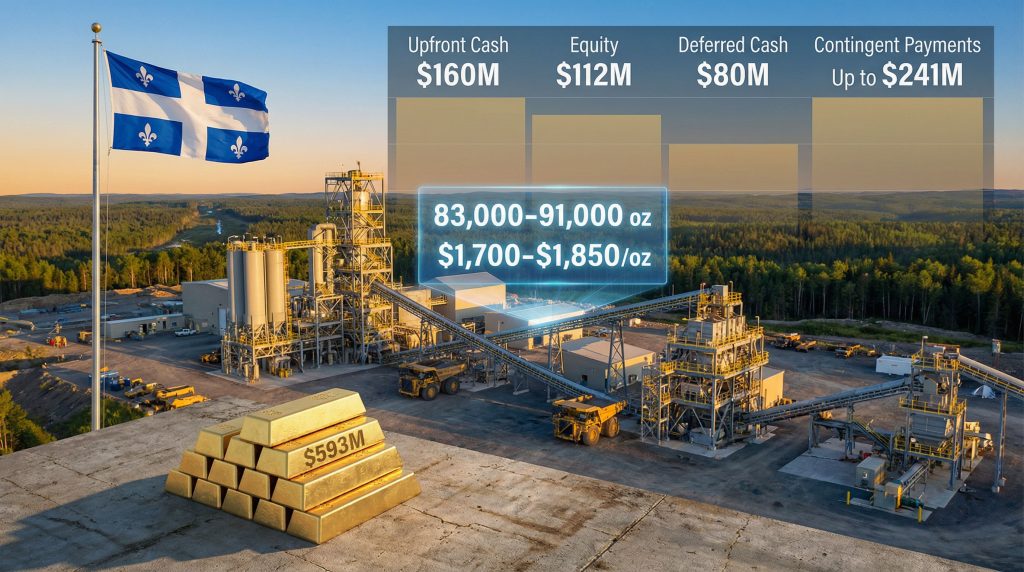
The acquisition structure reflects sophisticated capital allocation principles, with $593 million in total consideration structured across multiple payment components that align risk and reward between buyer and seller. This approach enables Orezone to acquire immediate cash flow generation while preserving balance sheet flexibility for ongoing exploration and development investment across the expanded asset base.
The New Economics of Tier 1 Jurisdiction Premiums
The $593 million consideration for Casa Berardi's 1.3 million ounces of gold reserves establishes a valuation benchmark of approximately $456 per ounce of reserves, which must be evaluated within the context of Quebec's jurisdictional advantages and operational infrastructure. This pricing reflects the premium that sophisticated mining investors assign to assets operating within stable regulatory environments where permitting processes, taxation policies, and community relations frameworks provide predictable operating conditions.
Casa Berardi's 2026 production guidance of 83,000 to 91,000 ounces annually with cash costs between $1,700 and $1,850 per ounce positions the operation within the first quartile of global gold producer cost curves. At current gold price record highs exceeding $2,000 per ounce, these operational metrics generate substantial operating margins that support both debt service and reinvestment in exploration activities.
The operational infrastructure advantages within Quebec's Abitibi region extend beyond regulatory stability to encompass transportation accessibility, skilled labour availability, and established mining services ecosystems. These factors reduce operational complexity and provide cost certainty that becomes particularly valuable during periods of supply chain disruption or skilled labour shortages affecting other mining jurisdictions.
In addition, Casa Berardi's proven resource replacement capability, demonstrated through 37 years of continuous operation, indicates sustainable mine life extension potential that supports long-term investment planning. The 37-kilometre strike length along the Casa Berardi Fault system hosts multiple zones of mineralisation beyond the current mining operations, with the Lac Germain prospect representing the most advanced exploration target identified to date.
When big ASX news breaks, our subscribers know first
How Will This Transaction Reshape North American Gold Production Dynamics?
The strategic implications of the Orezone acquisition of Casa Berardi extend throughout the North American gold mining sector, particularly among mid-tier producers seeking to achieve operational scale and capital market access advantages. The transaction establishes a precedent for geographic diversification strategies that balance regulatory stability against operational cost optimisation, creating a template that other mid-tier operators may attempt to replicate.
Orezone's expanded production profile, combining Casa Berardi's established operations with Bomboré's development potential, positions the company within the critical 100,000 to 500,000 annual ounce production range that institutional investors increasingly favour. This scale provides access to more favourable debt financing terms, enhanced analyst coverage, and improved trading liquidity that smaller producers struggle to achieve independently.
Franco-Nevada's Strategic Streaming Partnership Impact
The $100 million streaming arrangement with Franco-Nevada Corporation represents approximately 17 per cent of the total upfront cash consideration, demonstrating how precious metals streaming companies facilitate mid-tier consolidation through alternative financing structures. Franco-Nevada's commitment to this streaming arrangement validates Casa Berardi's production profile and operational stability while providing Orezone with acquisition financing that avoids traditional debt service obligations.
Streaming arrangements typically involve the streaming company acquiring rights to purchase a defined percentage of future metal production at predetermined prices, generally 20 to 30 per cent below spot prices, in exchange for substantial upfront cash payments. This financing mechanism becomes particularly attractive for mid-tier producers who require acquisition capital but seek to preserve equity ownership and avoid restrictive debt covenants that could limit operational flexibility.
Franco-Nevada's participation signals broader industry recognition of Casa Berardi's production reliability and reserve replacement potential, as streaming companies conduct extensive due diligence before committing significant capital to long-term production partnerships. However, the streaming structure aligns Franco-Nevada's interests with Casa Berardi's operational success while providing Orezone with patient capital that supports long-term value creation rather than short-term financial engineering.
The precedent established by this streaming arrangement may encourage other mid-tier consolidation transactions, as producers recognise that royalty company participation can bridge financing gaps while validating asset quality for other stakeholders. This dynamic creates positive reinforcement cycles where successful streaming partnerships facilitate additional transactions within the mid-tier sector.
Hecla's Silver-Focused Transformation Strategy
Rob Krcmarov, president and CEO of Hecla Mining, articulated that divesting Casa Berardi enables concentrated capital allocation toward the company's silver portfolio, particularly the Keno Hill ramp-up and Greens Creek operations. This strategic repositioning reflects broader industry recognition that commodity-diversified mid-tier producers face valuation discounts compared to specialised pure-play operators focused on specific metals.
Hecla's transformation toward silver specialisation positions the company to benefit from distinct silver supply-demand dynamics while accessing silver-focused investment capital that trades at premium valuations compared to diversified mining portfolios. The Casa Berardi divestment strengthens Hecla's balance sheet while eliminating operational complexity associated with managing geographically dispersed assets across different commodity exposures.
The transaction structure, providing Hecla with $160 million in immediate cash plus 65.7 million Orezone shares valued at $112 million, enables strategic capital reallocation toward core silver assets while maintaining exposure to Orezone's combined entity performance through the equity component. This balanced approach provides near-term liquidity for silver-focused investments while preserving upside participation in Casa Berardi's continued operational success.
Consequently, industry observers note that Hecla's strategic focus on silver, combined with other major producers' similar specialisation strategies, may accelerate sector consolidation as companies seek to achieve pure-play valuations rather than maintaining diversified commodity exposure that institutional investors often discount.
What Are the Key Financial Engineering Aspects of This Deal Structure?
The multi-component consideration structure underlying the Orezone acquisition of Casa Berardi demonstrates sophisticated deal engineering designed to balance competing interests while managing execution risk across the post-acquisition integration period. The $593 million total consideration comprises carefully structured payment components that align buyer and seller incentives around operational performance achievement.
| Payment Component | Amount | Timing | Risk Profile |
|---|---|---|---|
| Upfront Cash | $160M | Closing | Low execution risk |
| Equity Consideration | $112M (65.7M shares) | Closing | Market volatility exposure |
| Deferred Cash | $80M | 18-30 months | Operational performance linked |
| Contingent Payments | Up to $241M | Performance-based | High upside potential |
Contingent Consideration Mechanisms and Risk Allocation
The $241 million contingent consideration component, representing approximately 41 per cent of total consideration, creates substantial upside opportunity for Hecla while protecting Orezone from overpayment if Casa Berardi underperforms operational expectations. This structure reflects sophisticated risk allocation where the highest-value payment components require demonstrated operational success during the critical post-acquisition integration period.
Contingent payment mechanisms typically link to specific operational milestones including cumulative production volumes, average cash costs, reserve replacement achievement, and mine life extension targets. These performance triggers incentivise operational excellence while providing mathematical frameworks for determining additional compensation based on measurable outcomes rather than subjective assessments.
The 18 to 30-month timing for the $80 million deferred cash payment corresponds to Casa Berardi's full integration into Orezone's operational framework and achievement of stable combined-entity production targets. This deferred component requires Orezone to demonstrate cash flow generation capacity while providing Hecla with additional consideration that bridges immediate liquidity needs and longer-term contingent payments.
For instance, the equity consideration component, transferring 65.7 million Orezone shares valued at $112 million, creates direct alignment between Hecla and Orezone's combined entity performance. This structure means Hecla participates in value creation if Orezone achieves operational synergies and production growth targets while accepting downside exposure if integration challenges or market conditions negatively impact combined entity performance.
Accretion Analysis and Shareholder Value Creation
Financial modelling suggests that Orezone's combined entity could generate $425 million in free cash flow over 2026-2027, providing substantial capacity to service contingent payments while funding debt reduction and exploration investment. These projections assume combined annual production of approximately 170,000 to 180,000 ounces at average cash costs consistent with current Casa Berardi guidance of $1,700 to $1,850 per ounce.
The transaction structure enables value creation through multiple channels including immediate accretion from Casa Berardi's cash flow generation, operational synergies between Quebec and Burkina Faso assets, and exploration upside across the expanded property portfolio.
Return on invested capital calculations at various gold price forecast scenarios indicate positive value creation across a broad range of commodity price assumptions, with particularly attractive returns if gold prices maintain levels above $2,000 per ounce during the initial post-acquisition period. The combination of established production and exploration upside provides both near-term cash flow certainty and longer-term growth optionality.
The accretion analysis incorporates conservative assumptions regarding operational performance and excludes potential synergies that could emerge from shared services, combined exploration programmes, or optimised capital allocation across the expanded asset base. These factors suggest that actual value creation may exceed baseline financial projections if integration execution meets or exceeds management expectations.
How Does Casa Berardi's Operational Profile Support Long-Term Growth?
Casa Berardi's operational excellence spans nearly four decades of continuous production, establishing proven systems and processes that support sustainable long-term growth across multiple commodity price cycles. The mine's ability to consistently replace reserves while maintaining production has demonstrated resilience that becomes increasingly valuable as ore bodies at other operations approach depletion.
Production Consistency and Reserve Replacement Track Record
The 38-year operational history since 1988 with cumulative production exceeding 3.2 million ounces establishes Casa Berardi among Quebec's most successful mining operations. The mine's demonstrated ability to maintain production through various commodity cycles, regulatory changes, and operational challenges provides confidence in management systems and technical expertise that support continued operational success.
Casa Berardi's 2025 production of 91,160 ounces, representing a 5 per cent increase over 2024, resulted from operational optimisation focused on recovery improvements rather than throughput expansion. The mill processed 4,202 metric tonnes per day with ore grades and recovery rates that maintained production consistency while preserving higher-grade ore reserves for future extraction during favourable market conditions.
Current production guidance for 2026 of 83,000 to 91,000 ounces annually reflects conservative planning that prioritises operational sustainability over maximum short-term production. This approach enables mine planning flexibility that can respond to commodity price fluctuations while maintaining workforce stability and equipment utilisation efficiency throughout various market conditions.
The processing infrastructure includes expansion capability to 4,400 metric tonnes per day from the current 3,730 metric tonnes per day base capacity, providing production scaling potential without requiring major capital expenditure for completely new processing facilities. This technical flexibility becomes particularly valuable during periods of favourable commodity pricing or when processing higher-grade satellite deposits.
Exploration Upside Along the 37km Casa Berardi Fault System
The 37-kilometre strike length along the Casa Berardi Fault system represents one of Quebec's most prospective geological trends for additional gold mineralisation discovery. Limited exploration conducted to date has successfully identified several zones of mineralisation beyond the main Casa Berardi operation, with the Lac Germain prospect representing the most advanced exploration target currently under evaluation.
Geological interpretation suggests that the Casa Berardi Fault system hosts structural and lithological conditions favourable for multiple satellite deposits that could extend mine life and increase production capacity through staged development programmes. The regional geological framework includes similar rock formations and structural settings that have supported major gold discoveries throughout Quebec's Abitibi region.
Exploration programmes have historically focused on areas immediately adjacent to existing mining operations, leaving significant portions of the regional trend underexplored using modern exploration techniques and geological understanding. Consequently, this situation creates substantial exploration upside that could support resource expansion without requiring acquisition of additional properties or exploration permits.
The combination of established infrastructure and regional exploration potential provides multiple pathways for production growth including satellite deposit development, main deposit resource expansion, and processing optimisation that could significantly extend mine life beyond current reserve estimates.
What Market Timing Factors Influenced This Strategic Decision?
The Orezone acquisition of Casa Berardi occurs during a convergence of favourable market conditions including gold price stability above $2,000 per ounce, increased institutional investor interest in mid-tier gold producers, and growing recognition of jurisdictional risk premiums that favour operations in stable regulatory environments like Quebec.
Gold Price Environment and Production Cost Dynamics
Casa Berardi's cash cost guidance of $1,700 to $1,850 per ounce positions the operation to generate substantial operating margins at current gold market performance levels, creating financial flexibility that supports both debt service and reinvestment in exploration activities. These cost parameters place Casa Berardi within the first quartile of global gold producer cost curves, providing competitive advantages during periods of commodity price volatility.
The margin optimisation opportunities available through operational synergies between Casa Berardi and Bomboré could further improve the combined entity's cost position through shared services, optimised supply chain management, and coordinated capital allocation. These potential efficiency gains become particularly valuable during periods of inflationary pressure on mining costs or supply chain disruption.
Market timing considerations include the current environment of elevated gold prices that makes cash flow positive mining operations particularly attractive to institutional investors seeking exposure to precious metals without direct commodity ownership. This investment theme supports premium valuations for established producers with proven operational track records and resource replacement capabilities.
Strategic hedging opportunities enable mining companies to lock in favourable pricing for portions of future production, providing revenue certainty that supports debt financing and operational planning. Casa Berardi's established production profile creates opportunities to implement sophisticated hedging strategies that balance price protection with upside participation during gold price appreciation.
Mid-Tier Consolidation Trends and Competitive Positioning
Industry analysis indicates accelerating consolidation within the mid-tier gold producer segment as companies seek scale advantages in capital market access, operational efficiency, and exploration programme funding. The Orezone acquisition of Casa Berardi positions the combined entity within the 100,000 to 500,000 annual ounce production range that institutional investors increasingly prefer over smaller independent operators.
Competitive landscape dynamics favour producers with diversified geographic exposure that balances operational costs against jurisdictional stability, creating natural competitive advantages for companies that successfully implement multi-jurisdictional strategies. Orezone's combination of Quebec and Burkina Faso assets provides this geographic diversification while maintaining operational focus on gold production.
The transaction creates strategic optionality through the expanded asset base that enables flexible capital allocation responses to changing market conditions, exploration success, or acquisition opportunities. This operational flexibility becomes increasingly valuable as commodity markets experience greater volatility and mining companies require multiple development options to optimise shareholder returns.
Scale advantages in accessing capital markets include improved analyst coverage, enhanced trading liquidity, and more favourable debt financing terms that smaller producers struggle to achieve independently. These factors create positive reinforcement cycles where successful mid-tier consolidation enables additional growth through improved access to development capital.
How Will Integration Challenges Shape Near-Term Performance?
The successful integration of Casa Berardi's Quebec operations with Orezone's Burkina Faso asset base requires sophisticated management systems that accommodate different regulatory frameworks, operational practices, and cultural environments while maintaining production consistency across both operations.
Operational Integration Complexity Assessment
Management systems harmonisation between Bomboré and Casa Berardi involves standardising reporting protocols, financial controls, and operational procedures across jurisdictions with different regulatory requirements and cultural practices. This integration complexity requires experienced management teams capable of operating effectively in both Canadian and West African mining environments.
Technical team integration and knowledge transfer protocols become critical for sharing operational expertise between the two properties while maintaining site-specific knowledge that supports continued operational excellence. Casa Berardi's 38-year operational experience provides valuable institutional knowledge that could benefit Bomboré's development while Orezone's African mining experience may offer cost optimisation insights applicable to Quebec operations.
Cultural integration considerations extend beyond workforce management to encompass community relations, regulatory compliance, and supplier relationships that differ significantly between Quebec and Burkina Faso. Successful integration requires maintaining established community relationships while implementing consistent corporate policies across both jurisdictions.
The Q1 2026 closing timeline indicates that material regulatory approvals and operational transition planning were substantially completed during the negotiation period, reducing execution risk typically associated with mining acquisition integrations. This preparation suggests that both management teams prioritised integration planning to minimise operational disruption during the transition period.
Capital Allocation Priorities Post-Acquisition
Development capital requirements for both assets must be balanced against cash flow generation capacity and debt service obligations while maintaining exploration investment that supports long-term resource replacement. The projected $425 million free cash flow over 2026-2027 provides substantial capacity for capital allocation across multiple priorities including contingent payment fulfilment, exploration programmes, and operational optimisation.
Exploration budget optimisation across the expanded property portfolio enables coordinated programmes that leverage shared technical expertise while pursuing the highest-return exploration targets on both properties. Casa Berardi's 37-kilometre fault system and Bomboré's regional exploration potential create multiple opportunities for resource expansion through systematic exploration investment.
Debt service management and cash flow allocation strategies must accommodate the $80 million deferred payment scheduled for 18 to 30 months post-closing while maintaining operational flexibility and exploration investment capacity. This financial planning requires conservative cash flow assumptions that account for commodity price volatility and potential operational challenges.
Strategic capital allocation decisions include evaluating expansion opportunities at both operations, assessing acquisition opportunities that could further strengthen the combined platform, and implementing technology upgrades that improve operational efficiency across both properties.
The next major ASX story will hit our subscribers first
What Does This Transaction Reveal About Quebec's Mining Investment Appeal?
The $593 million consideration assigned to Casa Berardi reflects investor recognition of Quebec's superior mining investment environment, characterised by regulatory stability, infrastructure quality, and community support that creates measurable value premiums compared to operations in higher-risk jurisdictions.
Jurisdictional Risk Premium Analysis
Quebec's regulatory framework provides mining companies with predictable permitting processes, stable taxation policies, and established dispute resolution mechanisms that reduce operational uncertainty and support long-term investment planning. These factors create measurable value advantages that justify premium valuations compared to operations in jurisdictions with greater regulatory instability or policy unpredictability.
Infrastructure accessibility advantages in Quebec include established transportation networks, reliable power supply, and comprehensive mining services ecosystems that reduce operational costs while improving supply chain reliability. Casa Berardi's location within Quebec's Abitibi region provides access to specialised mining contractors, equipment suppliers, and technical services that support operational efficiency.
Community relations frameworks in Quebec emphasise consultation, environmental protection, and economic benefits sharing that create sustainable social licences for mining operations. Casa Berardi's 38-year operational history demonstrates successful community relationship management that supports continued operational permission and workforce stability.
The contrast with mining operations in higher-risk jurisdictions highlights Quebec's competitive advantages in attracting mining investment and supporting operational continuity throughout various political and economic cycles. These jurisdictional advantages become increasingly valuable as global mining operations face elevated political risks and regulatory challenges.
Abitibi Region's Strategic Importance in Global Gold Production
Quebec's Abitibi region represents one of the world's most prolific gold producing geological formations, with historical production significance dating back more than a century and continued geological prospectivity that supports ongoing exploration and development activities. Casa Berardi's position within this regional trend provides access to established geological knowledge and exploration expertise.
Mining services ecosystems within the Abitibi region include specialised contractors, equipment suppliers, and technical consultants that have developed expertise specifically relevant to regional geological conditions and operational challenges. This services availability reduces operational complexity while providing competitive cost structures compared to regions with less developed mining services infrastructure.
Transportation and logistics advantages enable efficient movement of equipment, supplies, and produced metals through established infrastructure networks that connect mining operations to major Canadian and international markets. These logistics efficiencies contribute to operational cost advantages while providing supply chain reliability during periods of transportation disruption.
Skilled labour availability within Quebec's mining regions provides access to experienced mining professionals who understand regional geological conditions and operational practices, reducing training requirements while supporting operational safety and efficiency standards.
How Should Investors Evaluate This Strategic Transformation?
Investment evaluation of the Orezone acquisition of Casa Berardi requires sophisticated analysis frameworks that account for operational diversification benefits, jurisdictional risk allocation, and free cash flow generation potential across multiple commodity price scenarios and operational performance assumptions.
Valuation Methodology for Multi-Asset Gold Producers
Net present value calculations for the combined entity must incorporate different discount rates for Quebec and Burkina Faso operations, reflecting jurisdictional risk premiums that institutional investors apply to mining investments in different regulatory environments. Casa Berardi's Tier 1 jurisdiction status supports lower discount rates compared to West African mining operations.
Risk-adjusted discount rates for diversified geographic exposure create portfolio benefits that may support premium valuations compared to single-jurisdiction operators, particularly during periods of elevated political risk or regulatory uncertainty. The combination provides operational stability through geographic diversification while maintaining exposure to different cost structures and development opportunities.
Comparable company analysis for similar transformation strategies remains limited due to the relative scarcity of successful multi-jurisdictional consolidation examples within the mid-tier gold producer segment. However, established producers operating across multiple jurisdictions typically trade at valuations that reflect both diversification benefits and operational complexity costs.
Financial modelling must account for currency exposure management between Canadian dollar-denominated Casa Berardi costs and potential US dollar or local currency exposure from Bomboré operations, creating natural hedging opportunities or additional currency risk depending on implementation strategies.
Key Performance Indicators for Monitoring Success
Production growth trajectory monitoring requires tracking both absolute production volumes and unit cost performance across both operations while identifying synergies that emerge from operational integration. Casa Berardi's 2026 guidance of 83,000 to 91,000 ounces provides baseline expectations against which management performance can be measured.
Free cash flow generation consistency across market cycles becomes a critical success metric, with particular attention to the combined entity's ability to generate the projected $425 million over 2026-2027 while servicing debt, funding exploration, and managing contingent payment obligations. This cash flow reliability supports investment thesis validation and future growth funding.
Reserve replacement ratios and exploration success metrics provide forward-looking indicators of operational sustainability, with particular focus on Casa Berardi's ability to extend mine life through the 37-kilometre fault system exploration programme and Bomboré's resource expansion potential.
Management execution capabilities in operating multi-jurisdictional mining portfolios represent qualitative success factors that influence long-term value creation, including demonstration of effective integration, cultural sensitivity, and strategic capital allocation across diverse operational environments.
For investors seeking broader market understanding, our gold stock market guide provides essential context for evaluating mining sector investments. Additionally, those interested in optimising their precious metals portfolios should consider reviewing comprehensive gold investment strategies that complement mining equity positions.
Disclaimer: This analysis is based on publicly available information and industry research. Mining investments carry substantial risks including commodity price volatility, operational challenges, and regulatory changes. Prospective investors should conduct thorough due diligence and consult qualified financial advisors before making investment decisions. Production forecasts, financial projections, and exploration potential assessments represent management estimates that may not be achieved due to various operational and market factors.
Want to Capitalise on ASX Mineral Discoveries?
Discovery Alert provides instant notifications on significant ASX mineral discoveries, powered by its proprietary Discovery IQ model, helping investors identify actionable opportunities ahead of the broader market. Explore how historic discoveries can generate substantial returns and begin your 14-day free trial today to position yourself ahead of major announcements.