July 31, 2026
When Commodity Traders Become Project Bankers: The Structural Logic Behind Base Metals Financing
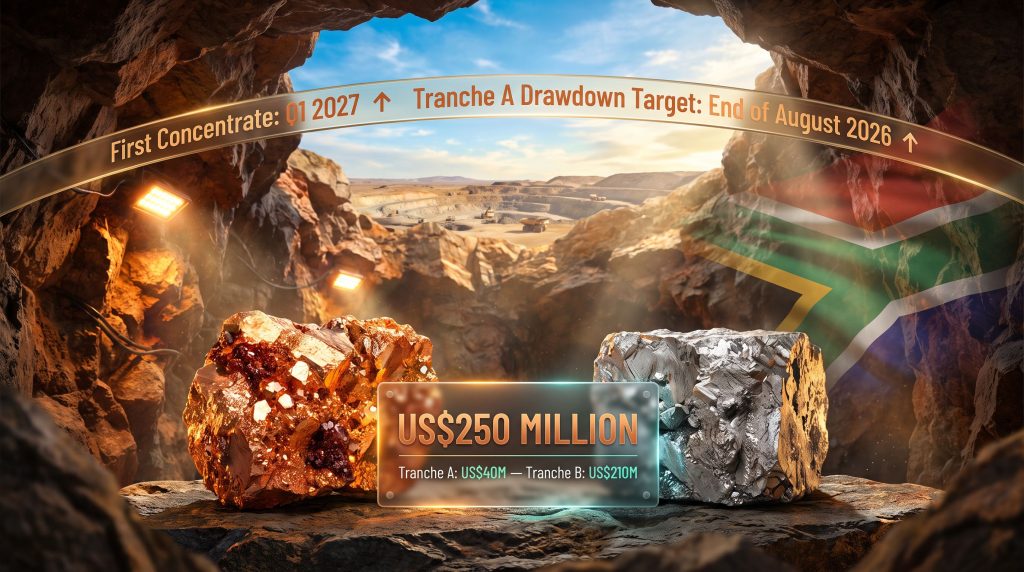
The line between commodity trader and project financier has been blurring for years across the global mining sector. As traditional bank syndication grows slower and more risk-averse, major trading houses with direct commodity offtake interests have stepped into the financing gap, offering junior developers integrated capital solutions that conventional lenders simply cannot replicate. The mechanics of this shift are visible in every clause of the Orion Minerals Glencore prepayment facility, a US$250 million structured arrangement that is now within weeks of its first drawdown and represents one of the most consequential base metals financing transactions to emerge from South Africa's Northern Cape province in recent memory.
When big ASX news breaks, our subscribers know first
Understanding the Prepayment Facility as a Project Finance Instrument
How Commodity-Linked Finance Differs From Conventional Debt
A prepayment facility is not a loan in the traditional sense. Rather than advancing cash against future cash interest payments, a commodity trader provides upfront capital in exchange for the right to purchase future production at agreed pricing terms. The repayment currency is not money but physical concentrate, meaning the financier's return is directly tied to the developer's ability to reach and sustain production output.
This structure creates a fundamentally different risk profile compared to bank debt. Furthermore, consider the key distinctions:
- Bank debt requires fixed cash servicing regardless of production status, creating liquidity pressure during ramp-up
- Prepayment facilities defer economic settlement until concentrate is physically delivered, aligning capital recovery with operational reality
- Royalty streaming extracts a percentage of revenue indefinitely, creating long-term dilution of project economics
- Equity raises preserve debt capacity but directly dilute existing shareholders
For a developer like Orion Minerals, the appeal of the Glencore structure is clear: capital becomes available without the rigid cash servicing obligations that could threaten solvency during the critical construction-to-production transition. This approach also mirrors broader mining consolidation trends that are reshaping how junior developers access growth capital.
The Financial Architecture of the Orion-Glencore Arrangement
The facility's structural parameters reflect a sophisticated tiering approach designed to match capital deployment with project development risk at each stage.
| Facility Parameter | Detail |
|---|---|
| Total Facility Value | US$250 million |
| Tranche A (Uppers Development) | US$40 million |
| Tranche B (Deeps Development) | US$210 million |
| Early Works Drawdown Option | Up to US$50 million |
| Repayment Mechanism | Copper and zinc concentrate deliveries |
| Early Repayment Penalty | None |
| Security Ranking | First-ranking, pari passu with other PCZM secured lenders |
The absence of an early repayment penalty deserves particular attention. In most large-scale commodity prepayment agreements, the financier embeds break fees or minimum return thresholds to protect against early exit. The Glencore structure contains no such mechanism, however, giving Orion meaningful financial flexibility should copper or zinc prices strengthen materially and allow accelerated concentrate deliveries or alternative refinancing.
The Prieska Copper-Zinc Project: A Historical Asset Returning to Life
From Apartheid-Era Production to Critical Minerals Relevance
The Prieska ore body in South Africa's Northern Cape province carries significant mining history. The original Prieska copper-zinc mine operated from 1971 to 1991, producing substantial volumes of base metal concentrate before closure amid depressed commodity prices. The re-emergence of Prieska under Orion Minerals represents a different proposition entirely: a resource being reassessed through the lens of modern critical minerals demand, updated metallurgical understanding, and new financing frameworks unavailable to its original operators.
What makes the ore body particularly compelling from a technical standpoint is its dual-metal character. Copper and zinc within the same deposit allows for blended concentrate production, giving the project natural revenue diversification across two commodity cycles that do not always move in synchrony. Zinc's role in galvanising steel and its growing application in zinc-air battery technologies adds a forward-looking dimension to what was historically considered a purely industrial metals asset.
The Uppers vs. Deeps Development Structure
The two-stage development model at Prieska is not merely a financing convenience. It reflects the genuine geological architecture of the deposit, where shallower, more accessible mineralisation in the Uppers zone provides an operationally achievable entry point before committing to the deeper and more capital-intensive Deeps development.
| Development Stage | Funding Tranche | Capital Allocation | Primary Purpose |
|---|---|---|---|
| Uppers | Tranche A | US$40 million | Construction and start-up |
| Deeps | Tranche B | US$210 million | Full-scale mine development |
This sequencing carries strategic logic for all parties. For Orion, the Uppers development creates a producing asset within a defined capital budget. For Glencore, Tranche A represents a relatively modest initial commitment that generates real-world operational data before the far larger Tranche B deployment is required.
First copper and zinc concentrate from the Prieska Uppers development is projected for Q1 2027, approximately 13 months after Tranche A drawdown closes, marking Orion's transition from developer to active producer.
Conditions Precedent: What Must Happen Before Capital Flows
Regulatory and Commercial Gating Mechanisms
In cross-border project finance arrangements involving South African assets and offshore capital, regulatory approval from the South African Reserve Bank is a non-negotiable gateway. The SARB's oversight of foreign exchange transactions and capital flows means that any prepayment facility drawing funds from an offshore entity into a South African operating company requires explicit authorisation. This approval has now been confirmed as received by Orion Minerals, removing one of the most significant regulatory uncertainties from the critical path to drawdown.
The remaining conditions precedent involve two commercial instruments:
-
Intercreditor agreement between Glencore and Triple Flag Precious Metals, governing the ranking and rights of two distinct secured creditors within the Prieska capital structure. This agreement is reported to be in advanced form and subject to execution.
-
Offtake agreements between Orion and Glencore, which define the concentrate delivery terms that will serve as the repayment mechanism for the prepayment facility. These agreements are in final form and also subject to execution.
Conditions Precedent Status at a Glance
| Condition Precedent | Status |
|---|---|
| South African Reserve Bank Approval | Confirmed received |
| Intercreditor Agreement (Glencore / Triple Flag) | Advanced form, pending execution |
| Orion-Glencore Offtake Agreements | Final form, pending execution |
| Tranche A Drawdown Target | End of August 2026 |
Triple Flag Precious Metals: The Intercreditor Dimension
Triple Flag Precious Metals holds a streaming interest in the Prieska project, having provided earlier-stage capital in exchange for precious metals by-product streams. The presence of two secured creditors with different repayment mechanisms and commodity exposures requires formal intercreditor documentation to define priority, enforcement rights, and cure periods in default scenarios.
The fact that this agreement is in advanced form rather than executed represents the primary remaining execution risk before Tranche A can close. Intercreditor negotiations between sophisticated institutional counterparties typically resolve around standardised terms, but the specific allocation of enforcement rights over a dual-commodity concentrate operation introduces nuances that require careful legal alignment.
Why Glencore Finances What It Trades: The Vertical Integration Logic
Securing Concentrate Supply in a Tightening Market
Glencore's rationale for structuring a prepayment facility rather than simply entering a standalone offtake agreement reflects a deeper commercial calculus. Commodity trading margins on base metal concentrates are partially a function of supply security. By embedding financing within an offtake arrangement, Glencore effectively purchases priority access to Prieska's future production stream at a point in the project lifecycle when alternative financing is most scarce and most expensive for the developer.
The growing copper supply crunch has faced persistent underinvestment relative to projected demand growth driven by electrification infrastructure, renewable energy buildout, and electric vehicle penetration. Independent analysts and major financial institutions have repeatedly flagged the structural copper supply deficit expected to materialise through the late 2020s. Against this backdrop, securing offtake from a new producing asset in a proven mining jurisdiction carries strategic value that extends beyond transaction-specific returns.
The Step-Down Return Mechanism
The Glencore facility includes a step-down in market-related returns once commercial production commences at Prieska. This is a structurally important feature: during the development and construction phase, Glencore earns a higher return commensurate with the elevated risk of a pre-production asset. Once concentrate flows begin, the return steps down to reflect the reduced risk profile of an operating mine.
This mechanism creates a built-in incentive structure that aligns both parties toward achieving production milestones as efficiently as possible. Orion benefits from lower effective financing costs post-production, while Glencore's transition to concentrate offtake at commercial terms provides the long-term commodity supply that justifies the original capital deployment. In addition, the copper demand drivers underpinning Glencore's interest in Prieska continue to strengthen across global markets.
Comparing Financing Options: Where Prepayment Facilities Sit in the Capital Stack
A Framework for Junior Mining Developers
Understanding where the Glencore prepayment structure sits relative to alternative financing instruments helps contextualise both its advantages and its constraints for Orion's long-term capital position. This comparison is particularly relevant given the growing role of mining private equity in filling financing gaps that conventional lenders leave behind.
| Financing Instrument | Repayment Mechanism | Equity Dilution Risk | Production Dependency | Early Exit Flexibility |
|---|---|---|---|---|
| Prepayment Facility (Glencore model) | Physical concentrate delivery | Low | High | High (no penalty) |
| Royalty Streaming | Revenue percentage | Low | Moderate | Low |
| Project Debt (Bank Loan) | Cash interest and principal | Low | Moderate | Moderate |
| Equity Raise | Not applicable | High | Low | High |
| Offtake-Backed Debt | Cash from sales | Low | High | Moderate |
The Glencore model scores particularly well on equity dilution avoidance and early exit flexibility, two parameters of acute relevance for a developer seeking to preserve shareholder value through the transition to production. The trade-off, however, is high production dependency: if Prieska encounters geological, operational, or processing challenges that delay or reduce concentrate output, the repayment timeline extends accordingly, potentially creating tension with Glencore's supply expectations.
Prepayment facilities structured around concentrate offtake are increasingly the preferred financing mechanism for base metals developers globally, as they align capital deployment with production reality rather than speculative equity valuations.
The next major ASX story will hit our subscribers first
Orion's Dual Listing Advantage and Path to Producer Status
ASX and JSE: Accessing Two Capital Markets Simultaneously
Orion Minerals' dual listing on the Australian Securities Exchange and the Johannesburg Stock Exchange provides structural advantages that single-listed developers lack. Access to Australian institutional capital, which has deep familiarity with junior mining project development, complements access to South African investors with direct knowledge of the Northern Cape's regulatory and operational environment.
This dual market presence also provides optionality for future equity raising should Tranche B deployment require supplementary capital, and it broadens the analyst coverage and investor awareness profile of a project that might otherwise receive limited attention from either market in isolation.
What Q1 2027 First Production Means for Project De-Risking
The 13-month development window between Tranche A close and first concentrate delivery is tight by mining construction standards but represents a defined and bounded execution challenge. The Uppers development draws on existing geological data, established processing knowledge from the original Prieska operation, and a capital allocation that reflects a focused construction scope rather than a greenfield development.
Successful execution of the Uppers development does several things simultaneously:
- It generates the first physical concentrate deliveries that begin settling the Orion Minerals Glencore prepayment facility
- It provides operational proof-of-concept for the processing circuit ahead of Deeps development commitment
- It transitions Orion from a development-stage company to a producing miner, fundamentally altering how the market prices the asset
- It establishes the operational track record that strengthens the case for Tranche B drawdown
The compounding effect of copper and zinc price movements on a producing asset versus a development-stage project is also significant. Markets typically apply substantial discounts to development-stage valuations to reflect construction, financing, and execution risk. Consequently, once production commences, those discount factors reduce materially, often producing valuation re-ratings that outpace commodity price movements alone.
Frequently Asked Questions: Orion Minerals Glencore Prepayment Facility
What is the total value of the Glencore prepayment facility for Orion Minerals?
The facility totals US$250 million, structured across two tranches: US$40 million allocated to the Uppers development and US$210 million reserved for the Deeps development.
When is Tranche A expected to be available for drawdown?
Orion Minerals has indicated that Tranche A drawdown is targeted for the end of August 2026, subject to the execution of the remaining conditions precedent including the intercreditor agreement and offtake agreements.
How will Orion repay the prepayment facility?
Repayment will occur through the physical delivery of copper and zinc concentrates produced at Prieska under linked offtake arrangements with Glencore. This structure means repayment is denominated in commodity production rather than cash.
Is there a financial penalty for early repayment?
No. The facility structure permits Orion to repay ahead of schedule without any financial penalty, providing balance sheet flexibility should production ramp-up exceed expectations or commodity prices create refinancing opportunities.
What is Triple Flag Precious Metals' role in the financing structure?
Triple Flag Precious Metals holds a secured position in the Prieska capital structure through a precious metals streaming arrangement. The intercreditor agreement between Triple Flag and Glencore is a required condition precedent, establishing the rights and ranking of both secured creditors within the project's capital stack.
What regulatory approval was required?
Approval from the South African Reserve Bank was required to authorise the cross-border financing arrangement. This approval has been confirmed as received, clearing the most significant regulatory gateway in the conditions precedent checklist.
Readers seeking broader context on base metals project development across Southern Africa and global prepayment facility structures in the mining sector can access related coverage and analysis through Mining Weekly, which tracks major financing and development milestones across the region.
Want to Invest in the Next Major Base Metals Discovery Before the Market Reacts?
Discovery Alert's proprietary Discovery IQ model delivers real-time alerts the moment significant ASX mineral discoveries are announced, transforming complex geological and commodity data into clear, actionable insights for both short-term traders and long-term investors — explore historic discoveries and their exceptional returns to understand the scale of opportunity, then begin your 14-day free trial at Discovery Alert to position yourself ahead of the broader market.