July 24, 2026
The Quiet Consolidation Reshaping Canada's Gold Mining Hierarchy
Gold mining has always rewarded scale, but the calculus behind that reward has shifted dramatically over the past decade. Rising capital expenditure requirements, deeper ore bodies, increasingly complex permitting environments, and the growing sophistication of institutional investors have collectively elevated the minimum viable size for a competitive senior gold producer. What was once a mid-tier ambition is now the baseline entry requirement for attracting the index-eligible capital flows that determine liquidity, analyst coverage, and ultimately, equity valuation multiples.
It is within this structural context that the Orla Equinox merger approval carries its full significance. This transaction is not simply one company absorbing another. It represents a deliberate repositioning of two complementary businesses into a single entity capable of operating at a tier of scale that commands genuine institutional attention across North American capital markets.
When big ASX news breaks, our subscribers know first
Why Scale Has Become the Defining Variable in Senior Gold Mining
The economics of gold mining have become increasingly unforgiving for producers sitting in the gap between junior developers and genuine majors. All-in sustaining costs (AISC) across the industry have climbed steadily, driven by energy price inflation, labour shortages in mining-intensive regions, and the technical complexity of processing lower-grade or deeper ore. Producers operating at sub-500,000-ounce annual output levels face a structural disadvantage.
Furthermore, they lack the operational leverage to spread fixed overhead costs efficiently, and they rarely generate the free cash flow required to self-fund meaningful exploration or development pipelines.
The market response to this dynamic has been a sustained wave of mid-tier consolidation. Mergers between producers in the 300,000 to 700,000 ounce per year range have become increasingly common, driven by the logic that combined entities can deliver cost efficiencies through shared infrastructure, centralised technical services, and rationalised corporate overhead. The mining industry consolidation trend reflects a broader truth: crossing the one-million-ounce production threshold unlocks inclusion eligibility in senior mining indices, expanding the universe of institutional buyers who can meaningfully participate in the stock.
Anatomy of the Orla Equinox Merger: What the Combined Entity Looks Like
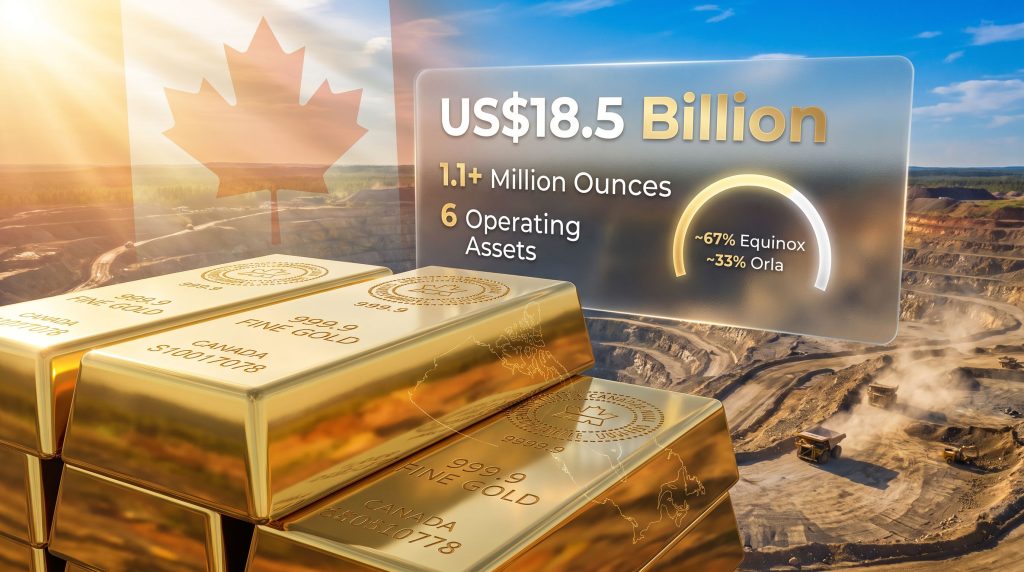
The Orla Equinox merger approval, secured through unanimous shareholder votes from both companies in late July 2026, creates a gold producer with a profile that few Canadian mining companies can match. The key metrics define the transaction's scale:
| Metric | Combined Entity |
|---|---|
| Estimated Enterprise Value | US$18.5 billion |
| Projected Annual Gold Production | 1.1+ million ounces |
| Number of Operating Assets | 6 |
| Equinox Shareholder Ownership | ~67% |
| Orla Shareholder Ownership | ~33% |
| Exchange Ratio | 1 Equinox share + US$0.0001 per Orla share |
| Expected Closing Date | On or about July 31, 2026 |
The ownership structure reflects the relative size differential between the two companies at the time of the transaction. Orla Mining shareholders receive one Equinox Gold share plus US$0.0001 in cash for each Orla share they hold, a structure that prioritises equity continuity over cash extraction. The result is a combined register where existing Equinox holders retain majority control at approximately 67%, while Orla shareholders gain exposure to a materially larger, more diversified platform.
The Legal Mechanism: Understanding the Plan of Arrangement
The Orla Equinox merger approval was structured as a court-approved plan of arrangement under Canadian corporate law, specifically requiring a final order from the Supreme Court of British Columbia before closing can occur. This mechanism is materially different from a conventional open-market takeover bid. For context, the Australian gold sector has seen similar dynamics, with gold M&A activity intensifying as producers seek comparable scale advantages.
A plan of arrangement in Canada requires judicial oversight as a condition of completion, providing shareholders with a formal legal gateway that scrutinises the transaction's fairness. This layer of court oversight is a meaningful structural protection that standard acquisitions do not always offer.
Under this framework, both shareholder bodies must separately endorse the transaction. According to Reuters, Equinox shareholders voted to authorise the share issuance required to fund the exchange, while Orla securityholders endorsed the plan of arrangement itself. Both votes passed unanimously, a result that signals strong alignment between the two investor bases on the strategic merits of the combination.
Canadian and Mexican competition authority approvals had already been secured as of late July 2026, materially de-risking the transaction. The remaining outstanding condition was the final court order from the Supreme Court of British Columbia.
The Asset Portfolio: Six Operations Across Multiple Jurisdictions
The combined company's operational base spans some of Canada's most productive gold-mining regions. Key assets within the merged portfolio include:
- Greenstone Mine, Ontario: One of Canada's largest new gold mining operations, representing a flagship asset for production volume within the combined entity.
- Musselwhite Mine, Ontario: An underground operation with an established reserve profile and long operational history in the province.
- Valentine Mine, Newfoundland and Labrador: A growth-stage asset offering future production optionality as it advances through its development timeline.
- Additional portfolio assets providing geographic diversification across multiple jurisdictions.
Producing over 1.1 million ounces of gold annually from six operations positions the merged company as Canada's second-largest gold producer, a distinction that carries practical consequences for index inclusion, analyst coverage breadth, and institutional investor eligibility thresholds.
The Greenstone Work Camp Decision: A Signal Worth Reading Carefully
One development at the Greenstone asset deserves specific attention from investors assessing the post-merger operational landscape. The Greenstone Council approved only a one-year extension for the mine's 613-bed temporary work camp, declining both the requested three-year renewal and a proposed 120-bed expansion. This outcome introduces a variable into workforce accommodation planning that the merged entity will need to resolve.
Greenstone Gold Mines, owned by Equinox Gold, may pursue an appeal to the Ontario Land Tribunal. The camp previously received council approval in both 2020 and 2023, meaning this shorter-than-requested renewal represents a shift in the local approval dynamic. For investors, this development illustrates a broader truth about modern mine operations: community relations and municipal approvals are not peripheral concerns. They directly affect operational continuity and workforce capacity planning at producing assets.
Social licence at the municipal level is increasingly as important as environmental permits. A mine that cannot house its workforce cannot produce at nameplate capacity, regardless of how strong its geological endowment may be.
Consolidation in Context: How Mid-Tier Mergers Compare to Major Acquisitions
The Orla Equinox merger sits within a broader pattern of mid-tier gold consolidation reshaping the competitive hierarchy below the tier-one majors. However, understanding where this type of transaction fits relative to larger deal structures helps investors calibrate their expectations. For instance, the Gold Fields takeover offer for Gold Road Resources, and the subsequent rejected takeover bid, illustrate how contested major acquisitions can diverge sharply from the more consensual mid-tier merger model.
| Factor | Mid-Tier Mergers (e.g., Orla-Equinox) | Major Acquisitions (e.g., Newmont/Newcrest) |
|---|---|---|
| Transaction Complexity | Moderate | High |
| Regulatory Scrutiny | Regional | Multi-jurisdictional |
| Integration Risk | Lower | Higher |
| Market Re-Rating Potential | Significant | Moderate |
| Shareholder Dilution Profile | Balanced | Often Material |
Mid-tier combinations carry distinct advantages that larger acquisitions often cannot replicate. Integration complexity scales roughly with organisational size, meaning two comparably-sized companies merging face more tractable cultural and systems integration challenges than a mega-cap absorbing a significantly smaller target. The re-rating potential is also asymmetric: a combined entity that crosses a meaningful production milestone often receives a valuation premium that neither constituent would have achieved independently.
Broader Canadian Mining Developments Shaping the Investment Context
Seabridge Gold's KSM Project: Funding Progress Against Legal Headwinds
Seabridge Gold has secured approximately $137 million in loan financing to maintain momentum at its KSM gold-copper project in northern British Columbia. The capital is being directed toward access road construction, feasibility-level engineering, and technical data collection while the company continues its search for a development partner.
The project is navigating meaningful legal complexity. The B.C. Supreme Court has ordered the province to reconsider KSM's "substantially started" designation following findings of inadequate Indigenous consultation. A separate dispute with Tudor Gold has also delayed permit amendments for the Mitchell Treaty Tunnels, which traverse land where Tudor holds mineral claims. These overlapping legal challenges illustrate the increasingly demanding consultation and permitting environment that large-scale Canadian mining projects must navigate.
Osisko Gold's Cariboo Project and the Social Licence Blueprint
Osisko Gold Group has formalised a three-year support and benefits agreement with British Columbia's District of Wells, tied to its subsidiary Barkerville Gold Mines' advancement of the Cariboo gold project. The agreement's structure is instructive:
- Infrastructure support for WILLDways High School, enabling local students to attend without relocating.
- Potential community infrastructure contributions of up to $3 million over the three-year term.
- Early underground development and site preparation already under way as the project advances toward full-scale construction.
This type of community agreement has become a template for responsible mine development in regions with established local populations. The financial commitment involved is modest relative to a mine's capital budget, but the relational capital it builds has measurable value in reducing the risk of community opposition during construction and permitting phases.
Rio Tinto Alcan's Aluminum Composites Exit
Rio Tinto Alcan is stepping away from its niche aluminum metal matrix composites business, transferring its customer relationships to Ontario-based Cymat Technologies. Under the commercial agreement, Cymat will manufacture the ceramic-reinforced aluminum material at its Mississauga facility and pay Rio Tinto a royalty of US$750 per tonne sold or used over five years, capped at a total of US$500,000. The material serves primarily automotive and rail applications. This divestiture reflects a broader pattern of major miners streamlining their portfolios around core commodity exposures rather than maintaining legacy niche manufacturing businesses.
The next major ASX story will hit our subscribers first
Global Developments With Relevance for Canadian Gold Investors
Cobre Panama: Restart Deliberations and the State Partnership Model
Panama is actively evaluating the creation of a state-owned mining entity that could serve as a co-owner in a potential Cobre Panama restart alongside First Quantum Minerals. One proposal under consideration would allocate 60 to 65 percent of the operational stake to First Quantum, with the remaining interest held by the Panamanian state entity. The mine was closed in 2023 after Panama's Supreme Court ruled that First Quantum's operating contract was unconstitutional, a decision that followed sustained public protests.
A government decision on the restart pathway could arrive before year-end 2026. For copper markets globally, Cobre Panama's return would represent a material supply-side event, given the mine's scale as one of the largest copper operations in the Western Hemisphere. Investors monitoring copper exposure within diversified Canadian mining portfolios should, consequently, watch this development closely.
Eldorado Gold's Skouries Project: Commissioning Phase Milestones
Eldorado Gold's Skouries copper-gold project in Greece has reached a pivotal operational threshold, having processed its first ore as construction approaches completion. A 3.9-million-tonne open-pit stockpile is in place to supply the processing plant through the current year, providing early operational buffer as the facility ramps up.
First copper-gold concentrate production is targeted for the third quarter of 2026, with commercial production expected in the fourth quarter. Final site energisation remains contingent on inspection and approval from the Greek power authority. Skouries represents a case study in the long development timelines characteristic of complex copper-gold projects in jurisdictions with evolving regulatory frameworks.
FAQ: Orla Equinox Merger Approval
What did Orla Mining shareholders receive in the merger?
Each Orla securityholder receives one Equinox Gold share plus US$0.0001 in cash per Orla share held under the terms of the court-approved plan of arrangement.
What percentage of the combined company do Equinox shareholders own?
Existing Equinox shareholders hold approximately 67% of the merged entity, with Orla shareholders accounting for the remaining 33%.
Has the merger received all required regulatory approvals?
Canadian and Mexican competition approvals were secured prior to the shareholder votes. The final outstanding condition as of late July 2026 was the Supreme Court of British Columbia's final order. As reported by Mining Weekly, Orla shareholders voted overwhelmingly in favour of the arrangement.
When is the Orla Equinox merger expected to close?
The transaction was expected to close on or about July 31, 2026, subject to satisfaction of remaining closing conditions.
How large will the combined gold producer be?
The merged company is projected to produce over 1.1 million ounces of gold annually across six operations, carrying a combined enterprise value of approximately US$18.5 billion, making it Canada's second-largest gold producer. In addition, the gold price impact on equities at this production scale will be a key variable investors should monitor as the merged entity establishes its post-close trading profile.
Key Takeaways for Investors Watching Canadian Gold Consolidation
- The unanimous Orla Equinox merger approval from both shareholder groups reflects genuine strategic alignment rather than a contested or coerced transaction.
- Crossing the one-million-ounce annual production threshold positions the combined entity for index inclusion eligibility, expanding its institutional investor addressable market.
- Competition clearances from Canadian and Mexican authorities were already secured before the shareholder vote, leaving only the court order as the final procedural gate.
- Community and municipal approvals, illustrated by the Greenstone work camp outcome, represent an underappreciated operational risk variable for large producing mines.
- Social licence frameworks adopted by companies like Osisko Gold at the Cariboo project are becoming industry standard practice, not optional goodwill gestures.
- Parallel global developments at Cobre Panama and Skouries reinforce that the gold and copper mining sectors are simultaneously navigating complex political, legal, and operational transitions that create both risk and opportunity for well-positioned investors.
Readers seeking further context on Canadian gold sector consolidation and the mechanics of mining mergers can explore ongoing industry coverage at CIM Magazine, published by the Canadian Institute of Mining, Metallurgy and Petroleum.
Want to Catch the Next Major ASX Gold Discovery Before the Market Does?
Discovery Alert's proprietary Discovery IQ model delivers real-time alerts on significant ASX mineral discoveries, instantly translating complex geological data into actionable investment insights — explore the historic returns major discoveries have generated and begin your 14-day free trial today to position yourself ahead of the market.