Pacgold Ltd
Pacgold Drills Shallow Oxide Extensions at Vertigo as White Dam Restart Work Advances
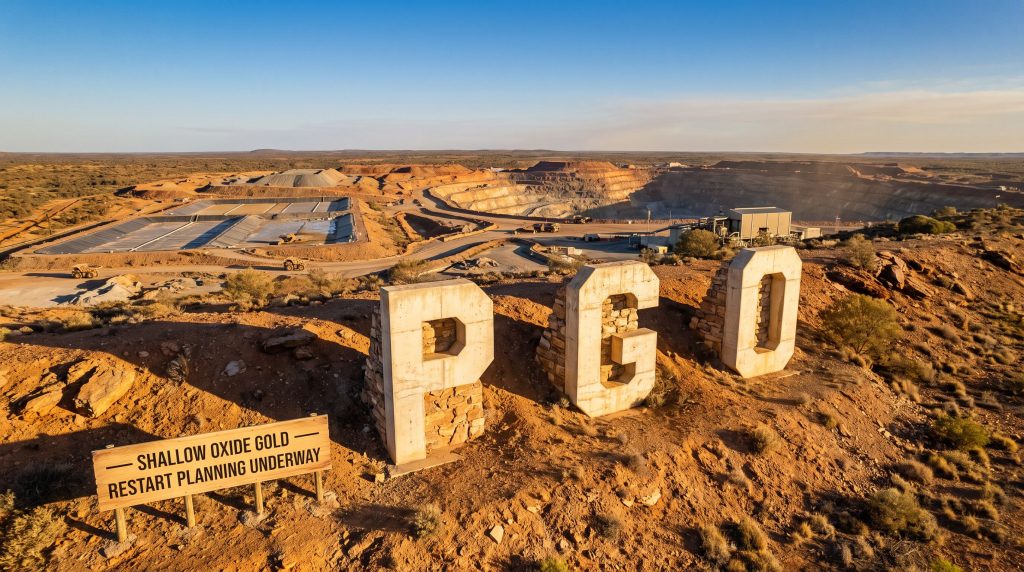
Pacgold Limited (ASX: PGO) has reported shallow oxide gold results from follow-up drilling at the White Dam Gold Project in South Australia, with the latest programme indicating mineralisation extends beyond the historic Vertigo open pit to the north and west. According to the ASX announcement, these results are being incorporated into an updated Mineral Resource Estimate (MRE), while mine planning, permitting and heap leach pad expansion work are being progressed in parallel.
For investors focused on near-term gold production stories, the update matters because White Dam already includes established open pits, a heap leach facility and an operating gold extraction plant. In that context, additional shallow oxide ore near an existing pit may have a direct bearing on restart timing, pre-strip requirements and early working capital needs.
When big ASX news breaks, our subscribers know first
What Did the Vertigo Drilling Programme Report?
In the announcement, Pacgold said the latest extension drilling programme comprised 102 holes for 2,904 metres, completed in May and June to assess grade distribution on the northern and western pit margins. This followed an earlier 178-hole, 10,526-metre programme aimed primarily at upgrading the confidence level of the 2020 Vertigo resource.
The newer drilling was undertaken after the earlier campaign encountered shallow gold mineralisation outside areas previously included in the resource model. The reported assays indicate that mineralisation continues near surface in these extension zones.
Selected shallow oxide intercepts reported by the company are shown below.
| Hole ID | Intercept | From | Grade |
|---|---|---|---|
| VRC181 | 13m | 14m | 1.3 g/t Au |
| incl. | 2m | 15m | 4.1 g/t Au |
| incl. | 1m | 19m | 2.7 g/t Au |
| VRC203 | 17m | 6m | 0.9 g/t Au |
| incl. | 1m | 13m | 3.1 g/t Au |
| incl. | 2m | 16m | 2.1 g/t Au |
| VRC243 | 9m | 3m | 1.3 g/t Au |
| incl. | 2m | 4m | 2.7 g/t Au |
| VRC257 | 7m | 4m | 0.9 g/t Au |
| incl. | 3m | 6m | 1.4 g/t Au |
| VRC260 | 4m | 0m | 3.1 g/t Au |
| incl. | 1m | 1m | 7.2 g/t Au |
| VRC263 | 13m | 5m | 1.0 g/t Au |
| incl. | 6m | 7m | 1.9 g/t Au |
| VRC268 | 6m | 0m | 2.2 g/t Au |
| incl. | 3m | 2m | 3.7 g/t Au |
| VRC277 | 8m | 0m | 1.0 g/t Au |
| incl. | 4m | 3m | 1.7 g/t Au |
| VRC278 | 11m | 0m | 1.2 g/t Au |
| incl. | 3m | 4m | 3.0 g/t Au |
Several intervals begin at surface or within the first few metres. That is important because shallow material can reduce the amount of waste rock that needs to be removed before ore mining begins.
The company also noted that the reported intercepts are downhole lengths, with drilling generally oriented close to perpendicular to mineralisation. Reported results used a 0.15 g/t Au cut-off, minimum downhole width of 1 metre, and maximum internal dilution of 3 metres.
What Did the Managing Director Say?
"These excellent shallow oxide intervals represent a very material win for PGO in respect to fast tracking the restart of the Vertigo mine and getting shallow low-cost oxide dirt onto the old pad while extending the ore leaching capacity with the new pad expansion," said Matthew Boyes, Managing Director.
He added that ore discovered on the pit margins is expected by management to reduce pre-strip costs and bring forward production from shallow oxide material.
Why Does Shallow Oxide Ore Matter at White Dam?
For non-specialist investors, the phrase shallow oxide gold is central to the investment case outlined in this update. Oxide ore is rock near the surface that has been altered by weathering. In many gold projects, oxide material is easier and less costly to process than deeper fresh sulphide ore.
At White Dam, this matters because the site uses a heap leach process. In simple terms, heap leaching involves:
- Mining and stacking crushed ore on a lined pad
- Applying a processing solution that dissolves the gold
- Recovering the dissolved gold through the plant
This style of processing is widely used for oxide gold where metallurgy is suitable. According to Pacgold, White Dam already has the relevant processing infrastructure on site.
Why Can This Matter Economically?
- Shallow ore may lower initial mining costs because less overburden needs to be removed
- Oxide ore may be suitable for lower-cost processing routes than harder fresh rock
- Existing infrastructure can reduce the amount of new construction needed before restart
- Quicker access to ore may support earlier cash flow if mine plans and permits align
That does not guarantee a restart outcome. However, the combination of near-surface mineralisation and existing site infrastructure is one reason this drilling update carries greater weight than a standard early-stage exploration result.
What Is the Current White Dam Resource Base?
The current White Dam MRE was published in August 2020 under JORC 2012 standards. It covers multiple zones, with Vertigo forming part of Pacgold's near-term production focus.
| Zone | Tonnes | Grade | Contained gold |
|---|---|---|---|
| White Dam North | 4,600,000t | 0.7 g/t Au | 101,900 oz |
| Vertigo | 1,700,000t | 0.8 g/t Au | 43,300 oz |
| Hannaford | 1,700,000t | 0.7 g/t Au | 38,300 oz |
| White Dam North sub-zone | 1,200,000t | 0.5 g/t Au | 20,300 oz |
Within Vertigo itself, the resource currently includes:
| Resource category | Tonnes | Grade | Contained gold |
|---|---|---|---|
| Indicated | 700,000t | 0.7 g/t Au | 16,400 oz |
| Inferred | 1,000,000t | 0.8 g/t Au | 26,900 oz |
| Total | 1,700,000t | 0.8 g/t Au | 43,300 oz |
A key point from the announcement is that 75% of the Vertigo resource is currently classified as Inferred. That is why the earlier infill drilling was important. Pacgold said that programme was designed to support an upgrade of the resource confidence category from Inferred to Indicated.
Furthermore, the extension drilling adds a second layer to the Vertigo story. It is not only about improving confidence in known ounces, but also about potentially adding new ounces on the pit margins that were not previously included in the 2020 model.
According to the company, an updated Vertigo MRE is being prepared by external consultants, with anticipated completion in August 2026, followed by revised open pit optimisations and mine designs.
What Do Resource Categories Mean for Investors?
Resource classification can appear highly technical, but it has practical implications for valuation and mine planning.
Inferred vs Indicated: A Simple Explanation
An Inferred Resource is the lowest confidence JORC resource category. It indicates there is evidence of mineralisation, but the geological continuity and grade consistency are not yet defined to a high enough standard for detailed mine planning.
An Indicated Resource, however, is a higher confidence category. It means drilling density and data quality are sufficient to support more detailed planning and technical studies.
In practice, this distinction matters for several reasons:
- Higher confidence resources are more useful for mine design and scheduling
- Updated classification can improve the reliability of production models
- Resource expansion plus category upgrades can have a combined effect on project studies
In Pacgold's case, the company is attempting to increase confidence in much of the existing Vertigo inventory while also adding shallow extension material. For investors, that means upcoming resource and mine design updates may be more informative than grade results alone.
Development Work Is Running Alongside Drilling
The announcement set out several parallel workstreams at White Dam, indicating that Pacgold is advancing project studies while drilling continues elsewhere on the mining leases. Key milestones reported by the company are summarised below.
| Milestone | Status / target timing |
|---|---|
| Updated Vertigo MRE | Anticipated August 2026 |
| Vertigo pit optimisation and mine design | To follow updated MRE |
| Vertigo restart timing update | Scheduled for early Q3 2026 |
| Heap leach pad expansion design | Deliverables due first week of August |
| Pad expansion tender | To commence immediately after design receipt |
| White Dam North drilling completion | Planned for late July 2026 |
| Rolling Prospect drilling | To begin after White Dam North |
| Hannaford drilling | Scheduled after Rolling |
| Entire current drilling programme complete | By end of Q3 2026 |
| Regional drilling on four priority targets | Proposed to commence in Q3 2026 |
This sequencing matters because Vertigo is framed by the company as the first White Dam asset targeted for return to production, while White Dam North, Rolling and Hannaford continue to be advanced in parallel.
Near-Mine and Deeper Exploration Add Another Layer
The update was not limited to the oxide restart case. Pacgold also said review of historical geochemical, geophysical, drilling and structural data has identified underexplored corridors near the existing mining leases.
According to the announcement, historical work at White Dam focused mainly on near-surface oxide mineralisation, with limited exploration below 40 metres vertically. Pacgold believes several oxide targets, including Vertigo East, White Dam North and Rolling, may also have potential for deeper gold-copper sulphide extensions.
Which Target Areas Have Limited Prior Drilling?
The company highlighted several target areas with limited prior drilling, including:
- Ground between the Hannaford and Vertigo pits
- The White Dam North area north of Hannaford
- The White Dam East prospect east of Hannaford
A regional geophysical programme is being designed to assess these zones, and permitting is in progress for four priority regional drilling targets.
This is relevant because White Dam could, therefore, develop into a two-part story: near-term oxide potential linked to restart planning at existing pits, and longer-dated sulphide exploration potential linked to underexplored deeper targets. The second part remains conceptual until drilling is completed; however, it broadens the project narrative beyond a simple restart case.
The next major ASX story will hit our subscribers first
Why Are Investors Watching the Next Quarter?
Pacgold's latest White Dam drilling update points to a concentrated series of catalysts rather than a single isolated assay release. The shallow Vertigo extensions may affect the updated resource model, pit shell design, strip ratio assumptions and early mining sequence, all of which are relevant to restart planning.
The project also benefits from existing infrastructure, which is a distinguishing factor in the context of small-cap gold developers. Mine designs, cashflow modelling, permitting and pad expansion work are all being progressed at the same time as follow-up drilling across the broader White Dam asset base.
For investors, the next major checkpoints are clear:
- Updated Vertigo MRE anticipated August 2026
- Mine design and optimisation outcomes to follow
- Pad expansion tender activity commencing shortly
- Restart timing guidance in early Q3 2026
- Progress at White Dam North, Rolling and Hannaford
If these workstreams remain on schedule, White Dam may move from exploration-led news flow into development and restart-focused milestones over the coming quarter.
Want to Stay Ahead of Significant ASX Gold Discoveries Like This One?
Discovery Alert's proprietary Discovery IQ model delivers real-time alerts on significant ASX mineral discoveries, instantly cutting through complex geological data to surface actionable opportunities for both short-term traders and long-term investors — start your 14-day free trial today and gain a market-leading edge, or explore Discovery Alert's dedicated discoveries page to understand how historic ASX mineral finds have generated substantial returns.