
May 21, 2026
Understanding Pakistan's Electricity Generation Surplus Problem
The persistent mismatch between Pakistan's electricity generation capacity and actual demand reveals fundamental flaws in energy sector planning that extend beyond simple forecasting errors. Recent data from the Jamshoro Pakistan 660MW coal plant overcapacity demonstrates how overcapacity has become a structural burden, with the facility operating at merely 6% utilization since its May 2025 commissioning despite a grid surplus of 10-12GW nationally.
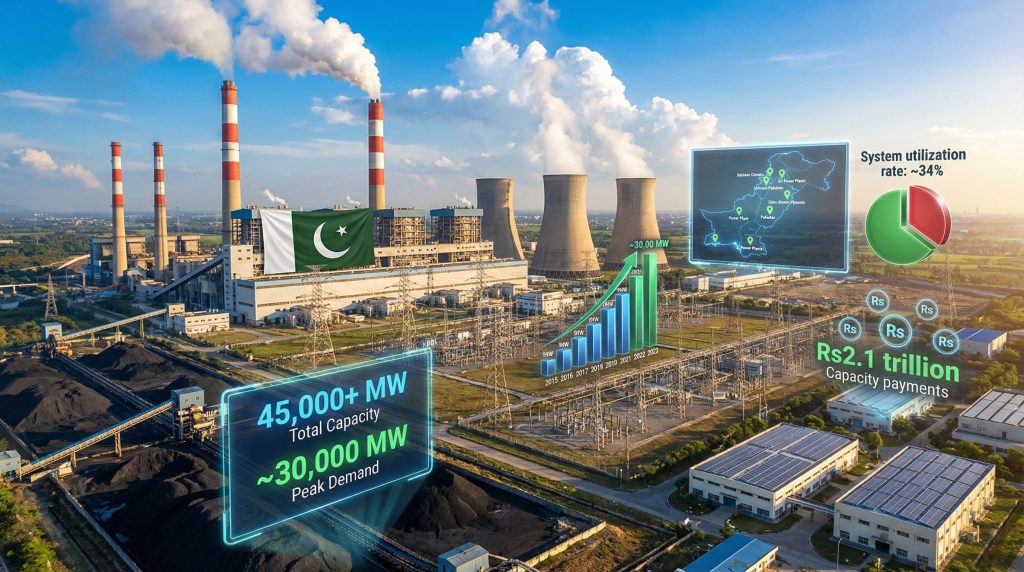
Pakistan's power sector maintains an installed generation capacity exceeding 45,000 MW while peak electricity demand rarely surpasses 30,000 MW, creating a utilization gap that forces consumers to subsidise idle infrastructure through capacity payments. Furthermore, this overcapacity crisis stems from optimistic demand projections that assumed industrial growth patterns that never materialised, leaving the system financially unsustainable and requiring comprehensive energy security insights.
Key Performance Indicators:
- Installed capacity: 45,000+ MW
- Peak demand: ~30,000 MW
- Average system utilisation: ~34%
- Annual capacity charge burden: Rs1.9-2.1 trillion
The Institute for Energy Economics and Financial Analysis noted that weak electricity demand has created structural challenges throughout Pakistan's power sector, with underutilised plants like Jamshoro exacerbating financial stress as capacity payments must be recovered through higher consumer tariffs regardless of actual generation output.
Coal import projections from data analytics firm Kpler indicate Pakistan's thermal coal imports remain flat at approximately 4 million tonnes annually. Consequently, this suggests that despite massive capacity additions, fuel utilisation has not increased proportionally with installed generation capability.
When big ASX news breaks, our subscribers know first
What Role Do Independent Power Producer Contracts Play in the Crisis?
Independent Power Producer agreements have created perverse incentives that prioritise capacity additions over demand optimisation through guaranteed payment structures that shift market risks entirely to consumers. Moreover, these contractual frameworks ensure revenue streams for generators regardless of electricity consumption levels, effectively removing market discipline from generation investment decisions.
The regulatory structure governing IPP contracts typically features "take-or-pay" mechanisms spanning 20-30 year terms, with capacity payments guaranteed independent of plant utilisation rates. The Jamshoro facility exemplifies this dysfunction, receiving fixed compensation despite operating at only 6% capacity whilst consumers bear the cost burden through mandatory tariff adjustments.
Contract Structure Challenges:
- Guaranteed capacity payments regardless of utilisation
- Long-term contractual commitments spanning decades
- Limited flexibility for demand-responsive generation
- Currency hedging costs transferred to consumers
- Minimal performance-based payment mechanisms
Recent regulatory notices from Pakistan's National Electric Power Regulatory Authority indicate that Jamshoro Power has abandoned plans for a second 660MW coal unit, citing lack of construction funding despite guaranteed payment contracts. This suggests that even IPP financial structures have become unsustainable, with capacity payment guarantees insufficient to support committed expansions.
In addition, the company has also proposed de-licensing four oil-fired generation units with 880MW combined capacity, representing a significant contraction in planned generation assets. These actions demonstrate how Pakistan 660MW coal plant overcapacity has created financial distress even within state-owned enterprises operating under guaranteed revenue frameworks.
How Has Coal Power Expansion Worsened the Overcapacity Problem?
Pakistan's coal generation capacity expanded dramatically from minimal levels in 2015 to over 7GW by 2023, primarily through international financing arrangements led by development banks and bilateral agreements. However, this rapid expansion occurred despite evident market weakness and declining industrial electricity consumption patterns, contributing significantly to energy transition challenges.
Coal Capacity Development Timeline:
| Year | Coal Capacity (GW) | Share of Total Generation Mix |
|---|---|---|
| 2015 | 0.15 | <1% |
| 2020 | ~2.5 | 11% |
| 2023 | 7+ | 25% |
| 2025 | 7.66+ | 27% |
The Jamshoro plant, developed with Asian Development Bank financing, represents the most recent addition to Pakistan's coal fleet and immediately encountered severe utilisation challenges. Commissioned in May 2025 into a market already maintaining 10-12GW surplus capacity, the facility's poor performance indicates coal expansion proceeded without adequate demand validation.
Furthermore, distributed solar adoption has reduced grid dependency by over 25% in some regions, fundamentally altering electricity consumption patterns whilst coal capacity additions continued. This shift exacerbates overcapacity during daylight hours when solar generation peaks, creating negative feedback loops for thermal plant utilisation.
The abandonment of Jamshoro's planned second 660MW coal unit demonstrates how market conditions have deteriorated to the point where even committed expansions cannot proceed financially. Consequently, this represents a significant reversal in coal sector growth expectations and highlights the magnitude of demand forecasting errors.
What Are the Economic Consequences of Underutilised Generation Assets?
The financial burden of maintaining idle generation capacity creates cascading economic inefficiencies that compound Pakistan's fiscal challenges through multiple transmission mechanisms. Consumers pay capacity charges averaging Rs17.5 per unit of electricity for generation capability that remains largely unused, whilst circular debt accumulation has exceeded Rs2.3 trillion.
Economic Impact Metrics:
- Capacity charge burden: Rs17.5 per unit consumed
- Circular debt accumulation: Rs2.3+ trillion
- Annual subsidy requirements: Increasing trajectory
- Industrial competitiveness: Declining due to high electricity costs
- Tariff escalation rate: Outpacing inflation consistently
The Institute for Energy Economics and Financial Analysis emphasised that low utilisation rates create a circular feedback mechanism where capacity charges drive tariff increases, which suppress demand, further reducing utilisation rates and requiring additional tariff adjustments to maintain generator financial viability.
Consumer subsidy requirements increase annually as the gap between cost-reflective tariffs and actual charges widens, placing mounting pressure on government finances. For instance, this burden distribution disproportionately affects different consumer categories, with cross-subsidy mechanisms often creating regressive impacts where industrial users subsidise residential consumption.
Manufacturing competitiveness suffers as Pakistani industrial electricity costs exceed regional competitors, potentially creating negative feedback loops that further suppress demand growth and worsen the Pakistan 660MW coal plant overcapacity problem. High energy costs reduce export competitiveness and discourage foreign direct investment in power-intensive industries.
How Do Distributed Energy Resources Affect Grid Demand Patterns?
The proliferation of rooftop solar installations and net metering arrangements has fundamentally altered electricity consumption patterns, reducing daytime grid demand whilst maintaining identical installed generation capacity. This transition creates temporal mismatches between renewable generation peaks and traditional demand patterns.
Net metering policies encourage grid defection behaviours, where consumers reduce grid electricity purchases during peak solar generation hours whilst maintaining grid connection for backup power. Consequently, this creates stranded asset risks for thermal generators that cannot easily adjust output to accommodate variable renewable injection.
Distributed Energy Impact Factors:
- Solar adoption reducing grid demand by 25%+ in some regions
- Net metering policies encouraging grid defection behaviours
- Captive power plants operating at 30% average efficiency
- Industrial consumers bypassing grid infrastructure investments
- Peak demand shifting to evening hours when solar generation ceases
Captive power generation continues expanding as industrial consumers seek to avoid high grid tariffs, further reducing demand for centralised generation whilst maintaining the same fixed cost base. These parallel systems operate at lower efficiency levels but provide cost advantages due to avoided capacity charges and transmission losses.
The timing of distributed solar generation creates particular challenges for coal plants like Jamshoro, which cannot economically cycle on and off to accommodate variable renewable output. This inflexibility compounds utilisation problems during daylight hours when solar generation is abundant, necessitating improved renewable energy integration.
What Policy Reforms Could Address the Overcapacity Crisis?
Regulatory authorities are exploring multiple intervention mechanisms to rebalance supply and demand dynamics, though existing contractual obligations significantly limit policy flexibility. Reform strategies focus on contract renegotiations, demand-side management programmes, and accelerated renewable energy integration with grid flexibility enhancements.
Potential Reform Approaches:
- Contract renegotiation: Modifying IPP payment structures to include performance metrics
- Demand aggregation: Incentivising industrial grid reconnection through competitive tariffs
- Flexible operation: Converting baseload plants to peaking unit operation
- Early retirement: Phasing out inefficient generation assets with compensation mechanisms
- Market restructuring: Introducing competitive wholesale electricity markets
IPP contract modifications represent the most significant potential intervention, though legal and political constraints limit renegotiation scope. Successful precedents from other developing economies demonstrate that contract adjustments are possible through negotiated settlements that balance generator financial viability with consumer cost burdens.
Furthermore, demand-side management programmes could help optimise existing capacity utilisation through time-of-use pricing, industrial load shifting incentives, and energy efficiency investments. These approaches require minimal additional capital whilst improving system economics through better asset utilisation.
Flexible operation conversions would allow thermal plants to provide grid balancing services rather than baseload generation, improving economics through reduced fuel consumption whilst maintaining capacity availability. However, this transition requires technical modifications and revised contract structures to accommodate variable operation patterns.
The next major ASX story will hit our subscribers first
How Does Pakistan's Experience Compare to Global Overcapacity Cases?
Pakistan's power sector challenges mirror similar overcapacity crises in other developing economies that experienced rapid industrialisation targets which failed to materialise as projected. The combination of optimistic demand forecasts, guaranteed return contracts, and limited regulatory oversight creates systemic risks across multiple jurisdictions.
Comparable situations have emerged in countries with similar development finance patterns, particularly where bilateral agreements or multilateral development bank financing supported large-scale generation additions based on economic growth assumptions that proved overly optimistic. These cases demonstrate common failure modes in power sector planning.
International Comparison Framework:
- Demand forecasting accuracy: Systematic overestimation in developing economies
- Contract flexibility mechanisms: Limited adaptation capability during market changes
- Regulatory oversight capacity: Insufficient technical expertise for complex contract evaluation
- Market structure design: Inadequate risk allocation between public and private sectors
- Political economy factors: Development finance pressures creating expansion bias
Successful overcapacity resolution typically requires comprehensive approaches that address contractual, regulatory, and market structure deficiencies simultaneously. Countries that have managed similar transitions often employed phased reforms that gradually introduced market discipline whilst maintaining investment climate stability.
The degree of overcapacity in Pakistan appears more severe than most comparable cases, with utilisation rates dropping to extremely low levels despite relatively recent capacity additions. This suggests that demand forecasting errors were particularly significant or that market structure changes accelerated beyond typical patterns, affecting broader natural gas trends in the energy sector.
What Are the Long-term Implications for Energy Security?
Whilst overcapacity theoretically provides energy security benefits through generation redundancy, the financial unsustainability of the current system threatens long-term sector viability. High electricity costs reduce industrial competitiveness, potentially creating negative feedback loops that suppress future demand growth and compound existing Pakistan 660MW coal plant overcapacity problems.
Investment climate deterioration affects both existing and future energy projects, as poor sector financial performance reduces investor confidence in Pakistani power market returns. Consequently, this dynamic could constrain future capacity additions even when legitimate demand growth eventually materialises.
Energy Security Risk Factors:
- Financial sustainability: Deteriorating utility and generator financial performance
- Infrastructure maintenance: Reduced investment in grid upgrades and plant maintenance
- Fuel security: Reduced coal import capability due to sector financial stress
- Technology transition: Limited resources for renewable energy integration
- Regulatory stability: Political pressure for policy reversals due to consumer cost burdens
Grid stability and reliability face threats from underinvestment in transmission infrastructure and generation plant maintenance as financial resources focus on debt service rather than capital expenditure. Moreover, deferred maintenance could create reliability problems that offset theoretical security benefits from excess capacity.
The transition toward renewable energy integration requires significant grid flexibility investments that become more difficult to finance when the existing thermal fleet operates at very low capacity factors. This creates timing mismatches between retirement needs and replacement capability development, impacting green transition strategies.
How Can Regulatory Frameworks Prevent Future Overcapacity?
Effective capacity planning requires integrated regulatory approaches that align generation investments with realistic demand projections whilst incorporating demand-side resources and maintaining contractual flexibility for changing market conditions. Lessons from Pakistan's experience highlight critical design principles for sustainable power sector development.
Regulatory Best Practices:
- Integrated resource planning: Coordinating supply and demand forecasts with economic growth scenarios
- Performance-based contracting: Linking payments to actual system reliability and economic needs
- Demand response integration: Incorporating flexible consumption in capacity planning
- Technology-neutral procurement: Optimising cost-effectiveness across generation technologies
- Regular plan updates: Revising capacity plans based on realised demand patterns
Demand forecasting methodologies should incorporate multiple economic scenarios rather than single-point projections, with regular updates based on actual consumption patterns and economic performance. Conservative planning approaches that account for distributed energy resources and energy efficiency improvements can help prevent overcapacity.
Furthermore, contract structures should include flexibility mechanisms that allow for capacity adjustments based on changing market conditions whilst maintaining appropriate risk allocation between public and private sectors. Performance-based elements can align generator incentives with system optimisation rather than pure capacity maximisation.
Regulatory capacity building remains essential for developing economies to effectively evaluate complex generation projects and contract proposals. Technical expertise in demand forecasting, contract analysis, and system planning enables better decision-making and reduces susceptibility to overly optimistic project promotions.
What Lessons Can Other Developing Countries Learn?
The Pakistani experience offers valuable insights for other developing countries considering large-scale power capacity additions. However, the importance of conservative demand forecasting cannot be overstated, particularly when economic growth assumptions underpin generation investment decisions spanning multiple decades.
International development finance institutions should incorporate more rigorous demand validation processes and avoid financing arrangements that create perverse incentives for overcapacity. Risk allocation mechanisms must be carefully designed to maintain appropriate market discipline whilst enabling necessary infrastructure development.
Regulatory frameworks should prioritise adaptability over rigid long-term commitments, allowing for course corrections as market conditions evolve. In addition, the integration of distributed energy resources and energy efficiency programmes into capacity planning becomes increasingly critical as these technologies mature and costs decline.
Disclaimer: This analysis is based on available information as of December 2025 and involves forecasts and assumptions that may not materialise as described. Energy sector conditions and policy frameworks can change rapidly, affecting the relevance of these observations.
Ready to Capitalise on Global Energy Market Opportunities?
Discovery Alert's proprietary Discovery IQ model delivers real-time alerts on significant ASX mineral discoveries, including critical minerals essential for energy infrastructure transitions, instantly empowering subscribers to identify actionable opportunities ahead of the broader market. Begin your 30-day free trial today and secure your market-leading advantage in the evolving energy and commodities landscape.