
June 23, 2026
Understanding Pakistan's Energy Vulnerability
Pakistan's economy sits at a critical juncture where external energy dependencies intersect with mounting fiscal pressures. The nation's overwhelming reliance on imported petroleum products creates a structural vulnerability that exposes approximately 240 million citizens to cascading economic consequences from regional instability. The Middle East crisis impact on Pakistan's oil import bill represents a fundamental threat to economic stability.
When big ASX news breaks, our subscribers know first
Understanding the Scale of Pakistan's Energy Import Crisis
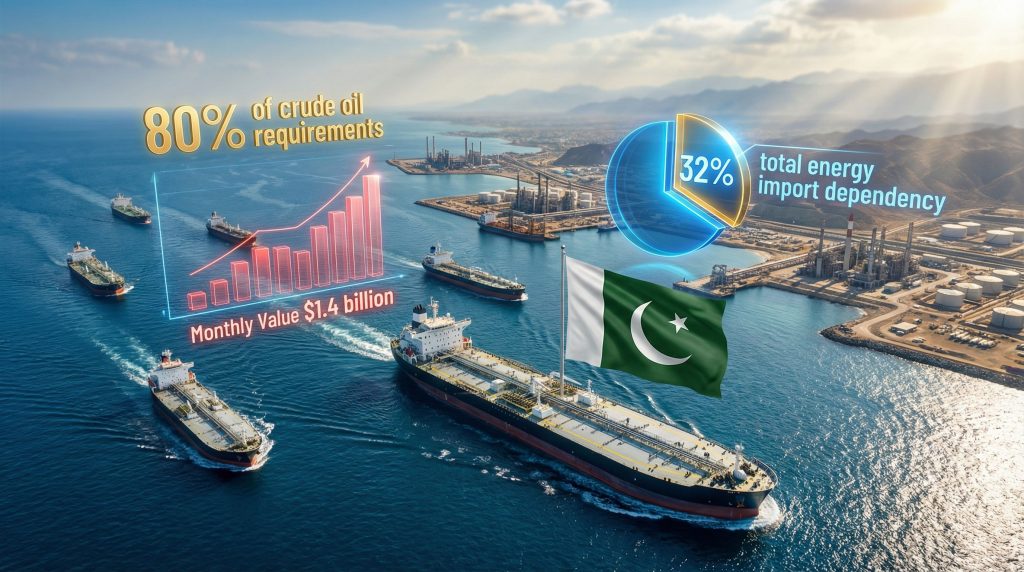
Pakistan's energy security challenges stem from a fundamental mismatch between domestic production capacity and consumption requirements. The country imports over 80% of its crude oil needs, creating an annual foreign exchange burden exceeding $17 billion during the first ten months of the current fiscal year.
This dependency extends beyond crude oil to encompass refined petroleum products and natural gas. Furthermore, Pakistan imports 25% of its annual natural gas consumption as liquefied natural gas, primarily sourced from Qatar, adding another layer of external vulnerability to the energy equation.
Critical Import Structure Analysis
| Energy Category | Monthly Import Value | Share of Total Imports | Annual Impact |
|---|---|---|---|
| Crude Oil | $1.4 billion | 24% | $16.8 billion |
| Refined Products | $300 million | 5% | $3.6 billion |
| LNG Imports | $200 million | 3% | $2.4 billion |
| Combined Total | $1.9 billion | 32% | $22.8 billion |
The Pakistan Institute of Development Economics has established a direct correlation between global oil price movements and Pakistan's import burden. Research indicates that every $10 increase in global oil prices translates to an additional $1.8-$2.0 billion annually in petroleum import costs, demonstrating the extreme sensitivity of Pakistan's economy to energy price volatility.
In addition, current natural gas forecasts suggest continued volatility in global energy markets, which further compounds Pakistan's challenges.
Geographic Concentration Risk: The Strait of Hormuz Vulnerability
Pakistan faces a compounded risk through the concentration of its energy import routes. Approximately 80% of Pakistan's crude oil imports transit through the Strait of Hormuz, a narrow 21-mile waterway between Iran and Oman that represents one of the world's most critical energy chokepoints.
This geographic dependency creates systemic vulnerability because disruptions to Hormuz passage affect not only global oil prices but also Pakistan's specific supply chains. When combined with the country's 80% import dependency, this means that over 64% of Pakistan's total crude oil supply depends on uninterrupted passage through this contested waterway.
Reserve Adequacy Crisis
Pakistan maintains petroleum reserves of only 10-14 days, placing the nation in the lowest tier of reserve adequacy globally. However, this limited buffer capacity contrasts sharply with international best practices and regional peers:
- Pakistan: 10-14 days of reserves
- India: 65-70 days of reserves
- International Energy Agency recommendation: 90 days minimum
- Saudi Arabia: 200+ days of reserves
The inadequacy of Pakistan's strategic reserves means that even a 15-20 day supply disruption would create severe shortages, forcing the country to compete urgently in global spot markets at premium prices during crisis periods.
Middle East Crisis Impact on Pakistan's Oil Import Bill
The escalation of Middle East tensions creates direct transmission mechanisms that amplify Pakistan's economic vulnerability. Recent geopolitical developments have already triggered significant price increases, with Brent crude prices rising nearly 50% to above $100 per barrel since the commencement of regional conflicts.
The Pakistan Institute of Development Economics has modelled various crisis scenarios and their potential impact on Pakistan's energy import costs. Consequently, analysts now predict substantial increases in the Middle East crisis impact on Pakistan's oil import bill across multiple scenarios.
Price Shock Scenario Analysis
| Crisis Level | Oil Price (per barrel) | Monthly Import Cost | Multiple of Baseline |
|---|---|---|---|
| Pre-Crisis | $70-80 | $1.7 billion | 1.0x |
| Current Level | $100-104 | $2.4 billion | 1.41x |
| Moderate Crisis | $120 | $2.8 billion | 1.65x |
| Severe Disruption | $150 | $3.5-4.5 billion | 2.06-2.65x |
Under the most severe scenario, where Strait of Hormuz closures trigger oil prices to $150 per barrel, Pakistan's monthly fuel import bills could reach $3.5-4.5 billion, representing a potential tripling of baseline costs.
For instance, detailed oil price rally analysis reveals how geopolitical tensions can rapidly escalate energy costs, creating severe challenges for import-dependent nations like Pakistan.
How Do Rising Oil Prices Create Inflation Throughout Pakistan's Economy?
Energy price increases create multiplier effects that extend far beyond direct fuel costs. The Pakistan Institute of Development Economics projects that sustained oil price elevation could drive Pakistan's inflation rate from the current 7% baseline to between 15-17% under severe disruption scenarios.
Direct Price Transmission Mechanisms
The inflationary impact operates through multiple channels:
- Transportation costs affecting all goods movement and distribution
- Manufacturing input costs reducing industrial competitiveness
- Agricultural mechanisation expenses impacting food production and rural incomes
- Electricity generation costs for thermal power plants dependent on imported fuel
Consumer Price Impact Projections
| Fuel Type | Current Price (PKR/litre) | Price at +$50/barrel | Percentage Increase |
|---|---|---|---|
| Petrol | 337 | 392 | 16.3% |
| Diesel | 329 | 384 | 16.7% |
| Kerosene | 312 | 367 | 17.6% |
These direct fuel price increases cascade through the economy as transportation costs for all goods rise, manufacturing becomes more expensive, and agricultural productivity faces input cost pressures. The phenomenon of oil price trade war effects demonstrates how global trade tensions can further amplify these domestic price pressures.
Pakistan's Crisis Response: Operation Muhafiz-ul-Bahr
Pakistan has launched Operation Muhafiz-ul-Bahr (Protector of the Seas), a comprehensive naval security operation initiated in March 2026 to provide direct warship protection to merchant vessels carrying critical energy supplies through contested maritime regions.
The operation addresses Pakistan's recognition that 90% of the country's trade is conducted by sea, making maritime security essential for economic stability. Pakistani naval vessels now provide escort services for energy tankers, though this tactical response addresses supply chain security rather than the underlying structural vulnerabilities of import dependency and reserve inadequacy.
Domestic Austerity Measures
Pakistan has implemented several immediate cost-reduction initiatives to manage rising energy costs:
- Four-day work weeks for public sector employees
- 50% remote work implementation reducing transportation fuel demand
- Two-week school closures minimising educational sector fuel consumption
- Parliamentary salary reductions and ministerial pay waivers
- Cabinet minister salary waivers for two-month periods
While these measures provide short-term demand reduction, they represent stopgap solutions rather than structural reforms to address Pakistan's fundamental energy security challenges.
The next major ASX story will hit our subscribers first
Balance of Payments and Currency Pressures
Higher energy import bills create direct pressure on Pakistan's foreign exchange reserves and balance of payments position. Energy imports represent Pakistan's largest single import category, meaning that price increases directly widen the current account deficit and potentially trigger balance of payments crises requiring international financial assistance.
The International Monetary Fund estimates that a 10% rise in oil prices produces a 40 basis points increase in global inflation and a 15 basis points decrease in global growth. For import-dependent economies like Pakistan with limited fiscal buffers, these global multipliers likely underestimate the localised impact, as import price increases cannot be easily absorbed through demand destruction or substitution.
Foreign Exchange Reserve Strain
Currency depreciation creates additional pressure through a negative feedback loop: as the Pakistani rupee weakens against major currencies, the cost of energy imports rises further, creating additional demand for foreign exchange and putting downward pressure on the currency.
This dynamic is particularly problematic for Pakistan because energy imports cannot be easily reduced in the short term due to the essential nature of petroleum products for transportation, electricity generation, manufacturing, and agricultural activities. Furthermore, trends in declining oil production globally add additional pressure to international energy markets.
Strategic Diversification and Long-Term Resilience Building
The Pakistan Institute of Development Economics has recommended comprehensive structural reforms to reduce Pakistan's energy vulnerability, focusing on three primary areas: strategic reserve expansion, supply route diversification, and supplier portfolio rebalancing.
The Middle East crisis impact on Pakistan's oil import bill has highlighted the urgent need for these structural changes to prevent future economic shocks.
Strategic Reserve Expansion Framework
Target Reserve Levels:
- Current capacity: 10-14 days
- PIDE recommendation: 30-60 days
- International best practice: 90 days minimum
Expanding petroleum reserves to 30-60 days capacity would provide essential buffer against supply disruptions, though this expansion requires significant infrastructure investment estimated in the billions of dollars.
Alternative Supply Corridor Development
Pakistan can reduce its dependence on Strait of Hormuz transit through several alternative routing strategies:
Overland Pipeline Development:
- Trans-Afghan Pipeline connecting Central Asian suppliers via Uzbekistan
- China-Pakistan Economic Corridor (CPEC) energy infrastructure projects
- Uzbekistan-Afghanistan-Pakistan (UAP) railway reducing transit times by 10-15 days
Maritime Route Diversification:
- Enhanced Red Sea routing capabilities despite higher transportation costs
- Development of Yanbu port alternatives to reduce Hormuz dependency
- Strengthened maritime insurance frameworks for alternative routes
Supplier Portfolio Rebalancing Strategy
Pakistan can reduce its concentration risk by diversifying energy procurement sources. In addition, developments such as Saudi exploration licenses may create new opportunities for energy partnerships.
Enhanced Procurement Options:
- United States WTI crude offering competitive pricing and refinery compatibility
- Central Asian producers accessible through overland routes
- Alternative LNG suppliers reducing Qatar dependency
- African crude sources providing geographic diversification
This diversification strategy requires developing new trade relationships, establishing appropriate payment mechanisms, and potentially investing in refinery modifications to process different crude oil grades.
Investment Climate and Economic Multiplier Effects
Sustained energy price volatility creates uncertainty that discourages both foreign direct investment and domestic capital formation, potentially slowing Pakistan's economic recovery trajectory. Consequently, the combination of high energy costs, currency pressures, and inflation creates a challenging environment for business investment and economic growth.
Economic Transmission Channels:
- Manufacturing competitiveness declines as input costs rise
- Agricultural productivity faces mechanisation cost pressures
- Transportation sector experiences margin compression
- Electricity generation costs increase for thermal power plants
These effects compound through supply chain relationships, creating economy-wide inflationary pressures that extend beyond direct energy costs to affect virtually all goods and services.
Risk Assessment and Future Scenarios
Pakistan's energy security crisis represents a confluence of structural vulnerabilities that require comprehensive policy responses. The current Middle East crisis could triple Pakistan's oil import bill according to energy analysts, highlighting the urgent need for strategic reforms that address both immediate crisis management and long-term resilience building.
Critical Risk Factors:
- Geographic concentration of supply routes through contested chokepoints
- Inadequate strategic reserves providing minimal buffer capacity
- Limited supplier diversification creating dependency on unstable regions
- Foreign exchange constraints limiting crisis response flexibility
Policy Priority Framework
The intersection of geopolitical instability and economic fragility creates compounding risks that extend beyond immediate fuel costs to broader macroeconomic stability, inflation control, and social welfare outcomes. However, experts warn oil price surge could cost Pakistan up to 15% of GDP under severe disruption scenarios.
Immediate Priorities:
- Strategic reserve expansion to 30-60 days capacity
- Supply route diversification through alternative corridors
- Supplier portfolio rebalancing reducing regional concentration
- Foreign exchange management supporting import financing
Long-term Structural Reforms:
- Domestic energy production capacity enhancement
- Renewable energy development reducing import dependency
- Energy efficiency improvements across all sectors
- Economic diversification reducing overall energy intensity
Pakistan's current energy security challenges underscore the fundamental importance of reducing external dependencies and building domestic resilience against global supply shocks. The ongoing Middle East crisis serves as a critical reminder of the economic costs associated with energy import dependency and the urgent need for comprehensive structural reforms to enhance Pakistan's energy security framework.
The Middle East crisis impact on Pakistan's oil import bill represents more than just a financial burden—it threatens the country's economic stability and social welfare. Only through strategic planning, infrastructure investment, and international cooperation can Pakistan build the resilience necessary to weather future energy crises.
This analysis is based on publicly available information and research findings. Energy markets remain highly volatile, and actual outcomes may differ from projections. Readers should consult qualified financial advisors before making investment decisions related to energy markets or Pakistani economic assets.
Are You Monitoring Global Energy Market Volatility for Investment Opportunities?
Discovery Alert's proprietary Discovery IQ model delivers real-time alerts on significant ASX mineral discoveries, helping investors capitalise on energy commodity opportunities as global markets face unprecedented volatility. Begin your 14-day free trial today to position yourself ahead of market movements and secure actionable insights into Australia's expanding energy exploration sector.