May 12, 2026
Pakistan's specialty fertilizer manufacturing sector faces unprecedented challenges as the Pakistan SOP output cut on sulphur shortage demonstrates how geopolitical tensions can rapidly transform industrial supply chains. The current disruption stems from regional conflicts that have severely impacted sulphur availability from Iran, Pakistan's primary feedstock source for sulphate of potash production. Furthermore, the trade war impacts occurring globally have created additional pressures on commodity markets, while the ongoing supply chain crisis has heightened awareness of industrial vulnerabilities.
Understanding the Technical Framework of Specialty Fertilizer Production
The Mannheim process represents one of the most widely adopted methodologies for sulphate of potash (SOP) production worldwide, utilizing a chemical conversion pathway that transforms potassium chloride feedstock through sulphuric acid interaction. This industrial process operates under strict stoichiometric requirements, demanding approximately 0.6 tonnes of sulphuric acid per tonne of SOP output, creating an inflexible relationship between raw material availability and production capacity.
The technical specifications of Mannheim SOP manufacturing prevent meaningful substitution of feedstock sources once production infrastructure is established. Unlike other fertilizer production methods that might accommodate alternative raw materials, the chemical pathway requires precise purity standards and consistent composition that limit sourcing flexibility. Consequently, this constraint becomes particularly significant when primary supply routes face disruption, affecting raw material supply networks globally.
Chemical Process Dependencies and Industrial Constraints
Pakistani SOP producers have structured their operations around the 0.2 tonnes of sulphur per tonne of SOP conversion ratio that defines Mannheim process economics. The chemical reaction cannot accommodate domestic sulphur alternatives due to both composition requirements and the established infrastructure designed specifically for Iranian feedstock integration.
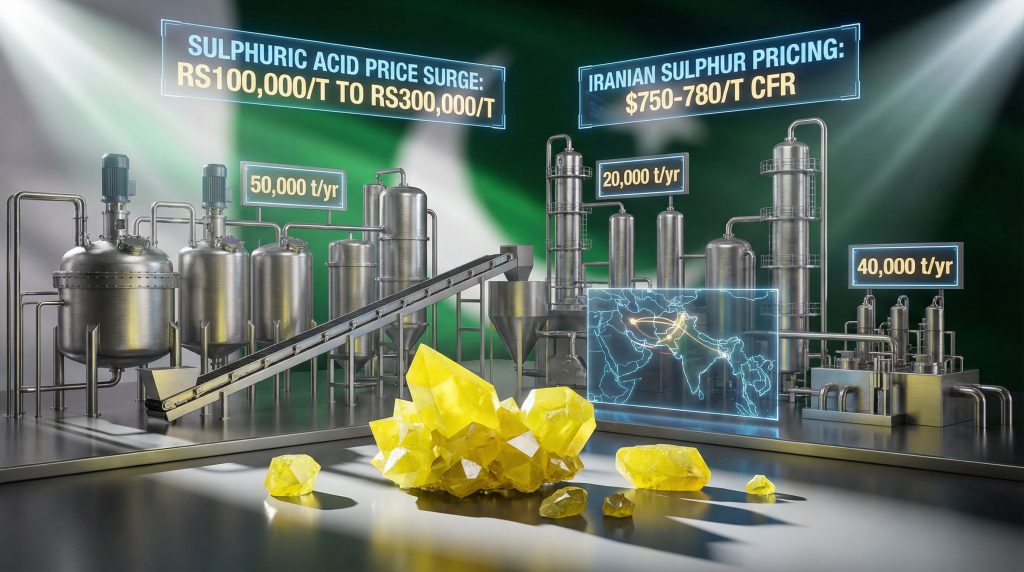
When sulphuric acid prices surge from Rs100,000 per tonne to Rs300,000 per tonne within a two-month period, as occurred between February and April 2026, the impact extends beyond simple cost increases. The price escalation represents a fundamental shift in production economics that forces operational adjustments across the entire manufacturing sector. According to Argus Media, "Pakistani SOP producers have reduced operating rates significantly due to elevated feedstock costs."
Regional Supply Chain Architecture
The Pakistan-Iran trade corridor for sulphur represents more than a commercial relationship; it constitutes a critical industrial dependency that shapes production decisions across multiple manufacturing facilities. Cross-border truck deliveries priced at $750-780 per tonne CFR equivalent reflect not just commodity pricing but the complex logistics of maintaining industrial feedstock flows amid regional disruption.
This supply chain architecture has evolved to optimise both cost efficiency and operational reliability, creating structural dependencies that cannot be quickly reconfigured when external pressures emerge. Therefore, the result is a system where individual facility production rates become directly correlated with international diplomatic and military developments.
When big ASX news breaks, our subscribers know first
Operational Adjustments Across Pakistan's SOP Manufacturing Network
Pakistan's specialty fertilizer producers have implemented differentiated response strategies that reflect both their operational capabilities and management assessments of market conditions. These adjustments reveal how industrial facilities adapt to sustained feedstock constraints while maintaining commercial viability.
Facility-Specific Production Modifications
Current Operating Status Across Major Producers:
| Producer | Plant Location | Annual Capacity | Operating Rate | Strategic Approach |
|---|---|---|---|---|
| Barket Fertilizers | Port Muhammad Bin Qasim | 50,000 tonnes/year | 75% (March-April) | Full capacity restart planned |
| Agven | Gwadar | 20,000 tonnes/year | 50% (maintenance period) | Decision pending on feedstock economics |
| Suncrop | Rahim Yar Khan | 40,000 tonnes/year | 50-75% capacity | Active market monitoring |
| Akbari | Bhikhi | 20,000 tonnes/year | 50-75% capacity | Cost-benefit analysis ongoing |
The variation in operational responses demonstrates how producers are interpreting current market conditions differently. Barket Fertilizers' decision to secure feedstock and plan full capacity restart by April 15, 2026, suggests management confidence in sustained demand and acceptable margin structures despite elevated input costs.
Conversely, facilities like Agven are timing maintenance periods to coincide with feedstock constraints, effectively using planned downtime to avoid operating during peak cost periods. This approach allows preservation of cash flow whilst maintaining optionality for future production increases when conditions improve.
Economic Analysis of Production Rate Adjustments
The reduction in operating rates from baseline 80-90% capacity to 50-75% capacity represents more than proportional cost management. At current sulphuric acid pricing levels of Rs300,000 per tonne, feedstock costs consume approximately 64-69% of final product selling prices, compared to an estimated 23-27% share at February 2026 pricing levels.
This margin compression creates a scenario where producers must carefully evaluate each production decision against contribution margin thresholds. Operating at reduced rates allows selective fulfilment of contracted commitments while declining spot market opportunities where pricing cannot accommodate elevated input costs. The tariff market impact extends beyond direct cost implications to influence production planning decisions.
The Rs120,000 per tonne increase in feedstock costs represents approximately 43-46% of current SOP selling prices of Rs260,000-280,000 per tonne ex-warehouse. This cost structure shift fundamentally alters the economics of specialty fertilizer manufacturing in ways that cannot be quickly reversed through operational efficiency improvements. In addition, the tariffs economic implications add further complexity to global trade considerations.
Regional Market Dynamics and Agricultural Sector Implications
The broader agricultural fertilizer market in Pakistan demonstrates price elasticity mechanisms that provide both challenges and opportunities for SOP producers. Current domestic pricing at $934-1,005 per tonne ex-warehouse approaches threshold levels where agricultural buyers begin evaluating alternative potassium sources.
Fertilizer Substitution Patterns in Agricultural Markets
Agricultural buyers maintain the option to substitute muriate of potash (MOP) for SOP in many crop applications, creating a pricing ceiling that constrains producer pricing flexibility. Industry participants indicate that further price increases would trigger demand destruction as buyers shift toward MOP alternatives where agronomic requirements permit.
This substitution capability serves as a market balancing mechanism that limits the extent to which supply disruptions can drive price increases. However, it also constrains producer ability to pass through feedstock cost increases, creating margin compression scenarios that persist until supply chain conditions normalise.
The statement that lower production rates are "unlikely to cause SOP shortages" reflects this substitution dynamic, where total potassium demand can be met through alternative products even when specialty fertilizer production faces constraints. Furthermore, the TBS News report highlights similar regional challenges, noting that "Iran's ongoing conflict has disrupted sulphur supply chains across South Asia."
Strategic Inventory and Supply Chain Adaptations
Pakistani SOP producers are implementing inventory management strategies that balance carrying costs against supply chain risk. The decision by some facilities to secure feedstock supplies ahead of production ramp-up indicates recognition that supply availability may become more critical than immediate cost optimisation.
These strategic adaptations reflect lessons learned about supply chain vulnerability that extend beyond the current crisis. Producers are evaluating whether their pre-disruption operating models adequately accounted for geopolitical supply chain risks that can materialise rapidly and persist for extended periods.
International Supply Chain Disruptions and Global Market Linkages
The Strait of Hormuz crisis demonstrates how regional conflicts can rapidly reconfigure global commodity trade flows. Shipping traffic through this critical waterway declined to approximately 7 vessels per day in March 2026 from baseline levels exceeding 100 vessels daily, directly impacting sulphur and other commodity movements.
Geopolitical Risk Pricing in Commodity Markets
Iran's implementation of a toll system for Strait of Hormuz transit, reportedly charging $2 million per Very Large Crude Carrier or approximately $1 per barrel equivalent, represents a fundamental shift in how regional trade flows are controlled and priced. This mechanism adds direct costs to commodity deliveries whilst creating uncertainty about long-term access conditions.
The toll system, payable in fiat currency, local currency, or cryptocurrency, introduces additional complexity for commodity traders and industrial buyers who must navigate both financial and operational risks when securing critical raw materials.
Alternative Sourcing and Market Restructuring
Turkey's sulphur export ban, implemented from April 7, 2026, eliminates approximately 226,500 tonnes of annual export capacity from Mediterranean markets. This restriction, attributed to domestic price surges of 35-40% and regional supply shortages, demonstrates how supply chain disruptions propagate across multiple producing regions.
The combination of Iranian supply constraints and Turkish export restrictions creates structural tightness in regional sulphur markets that cannot be quickly resolved through alternative sourcing. Pakistani producers face not just higher prices but fundamentally altered supply chain configurations that may persist beyond the immediate crisis period.
Pakistan's negotiation of safe passage arrangements for 20 Pakistani-flagged ships through diplomatic channels with Iran illustrates the extent to which industrial commodity trade has become intertwined with government-to-government relations and military considerations.
Long-Term Strategic Implications for Specialty Chemical Manufacturing
The current crisis reveals structural vulnerabilities in specialty chemical supply chains that extend beyond immediate price and availability concerns. Pakistani SOP producers are confronting questions about supply chain resilience, operational flexibility, and strategic positioning that will influence long-term investment and operational decisions.
What Are the Infrastructure and Feedstock Security Challenges?
The recognition that domestic sulphur supply is "structurally insufficient to sustain SOP manufacturing demand" highlights infrastructure limitations that cannot be addressed through short-term operational adjustments. Developing alternative feedstock sources would require substantial capital investment and potentially fundamental changes to production processes.
The technical constraints of the Mannheim process create path dependency that limits producer ability to quickly adapt to supply chain disruptions. Unlike industries where multiple raw material sources can be substituted relatively easily, specialty chemical manufacturing often involves inflexible technical requirements that constrain operational adaptability.
Regional Cooperation and Trade Relationships
The crisis demonstrates how industrial supply chains can become instruments of regional political and military strategy. Pakistan's ability to maintain sulphur imports from Iran despite broader international tensions reflects the strategic importance of these trade relationships for domestic industrial capacity.
Future supply chain planning for Pakistani producers must incorporate geopolitical risk assessment and diversification strategies that balance cost efficiency against supply security. This may require accepting higher baseline costs in exchange for reduced vulnerability to single-source supply disruptions.
Investment and Technology Considerations
The potential expansion of Pakistan SOP output cut on sulphur shortage capacity to 110,000 tonnes per year by 2026 occurs against a backdrop of demonstrated supply chain vulnerability. Investment decisions must now account for feedstock security considerations that were previously treated as secondary concerns compared to production efficiency and market access.
Technology adoption for enhanced feedstock flexibility or alternative production pathways may become strategic imperatives rather than marginal optimisation opportunities. The crisis has highlighted how technical process constraints can become competitive disadvantages when supply chains face disruption.
The next major ASX story will hit our subscribers first
Future Outlook for Pakistan's SOP Manufacturing Sector
The transformation of Pakistan SOP output cut on sulphur shortage illustrates how regional geopolitical developments can rapidly restructure industrial economics. Producers are learning that supply chain diversification and operational flexibility represent essential competitive capabilities rather than optional risk management measures.
Industry analysts suggest that the current disruption may accelerate discussions about alternative feedstock sourcing and potentially drive investment in production technologies that offer greater operational flexibility. However, the technical and economic barriers to such transitions remain substantial.
The experience also highlights the importance of government-level trade relationships in maintaining industrial supply chains during periods of regional tension. Pakistan's diplomatic negotiations for continued access to Iranian sulphur demonstrate how commercial considerations increasingly require political solutions.
Market Insight: The transformation of Pakistan SOP output cut on sulphur shortage manufacturing sector illustrates how regional geopolitical developments can rapidly restructure industrial economics. Producers are learning that supply chain diversification and operational flexibility represent essential competitive capabilities rather than optional risk management measures.
Disclaimer: The analysis presented reflects conditions and pricing as of April 2026. Commodity markets, geopolitical situations, and industrial operations remain subject to rapid change. Investment and operational decisions should incorporate comprehensive risk assessment and current market intelligence. The fertilizer manufacturing sector involves complex technical, commercial, and regulatory considerations that require specialised expertise for evaluation and decision-making.
Looking for Opportunities in Critical Minerals and Industrial Resources?
Discovery Alert's proprietary Discovery IQ model delivers real-time alerts on significant ASX mineral discoveries, instantly empowering subscribers to identify actionable opportunities ahead of the broader market. Begin your 14-day free trial today and secure your market-leading advantage in the critical resources sector.