July 22, 2026
The Structural Shift Uranium Investors Have Been Waiting For
Uranium mine ramp-ups are among the most operationally demanding transitions in the extractive industry. Unlike open-pit gold or copper operations, uranium processing facilities require precise calibration across ore blending, radiological safety protocols, chemical leaching circuits, and solvent extraction stages before they can be considered truly operational at nameplate capacity. When a uranium mine completes its ramp-up and transitions to feeding its processing plant from primary mined ore rather than stockpiled or blended feed material, the production economics change fundamentally. That shift has now occurred at the Langer Heinrich uranium mine in Namibia, and the implications for Paladin Langer Heinrich production guidance and the company's broader trajectory extend well beyond a single financial year.
When big ASX news breaks, our subscribers know first
Why Primary Ore Availability Is the Key Metric Most Analysts Miss
Most investor commentary on uranium mine production focuses on headline output numbers. What receives less attention is what is feeding the mill. During a ramp-up phase, operations often blend lower-grade stockpiled material with primary ore to maintain throughput while the mining fleet and processing plant scale toward design capacity. This blending strategy can mask underlying operational progress and makes production guidance inherently more uncertain.
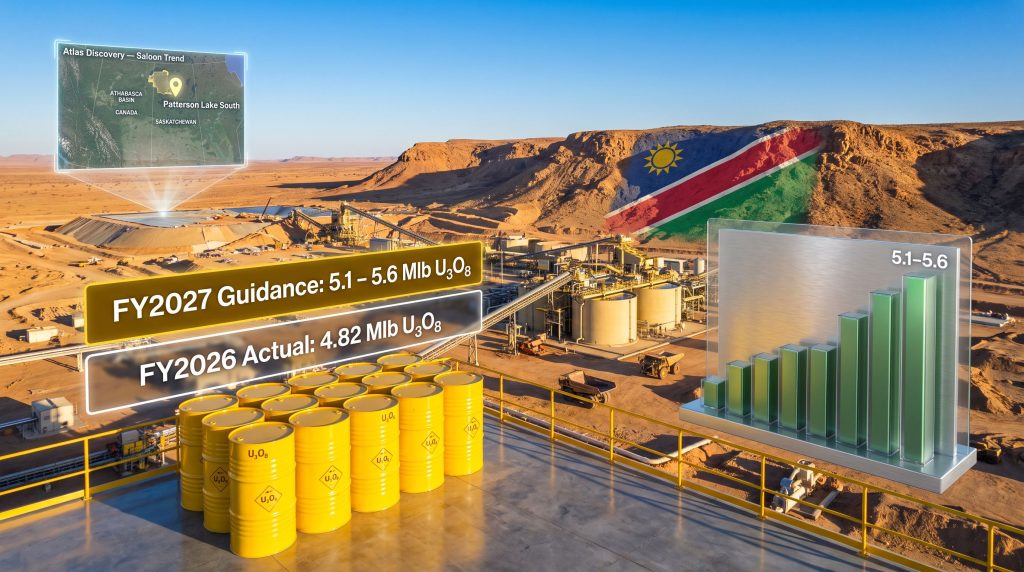
The formal completion of the Langer Heinrich ramp-up within the committed FY2026 timeframe represents a structural change in production predictability. With the plant now drawing on primary mined ore as its core feed source, the variability introduced by stockpile chemistry and grade inconsistency is substantially reduced. This is precisely why the FY2027 Paladin Langer Heinrich production guidance range of 5.1 million to 5.6 million pounds of U₃O₈ carries more operational credibility than any guidance figure issued during the transitional ramp-up period.
Furthermore, to understand the scale of this progression, consider the full trajectory:
- FY2024: Initial restart production as the mine returned from care and maintenance
- FY2025: Ramp-up continuation, with output of approximately 3.59 million pounds of U₃O₈
- FY2026: 4.82 million pounds of U₃O₈ produced, finishing at the upper end of revised guidance of 4.5 to 4.8 million pounds
- FY2027: Guidance set at 5.1 to 5.6 million pounds of U₃O₈, underpinned by full primary ore availability
FY2026 Operational Review: A Year of Progressive Guidance Upgrades
How Guidance Evolved Across the Financial Year
One of the less-discussed aspects of Langer Heinrich's FY2026 performance is the way guidance was progressively upgraded across the year. The mine began FY2026 with initial production targets in the range of approximately 4.0 to 4.4 million pounds, which were subsequently revised upward to 4.5 to 4.8 million pounds as operational performance exceeded expectations. The final reported figure of 4.82 million pounds came in at the top of even the upgraded range.
This pattern of upward guidance revisions is operationally significant. It suggests that the mine's processing circuit and ore supply chain were performing at or above design expectations during the critical final stages of ramp-up, rather than requiring remediation or recalibration. For additional context on how Paladin Namibia operations have navigated previous operational challenges, the contrast with earlier periods is instructive.
Sales Performance and What It Signals About Contract Positioning
The FY2026 sales result was equally noteworthy. Paladin delivered 4.35 million pounds of U₃O₈ against guidance of 3.8 to 4.2 million pounds, exceeding the top of the range. For the uranium sector, sales volumes are not simply a function of production output. They reflect the interplay between spot market exposure, long-term contract commitments, and the timing of customer deliveries. Outperforming sales guidance by this margin suggests strong offtake discipline and effective commercial scheduling.
| Metric | FY2026 Guidance | FY2026 Actual | FY2027 Guidance |
|---|---|---|---|
| Production (Mlb U₃O₈) | 4.5 – 4.8 | 4.82 | 5.1 – 5.6 |
| Sales (Mlb U₃O₈) | 3.8 – 4.2 | 4.35 | 4.8 – 5.3 |
| Capex (US$ million) | Not disclosed | Not disclosed | US$29 – US$35 |
Production Cost Context and Margin Implications
Langer Heinrich operates within an estimated all-in cost range of approximately US$44 to US$48 per pound of U₃O₈, a figure that positions the mine as a mid-cost producer on the global cost curve. With uranium spot prices having traded well above the US$70 to US$90 per pound range across much of the past two years, this cost profile supports meaningful free cash flow generation at current output levels.
As production volumes increase toward the upper end of the FY2027 guidance range, fixed cost dilution should further improve unit economics, assuming ore grades and processing recoveries remain consistent. These uranium market dynamics are central to understanding how Paladin's improving cost position fits within the broader sector picture.
It is worth noting that production cost figures are subject to exchange rate movements, reagent pricing, and energy costs in Namibia. Investors should treat cost guidance as indicative rather than fixed, particularly given the sensitivity of uranium processing to sulphuric acid prices, which represent a significant variable input cost.
What the FY2027 Capital Expenditure Program Reveals
Unpacking the US$29 Million to US$35 Million Allocation
The FY2027 capex program at Langer Heinrich totalling between US$29 million and US$35 million is structured around four core priorities:
- Tailings Storage Facility (TSF) design and construction – A non-negotiable requirement for any uranium operation seeking to sustain high-volume throughput. TSF capacity directly constrains the ceiling on annual production, making this investment a prerequisite for long-term output growth.
- Process improvement studies – These initiatives target incremental efficiency gains across leaching, solid-liquid separation, and solvent extraction circuits. Even modest improvements in uranium recovery rates translate to meaningful additional pounds at the current throughput scale.
- Infill drilling campaigns – Aimed at tightening geological confidence within the existing mine plan, reducing the risk of grade variability surprises in future ore scheduling.
- Deferred capital exploration activities – Carried over from FY2026, these items represent geological optionality that was de-prioritised during the ramp-up phase and is now being reactivated.
Why Tailings Infrastructure Is a Forward-Looking Capacity Signal
For investors unfamiliar with uranium processing specifics, tailings storage deserves particular attention. In uranium heap leach and tank leach operations, the tailings stream consists of the solid residue remaining after uranium extraction. Regulatory requirements govern the engineering standards, liner specifications, and monitoring systems for these facilities with considerable rigour, particularly in Namibia where environmental compliance frameworks are well-established.
Investing in TSF design and construction now, ahead of the volume growth that the FY2027 guidance range implies, signals that operational planning at Langer Heinrich is focused on removing infrastructure bottlenecks before they constrain production rather than after. This is a forward-leaning capital allocation philosophy that reduces the risk of unplanned production interruptions in subsequent years. According to Mining Weekly's coverage of Langer Heinrich, the operation's improving output trajectory reinforces this disciplined infrastructure-first approach.
Patterson Lake South: The Canadian Growth Catalyst
Understanding the Regulatory Milestone
While Langer Heinrich dominates the near-term production narrative, the Patterson Lake South project in Saskatchewan's Athabasca Basin represents Paladin's most significant long-term growth lever. The Canadian Nuclear Safety Commission's acknowledgement of sufficiency status for the PLS project is a procedurally important step that is often misunderstood outside the Canadian regulatory context.
| Project Attribute | Detail |
|---|---|
| Location | Saskatchewan, Canada, Athabasca Basin |
| Regulatory Body | Canadian Nuclear Safety Commission (CNSC) |
| Current Status | Sufficiency status acknowledged; administrative protocol agreed |
| Next Regulatory Trigger | Licence to commence construction |
| Key Deposit | Triple R |
| New Discovery | Atlas, on the Saloon Trend |
Sufficiency status does not mean approval. It means the CNSC has determined that the Environmental Impact Statement and supporting documentation submitted by Paladin are complete enough to proceed into the formal review phase. The agreed administrative protocol that accompanied this determination establishes the procedural framework and timeline within which the regulatory process toward a construction licence will unfold.
This distinction matters for investor expectations. The milestone activates a regulatory pathway, however, construction approval remains contingent on the successful completion of that review process. The Patterson uranium project context in the broader Athabasca Basin helps illustrate just how significant this jurisdictional setting is for long-term development potential.
The Athabasca Basin: Why Grade Changes Everything
The Athabasca Basin in Saskatchewan is not merely another uranium jurisdiction. It hosts some of the highest-grade uranium deposits ever discovered, with the region's unconformity-hosted deposits routinely grading orders of magnitude above global averages. Conventional open-pit uranium mines might operate at grades of 300 to 1,000 parts per million (ppm) uranium. Athabasca Basin unconformity deposits have historically been developed at grades measured in percentage terms rather than ppm.
The Triple R deposit at Patterson Lake South, while located outside the main basin and not classified as a classic unconformity deposit, still benefits from the geological complexity and structural setting of the broader Athabasca region. Its sub-Athabasca basement-hosted mineralisation style shares characteristics with some of the basin's most productive zones.
The Atlas Discovery and Its Geological Significance
The Atlas discovery on the Saloon Trend, which runs broadly parallel to the Triple R deposit within Paladin's Athabasca landholding, introduces a dimension of exploration upside that the market has not yet fully priced. What makes this discovery particularly noteworthy from a geological standpoint is the structural parallelism to a known economic deposit. When new mineralisation occurs along a structural corridor that mirrors the orientation and setting of a proven resource, the probability that the controlling geological factors have repeated themselves increases substantially.
The Saloon Trend is not simply a geographic proximity story. Structural parallelism in basement-hosted uranium systems often reflects repeated fluid pathway reactivation along deep crustal faults, which is the mechanism responsible for concentrating uranium mineralisation in the first place. A new discovery along such a trend warrants serious geological evaluation.
This is a speculative point that has not been independently confirmed through resource estimation, and investors should treat Atlas as an exploration-stage discovery rather than a resource with defined economic parameters at this stage.
Dual-Asset Strategy: Risk Distribution and Value Architecture
Namibia Versus Saskatchewan: Contrasting Operating Environments
Paladin's portfolio spans two very different uranium operating environments, and understanding the distinction helps frame the risk-adjusted value proposition.
Langer Heinrich (Namibia):
- Established open-pit, heap leach operation with decades of operational history
- Namibia maintains a stable mining regulatory framework and a track record of supporting foreign mining investment
- Processing is sulphuric acid-based tank leach, with reagent supply chains dependent on regional logistics networks
- Production costs are sensitive to energy prices, given Namibia's electricity import dependence
Patterson Lake South (Saskatchewan, Canada):
- Underground development project in a world-class uranium jurisdiction
- Canada's regulatory framework through the CNSC is rigorous but internationally respected, providing bankability for project financing
- Cold climate operations introduce specific engineering requirements around permafrost, water management, and seasonal access
- Indigenous consultation and agreement processes are a formal prerequisite in Canadian mining law, and Paladin has explicitly identified Indigenous agreement pathways as a parallel workstream to regulatory approvals
The strategic logic of holding both a producing cash-generating asset and an advanced development project simultaneously is straightforward. Langer Heinrich funds ongoing corporate operations and exploration expenditure, while PLS provides the long-term production growth narrative that underpins the equity valuation premium. Broader uranium market trends in 2025 further support this dual-asset positioning as the sector navigates shifting supply and demand fundamentals.
The next major ASX story will hit our subscribers first
Key Risks Facing the FY2027 Guidance Range
Investors should weigh the following risk factors when evaluating the probability of Paladin delivering within its FY2027 Paladin Langer Heinrich production guidance range:
- Processing circuit reliability: Any unplanned downtime in the leaching or solvent extraction circuits can compress output toward the lower bound of guidance, particularly if maintenance windows extend beyond scheduled durations.
- Ore grade variability: Even with infill drilling improving geological confidence, short-interval grade fluctuations within the mine plan can affect monthly recovery rates and accumulate into meaningful quarterly variances.
- Uranium price and capital discipline: If spot uranium prices contract significantly from current levels, the internal calculus around discretionary capex and exploration spending may shift, potentially affecting the deferred FY2026 capital items that have been reactivated in the FY2027 program.
- Namibian operational environment: Power supply reliability, water availability, and regional logistics networks all represent ongoing background risks for Namibian mining operations, even in a stable regulatory context.
- PLS regulatory timeline: The Canadian Environmental Impact Statement review process involves multiple federal and provincial bodies, and timelines can extend beyond initial projections. Investors should not assume that sufficiency status translates automatically into a near-term construction licence.
In addition, uranium supply-demand volatility at the global level introduces an external pricing dimension that remains beyond Paladin's operational control, and consequently warrants ongoing monitoring by investors.
Disclaimer: This article contains forward-looking statements and projections based on company-disclosed guidance and publicly available information. Production guidance, capital expenditure figures, and regulatory timelines are subject to change. This article does not constitute financial advice. Investors should conduct independent research and consult qualified financial advisors before making investment decisions.
Frequently Asked Questions: Paladin Langer Heinrich Production Guidance
What is Paladin Energy's Langer Heinrich production guidance for FY2027?
Paladin has set production guidance for the Langer Heinrich mine at between 5.1 million and 5.6 million pounds of U₃O₈ for the financial year ending June 30, 2027.
How much uranium did Langer Heinrich produce in FY2026?
The mine produced 4.82 million pounds of U₃O₈ in FY2026, finishing at the upper end of revised guidance of 4.5 to 4.8 million pounds.
What were Paladin's FY2026 uranium sales volumes?
Paladin sold 4.35 million pounds of U₃O₈ in FY2026, exceeding its sales guidance range of 3.8 to 4.2 million pounds. FY2027 sales guidance is set at 4.8 to 5.3 million pounds.
What is Paladin spending on capital expenditure at Langer Heinrich in FY2027?
Capital expenditure is guided at US$29 million to US$35 million, covering tailings storage facility construction, process improvement studies, infill drilling, and previously deferred capital exploration activities.
What does the Patterson Lake South sufficiency status mean?
The Canadian Nuclear Safety Commission's acknowledgement of sufficiency status confirms that Paladin's project documentation is complete enough to enter the formal regulatory review phase, activating the procedural pathway toward a licence to commence construction. It does not constitute approval.
What is the Atlas discovery?
Atlas is a uranium discovery on the Saloon Trend within Paladin's Athabasca Basin landholding, running broadly parallel to the Triple R deposit. It represents an exploration-stage discovery with potential to expand the long-term development optionality of the Patterson Lake South project area. For further detail on comparable Athabasca Basin uranium project developments and their regulatory trajectories, Resources Review provides a useful reference point on Paladin's broader production guidance upgrades.
Three Pillars of Paladin's Value Creation Thesis
Looking across Paladin's operational and developmental profile, the investment case rests on three structurally distinct value drivers that operate across different time horizons:
- Langer Heinrich volume optimisation: Transitioning from ramp-up execution to steady-state production optimisation, with FY2027 Paladin Langer Heinrich production guidance implying a meaningful step-up from the already-upgraded FY2026 result. The focus now shifts to cost per pound reduction through fixed cost dilution and processing circuit efficiency improvements.
- Patterson Lake South regulatory advancement: Each formal procedural milestone achieved through the CNSC process reduces timeline uncertainty and increases the probability-weighted value of the project's net present value in equity market models. The construction licence pathway is now formally activated.
- Athabasca Basin exploration upside: The Atlas discovery signals that Paladin's landholding in one of the world's premier uranium jurisdictions may carry resource potential beyond the currently defined Triple R deposit. This is the longest-dated but potentially highest-impact value driver in the portfolio.
For industry observers and investors tracking uranium supply dynamics, the progression at Langer Heinrich from care-and-maintenance restart to ramp-up completion to optimised steady-state production represents exactly the kind of supply-side normalisation that underpins longer-term uranium market balance assessments.
Want to Stay Ahead of the Next Major Uranium Discovery on the ASX?
Discovery Alert's proprietary Discovery IQ model scans ASX announcements in real time, instantly identifying high-potential mineral discoveries across uranium and more than 30 other commodities — explore historic discoveries and their returns to see what early positioning can mean, then begin your 14-day free trial at Discovery Alert to secure a market-leading edge.