August 6, 2026
The Pioneer's Burden: Why Being First in US Low-pH Uranium Mining Is Harder Than It Looks
There is a reason the mining industry rarely celebrates technological pioneers in real time. The companies that introduce genuinely novel extraction methods at commercial scale carry a disproportionate share of the learning curve, absorbing costs, delays, and operational friction that later entrants will never face. This dynamic sits at the heart of understanding the Peninsula Energy Lance uranium project production guidance withdrawn announcement of July 2026, and why the decision reveals more about the complexity of innovation than it does about the underlying asset.
For investors and industry observers tracking US domestic uranium supply, the Lance project in Wyoming's Powder River Basin is not simply another ISR operation. It is the first commercial-scale application of low-pH (acidic) in-situ recovery uranium mining ever attempted in the United States. That distinction shapes everything about how its ramp-up challenges should be interpreted. Understanding the broader uranium market dynamics can also help contextualise why this project carries such strategic weight.
When big ASX news breaks, our subscribers know first
Understanding In-Situ Recovery: The Method Behind the Milestone
How ISR Uranium Mining Works
In-situ recovery, sometimes called solution mining or in-situ leach (ISL), extracts uranium without the need for conventional open-pit or underground excavation. Instead, a leaching solution is injected directly into the uranium-bearing ore body through a network of injection wells. The solution dissolves uranium in place underground, and the resulting uranium-laden liquid, known as pregnant solution, is pumped to the surface through recovery wells for processing.
The technique is well-established across global uranium production, accounting for the majority of world output. Kazakhstan, the world's largest uranium producer, operates almost exclusively through ISR methods. However, the specific chemistry of the leaching solution is not a universal choice. It depends entirely on the host geology.
Low-pH vs. High-pH ISR: A Critical Technical Divide
The distinction between acidic (low-pH) and alkaline (high-pH) ISR is not trivial. It determines recovery efficiency, operating economics, and geological suitability in fundamentally different ways. Furthermore, the in-situ leaching benefits extend beyond economics to include meaningful environmental advantages over conventional extraction methods.
| Feature | Low-pH (Acidic) ISR | High-pH (Alkaline) ISR |
|---|---|---|
| Recovery efficiency | Higher | Lower |
| Operating costs | Generally lower | Generally higher |
| Geological suitability | Requires absence of acid-consuming minerals | Suitable for limestone and gypsum-bearing aquifers |
| US commercial precedent | None prior to Lance | Industry standard in the USA |
| Application at Lance | Current method (post-2022 decision) | Previous method (pre-2019 suspension) |
The critical constraint on acidic ISR is the presence of acid-consuming minerals such as gypsum and limestone in the host aquifer. Where these minerals are abundant, they neutralise the leaching solution before it can dissolve uranium effectively, making the method unworkable. Wyoming's Powder River Basin geology, at the specific zones targeted by Lance, is compatible with low-pH application, which is precisely why the 2022 strategic pivot was considered viable.
The shift to low-pH ISR at Lance is not an experiment in untested science. Acidic ISR is the dominant method used in Kazakhstan and other major global producers. The experiment at Lance is about applying that proven chemistry within US regulatory, geological, and operational conditions for the first time at commercial scale.
Why Lance Switched Away From Alkaline Leaching
Before its 2019 operational suspension, Lance used the high-pH alkaline method that had been standard across US ISR uranium operations for decades. The problem was performance. Recovery rates consistently fell below expectations, undermining the project's economic case. Following detailed field trials and feasibility work completed between 2019 and 2022, management concluded that transitioning to acidic leaching was the only pathway to making Lance genuinely competitive as a production asset.
What Triggered the Peninsula Energy Lance Uranium Project Production Guidance Withdrawal
The Original 2026 Target and Its Rationale
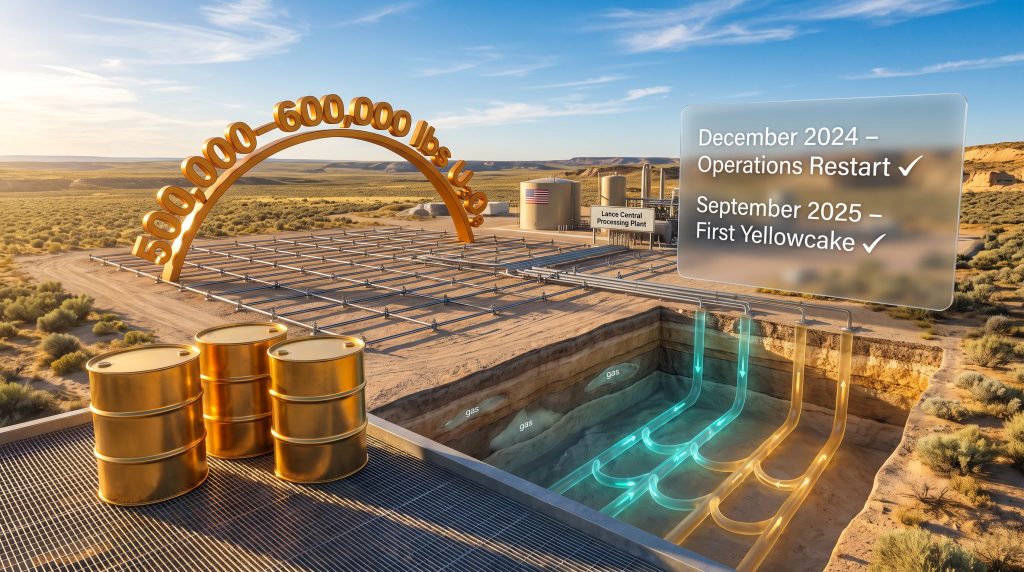
When Peninsula Energy set its 2026 production guidance of 400,000 to 500,000 pounds of U3O8, it was projecting a ramp-up trajectory based on the best available modelling of how the new low-pH system would perform after restart. Wellfield and uranium capture operations had resumed in December 2024, and the first dried yellowcake from the expanded Lance Central Processing Plant was produced in September 2025, both genuine milestones in a complex restart sequence. The Lance Projects in Wyoming represent one of the most significant low-pH ISR developments in US uranium history.
Three Operational Challenges Driving the Delay
The guidance withdrawal is the result of three interconnected operational problems, all of which relate to wellfield dynamics rather than resource quality:
- Gas generation within wellfield sections accumulating underground and disrupting the movement of leaching solution through the ore body, with resolution taking longer than the original operational plan anticipated
- Below-target solution flow rates directly limiting the volume of pregnant solution reaching the Lance Central Processing Plant, which constrains throughput regardless of how efficiently the surface processing infrastructure operates
- Wellfield chemistry optimisation requiring ongoing calibration to ensure the acidic leaching solution is interacting with uranium-bearing zones at the right concentrations and contact times for each specific geological interval
What makes these challenges particularly significant is their combined effect. Each issue individually would slow ramp-up. Together, they create a compounding throughput constraint that makes hitting a fixed annual production target within a calendar year effectively impossible to guarantee.
A Production Timeline in Context
| Milestone | Original Expectation | Actual Outcome |
|---|---|---|
| Operations restart | 2024 | December 2024 (achieved) |
| First yellowcake production | Early 2025 | September 2025 (achieved) |
| CY2026 production guidance | 400,000 to 500,000 lbs U3O8 | Withdrawn (July 2026) |
| CY2027 production guidance | 500,000 to 600,000 lbs U3O8 | Reconfirmed |
The pattern here is instructive. Physical restart and first production were achieved, confirming that the core infrastructure and the low-pH recovery process itself are functional. The shortfall is in the rate of scaling, not in the fundamental viability of the approach.
Resource Quality vs. Process Optimisation: A Crucial Distinction
Peninsula Energy's management has been explicit that the difficulties being encountered are confined to wellfield hydraulics, solution flow dynamics, and chemistry calibration. They are not attributable to problems with the uranium resource itself, nor do they reflect any inherent flaw in low-pH recovery as a method.
This distinction carries significant weight for long-term project assessment. A guidance withdrawal caused by grade disappointment or resource depletion would represent a structural problem. A guidance withdrawal caused by the pace of wellfield chemistry optimisation at a first-of-kind operation represents a timing problem, which is a fundamentally different risk category.
The Pioneer Problem: Operating Without a Domestic Playbook
What It Actually Means to Be First at Commercial Scale
Because Lance is the first US commercial-scale low-pH ISR uranium operation, Peninsula Energy is navigating territory that has no domestic precedent. There is no established workforce with hands-on experience in managing acidic wellfield chemistry at this scale within US geological and regulatory conditions. There is no industry knowledge base of how gas generation behaves in Powder River Basin aquifers under acidic leaching conditions.
Furthermore, there are no peer companies to benchmark against, no consultants with operational experience in an identical US setting, and no historical data from comparable domestic operations to calibrate expectations. This structural isolation is a legitimate amplifier of operational risk during ramp-up. It does not invalidate the long-term strategy, but it does explain why the learning curve has proven steeper than initial projections assumed.
The 2019 Suspension and Its Legacy
Lance's five-year operational hiatus between 2019 and the December 2024 restart added further complexity. Workforce continuity was disrupted, institutional knowledge accumulated under the previous high-pH operations was partially lost, and the transition to a completely different leaching chemistry meant that much of the prior operational experience was only partially transferable.
The restart was effectively a new commissioning process for a new operational method, not simply a resumption of an established production system. In addition, the Peninsula Energy Lance uranium project production guidance withdrawn announcement must be viewed against this backdrop of accumulated operational complexity.
What the 2027 Guidance Reconfirmation Actually Signals
Breaking Down the 500,000 to 600,000 lbs U3O8 Target
The decision to reconfirm 2027 guidance of 500,000 to 600,000 pounds U3O8 while withdrawing 2026 guidance is the most strategically informative element of the July 2026 announcement. Management is communicating that the operational challenges are viewed as a ramp-up timing issue, with resolution expected within a window that preserves the following year's production capacity. Consequently, uranium investment trends in 2025 and beyond remain closely tied to such project-level developments.
Scenario Analysis: What Would Need to Go Right
| Scenario | Key Conditions Required | Assessment |
|---|---|---|
| Base Case | Gas generation resolves in H2 2026; flow rates normalise by Q1 2027 | Moderate to high plausibility given management confidence |
| Upside Case | Chemistry optimisation ahead of schedule; expanded wellfield zones contribute early | Lower probability but not implausible |
| Downside Case | Gas generation persists into 2027; further guidance revision required | Possible if current challenges prove more entrenched than expected |
The reconfirmation of 2027 guidance should not be taken as a guarantee, but it does reflect management's assessment that the wellfield challenges are resolvable within a defined timeframe.
Broader Implications for US Uranium Production
America's Domestic Uranium Supply Gap
The United States consumes roughly 48 million pounds of uranium annually to fuel its nuclear reactor fleet, yet domestic production has covered only a small fraction of that demand in recent years. The gap is filled predominantly by imports from Kazakhstan, Canada, Australia, and other international suppliers. Geopolitical considerations and energy security priorities have intensified focus on rebuilding US domestic uranium production capacity, making operations like Lance strategically relevant beyond their individual production volumes. Indeed, US uranium production growth has become a critical policy and investment theme in recent years.
Why Low-pH ISR Could Change US Uranium Economics
If Lance successfully demonstrates low-pH ISR at commercial scale, the implications extend well beyond Peninsula Energy. Other Wyoming and South Dakota uranium deposits that were previously uneconomic or underperforming under alkaline leaching conditions could become viable candidates for redevelopment using acidic methods.
The knowledge base developed at Lance, once accumulated, could become a transferable asset for the broader US uranium sector. Moreover, US ISR uranium production is increasingly viewed as a cornerstone of America's long-term energy security strategy. This is the paradox of the pioneer position: the short-term costs of being first are absorbed entirely by Peninsula Energy, while the long-term benefits of a proven low-pH ISR playbook would be partially available to the entire industry.
What Investors and Industry Observers Should Watch
For those monitoring the Lance project through the second half of 2026 and into 2027, the following indicators carry the most informational value:
- Progress on resolving gas generation issues across active wellfield sections, with any quantified improvement in affected zones being a strong positive signal
- Monthly or quarterly trends in solution flow rates reaching the Lance Central Processing Plant
- Whether management updates, revises, or maintains the 2027 guidance reconfirmation as H2 2026 data accumulates
- Development of operational workforce capability and the institutional knowledge base around low-pH wellfield management at Lance
- Any commentary on plans to expand active wellfield zones once hydraulic challenges in existing sections are resolved
The next major ASX story will hit our subscribers first
Frequently Asked Questions: Peninsula Energy Lance Uranium Project
Why did Peninsula Energy withdraw its 2026 production guidance for the Lance project?
Peninsula Energy withdrew its CY2026 guidance of 400,000 to 500,000 lbs U3O8 because the ramp-up of low-pH ISR operations progressed more slowly than originally planned. The primary factors include gas generation within wellfield sections disrupting fluid dynamics, lower-than-expected solution flow rates, and ongoing wellfield chemistry optimisation. Management has confirmed these are operational process challenges, not resource quality issues. The operational and production guidance update released by the company provides a detailed breakdown of the factors behind the withdrawal.
What is low-pH ISR uranium mining and why is Lance significant?
Low-pH ISR uses an acidic leaching solution to dissolve uranium in place underground before pumping it to surface processing facilities. It typically delivers higher uranium recovery at lower operating cost than alkaline ISR, but requires geology free of significant acid-consuming minerals. Lance is the first operation in the United States to apply this method at commercial scale, giving it unique strategic importance to the future of US domestic uranium production.
Has Peninsula Energy maintained its 2027 production guidance?
Yes. Despite withdrawing its 2026 target, Peninsula Energy has reconfirmed its 2027 production guidance of 500,000 to 600,000 lbs U3O8. This signals management's view that current delays represent a ramp-up timing issue rather than any fundamental impairment to the project's long-term productive capacity.
What are the main technical challenges currently facing the Lance project?
The three primary challenges are gas generation within wellfield sections taking longer than expected to resolve, below-target solution flow rates limiting uranium throughput to the processing plant, and ongoing optimisation of wellfield chemistry to maximise uranium dissolution and recovery efficiency across active production zones.
This article contains forward-looking statements and scenario analyses that are inherently speculative. Production guidance, timelines, and project outcomes discussed herein are subject to operational, geological, regulatory, and market risks. This content is informational only and does not constitute financial or investment advice. Readers should conduct their own due diligence before making any investment decisions.
Want to Identify the Next Major Uranium Discovery Before the Market Does?
Discovery Alert's proprietary Discovery IQ model scans ASX announcements in real time, instantly alerting subscribers to significant mineral discoveries — including uranium — and translating complex data into actionable opportunities for both short-term traders and long-term investors. Explore historic discoveries and their exceptional returns or start your 14-day free trial today to position yourself ahead of the market.