May 15, 2026
The convergence of artificial intelligence, renewable energy expansion, and next-generation electronics manufacturing creates unique opportunities for palladium solar panels to revolutionise energy conversion efficiency. Furthermore, this transformation extends beyond traditional market boundaries, establishing new competitive landscapes where material science innovations drive commercial success in the rapidly evolving critical minerals energy transition.
Additionally, technological innovations continue reshaping global energy markets at unprecedented rates. Industrial demand patterns historically dominated by automotive applications are experiencing fundamental transformation as emerging applications create new value propositions across diverse sectors.
What Makes Palladium a Game-Changer for Next-Generation Solar Technology?
Understanding Palladium's Unique Material Properties
Palladium's exceptional conductivity characteristics position it as a superior alternative to conventional materials in high-performance applications. With electrical resistivity of 10.8 microohm-centimetres, palladium approaches gold's industry-leading 2.44 microohm-centimetres while offering significant cost advantages in specific configurations. This conductivity profile enables enhanced charge transport in photovoltaic systems where electron mobility directly impacts energy conversion efficiency.
Moreover, the material's proven barrier function capabilities in microelectronics applications translate effectively to solar panel architectures. Palladium forms stable oxide layers that prevent ionic migration and resist environmental degradation, addressing critical durability concerns in outdoor photovoltaic installations. These barrier properties extend operational lifespan by protecting sensitive interface layers from moisture infiltration and thermal cycling stress.
Additionally, temperature stability advantages become particularly valuable in high-performance solar environments. Palladium maintains structural integrity and electrical characteristics across temperature ranges typical of concentrated solar installations, where standard materials experience performance degradation. This thermal resilience enables deployment in challenging geographic regions where temperature fluctuations would compromise alternative material systems.
The Silicon Solar Cell Efficiency Ceiling Problem
Current silicon-based photovoltaic technology faces fundamental physical limitations constraining performance improvements. Silicon solar cells have reached maximum efficiency thresholds around 30 percent, representing the practical limit for single-junction architectures without advanced material innovations. This efficiency ceiling stems from silicon's fixed bandgap energy of approximately 1.1 electron volts, which optimises conversion of specific wavelength ranges while losing efficiency across broader spectral distributions.
Furthermore, manufacturing cost implications of traditional silicon wafer production create additional economic pressures. Thick silicon construction requirements increase material consumption and processing complexity, establishing higher baseline costs that limit market penetration in price-sensitive applications. Wafer thickness directly correlates with manufacturing expenses, making thinner panel architectures economically attractive despite technical complexity.
Consequently, market demand for breakthrough efficiency improvements intensifies as renewable energy deployment accelerates globally. Energy density requirements for limited installation space drive premium pricing for high-efficiency systems, creating commercial incentives for advanced material integration.
When big ASX news breaks, our subscribers know first
Why Are Tandem Solar Panels the Future of Renewable Energy?
Silicon-Perovskite Hybrid Technology Explained
Tandem photovoltaic configurations combine complementary semiconductor materials to capture broader spectral ranges than single-material systems. Silicon-perovskite hybrid architectures utilise different bandgap energies in stacked arrangements, enabling each layer to optimise conversion efficiency for specific wavelength distributions within the solar spectrum. These advancements align with broader renewable energy transformations across multiple industrial sectors.
Additionally, enhanced light capture capabilities during low-sun conditions represent a key advantage of perovskite materials. The wider spectral absorption range enables effective energy generation during sunrise and sunset periods when solar irradiance angles reduce efficiency in traditional silicon-only systems. This temporal performance improvement increases daily energy yield, particularly valuable in high-latitude installations where low-angle radiation comprises significant portions of available solar resources.
Moreover, cost reduction opportunities through thinner panel construction address economic barriers to widespread adoption. Perovskite materials achieve comparable efficiency levels with reduced material thickness, decreasing manufacturing costs while maintaining performance standards. This architectural advantage enables competitive pricing strategies for premium efficiency installations.
Palladium's Role in Perovskite Enhancement
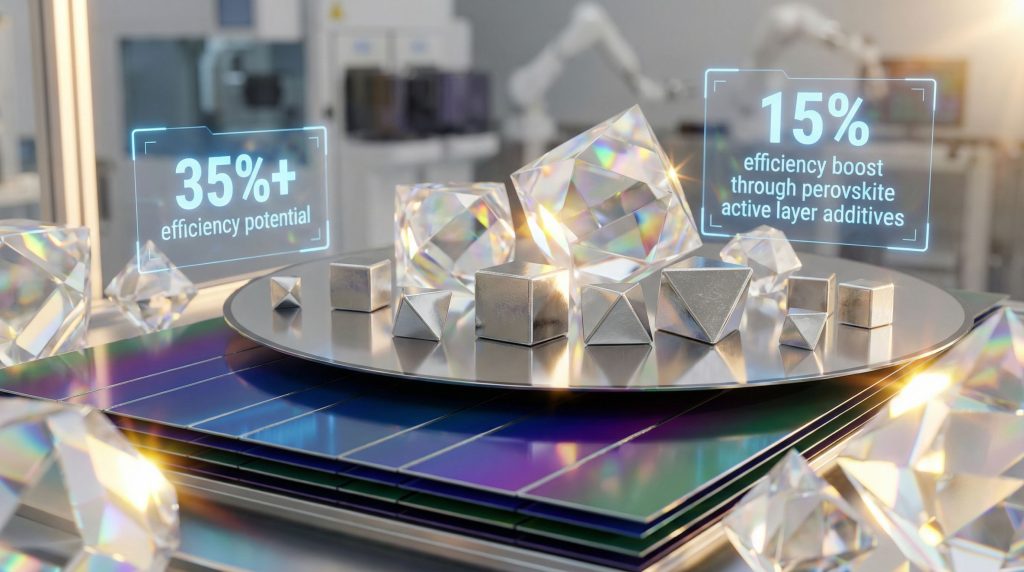
Laboratory testing has validated 15 percent efficiency improvements through perovskite active layer additives incorporating palladium compounds. These enhancements operate through chemical interactions with perovskite crystalline structures, improving charge transport characteristics and reducing recombination losses during photogeneration processes.
Furthermore, three-layer palladium configurations specifically address lifetime limitations inherent in perovskite devices. These architectural designs leverage palladium's established barrier function properties to prevent material degradation through oxidation resistance and ionic migration control. The multi-layer approach extends operational lifespan by protecting critical interface regions from environmental stresses that typically limit perovskite device durability.
Consequently, commercial applications target high-performance installations where efficiency premiums justify material costs. The technology pathway focuses on applications requiring maximum energy density, such as space-constrained urban installations or premium residential systems where performance optimisation outweighs cost considerations.
What Industrial Applications Drive Palladium Demand in Electronics?
Microelectronics Market Disruption Potential
The global microelectronics sector currently consumes nine million ounces of gold annually across printed circuit boards, bonding wires, plating applications, and connector systems. This massive consumption represents demand equivalent to total global palladium supply, highlighting the scale of potential market opportunities for palladium-based alternatives. Additionally, AI transforming mining operations creates unprecedented demand for advanced electronics materials.
Furthermore, artificial intelligence infrastructure expansion creates unprecedented demand for advanced electronics materials. Data centre construction and next-generation printed circuit board requirements drive specifications for high-reliability interconnection systems capable of supporting increased computational loads. These applications prioritise performance characteristics where palladium's properties provide competitive advantages over traditional materials.
Moreover, cost pressure opportunities from high precious metal prices create economic incentives for material substitution strategies. Gold price volatility directly impacts manufacturing costs for electronics producers, making alternative materials increasingly attractive when performance trade-offs remain acceptable.
| Application Category | Current Gold Consumption | Performance Requirements | Cost Pressure Level |
|---|---|---|---|
| PCB Manufacturing | ~3 million ounces | High conductivity, corrosion resistance | Severe |
| Bonding Wire Systems | ~2 million ounces | Thermal cycling reliability | Moderate |
| Connector Plating | ~2 million ounces | Contact resistance stability | High |
| Semiconductor Packaging | ~2 million ounces | High-frequency performance | Variable |
Gold-Palladium Hybrid Solutions
Reduced gold content approaches maintain electrical performance standards while incorporating palladium to achieve cost savings. Gold-palladium layer combinations leverage gold's superior conductivity for critical interface regions while utilising palladium for bulk conductive functions where performance requirements allow substitution.
Additionally, palladium-copper bonding wire alternatives address specific cost pressures in semiconductor packaging applications. These systems combine copper's thermal and electrical properties with palladium's corrosion resistance and interface stability characteristics. Development focuses on high-volume manufacturing applications where cost reduction justifies process changes.
Furthermore, performance comparison studies validate competitive characteristics with traditional gold-based systems across multiple application categories. Testing protocols evaluate contact resistance, thermal cycling reliability, and long-term stability under accelerated conditions. Results indicate acceptable performance levels for numerous applications currently dominated by gold-based solutions.
How Do Lithium-Sulfur Batteries Benefit from Palladium Catalysts?
Advantages Over Lithium-Ion Technology
Lithium-sulfur battery systems offer multiple strategic advantages positioning them as next-generation energy storage solutions. Lower cost per unit energy storage stems from abundant sulfur availability and simplified manufacturing processes compared to lithium-ion technology requiring complex cathode materials and expensive electrolyte formulations. These developments complement the recent battery recycling breakthrough in sustainable energy storage solutions.
Moreover, superior energy density characteristics enable significant weight reduction benefits for mobile applications. Theoretical energy density of lithium-sulfur systems exceeds lithium-ion technology by factors approaching 2-3 times, creating compelling value propositions for electric vehicles, portable electronics, and aerospace applications where weight constraints drive design decisions.
However, commercial viability depends on solving fundamental technical limitations that have historically prevented widespread adoption. Energy density advantages require balancing against cycle life constraints and operational complexity considerations that influence total cost of ownership calculations.
Solving Lithium-Sulfur Battery Limitations
Palladium catalysts address critical degradation mechanisms limiting lithium-sulfur battery performance. Soluble polysulfide formation represents the primary failure mode, where intermediate sulfur species dissolve into organic electrolytes and migrate to lithium anodes, causing irreversible capacity losses through parasitic reactions.
Furthermore, the catalytic mechanism operates through surface-mediated chemical pathways converting soluble polysulfides into insoluble sulfur compounds, preventing migration losses that typically reduce cycle efficiency. Palladium's catalytic activity targets both electrolyte-phase polysulfide neutralisation and cathode material surface interactions that influence reaction kinetics.
Additionally, electrolyte and cathode material enhancement strategies utilise palladium catalysts to address mechanical degradation from volumetric expansion-contraction cycling. Enhanced conductivity pathways reduce charge transfer overpotentials, moderating reaction rates and mechanical stress that cause cathode fragmentation during charge-discharge cycles.
Market projections indicate palladium demand exceeding 1.5 million ounces annually following commercial market entry, contingent upon successful technology validation and manufacturing scale-up achievement.
What Role Does AI Play in Palladium Material Development?
Machine Learning Applications in Materials Science
Artificial intelligence platforms enable accelerated materials discovery through predictive modelling capabilities that reduce experimental iteration requirements. Computational approaches optimise multiple variables simultaneously, evaluating thousands of compositional variations before directing experimental validation resources toward highest-probability candidates. These advances represent part of the broader mining industry evolution driven by technological innovation.
Furthermore, predictive modelling for optimal palladium-carbon nanotube composites exemplifies AI applications in advanced materials development. Machine learning algorithms analyse electroconductivity enhancement mechanisms and interface stability conditions to determine optimal carbon nanotube form, position, and size distribution within palladium crystal structures.
Additionally, interface stability calculations through AI algorithms address critical technical challenges in composite material design. Computational models predict thermal and mechanical stability characteristics under operating conditions, enabling optimisation strategies that balance performance requirements with manufacturing constraints.
Accelerated Research and Development Timelines
Development acceleration demonstrates measurable improvements over traditional sequential optimisation approaches. Laboratory prototypes achieve completion in nine months compared with traditional 18-24 month cycles, representing significant competitive advantages for companies implementing AI-enhanced development strategies.
Moreover, streamlined testing protocols reduce experimental requirements through computational pre-screening of candidate materials. AI models identify promising compositions before physical testing, concentrating limited laboratory resources on highest-probability solutions rather than exhaustive experimental matrices.
Furthermore, collaboration frameworks with leading university research teams leverage academic institutional expertise for fundamental science capabilities while industrial partners focus on commercialisation pathway development. This division of responsibilities accelerates overall development timelines by optimising resource allocation across complementary capabilities.
The pharmaceutical breakthrough achieved by AlphaFold expanded protein structure databases from 190,000 to 200 million entries, illustrating AI's transformative potential for materials science applications.
Which Industrial Sectors Show Strongest Palladium Adoption Potential?
Glass Manufacturing Industry Transformation
The glass manufacturing sector represents the most advanced palladium market development opportunity, currently consuming eight million ounces of platinum and rhodium annually across fiberglass, optical, technical, and display glass production processes. This established precious metal consumption provides direct substitution pathways for palladium-based solutions.
Additionally, palladium-platinum alloy developments address temperature stability requirements for high-temperature glass production applications. Enhanced alloy formulations compensate for palladium's lower melting point through specialised additives that maintain structural integrity at temperatures approaching 1,300°C required for fiberglass manufacturing.
Furthermore, commercial traction accelerates in Chinese fiberglass production facilities where equipment replacement cycles enable rapid technology adoption. The one-year lifespan of fiberglass equipment facilitates switching compared to chemical catalysts with eight-year lifecycles, creating favourable conditions for palladium technology penetration.
- Successful 300-day industrial testing at major Chinese production facilities validated performance standards
- 20,000 ounces purchased in 2025 for initial fiberglass production installations
- Industry transition from platinum to palladium-based systems currently underway
Electrochemistry Process Improvements
Three-component palladium-iridium-ruthenium anode systems deliver quantifiable performance and cost advantages over conventional technologies. These advanced architectures reduce iridium content while achieving 15% cost reduction and 20% energy efficiency gains compared to traditional iridium-ruthenium anodes.
Moreover, applications span multiple electrolysis processes across diverse industrial sectors. Implementation pathways target cathode nickel production, copper foil manufacturing, water treatment systems, and chlor-alkali processes where palladium's catalytic properties enable process optimisation.
Additionally, commercial validation demonstrates successful technology transfer from laboratory development to industrial implementation. The water disinfection project progressed from concept to 500 installed anodes in 14 months, compared with typical five-to-ten-year development cycles for industrial catalyst applications.
The next major ASX story will hit our subscribers first
What Are the Market Size Projections for Palladium Solar Applications?
Demand Forecasting by Application Sector
Market analysis projects substantial palladium demand growth across multiple application categories as technologies achieve commercial viability. Solar energy applications target 0.5 to 1.0 million ounces annually between 2030-2035, reflecting assumptions regarding Chinese market adoption rates and manufacturing scale-up timelines. This growth aligns with broader renewable energy deployment trends documented by the Palladium Group's Pacific renewable energy partnerships.
| Application Area | Projected Annual Demand | Timeline | Market Penetration Factors |
|---|---|---|---|
| Solar Energy | 0.5-1.0 million ounces | 2030-2035 | Chinese market adoption rates |
| Microelectronics | 1.0+ million ounces | 2030-2035 | AI infrastructure growth |
| Lithium-Sulfur Batteries | 1.5+ million ounces | Post-market entry | EV sector expansion requirements |
| Glass Manufacturing | 0.8-2.0 million ounces | Near-term | Equipment replacement cycles |
| Electrochemistry | 0.2-0.3 million ounces | Mid-term | Industrial process adoption |
Furthermore, microelectronics demand projections exceed one million ounces annually as artificial intelligence infrastructure development drives advanced PCB requirements. Technology substitution rates depend on gold price sustainability dynamics and performance validation across critical application categories.
Additionally, battery technology applications represent the largest potential demand category, contingent upon successful commercialisation of lithium-sulfur systems. Electric vehicle sector expansion creates compelling market opportunities where weight reduction and cost advantages justify palladium catalyst implementation.
Global Supply Chain Implications
Current palladium production concentration presents strategic supply considerations as demand diversification accelerates. Forty percent of global primary palladium production originates from single-source suppliers, creating potential supply chain vulnerabilities as industrial demand grows beyond automotive applications.
Moreover, Asian market consumption patterns shift dramatically from historical distributions. Regional demand increases from 25% to over 50% of global consumption, driven primarily by Chinese manufacturing expansion in solar panels, electronics, and battery technologies where palladium solar panels show strongest commercial traction. This trend reflects the potential for palladium as a game-changer in energy transition applications.
Furthermore, strategic importance for automotive-independent demand establishes palladium's role in diversified industrial applications. This market evolution reduces dependency on automotive sector dynamics while creating new demand drivers aligned with global technology trends and infrastructure development priorities.
How Does Palladium Solar Technology Compare to Traditional Panels?
Performance Metrics Analysis
Comparative analysis demonstrates measurable performance advantages for palladium-enhanced tandem solar systems across multiple evaluation criteria. Efficiency improvements represent the primary differentiating factor, with palladium solar panels achieving 35%+ potential efficiency compared to traditional silicon's ~30% maximum capability.
| Comparison Factor | Traditional Silicon | Palladium-Enhanced Tandem |
|---|---|---|
| Maximum Efficiency | ~30% theoretical limit | 35%+ demonstrated potential |
| Low-light Performance | Limited spectral capture | Enhanced sunrise/sunset generation |
| Production Cost | Established manufacturing baseline | Initially higher, trending toward parity |
| Operational Lifespan | 20-25 years standard warranty | Extended through barrier technology |
| Material Requirements | Thick silicon wafers required | Thinner construction enabled |
| Temperature Stability | Standard silicon characteristics | Enhanced thermal performance |
Additionally, low-light performance characteristics provide competitive advantages in geographic regions with extended dawn/dusk periods. Enhanced spectral capture capabilities enable energy generation during conditions where traditional silicon systems operate below optimal efficiency levels, increasing total daily energy yield.
Furthermore, manufacturing cost trajectories indicate initial premium pricing transitioning toward cost parity as production volumes increase. Thinner panel construction requirements reduce material consumption while palladium additive costs decrease through economies of scale and supply chain optimisation.
Investment and Commercialisation Timeline
Technology development roadmaps target prototype completion by end-of-2026, establishing foundation for commercial deployment strategies. Initial market entry focuses on premium applications where efficiency advantages justify cost premiums before expanding to broader market segments.
Moreover, Chinese market entry strategies leverage existing manufacturing infrastructure and established supply chain relationships. Partnership approaches enable technology transfer to major panel manufacturers while maintaining intellectual property protection and quality control standards.
Additionally, scaling challenges require coordination across multiple manufacturing disciplines including materials processing, device fabrication, and quality assurance protocols. Infrastructure requirements encompass specialised equipment for palladium handling, perovskite deposition, and multi-layer assembly processes.
What Are the Strategic Implications for Solar Industry Players?
Competitive Positioning Opportunities
First-mover advantages in palladium-enhanced technology create sustainable competitive differentiation for early adopters. Technology leadership positions enable premium pricing strategies and preferred supplier relationships with customers prioritising maximum efficiency solutions.
Furthermore, patent landscape considerations require strategic intellectual property development to protect competitive advantages while avoiding infringement issues. Collaboration strategies balance technology sharing benefits against proprietary knowledge protection requirements.
Additionally, partnership strategies with palladium suppliers establish secure material access while managing cost volatility through long-term supply agreements. Research institution collaborations accelerate development timelines while leveraging external expertise in materials science and device engineering.
Market Disruption Scenarios
Impact assessment on existing silicon panel manufacturers indicates gradual technology transition rather than immediate displacement. Premium market segments adopt advanced technologies first, creating tiered market structures where different technologies serve distinct customer requirements.
Moreover, technology adoption curves follow typical innovation diffusion patterns with early adopters driving initial deployment before mainstream market acceptance. Market penetration rates depend on cost parity achievement and performance validation across diverse operating conditions.
Furthermore, cost parity timelines with conventional solar technology determine mass market viability. Economic modelling projects competitive pricing achievement within 5-7 years as manufacturing scales increase and material costs decrease through supply chain optimisation.
Disclaimer: This analysis contains forward-looking projections and market assessments that involve inherent uncertainties. Technology development timelines, market adoption rates, and cost projections may vary significantly from current expectations. Investment decisions should consider multiple risk factors including technology validation requirements, regulatory approvals, and competitive landscape evolution.
Palladium's Strategic Role in Industrial Technology Evolution
Key Takeaways for Industry Stakeholders
Multiple application pathways beyond automotive dependence establish palladium's strategic importance across diverse industrial sectors. Solar energy, microelectronics, battery technologies, and glass manufacturing represent substantial demand opportunities that reduce reliance on automotive market dynamics while creating growth drivers aligned with global technology trends.
Additionally, significant efficiency improvements justify development investment across multiple application categories. Fifteen percent efficiency gains in solar applications, 20% energy efficiency improvements in electrochemistry, and substantial cost reductions in microelectronics demonstrate quantifiable value propositions supporting technology adoption decisions.
Furthermore, strategic positioning requirements emphasise early-stage technology development and supply chain security considerations. Companies pursuing palladium solar panels and related technologies must balance intellectual property development, partnership strategies, and manufacturing capability requirements to achieve competitive advantages in emerging technology markets.
Future Research and Development Priorities
Continued artificial intelligence integration accelerates materials optimisation processes and reduces development timelines. Machine learning applications enable computational evaluation of material compositions before experimental validation, concentrating resources on highest-probability solutions.
Moreover, scale-up manufacturing process development represents critical success factors for commercial viability. Technology transfer from laboratory prototypes to industrial production requires specialised equipment, quality control protocols, and supply chain coordination across multiple material categories.
Finally, cost reduction strategies for mass market adoption focus on manufacturing efficiency improvements and supply chain optimisation. Economic viability depends on achieving cost parity with existing technologies while maintaining performance advantages that justify market transition investments in palladium solar panels and related applications.
Looking to Capitalise on Next-Generation Solar Technology Breakthroughs?
Discovery Alert delivers instant notifications on significant ASX mineral discoveries through its proprietary Discovery IQ model, including companies developing revolutionary technologies like palladium-enhanced solar panels and critical materials for the energy transition. Begin your 14-day free trial today to position yourself ahead of market-moving announcements in the rapidly evolving clean technology sector.