August 25, 2026
Pan African Resources' landmark renewable energy agreement exemplifies how strategic partnerships are transforming mining operations across Africa. Mining enterprises face unprecedented convergence of operational pressures, including rising electricity costs, grid instability, and intensifying ESG requirements that demand fundamental strategic recalibration. This Pan African renewable energy deal demonstrates how sophisticated energy procurement strategies extend far beyond traditional utility relationships, fundamentally altering competitive positioning in global commodity markets.
Furthermore, the emergence of renewable energy aggregation models represents a paradigm shift in how large-scale industrial operations approach energy security. Companies are increasingly leveraging specialized partnerships to achieve cost predictability while addressing decarbonisation mandates from investors and regulatory frameworks.
Strategic Energy Risk Mitigation Through Partnership Models
Mining operations across Africa confront electricity costs representing 15-25% of total operational expenses, creating substantial exposure to tariff volatility that directly impacts competitive positioning. South African mining companies face particularly acute challenges, with Eskom tariff increases averaging 8-11% annually from 2018-2024.
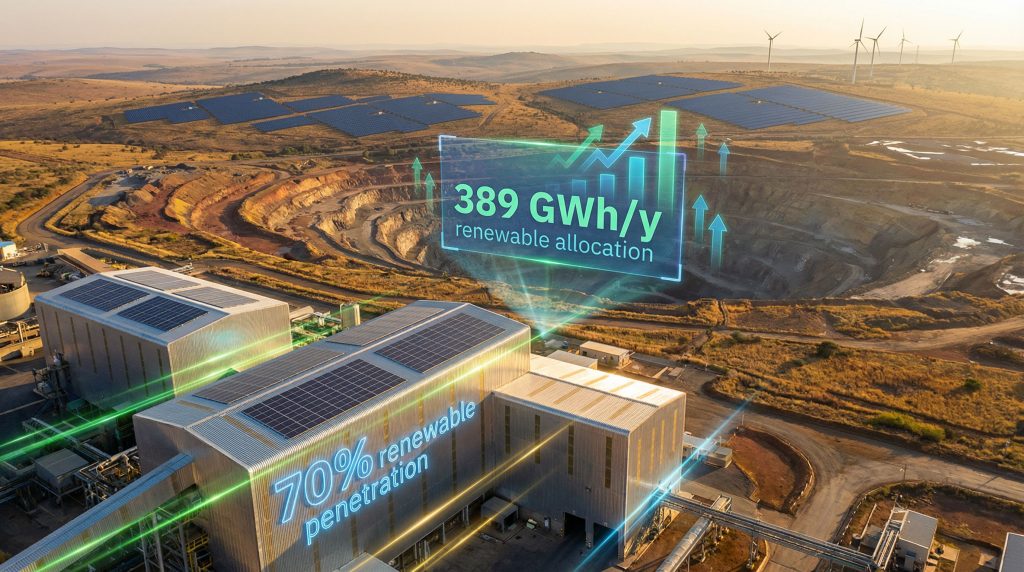
Pan African Resources recently demonstrated the scale of transformation possible through strategic energy partnerships, securing a renewable energy allocation of 389 GWh annually to achieve 70% renewable penetration across its consolidated operations. This represents approximately 556 GWh total annual consumption, positioning the company as a significant industrial energy consumer.
Key Strategic Benefits of Energy Partnership Models:
- Cost Predictability: Fixed or capped pricing structures eliminate exposure to utility tariff fluctuations
- Operational Continuity: Reduced vulnerability to grid disruptions that directly impact production schedules
- Competitive Advantage: Energy cost optimisation supports margin protection in global commodity markets
- ESG Alignment: Renewable energy solutions enable access to ESG-focused capital and customer relationships
The Pan African arrangement specifically covers multiple operational sites across Mpumalanga and Gauteng provinces, including Barberton mines, Evander mines, and Mogale tailings retreatment facilities. This portfolio approach demonstrates energy risk management at enterprise scale rather than single-asset solutions.
When big ASX news breaks, our subscribers know first
Aggregation Models Enable Rapid Industrial Energy Transformation
Energy aggregators have emerged as critical intermediaries enabling mining companies to access renewable energy solutions without developing internal energy expertise. NOA Group Trading's role in the Pan African agreement exemplifies this model, facilitating agreement completion in one month compared to traditional renewable development timelines of 18-24 months.
This acceleration reflects several structural advantages inherent in aggregation models:
Rapid Deployment Capability:
- Pre-existing power purchase agreements eliminate lengthy development phases
- Available capacity allocation enables immediate supply commitments
- Streamlined due diligence processes reduce negotiation complexity
Risk Transfer Mechanisms:
- Aggregators assume commodity price risk associated with renewable generation
- Weather and performance risks transfer to specialised energy partners
- Credit and counterparty risks managed through aggregator balance sheets
The South African renewable energy sector currently has an estimated 16 GW of renewable energy initiatives under development. This pipeline indicates widespread industry recognition that energy transformation has shifted from strategic aspiration to operational imperative.
Certification Integration Supports ESG Reporting
Modern renewable energy agreements incorporate International Renewable Energy Certificates (I-RECs), providing verified documentation of renewable consumption for ESG reporting purposes. Each certificate represents 1 MWh of renewable generation, enabling mining companies to substantiate emissions reduction claims with third-party verification.
Consequently, this certification integration addresses multiple strategic objectives simultaneously, supporting compliance with international emissions reporting standards while enabling access to ESG-focused capital markets.
Operational Scale Transformation Across Multi-Site Mining Operations
Large-scale renewable energy agreements fundamentally alter mining operational economics through both cost structure optimisation and supply reliability improvements. Pan African's 70% renewable penetration target demonstrates the magnitude of transformation possible when energy strategy aligns with operational scale requirements.
The company's CEO Cobus Loots articulated the competitive imperative: "energy risk directly impacts cost, competitiveness, and operational continuity in mining operations". This framework reflects industry-wide recognition that electricity represents a material operational risk factor extending beyond simple cost considerations.
Operational Impact Analysis:
| Metric | Impact | Strategic Value |
|---|---|---|
| Energy Cost Volatility | Reduced through fixed pricing | Margin protection and budget predictability |
| Production Continuity | Enhanced through supply diversification | Improved throughput reliability |
| ESG Performance | 70% emissions reduction | Access to ESG-focused capital |
| Competitive Position | Lower all-in sustaining costs | Global market competitiveness |
South African gold operations typically require 8-12 MWh per tonne of ore processed, varying significantly by deposit depth and processing methodology. Pan African's 556 GWh annual consumption aligns with mid-tier African gold producer operational requirements.
Global Competitiveness Through Energy Cost Optimisation
African mining operations face structural cost disadvantages compared to lower-cost jurisdictions, with South African gold producers averaging $1,200-1,400 per ounce all-in sustaining costs. Energy cost optimisation through renewable partnerships creates sustainable competitive advantages while meeting increasingly stringent ESG requirements.
The competitive strategy encompasses multiple operational dimensions:
Cost Structure Transformation:
- Each $0.01/kWh electricity cost variation impacts gold mining operations by approximately $50-80 per ounce in all-in sustaining costs
- Long-term renewable agreements provide cost certainty across commodity price cycles
- Fixed pricing structures enable sustainable dividend policies and capital reinvestment planning
ESG Market Access:
- ESG-focused investment funds represent over $40 trillion in global capital allocation as of 2024-2025
- Renewable energy penetration directly influences ESG scoring and investor preference
- Supply chain partners increasingly require ESG compliance certifications from suppliers
Pan African's specific emphasis on maintaining global competitiveness reflects structural challenges facing South Africa's mining sector, where energy costs represent 15-20% of all-in sustaining costs.
Investment Capital Flows Drive African Energy Transition Acceleration
The African renewable energy sector is experiencing accelerated growth driven by converging factors: falling technology costs, improved policy frameworks, and increasing international capital availability. Mining sector adoption serves as a catalyst for broader industrial energy transformation.
Technology Cost Trajectory:
- Solar photovoltaic costs have declined 90% since 2010
- Wind generation costs have fallen 70% over the same period
- Battery storage costs declining 14-16% annually
- These reductions enable economically viable renewable models previously considered unviable
The 16 GW mining sector renewable pipeline identified across South African operations indicates the market has transitioned from strategic intent to execution focus. This development aligns with broader energy transition insights highlighting how critical minerals supply chains are adapting to renewable energy demands.
How Do Regulatory Frameworks Support Mining Energy Transformation?
Mining companies must navigate increasingly complex regulatory environments while managing operational risks across multiple jurisdictions. Renewable energy adoption addresses several regulatory requirements simultaneously, from emissions reporting to local economic development obligations.
Regulatory Compliance Framework:
- International emissions reporting standards require verified renewable energy consumption data
- Carbon pricing mechanisms create financial incentives for emissions reduction
- Local content requirements often favour renewable energy partnerships with domestic providers
- Operational licensing increasingly incorporates ESG performance metrics
The integration of I-RECs certification within renewable energy agreements enables mining operators to demonstrate compliance with multiple regulatory frameworks through single operational decisions. This streamlines compliance management while reducing administrative complexity.
Mining Decarbonisation Delivers Multiple Benefits
Furthermore, mining decarbonisation benefits extend beyond regulatory compliance to encompass operational cost reduction and improved access to capital markets. Companies achieving significant renewable energy penetration often report enhanced investor relations and reduced financing costs.
The next major ASX story will hit our subscribers first
Long-Term Strategic Integration With Mining Business Development
Successful renewable energy partnerships must align with long-term mine planning, production forecasts, and expansion strategies. Pan African's agreement demonstrates strategic integration incorporating consumption data analysis and operational growth projections.
Strategic Planning Integration Elements:
- Granular Consumption Analysis: Energy agreements sized based on detailed operational demand profiles
- Expansion Alignment: Flexible supply arrangements supporting production growth scenarios
- Mine Life Optimisation: Energy costs integrated into resource extraction sequencing decisions
- Purpose-Built Solutions: Customised agreements addressing specific operational requirements
Karel Cornelissen of NOA Group Trading emphasised that successful energy solutions require design informed by granular consumption data and planned operational expansions. This ensures renewable energy supply evolves alongside business requirements rather than constraining operational flexibility.
Financial Structure Transformation And Margin Protection Strategies
Electricity represents a significant portion of mining operational costs, particularly in energy-intensive processes like gold extraction and processing. In addition, renewable energy agreements provide cost certainty while potentially reducing absolute energy expenses over agreement terms.
Financial Impact Considerations:
| Financial Metric | Traditional Utility | Renewable Partnership |
|---|---|---|
| Cost Predictability | Variable tariff exposure | Fixed/capped pricing |
| Capital Requirements | Minimal upfront | Partnership-based |
| Margin Protection | Limited | Enhanced through cost certainty |
| Investment Planning | Constrained by volatility | Improved through predictability |
The emphasis on competitive electricity pricing reflects the material impact of energy expenses on mining profitability. For gold producers competing in global spot markets, energy cost optimisation can represent the difference between profitable operations and margin pressure.
Technology-Driven Operations Enable Advanced Energy Management
Contemporary renewable energy agreements incorporate sophisticated monitoring and management systems providing operational transparency and optimisation opportunities. These data-driven mining operations enable real-time energy consumption analysis and predictive maintenance integration.
Technology Integration Benefits:
- Real-Time Monitoring: Continuous consumption tracking enabling demand optimisation
- Predictive Analytics: Advanced systems supporting maintenance scheduling and performance optimisation
- Operational Integration: Energy management systems coordinated with existing mining operational platforms
- Performance Optimisation: Data analytics enabling continuous improvement in energy utilisation efficiency
What Does The Future Hold For African Mining Energy Evolution?
The African mining sector's energy transformation is entering an execution-focused phase, with successful early adopters demonstrating viable pathways for broader industry adoption. Future developments will likely emphasise hybrid renewable systems, enhanced storage integration, and potentially cross-border energy trading arrangements.
Emerging Development Scenarios:
- Hybrid System Evolution: Integration of solar, wind, and battery storage for enhanced operational reliability
- Regional Energy Trading: Cross-border arrangements enabling continental energy optimisation
- Green Hydrogen Integration: Renewable-powered hydrogen production for mining process applications
- Aggregation Model Expansion: Specialised energy fuels partnership models serving smaller mining operations
Market Development Indicators:
- Transition from strategic intent to operational execution across major mining companies
- Growing pipeline of bankable, scalable energy solutions designed for industrial applications
- Integration of energy security considerations into long-term mine planning processes
- Enhanced focus on hybrid systems incorporating storage for operational reliability
The transformation from energy cost acceptance to strategic energy procurement represents a fundamental shift in mining operational philosophy. As renewable technology costs continue declining and ESG requirements intensify, energy partnerships will likely become standard operational practice.
However, companies exploring similar energy transformation strategies should evaluate comprehensive partnership models that address cost optimisation, supply reliability, and regulatory compliance simultaneously. The success of the Pan African renewable energy deal demonstrates that well-structured energy partnerships can deliver material operational benefits while supporting long-term strategic positioning in increasingly competitive global commodity markets.
Exploring Investment Opportunities in African Mining Renewable Energy Transformation?
Discovery Alert's proprietary Discovery IQ model delivers real-time alerts on significant mining and energy sector discoveries across the ASX, instantly empowering subscribers to identify actionable opportunities ahead of the broader market. Begin your 14-day free trial today to position yourself ahead of transformative developments in the mining energy transition sector.