May 13, 2026
Regional supply chain disruptions across Asia-Pacific markets have created unprecedented volatility in industrial metal procurement costs, fundamentally altering traditional pricing mechanisms that manufacturers rely on for planning and profitability. The convergence of concentrate shortages, processing capacity constraints, and shifting trade flows has established a new paradigm where physical delivery premiums reflect structural imbalances rather than temporary market dislocations. Furthermore, the Pan Pacific Japan copper premium 2026 announcement demonstrates how these market forces are reshaping cost structures across Asian manufacturing sectors.
Regional Premium Escalation Transforms Japanese Manufacturing Economics
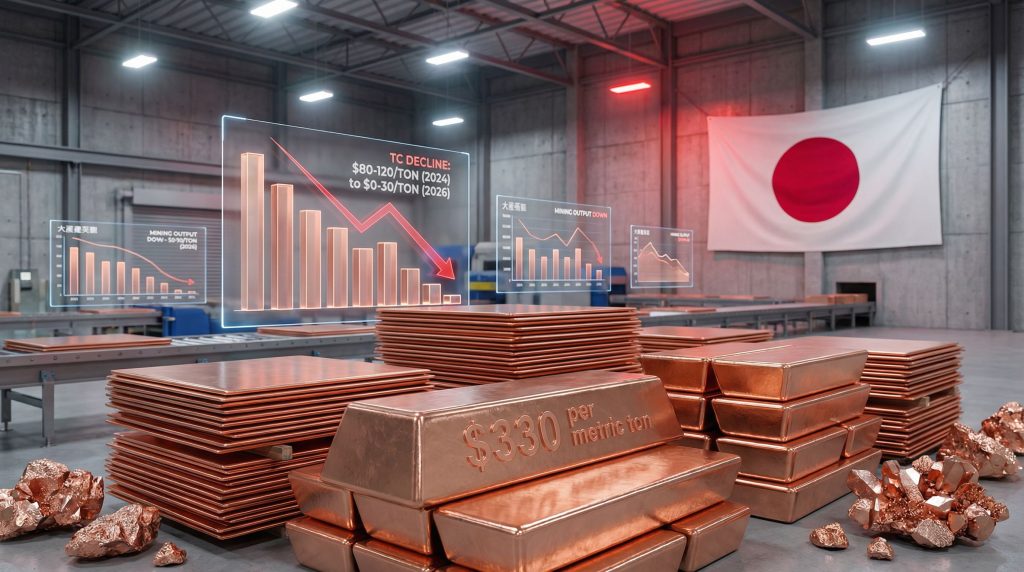
Japanese industrial consumers face a dramatic cost environment as copper delivery premiums surge to unprecedented levels. The $330 per metric ton premium established for 2026 represents a fundamental shift from the $88 per metric ton rate that characterised 2025 markets, creating a 275% year-over-year increase that forces manufacturers to reassess input cost assumptions across multiple sectors.
This premium escalation extends beyond typical seasonal fluctuations or short-term supply disruptions. The rate reflects underlying tensions in the global copper supply outlook, processing capacity utilisation, and regional inventory positioning that indicate structural rather than cyclical market changes. With New York copper prices trading at approximately $5.89 per pound as of early 2026, the premium component represents a significant additional cost burden for Japanese manufacturers operating in sectors with high copper intensity.
Pan Pacific Copper's positioning as Japan's largest refined copper supplier, with ownership distributed among JX Advanced Metals (47.8%), Mitsui Mining and Smelting (32.2%), and Marubeni (20.0%), provides insight into how major industrial supply chains adapt to cost pressures. Consequently, the company's decision to implement record premiums reflects the necessity to maintain operational viability despite collapsing treatment and refining charge revenues.
The premium calculation incorporates multiple cost components beyond basic metal delivery:
• Transport costs reflecting Pacific shipping rates and vessel availability
• Insurance premiums for refined copper cargo protection
• Customs duties and consumption taxes on imported metal products
• Quality adjustments for cathode purity specifications above standard grades
• Logistics efficiency costs including port handling and warehouse fees
Japanese manufacturers in automotive, electronics, and construction sectors must now incorporate these elevated input costs into pricing strategies, potentially affecting competitiveness in global markets where competitors may access copper at different premium levels.
When big ASX news breaks, our subscribers know first
Processing Fee Collapse Eliminates Traditional Smelter Revenue Streams
The fundamental economics of copper smelting have experienced unprecedented disruption as treatment and refining charges collapse toward zero or negative levels. Traditional smelter business models relied heavily on fees charged to miners for converting concentrates into refined metal, typically ranging from $80-120 per metric ton during balanced market conditions.
Treatment Charge Evolution Timeline:
| Year | TC/RC Range | Market Dynamics | Smelter Impact |
|---|---|---|---|
| 2024 | $80-120/ton | Supply-demand balance | Healthy processing margins |
| 2025 | Negative levels | Severe concentrate shortage | Revenue model inversion |
| 2026 | $0-30/ton | Continued constraints | Margin compression continues |
The severity of concentrate supply constraints has created market conditions where Antofagasta and Chinese smelter operations agreed to zero treatment charges for 2026, indicating that premium mining companies can secure processing services without traditional fee payments. This arrangement demonstrates how market power has shifted from smelters toward concentrate producers during supply shortage periods.
Smelter operations face multiple simultaneous pressures:
• Fixed cost absorption as depreciation, labour, and utility expenses continue despite revenue decline
• Raw material competition requiring premium payments to secure concentrate supplies
• Capacity utilisation decisions between operating at reduced margins versus idling facilities
• Capital allocation priorities for efficiency improvements to reduce unit operating costs
For mid-sized smelting operations processing 200,000 tons annually, the decline from normal TC/RC levels to zero represents $16-24 million in annual revenue loss. This magnitude of impact requires fundamental operational restructuring rather than incremental cost management approaches.
The collapse of treatment charges represents a complete inversion of traditional copper industry value distribution, forcing smelters to compete for concentrates rather than processing services.
Supply Disruption Patterns Create Global Market Ripples
Major mine production disruptions during 2025 established the foundation for current premium escalation patterns. Grasberg operations in Indonesia and Kamoa-Kakula facilities in the Democratic Republic of Congo experienced significant outages that constrained global concentrate availability precisely when Chinese smelting capacity expansion increased demand for raw materials.
These disruptions demonstrated the interconnected nature of global copper supply chains. When two major concentrate producers experience simultaneous production problems, the impact cascades through:
• Regional smelter competition for remaining available concentrates
• Spot market pricing volatility as operations bid aggressively for supplies
• Long-term contract renegotiation to secure reliable material flows
• Inventory repositioning across geographic markets to optimise supply security
The spot processing fee environment turned negative during peak supply constraints, meaning smelters were paying miners for concentrate access rather than receiving processing revenues. This unprecedented market condition forced industry participants to fundamentally reconsider traditional commercial relationships and contract structures.
Asian markets experienced particular tightness as speculation regarding potential US tariff implications on copper ingots redirected metal flows toward North American markets. This geographic rebalancing created additional supply pressure in import-dependent regions like Japan, contributing to the Pan Pacific Japan copper premium 2026 escalation beyond levels justified by production disruptions alone.
How Are Concentrate Shortages Affecting Global Trade Flows?
The concentrate shortage has fundamentally altered traditional shipping patterns and commercial relationships. For instance, major Japanese consumers have been forced to compete with Chinese smelters for limited Indonesian concentrate supplies, creating a bidding war that has driven spot premiums to unprecedented levels.
Speculative Trade Flows Amplify Regional Supply Imbalances
Trade policy uncertainty has introduced speculative elements into physical copper market positioning that extend beyond traditional supply-demand fundamentals. Concerns about potential U.S. copper ingot tariffs have encouraged precautionary inventory building in North American markets, diverting metal supplies that would typically flow to Asian consumers.
This trade flow redirection creates multiple market distortions:
Inventory Redistribution Effects:
• North American warehouse stocks increase due to precautionary positioning
• Asian regional inventories decline as typical supply sources redirect material
• Premium differentials widen between geographic markets based on relative supply availability
• Arbitrage opportunities emerge for traders with logistics capabilities across regions
Price Discovery Complications:
• Physical premiums reflect speculative positioning rather than consumption demand
• Regional price differentials exceed normal logistics cost justification
• Contract negotiations incorporate trade policy risk premiums
• Spot market volatility increases due to uncertain supply allocation patterns
The speculative component of current market dynamics suggests that premium levels could experience rapid adjustment if trade policy clarity emerges. However, effective market volatility hedging strategies remain essential for managing these uncertainties.
Chinese Smelting Expansion Reshapes Competitive Dynamics
China's continuing expansion of copper smelting capacity creates additional pressure on global concentrate markets while potentially offering alternative processing options for regional consumers. Chinese smelter operations have demonstrated willingness to accept zero or negative treatment charges to secure concentrate supplies, indicating strategic positioning for long-term market share rather than short-term profitability optimisation.
Competitive Positioning Analysis:
• Cost structure advantages through newer facility technology and integrated operations
• Government support mechanisms providing financing flexibility during market transitions
• Scale economies enabling competitive positioning during industry consolidation phases
• Concentrate procurement strategies emphasising supply security over immediate processing margins
Japanese smelter operations face strategic decisions regarding competitive responses to Chinese capacity expansion. Moreover, these decisions occur within a broader context of mining evolution trends that favour technological advancement and operational efficiency.
Operational Excellence Focus:
• Energy efficiency improvements to reduce unit processing costs
• Automation implementation for labour productivity enhancement
• Process optimisation to minimise fuel and reagent consumption per ton
• Quality differentiation through superior cathode specifications
Strategic Positioning Alternatives:
• Vertical integration through mining asset acquisition
• Geographic diversification of processing locations
• Technology partnerships for next-generation smelting processes
• Customer relationship deepening through value-added services
Industrial Consumer Adaptation Strategies
Japanese manufacturers across multiple sectors must develop comprehensive approaches to managing elevated copper input costs while maintaining competitive positioning in global markets. The 275% premium increase requires strategic responses extending beyond traditional procurement optimisation.
What Sectors Face the Greatest Impact?
Automotive Manufacturing:
• Vehicle copper content ranges from 50-80 kg per conventional vehicle
• Electric vehicle copper requirements increase to 180-200 kg per unit
• Premium escalation adds $16-66 to material costs per vehicle depending on copper intensity
• Supply chain security becomes critical for production planning continuity
Electronics Production:
• High-purity copper requirements command additional quality premiums
• Component miniaturisation increases processing precision requirements
• Supply interruptions create cascading effects through complex assembly operations
• Alternative material evaluation accelerates for non-critical applications
Construction Industry:
• Infrastructure projects incorporate copper cost escalation into bid calculations
• Long-term contracts require price adjustment mechanisms for material volatility
• Building system designs may shift toward alternative conductive materials where feasible
• Supply timing coordination becomes crucial for project schedule maintenance
Risk management frameworks must address both price volatility and supply availability concerns. Furthermore, the Pan Pacific Japan copper premium 2026 announcement has prompted manufacturers to reassess their hedging strategies:
• Financial hedging strategies for copper price exposure through futures or options
• Supply relationship diversification across multiple geographic sources
• Inventory optimisation balancing carrying costs with supply security requirements
• Contract structure evolution incorporating premium adjustment mechanisms
The next major ASX story will hit our subscribers first
Investment Implications Across the Copper Value Chain
The current market structure creates differentiated investment opportunities and risks across mining, smelting, and industrial consumer segments. Premium miners with high-quality concentrate production benefit from improved negotiating positions, while processing operations face margin compression requiring strategic adaptation.
Mining Sector Value Creation:
• Premium concentrate producers can negotiate favourable treatment charge agreements
• Development projects gain economic viability through improved concentrate pricing
• Exploration activities receive increased funding as resource scarcity premiums emerge
• Mine expansion decisions accelerate timelines to capture market opportunities
Processing Sector Challenges:
• Smelter operations require efficiency improvements to maintain viability
• Consolidation opportunities emerge among financially stressed facilities
• Technology upgrade investments become essential for competitive positioning
• Geographic optimisation may favour processing locations near concentrate sources
The challenges facing the global copper smelting industry are particularly acute in Japan, where smelters must balance operational costs with securing adequate concentrate supplies.
Industrial Consumer Strategies:
• Vertical integration assessment for supply chain control and cost management
• Technology development priorities shift toward copper-efficient product designs
• Geographic manufacturing diversification to access different supply markets
• Circular economy initiatives gain importance for material cost optimisation
How Will Long-Term Market Structure Evolution Affect Pricing?
Current market conditions suggest structural changes that extend beyond cyclical supply-demand imbalances. The combination of concentrate supply constraints, processing capacity redistribution, and trade policy uncertainty indicates that copper markets may operate within permanently elevated premium volatility ranges.
Structural Change Indicators:
• Regional premium differentiation becoming a persistent market feature rather than temporary disruption
• Supply chain fragmentation along geopolitical lines affecting traditional trade patterns
• Processing location optimisation based on concentrate access rather than consumer proximity
• Technology development acceleration for both mining efficiency and copper substitution applications
Future market scenarios encompass multiple potential outcomes:
Supply Normalisation Scenario:
• New mine development reduces concentrate shortage conditions
• Treatment charges recover toward historical ranges as processing competition resumes
• Regional premiums narrow as trade flows normalise and speculative positions unwind
• Industrial consumers benefit from reduced input cost pressures
Continued Structural Tightness:
• Concentrate supply remains constrained due to development lead times and operational challenges
• Processing capacity continues geographic redistribution with efficiency-driven consolidation
• Premium volatility persists as regional supply-demand imbalances fluctuate with economic cycles
• Innovation accelerates in both mining technology and copper-efficient industrial applications
The Japanese experience with record copper premiums provides insight into how import-dependent economies adapt to fundamental shifts in global commodity market structure. In addition, these developments offer valuable strategic lessons for industrial policy and corporate planning across multiple sectors reliant on critical material inputs.
This analysis incorporates market data and industry developments through early 2026. Copper market conditions remain subject to rapid change based on mine production, trade policy, and macroeconomic factors affecting global industrial demand.
Are You Tracking the Next Major Copper Discovery?
The unprecedented premium escalation in copper markets highlights the critical importance of supply disruptions and new discoveries. Discovery Alert's proprietary Discovery IQ model delivers instant notifications on significant ASX mineral discoveries, helping subscribers identify potential copper opportunities ahead of market awareness. Begin your 30-day free trial today and position yourself to capitalise on the next major discovery that could reshape these supply dynamics.