July 15, 2026
The Geology Gap: Why Africa's Mineral Wealth Remains Locked Underground
Long before a single tonne of copper or lithium leaves an African port, decades of invisible work must take place underground, on paper, and inside government institutions. The critical minerals demand created by the global energy transition has produced extraordinary appetite for the raw materials that Africa holds in abundance, yet the continent continues to attract a fraction of the exploration capital that flows into Canada, Australia, or even parts of Latin America.
Understanding why requires looking past the obvious barriers of political risk and infrastructure deficits, and examining a far more fundamental constraint: the chronic shortage of reliable, accessible, and modern geological knowledge.
This knowledge deficit is not a minor inconvenience. It is the primary ceiling on Africa's investment readiness, and addressing it is precisely what the PanAfGeo+ mineral investment program is designed to do.
When big ASX news breaks, our subscribers know first
Africa's Critical Minerals Opportunity: Scale, Scope, and Strategic Importance
The Global Race for Critical Raw Materials and Africa's Central Role
The energy transition is not simply an environmental project. It is a supply chain restructuring of historic proportions. Electric vehicle batteries, wind turbines, solar panels, and grid storage systems all depend on specific minerals, many of which are concentrated in African geology. Copper underpins electrification infrastructure at every scale. Cobalt remains central to high-density battery chemistry. Lithium and graphite are foundational to energy storage.
Africa holds significant reserves across all of these categories, alongside manganese, platinum group metals, and rare earth deposits that are only beginning to be characterised properly. Furthermore, critical raw materials transition strategies across Europe and Asia are increasingly looking to the continent to diversify supply chains away from geopolitically concentrated sources.
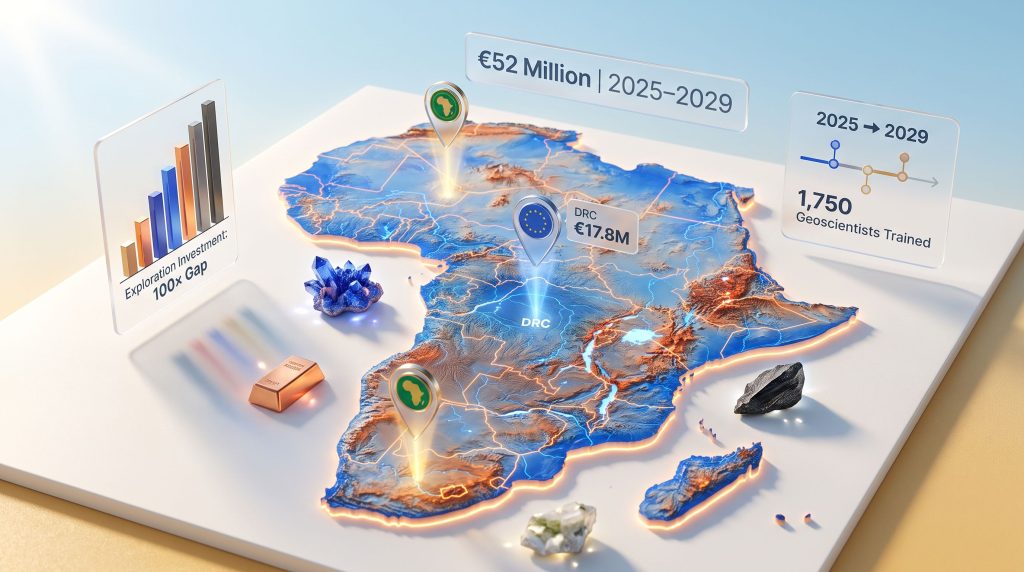
Despite this endowment, the continent's exploration spending remains strikingly low. According to Jean-Claude Guillaneau, coordinator of PanAfGeo+ at the French Geological Survey (BRGM), exploration investment per square kilometre runs approximately 100 times higher in jurisdictions like Canada and Australia than across most of Africa. This is not primarily a reflection of geological potential. It reflects the absence of the foundational data infrastructure that private capital requires before committing exploration budgets.
Why Africa Remains Chronically Underexplored Despite Its Resource Endowment
Several compounding factors explain this persistent underexploration:
- Geological maps across large portions of the continent date to the colonial era, in some cases the 1950s and 1960s, and have never been updated with modern survey methods
- Historical records held by former colonial administrations were often never transferred to national geological survey bodies
- Many national geological surveys lack the technical equipment, digital infrastructure, and trained personnel to conduct or interpret modern surveys
- Geopolitical instability and security risks in certain regions create risk premiums that deter early-stage private capital
- Pre-competitive geological data, the kind that forms the foundation of any investment case, is fundamentally a public good that private companies are structurally unlikely to fund
The result is a market failure at the earliest stage of the mineral development pipeline. Without basic subsurface knowledge, no credible investment thesis can be constructed, and the continent's resource wealth remains theoretical rather than bankable.
What Is PanAfGeo+ Invest? Program Architecture and Strategic Design
From Geoscience Training to Investment Facilitation: The Evolution of a Decade-Long Initiative
PanAfGeo began a decade ago as a geoscience capacity-building program. Over its initial phase, it trained nearly 1,750 geoscientists drawn from all 54 African Union member states, building a generation of qualified professionals capable of conducting and interpreting modern geological surveys. PanAfGeo+ extends this work through 2029 while adding an entirely new dimension: converting geological knowledge into investable projects.
The investment facilitation component, formally known as PanAfGeo+ Invest, was officially launched at a dedicated event held in Kinshasa, DRC, in March 2026. It builds directly on the groundwork laid by an earlier initiative called AfricaMaVal, which identified approximately 100 investment opportunities across the African mineral value chain, spanning exploration, processing, and recycling.
Program Timeline, Budget, and Institutional Structure at a Glance
| Program Component | Details |
|---|---|
| Program Period | 2025 to 2029 |
| Total Program Budget | Approximately €52 million (~USD $59.6 million) |
| Coordinating Institution | French Geological Survey (BRGM) |
| Partner Network | 21 institutional partners |
| Geoscientists Trained (Legacy) | Nearly 1,750 professionals across 54 AU member states |
| Official Launch of Invest Component | March 17 to 18, 2026, Kinshasa, DRC |
With a total envelope of approximately €52 million, PanAfGeo+ mineral investment represents the largest geoscience initiative ever launched on the African continent.
Three Strategic Pillars of PanAfGeo+ Invest
The Invest component operates across three interconnected strategic functions:
- Investment Facilitation: Reducing the information asymmetry and transactional friction that prevents African project developers from accessing European capital markets
- Strategic Intelligence: Equipping investors with the political, regulatory, environmental, and social context required for informed decision-making in diverse African jurisdictions
- Project Development: Identifying, validating, and accelerating mining and processing projects aligned with EU critical mineral supply chain priorities
Which African Countries Are Priority Targets for PanAfGeo+ Invest?
The Three Showcase Countries and Their Funding Allocations
While PanAfGeo+ engages all 54 African Union member states through its training and network-building activities, three countries receive dedicated showcase-level investment under the program's current phase:
| Country | Funding Allocation | Strategic Priority |
|---|---|---|
| Democratic Republic of Congo | €17.8 million (of €45.5M total) | Subsoil mapping, laboratory modernisation, copper, cobalt, and lithium value chains |
| South Africa | €3.8 million | Skills development, technical tools, and infrastructure capacity |
| Namibia | Pending detailed allocation | Critical minerals diversification |
Why the DRC Receives Nearly 4x More Funding Than South Africa
The DRC's disproportionate funding allocation reflects both its extraordinary mineral endowment and the severity of its geological data deficit. The country holds some of the world's highest-grade copper and cobalt deposits, yet vast portions of its territory remain inadequately mapped. A significant component of the DRC's program funding is directed toward digitising geological records originally held by the Belgian government.
This data was accumulated during the colonial period but never formally transferred to Congolese national institutions. Consequently, this digitisation work is itself a form of resource repatriation, giving the DRC's own geological survey access to historical subsurface intelligence for the first time.
Namibia's Emerging Role and the Full Continental Reach
Namibia's inclusion reflects growing recognition of the country's potential as a diversified critical minerals producer, particularly in lithium, uranium, and rare earths. Beyond the three showcase countries, the program's training and expert network components extend across the full membership of the African Union, ensuring that geological capacity improvements are not concentrated exclusively in a handful of high-profile jurisdictions.
How Does PanAfGeo+ Address Africa's Geological Data Deficit?
The Hidden Infrastructure Problem: Outdated Maps, Inaccessible Records, and Fragmented Data Systems
For investors evaluating African mineral assets, the first requirement is a credible overview of a country's geology and the location of potentially attractive mineral occurrences. In many African jurisdictions, that overview simply does not exist in an accessible, modern format. Geological maps may date to the 1960s, produced by colonial survey teams using techniques that predate satellite data, airborne geophysics, and modern geochemical sampling methods.
PanAfGeo+ addresses this through several parallel workstreams:
- Malawi: Complete national geological remapping, replacing maps originally produced by British surveyors in the 1960s, funded by France through the BRGM
- Democratic Republic of Congo: Digitisation and repatriation of Belgian colonial-era geological records, converting inaccessible physical archives into usable digital formats for the national survey
- Gabon, Ghana, Cameroon, Guinea, and Senegal: EU and World Bank-funded geological survey programs coordinated through BRGM technical teams
Building Permanent Knowledge Infrastructure
One of the more distinctive and lesser-known aspects of PanAfGeo+ is its commitment to creating knowledge infrastructure that outlasts the program itself. Two initiatives stand out:
Over the 2025 to 2029 program period, PanAfGeo+ will produce a landmark reference volume on African geology authored by between 200 and 250 African contributors drawn from across all AU member states. This is a deliberate effort to ensure that Africa's geological identity is defined by African expertise rather than external interpretation.
The second initiative involves establishing permanent professional networks modelled on the expert group structure used by EuroGeoSurveys. These networks, covering critical minerals, geophysics, geoparks, and geoheritage, are designed to continue operating independently after the program concludes. Crucially, they do not require significant ongoing funding or formal bureaucratic structures, as their value lies in enabling sustained communication and technical collaboration between professionals across national boundaries.
Who Should Pay for Early-Stage Geological Exploration in Africa?
The Public-Private Financing Divide in Upstream Mineral Development
One of the most consequential and least-discussed questions in African mineral development concerns the financing of pre-competitive geological work. The mineral exploration importance of this early-stage work cannot be overstated, yet private mining companies, regardless of their nationality or balance sheet strength, are structurally disinclined to fund basic geological surveys.
Their investment logic requires a known deposit with a defined resource estimate before capital allocation decisions can be justified to shareholders. The work required to reach that point, acquiring subsurface knowledge, generating geological maps, collecting geochemical data, falls into a category that markets consistently underprovide.
This is fundamentally a public goods problem, and the appropriate response is public financing. According to Jean-Claude Guillaneau, the first stage of exploration, acquiring basic knowledge of the subsurface, is normally the responsibility of governments. France recently relaunched a national mineral inventory for its own territory, including mainland France and French Guiana, using improved modern techniques to reassess areas previously considered well-characterised.
Government-Led Geological Investment: Positive Models Across the Continent
Several African governments have demonstrated that self-directed geological investment is achievable:
- Morocco: Systematic, government-financed expansion of national geological knowledge across its territory
- Botswana: Drawing on diamond revenue to fund diversification into multi-mineral exploration programs beyond its established kimberlite resources
- Gabon and Chad: Oil-producing nations with sufficient fiscal capacity to partially self-fund initial geological surveys
- Algeria: Incremental expansion of national geological mapping programs across its large territory
Where governments lack the fiscal capacity to finance this work independently, bilateral donors and multilateral institutions fill the gap. France has directly financed the complete remapping of Malawi. The World Bank has funded BRGM technical work in the DRC, Cameroon, Guinea, and Senegal. The European Union has supported field survey programs in Gabon and Ghana.
The Statistical Reality of Mineral Exploration
Industry Benchmark: When geological exploration begins in a new territory, the statistical probability of discovering a commercially viable deposit is approximately 1 in 100. If a discovery is made, the average timeline from that point to active production is estimated at 17 years, with gold deposits capable of developing significantly faster and large-scale copper projects requiring considerably longer lead times and capital commitments.
This statistical reality has direct implications for how investment in geological knowledge should be framed. The returns are long-dated, diffuse, and captured largely by governments and the broader economy rather than the organisations that fund the surveys. This makes public financing not merely appropriate but essential.
The next major ASX story will hit our subscribers first
How Does PanAfGeo+ Invest Plan to Engage European Companies?
The Structural Absence of European Mining Companies in Africa
European-headquartered mining companies are a relatively rare presence on the African continent compared to their Australian, Canadian, or Chinese counterparts. Major European industrial players with significant exposure to metals, including aerospace manufacturers, automotive companies, and defence contractors, participate in the mineral economy primarily as consumers rather than producers.
Organisations like the European Raw Materials Alliance (ERMA), which operates within the EIT RawMaterials framework, represent hundreds of such companies with direct or indirect interests in securing critical mineral supply. The metals and mining geopolitics of this dynamic are shifting rapidly, however, as supply chain vulnerability has become a strategic priority at the highest levels of European industrial policy.
PanAfGeo+ Invest uses this network as a primary channel for connecting European industrial buyers with African project developers.
Why Offtake Agreements Have Become the Primary Mechanism for European Participation
Investment Mechanism Explained: Rather than acquiring direct equity stakes in African mining ventures, European industrial players are increasingly participating through offtake agreements, contractual commitments to purchase a defined percentage of future production at agreed pricing terms. These arrangements serve a dual function: securing supply for European manufacturers while simultaneously improving the bankability of African projects by giving lenders confidence that output has a guaranteed buyer at a commercially viable price.
The mechanics of how offtake agreements unlock project finance deserve particular attention for investors unfamiliar with the structure:
- A European industrial buyer commits contractually to purchasing a defined percentage of a project's future output, typically indexed to prevailing commodity market prices
- That purchase commitment provides lenders with revenue certainty, effectively transforming an uncertain future production stream into something resembling a contracted cash flow
- With revenue certainty established, commercial banks and development finance institutions become willing to extend project finance that would otherwise be unavailable
- Increasingly, offtake agreements also include an upfront capital contribution from the buyer, with individual commitments ranging from tens to hundreds of millions of euros depending on project scale
- The combined effect improves project bankability at every level of the capital structure
This mechanism explains why European participation in African mining tends to take the form of supply agreements rather than equity ownership. It allows large industrial companies to secure critical mineral access without taking on the operational risks and reputational complexities of direct mine ownership in frontier jurisdictions.
Beyond Mining: Supporting Processing and Downstream Value Addition
A critical dimension of the PanAfGeo+ Invest approach is its explicit support for processing facilities and downstream industrial development, not merely raw material extraction. The Tanzania graphite processing initiative provides a live example: rather than simply facilitating the export of raw graphite flake, the program is supporting the development of in-country processing capacity that would allow Tanzania to export a higher-value product positioned further along the battery supply chain.
This co-development orientation aligns with the EU's Global Gateway strategy and reflects a broader policy commitment to ensuring that African countries capture more of the value generated by their mineral resources rather than simply serving as raw material exporters.
Five African Projects and the EU Strategic Designation
A significant advocacy outcome from the AfricaMaVal phase deserves emphasis. Of the approximately 13 strategic raw material projects that the European Union has formally recognised outside its own borders, 5 are located in Africa. This designation carries meaningful implications for financing access and institutional support at the EU level, and represents the direct result of systematic project identification and advocacy work conducted through the PanAfGeo ecosystem.
What Institutional Framework Supports PanAfGeo+ at the Continental Level?
Key Multilateral Partners and Their Roles
| Institution | Role Within PanAfGeo+ |
|---|---|
| African Union / African Minerals Development Centre | Continental policy alignment and Africa Mining Vision implementation |
| Organisation of African Geological Surveys | Technical coordination across national geological survey bodies |
| Geological Society of Africa | Knowledge-sharing platform and contributor network for the African geology publication |
| EIT RawMaterials / ERMA | European industrial network connecting manufacturers to African mineral projects |
| BRGM (French Geological Survey) | Program coordinator and technical lead |
The Africa Mining Vision, developed under AU auspices, provides the overarching policy context within which PanAfGeo+ operates. It articulates a framework for responsible, knowledge-driven resource development that prioritises local value retention, environmental stewardship, and human capital investment alongside raw material extraction.
Frequently Asked Questions About PanAfGeo+ Mineral Investment in Africa
What is PanAfGeo+ Invest and how does it differ from the original PanAfGeo program?
The original PanAfGeo program focused exclusively on building geoscience capacity within African national geological surveys through structured training of professionals. PanAfGeo+ retains and extends this training function while adding a new investment facilitation dimension. PanAfGeo+ Invest specifically works to translate accumulated geological knowledge into bankable project opportunities accessible to European capital markets.
How many African geoscientists has PanAfGeo trained to date?
The program has trained nearly 1,750 geoscientists representing all 54 African Union member states over its first decade of operation.
What is an offtake agreement and why is it central to European investment in African mining?
An offtake agreement is a contractual arrangement under which a buyer commits in advance to purchasing a specified volume of a project's future production at defined pricing terms. In the context of African mining, these agreements allow European industrial companies to secure critical mineral supply without taking on direct equity risk, while simultaneously improving the financial bankability of African projects by providing revenue certainty to project lenders.
What is the total budget of PanAfGeo+ and who funds it?
The total program budget is approximately €52 million (equivalent to around USD $59.6 million). Funding comes primarily through the European Union, with coordination led by BRGM and delivered through a network of 21 institutional partners.
How long does it typically take to develop a mineral deposit from discovery to production?
From initial discovery, the average development timeline to active production is estimated at approximately 17 years, though this varies significantly by deposit type and scale. Gold deposits can progress faster through the development cycle, while large copper deposits involve substantially longer timelines and capital requirements.
The Strategic Outlook: Can PanAfGeo+ Reshape Africa's Position in Global Critical Mineral Supply Chains?
Translating Geological Knowledge Into Sovereign Economic Leverage
The most transformative potential of PanAfGeo+ mineral investment lies not in any individual project or offtake agreement, but in the cumulative effect of systematic geological knowledge building across a continent that has historically been characterised by information asymmetry. When African governments possess accurate, comprehensive, and digitally accessible geological data, they negotiate from an entirely different position. They can assess which projects to prioritise, which investors to engage, and what royalty and fiscal terms reflect the actual value of their subsurface resources.
The Risk of Remaining a Raw Material Exporter
The Tanzania graphite processing example points toward a wider strategic challenge. Africa currently captures a relatively small share of the value generated from its mineral wealth because most processing, refining, and manufacturing occurs outside the continent. Changing this dynamic requires not only mining investment but industrial investment, the kind that PanAfGeo+ Invest is beginning to facilitate through its support for downstream processing facilities. In addition, the mining exploration licences frameworks emerging in other resource-rich regions offer instructive models for how regulatory reform can accelerate investment readiness.
Building African Geoscience Leadership: The Long-Term Human Capital Dividend
Perhaps the most durable legacy of the PanAfGeo initiative will be the human capital it has developed. Nearly 1,750 trained geoscientists, a permanent reference volume on African geology authored by African experts, and self-sustaining professional networks modelled on EuroGeoSurveys, these are assets that outlast any individual program cycle and compound in value over time. The deliberate choice to have African experts author each country's geological chapters, rather than delegating that intellectual work to European institutions, represents a meaningful philosophical commitment to knowledge sovereignty.
Measuring Success Beyond Investment Volumes
The ultimate measure of PanAfGeo+ will not be captured in headline investment figures alone. Meaningful success requires tracking institutional capacity improvements within national geological surveys, the quality and accessibility of geological data systems, the depth of African expertise represented in continental geoscience leadership, and the extent to which downstream processing capacity is developed alongside raw material extraction. These are slower, less visible metrics than project investment announcements, but they are the foundations on which lasting resource sovereignty is built.
Further Exploration: Readers seeking additional context on Africa's mineral investment landscape and EU-Africa resource partnerships can explore the BRGM's dedicated coverage of the PanAfGeo+ Invest launch, as well as ongoing reporting across African mining, energy, and finance sectors via Ecofin Agency.
Want to Know When the Next Major Mineral Discovery Hits the ASX?
Discovery Alert's proprietary Discovery IQ model scans ASX announcements in real time, instantly identifying significant mineral discoveries across more than 30 commodities and translating complex geological data into clear, actionable investment insights — visit the Discovery Alert discoveries page to see the historic returns major discoveries have delivered, and begin your 14-day free trial to position yourself ahead of the broader market.