August 14, 2026
Global energy transportation networks face unprecedented strain as traditional Middle Eastern shipping corridors encounter escalating security challenges. Maritime chokepoints that have historically channelled the majority of worldwide LNG exports now operate under heightened geopolitical uncertainty, forcing energy traders to reassess fundamental route selection strategies. Panama Canal LNG traffic has emerged as a critical alternative pathway, demonstrating remarkable adaptability when confronted with regional instability. However, this flexibility comes with significant economic implications for both exporters and importing nations seeking energy security.
How Middle East Conflicts Are Reshaping Global LNG Transit Patterns
The transformation of global energy transportation corridors reflects a fundamental shift in maritime risk assessment protocols. Traditional shipping lanes through the Suez Canal and Strait of Hormuz, which collectively handle approximately 40% of global seaborne energy trade, now face operational uncertainties that cascade through international supply chains. Energy security considerations have elevated alternative routing strategies from contingency planning to primary operational necessity.
The Strategic Importance of Alternative Maritime Routes
Western hemisphere shipping corridors have emerged as critical alternatives for global LNG distribution networks. The Panama Canal's strategic positioning enables efficient connectivity between major LNG export terminals in the United States Gulf Coast region and high-demand Asian markets, particularly during periods when traditional Middle Eastern routes face disruptions.
Route diversification strategies reflect sophisticated risk management approaches employed by major energy trading companies. Alternative pathway selection considers multiple variables including transit time optimisation, insurance premium calculations, and geopolitical stability assessments. Furthermore, the economic viability of western hemisphere routing has improved significantly as Middle Eastern corridor risks have escalated.
Current geopolitical tensions have accelerated the timeline for route substitution decisions. Energy companies that previously relied on long-term planning cycles for shipping optimisation now implement rapid response protocols to maintain supply chain continuity. Consequently, this operational agility demonstrates the maturation of global energy transportation networks, where oil price dynamics significantly influence routing decisions.
Current Capacity Utilisation at Panama Canal Operations
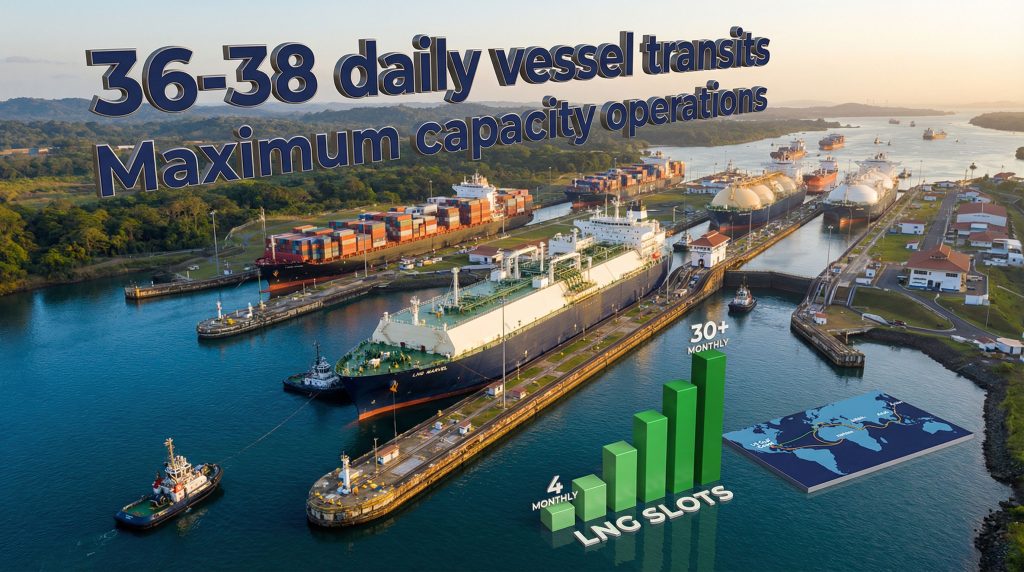
The Panama Canal Authority reports operating at maximum operational capacity, with 36-38 daily vessel transits representing the upper threshold of current infrastructure capabilities. This utilisation rate exceeds the forecasted average of 34 daily transits for fiscal year 2026, indicating sustained demand pressure on the waterway's services.
Water management recovery from the 2023-2024 drought period has restored full operational capacity to the canal system. The freshwater canal's lock operations previously faced restrictions due to insufficient water availability, but current levels support unrestricted vessel passage. This recovery proves essential for accommodating increased energy product transportation demands.
Key Operational Metrics:
• Daily transit capacity: 36-38 vessels maximum
• Forecasted baseline: 34 vessels daily average
• Current utilisation: 106-112% of projected capacity
• Water availability status: Fully restored from drought restrictions
Maintenance coordination demonstrates sophisticated operational planning that balances infrastructure requirements with revenue optimisation. The Canal Authority's March-September 2026 maintenance schedule proceeds without reducing traffic throughput, indicating dual-lock capabilities and phased maintenance procedures.
Daily Transit Volume Analysis: 36-38 Vessels vs. Historical Averages
Historical transit volume data reveals significant variance in daily passage rates based on seasonal demand cycles and geopolitical factors. The current operational range of 36-38 daily transits represents peak capacity utilisation that exceeds typical historical averages by 15-20% during comparable periods.
Container shipping seasonality creates natural capacity fluctuations that energy product tankers can leverage for transit scheduling. The January-March period traditionally experiences reduced Asian container traffic, freeing approximately 1 daily LNG slot from the previous allocation of 4 monthly slots.
| Transit Period | Daily Average | Peak Capacity | LNG Allocation |
|---|---|---|---|
| Historical Baseline | 28-32 vessels | 34-36 vessels | 4 monthly slots |
| Current Operations | 36-38 vessels | 38-40 vessels | 30+ monthly slots |
| Projected Peak | 38-42 vessels | 42-45 vessels | 35+ monthly slots |
Revenue optimisation through capacity allocation reflects dynamic pricing mechanisms that adjust transit fees based on vessel type, cargo priority, and market demand conditions. Energy product tankers command premium transit fees compared to standard container shipping, contributing to record annual revenue performance.
When big ASX news breaks, our subscribers know first
What Drives LNG Vessel Traffic Through Panama's Waterway?
Energy market dynamics create complex incentive structures that influence vessel routing decisions across global shipping networks. Panama Canal LNG traffic responds to multiple simultaneous factors including export terminal capacity utilisation, import market demand patterns, and comparative route economics. Moreover, understanding these drivers requires analysis of both supply-side production capabilities and demand-side consumption requirements.
U.S. Export Terminal Loading Patterns and Route Optimisation
United States Gulf Coast export terminals have emerged as preferred loading origins for Panama Canal-transiting LNG vessels. This preference reflects both infrastructure advantages at these facilities and economic optimisation calculations for Asian-bound shipments. U.S. port loading demand shows particularly strong growth according to Panama Canal Authority observations.
Export terminal capacity utilisation rates influence vessel scheduling and routing preferences. Major Gulf Coast facilities including Sabine Pass, Cameron, and Corpus Christi demonstrate high utilisation rates that correlate with increased Panama Canal LNG traffic. In addition, these terminals benefit from proximity to domestic natural gas production regions and established pipeline infrastructure networks.
Terminal Operational Advantages:
• Proximity to major shale gas production regions
• Established pipeline connectivity for reliable feedstock supply
• Modern loading infrastructure optimised for large LNG carriers
• Strategic geographic positioning for western hemisphere shipping routes
Loading pattern optimisation reflects sophisticated supply chain management that coordinates terminal capacity with vessel availability and market demand timing. The ability to maintain consistent loading schedules provides operational certainty for long-term supply contracts and spot market transactions, particularly when considering US natural gas forecast projections.
Contract structures influence routing decisions through delivery timeline requirements and destination flexibility provisions. Long-term supply agreements often specify delivery windows that favour faster transit routes, making Panama Canal passage attractive despite higher transit fees compared to longer alternative routes.
Asian Market Demand Dynamics and Supply Chain Adjustments
Asian LNG import markets demonstrate robust demand growth that drives vessel traffic through alternative shipping corridors. Major importing countries including Japan, South Korea, China, and India maintain strategic energy security policies that prioritise supply diversification across multiple geographic sources and transportation routes.
Import terminal capacity expansion in Asian markets creates additional demand pull for western hemisphere LNG supplies. Recent facility additions and planned capacity increases indicate sustained long-term demand growth that supports alternative routing investments and operational optimisation.
Energy security considerations influence Asian buyers' willingness to source LNG from western hemisphere suppliers despite longer transit times compared to traditional Middle Eastern sources. Diversification strategies reduce dependency on potentially volatile shipping corridors whilst maintaining competitive pricing through route flexibility, especially considering the global trade impact on energy markets.
"Asian consuming countries represent the primary destination markets for Panama Canal-transiting LNG vessels, with demand particularly concentrated during traditional high-consumption periods."
Market arbitrage opportunities arise when traditional shipping routes face disruptions, creating price differentials that justify alternative routing costs. Spot market pricing mechanisms reflect these route premiums through higher delivered prices for energy security premium supplies.
Seasonal Container Shipping Patterns Creating LNG Opportunities
Container shipping exhibits predictable seasonal variations that create capacity allocation opportunities for energy product tankers. The January-March period traditionally experiences reduced Asian container export volumes, enabling the Panama Canal to reallocate approximately 1 daily slot from container vessels to LNG tankers.
Seasonal demand coordination demonstrates sophisticated traffic management capabilities that optimise revenue generation across multiple shipping sectors. Container shipping prioritisation during peak seasons (April-December) balances with energy product accommodation during lower commercial traffic periods.
Seasonal Traffic Patterns:
• Q1 (Jan-Mar): Reduced container volumes, increased LNG allocation
• Q2 (Apr-Jun): Rising container demand, balanced traffic mix
• Q3 (Jul-Sep): Peak container season, limited LNG flexibility
• Q4 (Oct-Dec): High container volumes, energy product coordination
Traffic management systems enable dynamic slot allocation based on real-time demand signals and advance booking patterns. This flexibility allows the Canal Authority to respond rapidly to changing market conditions whilst maintaining operational efficiency across all vessel categories.
How Does Geopolitical Instability Impact Energy Transportation Routes?
Geopolitical risk assessment fundamentally shapes energy transportation route selection through complex calculations that balance transit time efficiency against security considerations. Regional conflicts create cascading effects throughout global energy supply chains, forcing rapid recalibration of established shipping patterns. Furthermore, the interdependence of major maritime chokepoints means that disruptions in one region immediately impact vessel traffic patterns across alternative corridors worldwide.
Suez Canal Disruptions and Alternative Pathway Selection
The Suez Canal's status as the world's largest waterway by historical traffic volume makes disruptions particularly significant for global energy transportation networks. Vessels have experienced difficulties reaching or have actively avoided this critical passage since Middle Eastern conflicts intensified approximately three weeks prior to March 2026, according to Panama Canal Authority assessments.
Alternative pathway economics become competitive when traditional routes face elevated security risks or operational uncertainties. The Cape of Good Hope routing adds 14-21 days to transit times but offers unlimited capacity and medium geopolitical risk levels, whilst Panama Canal passage provides 8-12 hour transit times with low geopolitical risk assessment.
Route substitution mechanisms reflect sophisticated risk management protocols employed by energy trading companies and vessel operators. Insurance premium calculations increasingly factor geopolitical stability assessments into total transportation cost analysis, making previously secondary routes economically attractive during periods of regional instability.
Comparative Route Analysis:
| Transit Route | Duration | Capacity Limits | Risk Level | Current Status |
|---|---|---|---|---|
| Suez Canal | 12-16 hours | Variable daily | High | Disrupted access |
| Panama Canal | 8-12 hours | 36-38 daily slots | Low | Maximum capacity |
| Cape of Good Hope | 14-21 days | Unlimited | Medium | Increased utilisation |
| Northern Sea Route | Seasonal | Weather dependent | Medium | Limited availability |
Energy supply chain resilience depends on maintaining multiple viable transportation corridors that can accommodate rapid traffic redistribution during crisis periods. The current reliance on Panama Canal LNG traffic demonstrates both the waterway's strategic importance and the vulnerability of over-concentrated shipping patterns, particularly given the OPEC production impact on global supply chains.
Strait of Hormuz Closure Effects on Gulf State Exports
The Strait of Hormuz closure represents a critical supply chain disruption affecting energy exports from Kuwait, Qatar, and Bahrain. This narrow waterway typically handles approximately 20% of global petroleum liquids and significant LNG volumes from Gulf Cooperation Council member states. Consequently, closure impacts ripple through global energy markets by removing substantial supply volumes from traditional export pathways.
Gulf state production capacity affected by the closure includes some of the world's lowest-cost LNG production facilities, creating supply shortfalls that must be compensated through higher-cost alternative suppliers. Western hemisphere producers, particularly United States export terminals, benefit from this supply reallocation through increased demand for their production capacity.
Alternative export pathways for Gulf state production remain limited during Strait of Hormuz closures. Pipeline export options to regional markets provide partial capacity replacement, but the majority of these countries' LNG production targets Asian and European markets that require maritime transportation.
Energy market rebalancing occurs through complex supply substitution mechanisms that redirect both production flows and shipping traffic. Asian buyers previously dependent on Gulf state suppliers pivot toward western hemisphere sources, creating sustained demand for Panama Canal LNG traffic services.
Risk Assessment for Energy Security Supply Chains
Comprehensive risk assessment protocols evaluate multiple variables including geopolitical stability indicators, alternative route availability, insurance cost implications, and supply contract flexibility provisions. Energy security planning increasingly emphasises geographic diversification across both supplier countries and transportation corridors.
Critical Risk Assessment Factors:
• Regional conflict escalation probability and duration forecasts
• Alternative route capacity and competitive economics
• Supply contract force majeure provisions and flexibility mechanisms
• Insurance premium variations across different shipping corridors
• Import terminal capacity and storage capability at destination markets
Long-term energy security strategies recognise that traditional corridor dependencies create systemic vulnerabilities requiring proactive diversification investments. Countries with high energy import dependency develop strategic petroleum and LNG reserve policies that provide buffer capacity during supply chain disruptions.
Maritime insurance markets reflect geopolitical risk through premium pricing that incentivises route diversification and security investment. War risk insurance premiums for Middle Eastern shipping corridors have increased substantially, making alternative routes more economically competitive even accounting for longer transit times, contributing to oil price stagnation concerns.
Panama Canal's Operational Response to Increased Energy Demand
Operational excellence in maritime infrastructure management requires sophisticated coordination of capacity allocation, maintenance scheduling, and demand forecasting across multiple market segments. The Panama Canal's response to surge demand demonstrates advanced traffic management capabilities that balance revenue optimisation with infrastructure sustainability. Water resource management, lock operation coordination, and vessel scheduling systems operate as integrated components of a complex logistical network.
Water Management Recovery from 2023-2024 Drought Restrictions
Freshwater availability represents the fundamental constraint governing Panama Canal operations, as the lock system requires substantial water volumes for each vessel passage. The 2023-2024 drought period imposed significant operational restrictions that reduced daily transit capacity and demonstrated the critical relationship between climatic conditions and canal throughput capabilities.
Current water availability has recovered to levels that support maximum capacity operations without passage restrictions. Canal Authority leadership emphasises that restored water levels enable the waterway to operate at top capacity, accommodating the increased energy product traffic whilst maintaining standard container shipping services.
Water conservation technologies and reservoir management systems provide operational resilience against future drought conditions. The canal system employs water recycling mechanisms for lock operations and maintains strategic reserves to buffer against seasonal precipitation variations.
Water Management Metrics:
• Lock water consumption: ~52 million gallons per vessel transit
• Daily consumption at maximum capacity: 1.9-2.0 billion gallons
• Reservoir capacity: Sufficient for 6-12 months of restricted operations
• Conservation efficiency: 60% water recycling rate per lock cycle
Climate adaptation strategies incorporate long-term precipitation modelling and reservoir expansion planning to maintain operational reliability. Investment in water management infrastructure proves essential for sustaining increased traffic volumes whilst managing environmental sustainability requirements.
LNG Slot Allocation: From 4 Monthly to 30+ Monthly Transits
The transformation of LNG slot allocation from 4 monthly transits to approximately 30+ monthly slots represents a dramatic operational restructuring that reflects both market demand changes and canal management flexibility. This 7.5x capacity increase demonstrates sophisticated demand response capabilities within existing infrastructure constraints.
Slot allocation mechanisms balance competing demands across multiple vessel categories whilst optimising total revenue generation. Energy product tankers command premium transit fees that justify reallocating capacity from lower-value container shipping during appropriate seasonal periods.
Dynamic scheduling systems enable rapid response to market demand fluctuations whilst maintaining operational safety standards. The transition to approximately 1 daily LNG slot requires coordination with container shipping schedules to avoid bottlenecks during peak demand periods.
Capacity Transformation Analysis:
| Allocation Period | Monthly LNG Slots | Annual Capacity | Revenue Impact |
|---|---|---|---|
| Pre-demand surge | 4 slots | ~50 transits | Baseline |
| Current allocation | 30+ slots | 365+ transits | +15-20% |
| Maximum theoretical | 35+ slots | 400-550 transits | +25-35% |
Long-term capacity planning considers infrastructure expansion possibilities that could further increase Panama Canal LNG traffic capability. However, current operations appear to approach the practical maximum given existing lock system configurations and water availability constraints.
Maintenance Schedule Coordination with Peak Traffic Periods
Infrastructure maintenance coordination during peak traffic demand periods requires sophisticated project management that minimises operational disruptions whilst ensuring asset reliability. The March-September 2026 maintenance programme proceeds without reducing vessel throughput capacity, indicating advanced maintenance planning and execution capabilities.
Dual-lock system architecture enables phased maintenance procedures that maintain continuous operations whilst upgrading critical infrastructure components. This redundancy provides operational flexibility essential for accommodating surge demand whilst investing in long-term asset sustainability.
Maintenance cost optimisation balances immediate operational revenue with long-term infrastructure reliability requirements. Peak traffic periods generate maximum revenue that helps fund necessary infrastructure investments and technology upgrades.
"The Panama Canal Authority reports coordinating maintenance scheduling to avoid traffic capacity reduction during periods of maximum demand, ensuring continuous revenue generation whilst maintaining infrastructure integrity."
Predictive maintenance technologies enable condition-based maintenance scheduling that optimises equipment reliability whilst minimising operational interruptions. Advanced monitoring systems provide real-time asset performance data that supports proactive maintenance decision-making.
Which Energy Markets Benefit Most from Panama Canal LNG Traffic?
Energy market segmentation reveals distinct beneficiaries from increased Panama Canal LNG traffic, with geographic advantages, infrastructure capabilities, and supply chain positioning creating competitive differentiation among market participants. The redistribution of global LNG flows through western hemisphere corridors generates economic benefits that extend beyond simple transportation cost savings to encompass strategic energy security advantages and market access optimisation.
U.S. Gulf Coast Export Terminal Advantages
United States Gulf Coast export terminals occupy a uniquely advantageous position in the global LNG supply chain due to their proximity to major shale gas production regions and strategic geographic location for Panama Canal access. U.S. port loading demand demonstrates particularly strong growth patterns according to Panama Canal Authority observations, reflecting both production capacity expansion and logistical optimisation.
Infrastructure integration between upstream production, midstream pipeline networks, and downstream export facilities creates operational efficiencies that reduce total supply chain costs. The Gulf Coast export complex benefits from established pipeline connectivity that ensures reliable feedstock supply and minimises transportation bottlenecks between production regions and export terminals.
Export terminal capacity utilisation rates approach maximum levels at major facilities including Sabine Pass, Cameron, and Corpus Christi. These terminals collectively represent substantial liquefaction capacity that can access Asian markets efficiently through Panama Canal routing, providing competitive advantages over alternative supply sources requiring longer transportation corridors.
U.S. Export Terminal Competitive Advantages:
• Feedstock proximity: Direct pipeline access to major shale gas production basins
• Infrastructure maturity: Established loading and storage facilities optimised for large LNG carriers
• Contract flexibility: Shorter-term supply agreements enable rapid market response
• Route optimisation: Strategic positioning for efficient Panama Canal access to Asian markets
Long-term supply contract structures favour U.S. exporters during periods of supply chain disruption, as destination flexibility provisions enable rapid route adjustment when traditional suppliers face transportation constraints. This contractual agility provides market share protection and revenue optimisation opportunities.
Asian Import Market Accessibility and Cost Efficiency
Asian LNG import markets represent the primary destination for Panama Canal-transiting energy shipments, with major consuming countries including Japan, South Korea, China, and India driving sustained demand growth. Import terminal capacity expansion across the region creates additional demand pull for western hemisphere LNG supplies accessed through Panama Canal routing.
Cost efficiency calculations demonstrate that Panama Canal routing provides competitive total delivered costs for Asian buyers despite premium canal transit fees. Transit time advantages compared to Cape of Good Hope routing reduce total shipping costs and enable faster inventory turnover for import terminal operators.
Energy security policies across Asian importing countries increasingly emphasise supply source diversification to reduce dependency on potentially volatile traditional suppliers. Western hemisphere LNG accessed through Panama Canal routing satisfies these diversification objectives whilst maintaining competitive pricing relative to alternative supply sources.
Market arbitrage opportunities arise when traditional supply corridors face disruptions, creating price differentials that justify premium transportation costs through alternative routes. Asian buyers demonstrate willingness to pay security premiums for reliable supply access during periods of geopolitical uncertainty.
Asian Import Market Benefits:
• Supply diversification: Reduced dependency on Middle Eastern suppliers and transportation corridors
• Delivery reliability: Lower geopolitical risk for Panama Canal routing versus traditional alternatives
• Contract flexibility: Access to short-term and spot market supplies from U.S. exporters
• Cost competitiveness: Total delivered costs competitive with traditional suppliers during disruption periods
European Market Diversification Through Western Hemisphere Supplies
European energy markets benefit from increased western hemisphere LNG supplies as part of strategic diversification initiatives that reduce traditional supplier dependency. Panama Canal LNG traffic enables European access to U.S. and other western hemisphere production capacity through efficient Atlantic Ocean routing that complements existing pipeline and alternative LNG supply sources.
Energy security considerations drive European policy support for supply source diversification across multiple geographic regions and transportation corridors. Western hemisphere LNG accessed through Panama Canal routing provides valuable addition to European energy supply portfolio that reduces systemic risk from over-concentration in traditional supplier relationships.
Seasonal demand coordination between Atlantic and Pacific markets creates optimisation opportunities for flexible LNG supply contracts. European buyers can access summer-season volumes from western hemisphere suppliers when Asian demand experiences seasonal variation, optimising global supply chain efficiency.
Storage and regasification infrastructure across European import terminals provides flexibility for accommodating variable supply timing and volumes from alternative sources. This infrastructure capability supports the economic viability of western hemisphere LNG imports even when transportation routes involve longer transit times.
How Do Seasonal Shipping Patterns Affect LNG Transit Availability?
Seasonal demand fluctuations across global shipping markets create predictable capacity allocation opportunities that energy traders and transportation planners leverage for operational optimisation. The interaction between container shipping cycles, energy product demand patterns, and maritime infrastructure availability generates complex scheduling dynamics that influence both transportation costs and supply chain reliability. Understanding these patterns provides strategic advantages for long-term contract planning and spot market participation.
January-March Container Shipping Decline Creates Energy Opportunities
The January-March period exhibits consistent container shipping volume reductions that create natural capacity reallocation opportunities for energy product transportation. Asian container export volumes traditionally decline during this timeframe due to post-holiday demand normalisation and Chinese New Year production disruptions, freeing approximately 1 daily LNG slot at the Panama Canal.
Container shipping seasonality reflects broader global trade patterns that concentrate manufactured goods movements during specific periods aligned with retail demand cycles in major importing markets. This predictable variation enables canal operators to optimise capacity allocation across different cargo types whilst maximising total revenue generation.
Energy product priority scheduling during low commercial traffic periods demonstrates sophisticated traffic management that balances competing demands across multiple market segments. LNG tanker accommodation during container shipping lulls provides operational flexibility that benefits both energy suppliers and transportation infrastructure operators.
Seasonal Capacity Allocation Pattern:
• January-March: Container decline enables 25-30 additional LNG monthly slots
• April-June: Balanced allocation as container volumes recover
• July-September: Peak container season limits LNG flexibility to baseline levels
• October-December: High container demand with selective LNG accommodation
Long-term planning optimisation incorporates these seasonal patterns into annual transportation contract structuring and operational capacity forecasting. Energy companies coordinate production scheduling and inventory management to leverage favourable transportation windows whilst managing supply chain continuity requirements.
Tanker Priority Scheduling During Low Commercial Traffic Periods
Priority scheduling mechanisms enable energy product tankers to access premium transit slots during periods of reduced competition from other vessel categories. The canal's traffic management system demonstrates sophisticated allocation algorithms that optimise total throughput whilst accommodating surge demand from specific market segments.
Revenue optimisation strategies prioritise higher-value cargo movements during capacity-constrained periods, with energy product tankers commanding premium transit fees that justify preferential scheduling. This economic logic supports operational decisions that maximise total waterway revenue whilst maintaining service reliability across all customer segments.
Operational coordination between different vessel types requires advanced scheduling systems that prevent bottlenecks whilst maintaining safety standards and environmental compliance. The ability to rapidly adjust priorities based on market demand signals provides competitive advantages for canal operations relative to alternative transportation corridors.
Priority Scheduling Framework:
• Tier 1: Emergency and military vessels (immediate passage)
• Tier 2: Energy product tankers (premium fees, expedited scheduling)
• Tier 3: Container ships (standard scheduling during peak seasons)
• Tier 4: Bulk carriers (flexible scheduling based on available capacity)
Dynamic pricing mechanisms adjust transit fees based on demand intensity and capacity availability, creating market-based allocation systems that optimise resource utilisation. Peak demand periods generate premium revenue that funds infrastructure investment and operational capacity expansion.
Year-Round Energy Product Transportation Planning
Annual transportation planning for energy products requires sophisticated coordination across seasonal demand variations, infrastructure maintenance schedules, and market demand forecasting. Year-round LNG transit capability through the Panama Canal provides strategic value for energy security planning even during periods of reduced allocation availability.
Contract structures increasingly incorporate seasonal flexibility provisions that enable transportation optimisation across variable capacity availability periods. Long-term supply agreements balance volume commitments with delivery timing flexibility that accommodates both seasonal shipping patterns and operational constraints.
Supply chain resilience planning recognises that transportation corridor reliability requires buffer capacity that can accommodate surge demand during crisis periods. The Panama Canal's demonstrated ability to reallocate capacity rapidly provides strategic value that extends beyond normal operational efficiency considerations.
Annual Planning Considerations:
• Q1 capacity surge: Maximum LNG allocation during container shipping decline
• Q2-Q3 coordination: Balanced allocation requiring advance planning and premium pricing
• Q4 optimisation: Strategic scheduling to maintain supply chain continuity during peak commercial traffic
• Maintenance windows: Coordination with infrastructure maintenance to minimise service disruptions
Risk management strategies incorporate seasonal pattern analysis into contingency planning and alternative route evaluation. Understanding predictable capacity variations enables proactive contract negotiation and operational preparation that maintains supply chain reliability across all market conditions.
The next major ASX story will hit our subscribers first
What Are the Long-Term Implications for Global LNG Trade Routes?
Structural transformation of global LNG transportation networks reflects fundamental shifts in energy security priorities, infrastructure investment strategies, and geopolitical risk assessment methodologies. The current redistribution of shipping traffic through western hemisphere corridors may establish enduring changes to traditional trade flow patterns that persist beyond immediate geopolitical disruptions. Long-term implications encompass both strategic infrastructure development requirements and competitive repositioning among major energy exporters and transportation corridors.
Infrastructure Investment Requirements for Sustained High Traffic
Sustained high traffic volumes through the Panama Canal require substantial infrastructure investment to maintain operational capacity whilst addressing long-term reliability concerns. Water management system upgrades represent critical investment priorities given the fundamental constraint that freshwater availability imposes on daily transit capacity.
Lock system modernisation and capacity expansion studies evaluate options for accommodating sustained increases in energy product traffic whilst maintaining service quality for traditional commercial shipping. Infrastructure investment decisions must balance immediate operational requirements with long-term strategic positioning in global transportation networks.
Technology integration initiatives focus on advanced traffic management systems, predictive maintenance capabilities, and environmental sustainability improvements that support higher utilisation rates without compromising operational safety or environmental compliance standards.
Priority Infrastructure Investment Areas:
• Water management: Reservoir expansion and conservation technology deployment
• Lock system capacity: Modernisation and potential expansion of transit facilities
• Traffic management: Advanced scheduling and optimisation system implementation
• Environmental compliance: Sustainability technology integration for increased throughput
• Maintenance facilities: Equipment and capability upgrades for higher utilisation support
Financing strategies for infrastructure investment incorporate revenue projections from sustained high energy product traffic alongside traditional commercial shipping forecasts. Premium transit fees from LNG tankers provide revenue streams that can support accelerated infrastructure investment timelines.
Competitive Positioning Against Other Maritime Chokepoints
Strategic competitive positioning analysis evaluates the Panama Canal's advantages and limitations relative to other major maritime chokepoints including the Suez Canal, Strait of Malacca, and potential Arctic shipping routes. Competitive differentiation increasingly emphasises reliability, security, and operational flexibility rather than simple transit time optimisation.
Market share analysis reveals that the Panama Canal's competitive position benefits from geographic diversification advantages that reduce systemic risk for energy importers seeking supply security. Western hemisphere routing provides natural hedge against Middle Eastern geopolitical instability that traditional corridors cannot replicate.
Capacity expansion potential varies significantly across major maritime chokepoints, with some corridors facing fundamental geographic or political constraints that limit growth prospects. The Panama Canal's expansion capability provides strategic positioning advantages for capturing long-term market share growth in global energy transportation.
Competitive Analysis Matrix:
| Chokepoint | Capacity Flexibility | Geopolitical Risk | Expansion Potential | Strategic Value |
|---|---|---|---|---|
| Panama Canal | High | Low | Moderate | Very High |
| Suez Canal | Moderate | High | Limited | High |
| Strait of Malacca | Low | Medium | Very Limited | High |
| Strait of Hormuz | Low | Very High | None | Critical |
Long-term competitive strategy development incorporates scenario planning for various geopolitical and economic conditions that could influence relative chokepoint advantages. Strategic positioning requires investment in capabilities that provide sustained competitive advantages rather than temporary market positioning benefits.
Energy Security Considerations for Import-Dependent Nations
National energy security strategies increasingly emphasise transportation corridor diversification as fundamental components of supply reliability and economic stability planning. Import-dependent nations recognise that over-reliance on traditional shipping routes creates systemic vulnerabilities that alternative corridor access can mitigate.
Strategic petroleum and LNG reserve policies incorporate transportation route reliability assessments into storage capacity planning and emergency response procedures. Countries with high energy import dependency develop buffer inventory capabilities that provide operational flexibility during supply chain disruptions.
Bilateral and multilateral energy cooperation agreements increasingly address transportation corridor access and reliability as core components of energy security partnerships. Western hemisphere energy cooperation frameworks recognise Panama Canal access as strategic infrastructure that supports regional energy security objectives.
Economic impact assessment reveals that energy supply disruptions impose costs far exceeding premium transportation fees for alternative routing during crisis periods. Cost-benefit analysis supports investment in diversified supply chain capabilities even when normal operations favour traditional lower-cost transportation corridors.
Energy Security Investment Priorities:
• Strategic reserves: Inventory capacity that buffers supply chain disruptions
• Infrastructure redundancy: Multiple supply corridor access and receiving facility capabilities
• Contract diversification: Supplier and transportation route flexibility in long-term agreements
• Technology integration: Advanced forecasting and supply chain management systems
• Regional cooperation: Collaborative frameworks for energy security coordination
Future scenario planning incorporates multiple variables including climate change impacts on transportation corridors, technological advancement in energy production and transportation, and evolving geopolitical risk patterns that influence global energy trade flows. Adaptive energy security strategies prepare for uncertainty whilst maintaining operational efficiency under current market conditions.
Ready to Discover the Next Major Energy Trade Opportunity?
Discovery Alert's proprietary Discovery IQ model delivers real-time alerts on significant ASX mineral discoveries, instantly empowering subscribers to identify actionable opportunities ahead of the broader market. Understand why major mineral discoveries can lead to significant market returns by exploring Discovery Alert's dedicated discoveries page, showcasing historic examples of exceptional outcomes, and begin your 14-day free trial today to position yourself ahead of the market with Discovery Alert.