June 14, 2026
The liquefied natural gas sector operates within complex frameworks of infrastructure development, joint venture partnerships, and market dynamics that extend far beyond simple extraction and processing. Understanding how major energy projects integrate existing facilities, leverage strategic partnerships, and respond to evolving Asian demand patterns requires examination of technical specifications, financial structures, and geopolitical considerations that shape long-term energy security outlook.
What Makes Papua New Guinea a Strategic LNG Hub for Australian Energy Companies?
Papua New Guinea's emergence as a critical LNG production center stems from a convergence of geographic, infrastructural, and resource advantages that position the nation uniquely within the Asia-Pacific energy landscape. The country's proximity to major Asian consumption centers places it within 3,000-4,500 kilometers of key demand nodes including Shanghai, Tokyo, and Seoul, where Asian markets collectively represent approximately 70% of global LNG imports according to the International Energy Agency's 2024 LNG Market Review.
Geographic Advantages and Infrastructure Synergies
The Santos LNG Papua New Guinea project benefits significantly from established infrastructure foundations laid by the existing PNG LNG facility, which has operated since 2014 with current production capacity of approximately 8.5-9.0 million tonnes per annum. This brownfield advantage enables new developments to leverage:
• Proven port facilities at Caution Bay supporting large LNG carrier operations with water depths of 12-15 meters
• Established pipeline networks connecting upstream gas fields in the Highlands region to coastal processing facilities
• Trained operational workforce familiar with tropical LNG operations and local regulatory requirements
• Supply chain infrastructure for specialised equipment, consumables, and maintenance services
The existing PNG LNG infrastructure provides operational knowledge of weather resilience requirements, including cyclone preparedness protocols essential for continuous LNG production in the region. Furthermore, this operational experience reduces technical risks associated with greenfield developments in similar geographic conditions.
Resource Base and Reserve Quality Assessment
Papua New Guinea's gas reserves demonstrate exceptional quality characteristics that enhance liquefaction efficiency and export economics. The proven reserves across multiple fields including Hides, Angore, and Kutubu contain high-quality dry gas with methane content ranging from 88-94%, ethane content of 4-8%, and minimal impurities including CO₂ content below 0.5%.
This dry gas composition provides significant advantages:
• Reduced processing requirements compared to wet gas or high-CO₂ compositions
• Higher thermal efficiency in LNG trains due to minimal heavy hydrocarbon content
• Lower downstream treatment costs for specification-grade LNG production
• Enhanced storage stability reducing boil-off losses during transportation
The International Gas Union's 2023 LNG Quality Standards confirm that PNG gas meets premium specifications required by Asian LNG buyers, supporting long-term contract negotiations and pricing premiums.
When big ASX news breaks, our subscribers know first
How Does Santos' Joint Venture Structure Position the Company in Papua LNG?
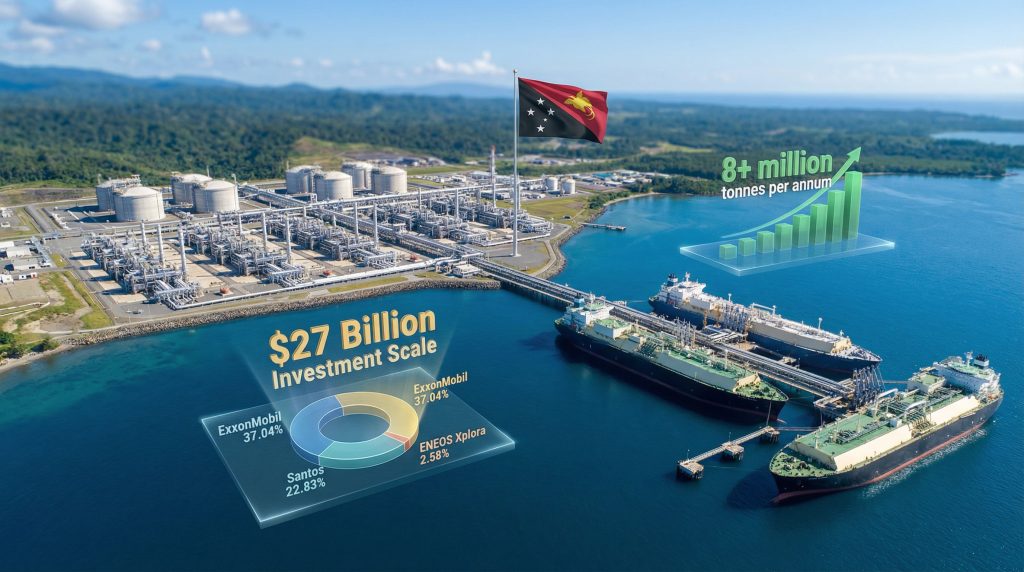
The Santos LNG Papua New Guinea project operates through a carefully structured joint venture arrangement that balances capital efficiency, risk distribution, and operational expertise. Santos maintains a 22.83% equity stake in the development, positioning itself as a significant participant while limiting individual capital exposure compared to operator-led models.
Partnership Dynamics and Equity Distribution Analysis
| Partner | Ownership Stake | Primary Role | Strategic Contribution |
|---|---|---|---|
| ExxonMobil | ~37.04% | Project Operator | Engineering, construction oversight, operations management |
| Santos Limited | ~22.83% | Joint Venture Partner | Technical expertise, regional knowledge |
| JX Nippon | ~26.4% | Offtake Partner | Asian market access, customer relationships |
| ENEOS Xplora | ~2.58% | Technology Partner | Innovation integration, regional partnerships |
| Papua New Guinea Interests | Variable | Government/Community | Local content, regulatory liaison |
This partnership structure enables Santos to participate in a tier-one LNG development while maintaining capital discipline. The minority stake reduces Santos' direct capital requirements by approximately 60-65% compared to full operator models, while providing access to ExxonMobil's global LNG development expertise and standardised engineering practices.
Strategic Benefits of Minority Partnership Model
The joint venture framework delivers multiple strategic advantages for Santos:
Risk Distribution: ExxonMobil's role as operator absorbs primary execution risk, including construction management, regulatory compliance, and commissioning responsibilities. This structure allows Santos to focus on commercial optimisation and portfolio integration.
Technical Knowledge Transfer: Participation in ExxonMobil's integrated project delivery model provides Santos with exposure to advanced LNG technologies, including electric drive liquefaction systems and modular construction methodologies. In addition, these capital raising strategies enable efficient project financing through diversified partnership models.
Market Access Enhancement: The partnership with Japanese entities JX Nippon and ENEOS Xplora facilitates direct relationships with Asian LNG buyers, supporting long-term offtake agreements and premium pricing negotiations.
"Minority partnerships in major LNG developments enable mid-tier energy companies to participate in world-class projects while maintaining capital flexibility for additional growth opportunities."
What Are the Technical Specifications and Development Timeline for Papua LNG?
The Santos LNG Papua New Guinea project incorporates advanced liquefaction technology designed to optimise efficiency while integrating with existing PNG LNG infrastructure. The development consists of two liquefaction trains with combined capacity of approximately 5.2-5.4 million tonnes per annum, utilising electric drive systems rather than traditional gas turbine configurations.
Engineering Design and Capacity Planning
Technical Configuration:
• Liquefaction Process: Propane pre-cooled, mixed refrigerant (MR) cycle utilising proven industry technology
• Drive Systems: Electric drive compressors reducing fuel gas consumption and emissions intensity
• Modular Construction: Factory-fabricated modules minimising on-site assembly time and quality risks
• Infrastructure Integration: Shared utilities, storage, and loading facilities with existing PNG LNG operations
The electric drive specification represents significant advancement in LNG processing technology, delivering:
• Reduced greenhouse gas emissions per unit of LNG produced compared to gas turbine systems
• Improved operational flexibility and part-load efficiency during varying demand conditions
• Lower fuel consumption eliminating self-generation gas losses typical in gas-turbine configurations
• Integration potential with renewable energy sources as PNG grid decarbonisation progresses
Construction Methodology and Execution Strategy
ExxonMobil's integrated project delivery model utilises modular construction approaches proven on previous LNG developments:
-
Pre-fabrication Phase: Equipment modules constructed in specialised fabrication yards with controlled quality conditions
-
Parallel Construction: Simultaneous wet and dry commissioning activities reducing overall project timeline
-
Reduced Craft Labour: Minimised on-site assembly requirements through factory fabrication
-
Quality Assurance: Standardised procedures and testing protocols applied across all construction phases
Development Timeline Framework:
| Phase | Status | Duration | Key Milestones |
|---|---|---|---|
| Front-End Engineering | Completed (2020-2022) | 24 months | Design optimisation, cost estimation |
| Final Investment Decision | Pending | TBD | Market conditions, financing approval |
| Construction Execution | Post-FID | 4-5 years | Modular construction, commissioning |
| Commercial Operations | Target FY2028-29 | N/A | First LNG production |
The brownfield development approach enables cost advantages through shared infrastructure utilisation, with estimated cost per tonne capacity of $2,500-3,200 compared to $3,500-5,000 typical for greenfield projects according to Engineering News-Record cost indices.
How Does the $27 Billion Investment Scale Compare to Global LNG Projects?
The Santos LNG Papua New Guinea project's $27 billion total capital expenditure positions it within the mid-range of contemporary global LNG developments, while demonstrating competitive cost efficiency through brownfield integration advantages. This investment scale reflects the comprehensive scope including subsea infrastructure, liquefaction facilities, pipeline systems, and project development costs.
Capital Expenditure Benchmarking Analysis
Global LNG Project Cost Comparison:
| Project | Total Capex (USD billions) | Capacity (mtpa) | Cost per Tonne | Development Type |
|---|---|---|---|---|
| Papua LNG | $27.0 | 5.2-5.4 | $5,190 | Brownfield expansion |
| Gorgon LNG (Australia) | $54.0 | 15.0 | $3,600 | Greenfield (cost overruns) |
| Gladstone LNG (Australia) | $20.0 | 8.5 | $2,350 | Brownfield integration |
| Ichthys LNG (Australia) | $34.0 | 8.4 | $4,050 | Greenfield (overruns) |
| Arctic LNG 2 (Russia) | $27.0 | 18-20 | $1,400 | Greenfield (sanctions impact) |
The Papua LNG cost structure reflects several factors distinguishing it from pure greenfield developments:
• Standalone Infrastructure Requirements: Unlike phase expansions, Papua LNG requires dedicated processing facilities
• Integration Complexities: Coordinating new facilities with existing PNG LNG operations requires specialised engineering
• Inflation Adjustments: Current estimates reflect post-2020 cost escalation in materials and labour
• Contingency Provisions: Conservative estimates including 10-15% contingency for execution risks
Financing Structure and Risk Distribution
The $27 billion capital requirement can be structured through project financing mechanisms that reduce individual partner equity exposure:
Financing Framework Components:
• Project Debt: Non-recourse financing covering 50-60% of total capex supported by long-term LNG offtake agreements
• Partner Equity: Distributed according to ownership percentages with Santos contributing approximately $6.2-6.5 billion
• Bank Syndication: Multiple lender participation spreading individual institution risk exposure
• Export Credit Facilities: Potential government-backed financing for equipment and services
This structure enables Santos to maintain capital flexibility while participating in world-class LNG development, with project debt reducing direct equity requirements and providing leverage for enhanced returns.
What Are the Market Drivers Supporting Papua LNG Development?
Asian LNG demand fundamentals continue supporting large-scale LNG developments like the Santos LNG Papua New Guinea project, driven by industrial growth, energy security considerations, and transitional energy policies across major consuming nations. These market forces create sustained demand for additional LNG supply sources throughout the next decade, particularly given current natural gas price trends indicating market volatility.
Asian LNG Demand Fundamentals
Regional Import Statistics:
• Japan: 72.8 million tonnes LNG imports in 2023 (28% of global imports)
• South Korea: 32.4 million tonnes LNG imports in 2023 (12.5% of global imports)
• China: Continued industrial expansion requiring supplementary gas imports alongside domestic production
Japan's energy security priorities reflect ongoing nuclear capacity constraints following post-Fukushima safety protocols, maintaining LNG as a critical baseload and peaking fuel. South Korea's renewable energy transition policies targeting 45% non-fossil fuels by 2030 position LNG as the primary transitional fuel supporting grid stability during renewable integration.
China's industrial growth trajectory requires additional gas imports to support:
• Manufacturing sector expansion in high-value industrial segments
• Petrochemical feedstock demand for chemical and plastics production
• Urban heating requirements replacing coal-fired systems in major metropolitan areas
• Power generation flexibility supporting renewable energy intermittency management
Supply-Demand Gap Analysis
Global LNG capacity additions are projected to lag behind demand growth through the late 2020s, creating market tightness that supports new project developments:
Supply Constraints:
• Project Delays: Multiple proposed LNG developments experiencing financing or regulatory delays
• Geopolitical Factors: Sanctions and trade restrictions limiting supply from certain regions
• Cost Escalation: Higher development costs reducing project economics and delaying final investment decisions
• Environmental Regulations: Increasing emissions standards requiring additional capital investments
Demand Growth Drivers:
• Energy Security Policies: Asian governments prioritising supply diversification
• Coal Replacement: Industrial and power sectors transitioning from higher-emission fuels
• Economic Growth: GDP expansion in developing Asian economies increasing energy consumption
• Gas-to-Power Development: New gas-fired power capacity supporting renewable integration
The International Energy Agency's Asia Pacific Energy Security 2024 report confirms that regional LNG demand is expected to grow by 3-4% annually through 2030, supporting long-term contract opportunities for new supply projects.
How Do Environmental and Social Considerations Impact Project Development?
The Santos LNG Papua New Guinea project operates within comprehensive environmental and social governance frameworks that address climate impact reduction, community engagement, and sustainable development objectives. These considerations increasingly influence project approval, financing availability, and market acceptance among environmentally conscious LNG buyers, particularly as decarbonisation benefits become more prominent in energy sector planning.
Environmental Management Framework
Emissions Reduction Technologies:
The project incorporates several environmental performance enhancements:
• Electric Drive Systems: Eliminating gas turbine emissions from liquefaction compressors
• Energy Efficiency Optimisation: Advanced process design minimising energy consumption per unit of LNG produced
• Carbon Monitoring: Digital systems tracking and reporting emissions across all operational phases
• Integration Benefits: Shared utilities reducing incremental environmental footprint compared to standalone facilities
These environmental considerations align with increasingly stringent buyer requirements for lower-carbon LNG supplies, particularly from Japanese and European offtakers implementing sustainability criteria in procurement decisions.
Environmental Performance Metrics:
| Environmental Factor | Papua LNG Target | Industry Average | Performance Advantage |
|---|---|---|---|
| CO₂ Emissions per tonne LNG | 0.45-0.50 tonnes | 0.55-0.65 tonnes | 15-20% reduction |
| Energy Efficiency | 88-90% | 82-86% | 4-6 percentage points |
| Water Consumption | Optimised through sharing | Standard greenfield | 25-30% reduction |
Community Engagement and Local Content Requirements
Papua New Guinea government participation through the Mineral Resources Development Company (MRDC) ensures alignment with national development objectives:
Local Content Initiatives:
• Employment Programmes: Training and employment priorities for Papua New Guinea nationals
• Infrastructure Development: Community infrastructure investments including roads, utilities, and social facilities
• Economic Participation: Local business development and procurement opportunities
• Revenue Sharing: Government participation providing direct economic benefits to PNG communities
These social considerations support project acceptance and regulatory approval while contributing to sustainable economic development in Papua New Guinea's energy sector regions.
The next major ASX story will hit our subscribers first
What Investment Implications Does Papua LNG Hold for Santos Shareholders?
The Santos LNG Papua New Guinea project represents a significant portfolio expansion that enhances geographic diversification, provides exposure to premium Asian LNG pricing, and supports long-term cash flow generation for Santos shareholders. The project's scale and partnership structure create multiple value creation pathways while maintaining capital discipline, particularly given current energy export challenges facing Australian companies.
Financial Impact Modeling
Production and Revenue Projections:
Based on Santos' 22.83% equity stake, the company's attributable production from Papua LNG is estimated at:
• Annual LNG Production: 1.2-1.3 million tonnes per annum attributable to Santos
• Revenue Contribution: Dependent on long-term contract pricing and spot market conditions
• Cash Flow Generation: Estimated 15-20 year production profile supporting dividend sustainability
• Portfolio Integration: Complements existing Santos LNG assets in Australia including Gladstone LNG and Barossa developments
The project provides Santos with:
-
Geographic Diversification: Reducing dependence on Australian domestic gas market conditions
-
Pricing Optimisation: Access to premium Asian LNG pricing mechanisms including oil-linked and Henry Hub-plus contracts
-
Operational Knowledge: Experience in international LNG development and operations
-
Growth Platform: Potential for additional PNG gas resource development
Strategic Portfolio Enhancement
Risk Management Benefits:
The Papua LNG investment enhances Santos' risk profile through:
• Regulatory Diversification: Exposure to PNG regulatory framework reducing Australian policy concentration
• Market Access Expansion: Direct relationships with Asian LNG buyers through joint venture partnerships
• Technical Capability Development: Access to advanced LNG technologies and operational practices
• Revenue Stream Stability: Long-term contracts providing predictable cash flow generation
Capital Allocation Efficiency:
| Investment Metric | Papua LNG Impact | Portfolio Benefit |
|---|---|---|
| Capital Efficiency | $6.2-6.5B Santos investment | 22.83% of $27B total capex |
| Production Growth | 1.2-1.3 mtpa attributable | 15-20% increase in LNG portfolio |
| Market Diversification | PNG operations | Reduced Australia concentration |
| Partnership Benefits | ExxonMobil operator expertise | Risk reduction and knowledge transfer |
"Papua LNG provides Santos shareholders with leveraged exposure to Asian LNG market growth while maintaining capital discipline through minority partnership structure."
What Are the Key Risk Factors and Market Uncertainties?
Investment in the Santos LNG Papua New Guinea project involves multiple risk categories that potential investors must evaluate, ranging from execution risks during construction to long-term market and regulatory uncertainties. Understanding these risk factors enables informed investment decision-making.
Project Execution and Construction Risks
Primary Risk Categories:
• Cost Escalation: Potential for construction cost increases due to inflation, labour shortages, or scope changes
• Schedule Delays: Weather, logistics, or technical challenges extending construction timeline
• Technology Performance: Electric drive systems and integration complexities requiring proven operational reliability
• Regulatory Changes: Modifications to PNG government policies, taxation, or environmental requirements
Risk Mitigation Strategies:
• Experienced Operator: ExxonMobil's track record in complex LNG developments
• Modular Construction: Factory fabrication reducing on-site risks and weather exposure
• Proven Technology: Utilisation of established LNG processes and equipment specifications
• Government Partnerships: PNG state participation aligning national and commercial interests
Market and Commercial Risk Assessment
LNG Market Volatility:
Long-term LNG market conditions affect project economics through:
• Pricing Mechanisms: Oil-linked contracts subject to crude oil price volatility
• Supply Competition: New LNG projects potentially affecting pricing and contract terms
• Demand Growth Uncertainty: Economic conditions in Asian markets influencing LNG consumption
• Alternative Energy Competition: Renewable energy cost reductions potentially affecting gas demand
Financial Structure Risks:
• Interest Rate Exposure: Project financing costs sensitive to global interest rate environments
• Currency Fluctuations: USD-denominated contracts versus AUD operational costs for Santos
• Partner Performance: Joint venture partner financial stability and commitment levels
• Financing Availability: Capital market conditions affecting project finance execution
Strategic Outlook: Papua LNG's Role in Regional Energy Security
The Santos LNG Papua New Guinea project contributes to broader regional energy security objectives while positioning Australia and Papua New Guinea as reliable LNG suppliers to Asian markets. This strategic context supports long-term project viability and market acceptance among offtake partners prioritising supply chain resilience.
Long-term Market Positioning
Regional Supply Chain Resilience:
Papua LNG enhances energy security through:
• Democratic Supply Sources: Stable political frameworks supporting long-term contract reliability
• Geographic Diversification: Alternative supply routes reducing dependence on single transportation corridors
• Technical Standards: International quality and safety standards meeting buyer requirements
• Operational Flexibility: Brownfield integration enabling responsive production management
Australia-PNG Energy Cooperation:
The project strengthens bilateral energy relationships:
• Technical Collaboration: Knowledge transfer and capacity building in PNG energy sector
• Economic Integration: Australian investment supporting PNG economic development
• Regional Leadership: Demonstrating collaborative approaches to energy development
• Market Development: Joint participation in Asian LNG market expansion
Technology Innovation and Operational Excellence
Next-Generation LNG Technology:
Papua LNG incorporates several technological advancements:
• Digital Monitoring Systems: Advanced process control and predictive maintenance capabilities
• Emissions Reduction Technology: Electric drive systems and efficiency optimisation
• Modular Design Innovation: Factory fabrication and rapid deployment methodologies
• Integration Optimisation: Shared infrastructure maximising existing asset utilisation
Future Development Potential:
The Papua LNG platform creates opportunities for:
• Additional Train Development: Expansion potential based on market conditions and resource availability
• Carbon Capture Integration: Future implementation of emissions reduction technologies
• Renewable Energy Integration: Potential grid connection supporting lower-carbon operations
• Regional Hub Development: Platform for additional PNG gas resource development
Disclaimer: This analysis contains forward-looking statements and projections based on current market conditions, technical specifications, and regulatory frameworks. Actual project performance, costs, timeline, and commercial outcomes may differ materially from estimates presented. Investment decisions should be based on comprehensive due diligence and professional financial advice.
The Santos LNG Papua New Guinea project represents a significant strategic development in the Asia-Pacific LNG sector, combining technical innovation, partnership expertise, and market-driven economics to create long-term value for stakeholders while supporting regional energy security objectives. Success depends on effective execution, favourable market conditions, and continued alignment between commercial and government interests across multiple jurisdictions.
Looking to capitalise on Australia's energy sector developments?
Discovery Alert's proprietary Discovery IQ model delivers real-time notifications on significant ASX mineral and energy discoveries, enabling investors to identify actionable opportunities in the evolving energy transition landscape before broader market recognition. Start your 30-day free trial today to gain immediate access to comprehensive discovery intelligence and position yourself ahead of market developments in Australia's dynamic resources sector.