Patagonia Lithium Ltd
Patagonia Lithium Delivers Breakthrough Flow Test Results at Formentera Project
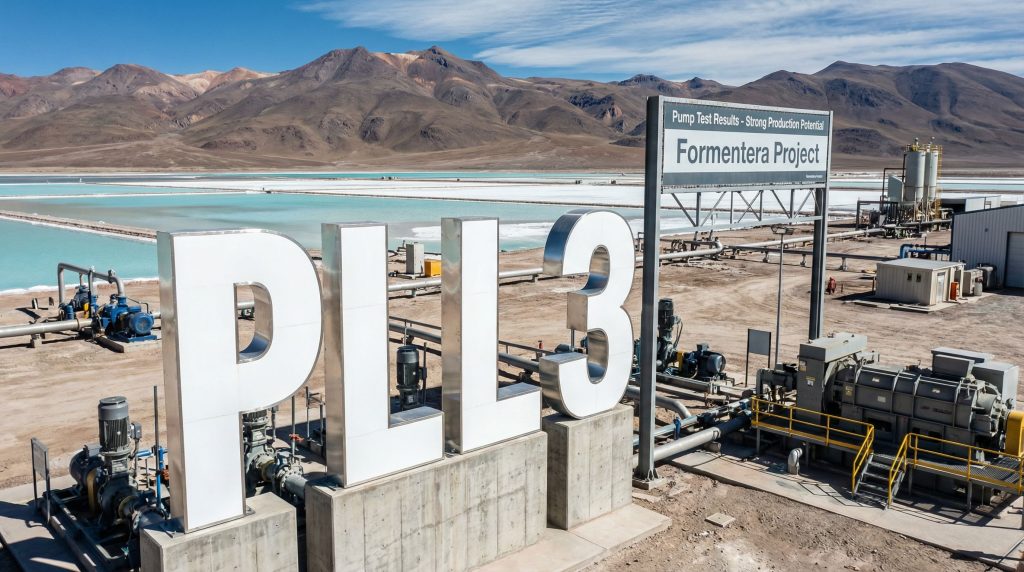
Patagonia Lithium Ltd (ASX:PL3) has delivered exceptional Patagonia Lithium pump test results from well JAM26-06 at its Formentera lithium brine project in Argentina. The testing demonstrates the aquifer's robust production potential and hydraulic connectivity across the project area.
The 72-hour continuous pump test extracted 225,325 litres through a small 19mm hose at an average rate of 3,206 litres per hour. These results provide critical validation of the project's commercial viability and set the stage for scaled production operations.
When big ASX news breaks, our subscribers know first
Pump Test Delivers Commercial-Scale Flow Rates
The comprehensive testing programme revealed several key performance indicators that exceed expectations for lithium brine operations. These Patagonia Lithium pump test results demonstrate the aquifer's capacity to support commercial extraction rates required for the company's planned demonstration plant.
Flow Performance Metrics:
- Total volume pumped: 225,325 litres over 72 hours
- Average flow rate: 3,206 L/h through 19mm diameter hose
- Target production rate: 13,500 L/h per production well (21cm diameter)
- Brine specific gravity: 1.10 g/cm³ indicating high total dissolved solids
- Conductivity: 160 mS/cm suggesting strong lithium content
The test demonstrated increasing flow rates as brine mobilised within the aquifer, indicating excellent reservoir characteristics. Water levels in adjacent wells JAM24-01 and JAM24-02 dropped during pumping, confirming hydraulic connectivity across the field.
Furthermore, the results validated the persistence of high porosity zones throughout the testing area. This connectivity proves essential for commercial-scale operations.
Recovery Performance Metrics
The aquifer demonstrated exceptional recovery characteristics following the test completion. Water level recovered from 16.7m to 8.5m depth within one hour post-shutdown.
Sharp initial drawdown occurred from 1.94m to 12.5m within minutes of startup. Subsequently, stabilisation at 16.7m was achieved after 12 hours of continuous pumping.
Executive Chairman Phil Thomas commented: "These pump results are great news. 3,200L an hour through a small hose means we will be on target for 13,500L/hour in each demonstration plant (1,000t Li₂CO₃) production well which is specified to be 21cm diameter. The recharge flow rate in the well showed the connectivity of the aquifers and the significant amount of lithium brine in the project."
Understanding Lithium Brine Aquifer Testing
What are pump tests and why do they matter?
Pump tests are critical engineering assessments that determine the commercial viability of lithium brine projects. By continuously extracting brine from a well over extended periods (typically 24-72 hours), operators can measure several key factors that directly impact project economics.
The Patagonia Lithium pump test results provide essential data on sustainable flow rates. These indicate how much brine can be extracted without depleting the aquifer. Additionally, these tests measure aquifer connectivity and recovery rates.
Key Performance Indicators
Successful pump tests evaluate multiple technical parameters that determine project feasibility. Sustainable flow rates measure volume of brine extraction without aquifer depletion. Aquifer connectivity determines whether brine deposits extend across multiple wells.
Recovery rates show how quickly water levels return after pumping stops. Porosity and permeability indicate ease of brine flow through rock formations.
For instance, investors benefit as successful pump tests de-risk lithium projects by proving sufficient volumes of lithium-rich brine can be economically extracted. This brine is then processed into battery-grade lithium carbonate.
Technical Terms Explained
Drawdown refers to the drop in water level during pumping operations. Specific gravity provides density measurement indicating dissolved mineral content.
Conductivity offers electrical measurement correlating to lithium concentration. Hydraulic connectivity describes physical connection between separate wells through underground aquifer systems.
Strategic Milestones and Development Timeline
The successful pump test accelerates Patagonia's development timeline toward its 1,000 tonne lithium carbonate demonstration plant. The company has outlined six critical near-term milestones advancing the project from exploration to production readiness.
Immediate Technical Programmes
The company will commence BMR Gamma porosity survey on well JAM26-06. A 7km seismic survey will map subsurface geology. Commencement of drilling well JAM26-07 follows immediately.
Development & Resource Activities
Packer tests and assays from JAM26-07 will provide additional validation. Mineral Resource Estimate update from Atacama Water Consultants is scheduled. Shaker tests for pilot plant preparation using Ekosolve™ solvent exchange technology will commence.
The company's systematic approach combines geological validation with engineering testing. This positions it for rapid advancement toward commercial production. Well JAM26-07 coordinates are already defined (X: 707749.913, Y: 7412302.867).
Consequently, drilling operations can commence immediately following completion of current technical programmes.
Investment Thesis: Proven Flow Rates Support Commercial Potential
| Performance Metric | JAM26-06 Results | Target Production Wells |
|---|---|---|
| Flow rate (L/h) | 3,206 | 13,500 |
| Hose/well diameter | 19mm | 21cm (210mm) |
| Scaling factor | Base case | 12x larger diameter |
The Patagonia Lithium pump test results provide compelling validation of the company's 551,400 tonne LCE resource at 294mg/L lithium concentration. The demonstrated flow rates through a narrow 19mm hose suggest production wells with 21cm diameters could achieve targeted extraction rates.
These target rates of 13,500 L/h are required for the 1,000 tonne demonstration plant.
Key Investment Drivers
Proven aquifer connectivity across multiple wells reduces geological risk. High porosity zones confirmed through rapid water level recovery support commercial viability.
Scalable extraction rates support commercial production targets. Strategic location in Argentina's established lithium triangle provides infrastructure advantages.
Moreover, established resource base of 551,400t LCE provides development runway. The combination of strong flow rates, aquifer connectivity, and rapid recovery positions Formentera favourably.
These characteristics place it among the more promising lithium brine developments in South America's proven lithium triangle region.
Capital Structure and Project Portfolio
Current Capital Structure
The company maintains 207.1 million ordinary shares on issue. Additionally, 23.4 million unquoted options and 25.0 million unquoted performance rights are outstanding.
Project Portfolio Highlights
Formentera/Cilon encompasses 19,500 hectares in Salar de Jama, Jujuy Province. Tomas III covers 580 hectares at Incahuasi Salar, Salta Province.
Brazil concessions span 41,746 hectares exploring REE clays, phosphates, niobium, antimony and lithium pegmatites.
The diversified portfolio provides multiple value creation pathways. The Brazilian concessions are positioned adjacent to CMOC's major niobium operation producing 10,024 tonnes annually.
This positioning offers potential synergies and infrastructure advantages as the company develops its South American projects.
Technical Validation Through Systematic Testing
The pump test programme represents a systematic approach to validating the Formentera project's commercial potential. JAM26-06 demonstrated several critical performance characteristics supporting the technical case for demonstration plant construction.
Aquifer Performance Indicators
Rapid drawdown response within minutes of pump startup confirms aquifer responsiveness. Stable flow rates after 12 hours indicate sustainable extraction potential.
Fast recovery to 8.5m depth within one hour demonstrates robust recharge capacity. Cross-well connectivity proven through water level impacts in adjacent wells validates field-wide aquifer systems.
The brine quality indicators also support commercial viability. Specific gravity of 1.10 g/cm³ indicates substantial dissolved solids content. Conductivity readings of 160 mS/cm suggest significant lithium concentrations.
These parameters align with expectations for commercial lithium brine operations.
Testing Methodology
The testing methodology followed industry best practices. Continuous 72-hour operation provided sufficient duration to assess aquifer response and recovery characteristics.
Two samples were collected for laboratory analysis at both Alex Stewart and SGS facilities. This ensures quality control and validation of brine chemistry.
The next major ASX story will hit our subscribers first
Why Investors Should Track Patagonia Lithium
The successful JAM26-06 pump test represents a pivotal validation moment for Patagonia Lithium's development strategy. The company has systematically de-risked its flagship Formentera project through six completed drill holes and comprehensive geophysics.
Now, proven aquifer performance through these critical Patagonia Lithium pump test results provides additional confidence.
Compelling Investment Catalysts
Technical validation through successful pump testing reduces execution risk significantly. Resource expansion potential exists with 319% increase in July 2025 MRE update planned.
Clear development pathway toward 1,000 tonne demonstration plant is established. Experienced management team led by qualified competent person Phil Thomas provides leadership.
Strategic project positioning in Argentina's proven lithium triangle offers infrastructure and regulatory advantages.
The combination of proven flow rates, expanding resource base, and systematic development approach positions Patagonia as a serious contender. The company demonstrates potential in the global lithium supply chain.
However, multiple technical milestones are planned over coming months. Investors have clear catalysts to monitor as the company advances toward commercial production.
The pump test results validate technical assumptions underlying the company's development strategy. This provides confidence in scalability from exploration to production.
Management's target of 13,500 L/h per production well appears achievable based on demonstrated performance through a significantly smaller diameter extraction system.
Key Takeaway: The Patagonia Lithium pump test results have proven the Formentera project can deliver commercial-scale flow rates, validating the technical and commercial potential of its 551,400 tonne LCE resource. With systematic development milestones ahead and proven aquifer connectivity, the company deserves close investor attention as it advances toward demonstration plant construction.
Ready to Capitalise on the Next Lithium Discovery?
Discovery Alert's proprietary Discovery IQ model delivers real-time alerts on significant lithium discoveries across the ASX, instantly empowering subscribers to identify actionable opportunities ahead of the broader market. Begin your 14-day free trial today and secure your market-leading advantage in the rapidly evolving battery metals sector.