
August 14, 2026
Understanding the Pax Silica Framework and Its Silicon-Based Economic Architecture
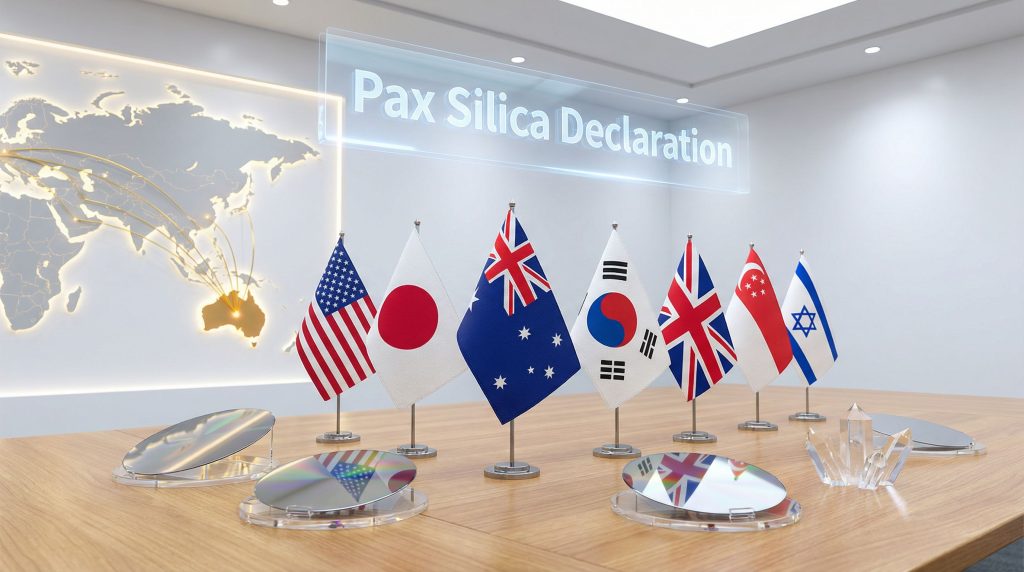
The Pax Silica Declaration establishes a comprehensive framework for securing silicon-based supply chains across seven allied nations. Australia signs Pax Silica declaration alongside the United States, Japan, Republic of Korea, United Kingdom, Singapore, and Israel to create an integrated approach to semiconductor and AI infrastructure resilience. This non-binding commitment addresses multiple layers of technological sovereignty, from raw material extraction through advanced manufacturing processes.
The framework operates on several interconnected principles that distinguish it from traditional trade agreements. Rather than focusing solely on commodity exchange, the declaration integrates critical minerals sourcing, semiconductor fabrication security, AI infrastructure protection, and energy system resilience into a unified approach. This holistic methodology acknowledges that modern technology supply chains cannot be secured through isolated interventions in single sectors.
Critical minerals form the foundation of this silicon-based economic security model. The declaration specifically targets minerals essential for semiconductor fabrication, including silicon, rare earth elements, gallium, germanium, cobalt, and nickel. These materials require specialized extraction, processing, and refining capabilities that are currently concentrated in limited geographic regions, creating potential supply chain vulnerabilities.
Transportation logistics and processing infrastructure receive equal emphasis within the Pax Silica framework. The declaration recognizes that raw material access means little without secure transportation corridors, advanced processing facilities, and redundant supply chain pathways. This integrated approach addresses lessons learned from the 2020-2022 global semiconductor shortage, which disrupted automotive, consumer electronics, and industrial manufacturing sectors worldwide.
Energy infrastructure requirements represent another critical component of the framework. Semiconductor manufacturing and AI systems demand enormous amounts of reliable electricity, making energy security integral to technological sovereignty. Furthermore, the declaration incorporates renewable energy mandates, grid stability requirements, and carbon footprint reduction targets as essential elements of supply chain resilience.
The non-binding nature of the declaration allows for flexible implementation while maintaining political commitment among signatories. This structure enables rapid adaptation to evolving technological requirements and geopolitical circumstances without requiring lengthy treaty ratification processes. However, the framework includes compliance incentives and peer pressure mechanisms to ensure substantive implementation despite its voluntary character.
When big ASX news breaks, our subscribers know first
Australia's Strategic Position in Global Critical Minerals Diplomacy
Australia's participation in the Pax Silica Declaration builds upon an extensive network of bilateral critical minerals agreements established throughout 2025. The country signed separate agreements with the United States and Canada while advancing key partnerships with Japan, the United Kingdom, and the European Union. This multilateral approach demonstrates a deliberate strategy of creating overlapping partnership networks rather than relying on single-nation relationships.
The strategic timing reflects Australia's recognition of its comparative advantages in critical minerals extraction and processing. Australia possesses significant domestic reserves of silicon and quartz, established rare earth processing capabilities, and geographic positioning that facilitates Asia-Pacific technology manufacturing integration. These natural endowments, combined with advanced mining expertise and stable political institutions, position Australia as an essential partner for democratic allies seeking supply chain diversification.
Australian government officials emphasise that participation reflects an approach to building on the country's comparative strengths in critical minerals, artificial intelligence, and critical technologies. This positioning acknowledges that Australia's role extends beyond raw material supply to encompass advanced processing, technology development, and regional coordination functions within the broader alliance framework.
The integration of existing frameworks enhances Australia's strategic value within the Pax Silica alliance. AUKUS defence collaboration, Quad technology partnerships, and Five Eyes intelligence sharing provide complementary mechanisms that strengthen the overall effectiveness of critical minerals cooperation. This layered approach creates multiple channels for coordination while reducing dependence on any single institutional arrangement.
Consequently, Australia's critical minerals reserve offers additional strategic advantages for semiconductor manufacturing and AI infrastructure development. The country's expanding solar and wind capacity supports the enormous electricity demands of advanced manufacturing, while hydrogen production potential could revolutionise industrial processing methods. These energy capabilities become increasingly valuable as alliance partners seek to establish resilient, low-carbon supply chains.
Regional partnership opportunities emerge from Australia's position as a trusted intermediary between Western allies and Asia-Pacific nations. Countries like Indonesia, Vietnam, and India possess critical mineral resources or processing capabilities that could enhance overall alliance resilience. Australia's diplomatic relationships and geographic proximity enable it to facilitate broader regional integration whilst maintaining security standards.
Technology Infrastructure Security and Supply Chain Protection Mechanisms
The Pax Silica framework establishes comprehensive security requirements for technology infrastructure across multiple domains. ICT systems protection encompasses fibre optic cable networks, while data centre resilience standards address both physical security and data sovereignty considerations. These requirements reflect recognition that modern supply chains depend entirely on secure information systems and communications networks.
Semiconductor manufacturing facility security protocols form a critical component of the infrastructure protection framework. These facilities represent enormous capital investments, typically ranging from $10 billion to $20 billion per advanced fabrication plant, and contain highly sensitive intellectual property. The declaration establishes coordinated security standards that protect against both physical threats and cyber intrusions while facilitating technology transfer among alliance partners.
AI infrastructure protection mechanisms address the unique vulnerabilities of machine learning systems and large-scale computational facilities. These systems require massive data storage capabilities, specialised processing hardware, and continuous network connectivity. The framework develops standardised cybersecurity protocols, data residency requirements, and intellectual property safeguards that enable secure collaboration while preventing unauthorised access.
Supply chain provenance tracking represents a fundamental element of the security architecture. Alliance partners must implement comprehensive traceability systems that document the origin, processing history, and transportation pathways of critical components. This capability enables rapid identification of compromised materials or facilities while providing transparency for alliance coordination purposes.
Physical security protocols extend beyond traditional facility protection to encompass transportation security, personnel vetting, and emergency response procedures. Critical minerals transportation requires specialised handling due to the strategic value of these materials and potential environmental hazards. The framework establishes secure transportation corridors and redundant routing options that maintain supply continuity even during regional disruptions.
Emergency supply chain activation procedures provide coordinated response mechanisms for various disruption scenarios. These protocols define trigger points for emergency coordination, resource allocation procedures, and communication channels among alliance partners. The framework anticipates disruptions ranging from natural disasters and infrastructure failures to geopolitical escalations and cyber attacks.
Alliance Composition and Strategic Rationale Behind Partner Selection
The seven-nation composition of the Pax Silica alliance reflects careful strategic calculation based on complementary capabilities and shared democratic values. The United States serves as the convening nation and primary technology driver, leveraging its dominance in semiconductor design, AI software development, and research funding. American companies control the majority of advanced chip design capabilities while providing the largest market for semiconductor products globally.
Japan's participation brings essential semiconductor manufacturing expertise through companies like Tokyo Electron and Sony Semiconductor, making it the world's second-largest semiconductor equipment producer. Japan also contributes advanced optics and fibre technology manufacturing capabilities that are essential for communications infrastructure. The country's experience with rare earth processing, despite limited domestic reserves, provides valuable technical knowledge for alliance partners.
Republic of Korea contributes world-leading memory chip production through Samsung Electronics and SK Hynix, which together control approximately 70% of global DRAM production. Korean expertise in advanced display technologies and consumer electronics manufacturing complements the alliance's broader technological capabilities. The country's experience with rapid industrialisation provides valuable insights for developing critical minerals processing infrastructure.
United Kingdom's role extends beyond traditional manufacturing to encompass financial services, advanced research institutions, and semiconductor design architecture. Arm Holdings, despite its recent acquisition by SoftBank, remains headquartered in the UK and licences fundamental processor architectures used in mobile devices and emerging AI chips. British universities contribute essential research capabilities in materials science and advanced manufacturing processes.
Singapore's strategic position as Southeast Asia's primary semiconductor assembly and testing hub makes it an essential logistics and manufacturing partner. The city-state processes approximately 11% of global semiconductor testing and serves as a critical transportation node for Asia-Pacific supply chains. Singapore's regulatory sophistication and financial sector capabilities facilitate investment coordination across the alliance.
Israel's contributions centre on cybersecurity expertise, advanced semiconductor design, and intelligence capabilities. Israeli companies lead development of specialised chips for autonomous vehicles, defence applications, and AI acceleration. The country's experience with technology security under constant threat provides valuable expertise for protecting critical infrastructure and intellectual property.
Notable absences from the initial signatory list reflect both geopolitical sensitivities and strategic considerations. Taiwan, despite producing approximately 63% of global semiconductors and 90% of advanced chips, cannot participate due to diplomatic constraints with China. However, Taiwan's capabilities are likely integrated through bilateral US-Taiwan relationships and Japanese coordination mechanisms.
Canada's absence appears tactical rather than strategic, given the country's significant critical minerals resources and existing bilateral agreement with Australia. Canadian companies produce substantial quantities of lithium, cobalt, and nickel essential for battery technologies and semiconductor manufacturing. Future expansion to include Canada seems probable given North American integration imperatives.
European Union member states participated individually rather than as a collective bloc, suggesting potential future harmonisation under unified European participation. Germany, France, and the Netherlands possess advanced manufacturing capabilities and semiconductor equipment production that would strengthen the alliance. The individual state model may reflect EU institutional constraints rather than lack of strategic interest.
Economic Impact and Business Opportunities for Australian Industry
The Pax Silica Declaration creates substantial market access opportunities for Australian critical minerals producers through preferential purchasing arrangements and long-term supply agreements. Alliance partners have committed to prioritising sourcing from member nations, potentially capturing market share currently held by non-allied suppliers. This preference system could generate billions of dollars in additional revenue for Australian mining companies while providing price stability through extended contract terms.
Rio Tinto's attendance at the Pax Silica summit exemplifies how major Australian mining producers are directly engaging with alliance implementation. The company's diversified critical minerals portfolio, including lithium, rare earths, and copper, positions it to benefit from increased demand across multiple semiconductor and AI infrastructure applications. Similar opportunities exist for other major producers with relevant mineral assets.
Joint venture frameworks enable partnerships between Australian mining companies and allied nation technology firms, creating opportunities for vertical integration and technology transfer. These partnerships could establish advanced processing facilities in Australia with international technology partners providing specialised expertise and equipment. Such arrangements would capture higher-value processing margins while reducing transportation costs and supply chain risks.
Research and development collaboration provides access to alliance-coordinated funding for critical minerals processing innovation. Australian universities and research institutions could participate in joint research programs with international partners, developing new extraction techniques, processing technologies, and recycling methods. These collaborations could generate intellectual property rights while strengthening Australia's technological capabilities.
Investment flows from alliance partners could accelerate critical minerals infrastructure development across Australia. In addition, Japanese, Korean, and American companies have demonstrated willingness to invest in Australian mining projects when strategic supply security justifies the expenditure. The Pax Silica framework provides additional investment incentives through reduced regulatory barriers and coordinated government support.
However, compliance requirements impose operational costs and administrative burdens on Australian businesses. Companies must implement enhanced security protocols, supply chain documentation systems, and cybersecurity standards that exceed typical commercial practices. These requirements necessitate workforce training, technology upgrades, and ongoing compliance monitoring that could impact profit margins.
Furthermore, the decarbonisation benefits present additional opportunities for Australian companies engaging with alliance partners. Coordinated government support mechanisms could reduce financing costs, accelerate customs procedures, and provide risk insurance for long-term supply contracts. These advantages could improve the competitiveness of Australian suppliers relative to non-alliance alternatives.
Strategic Challenges and Implementation Hurdles
Technical coordination challenges emerge from the need to harmonise standards and protocols across different regulatory systems and industrial practices. Each alliance member operates under distinct environmental regulations, safety standards, and quality control requirements that must be reconciled to enable seamless supply chain integration. This harmonisation process requires extensive negotiation and could delay implementation timelines.
Capacity building requirements present substantial financial and logistical challenges for expanding critical minerals processing capabilities. Establishing advanced refining facilities, semiconductor fabrication plants, and AI infrastructure requires multi-billion dollar investments and specialised technical expertise that may be scarce among alliance partners. The timeline for developing these capabilities could extend well beyond immediate supply chain security needs.
Geopolitical risks include potential retaliation from excluded nations, particularly China, which currently dominates critical minerals processing and rare earth refining. Chinese companies control approximately 80% of rare earth processing and 60% of lithium processing globally, creating significant leverage for potential economic retaliation against Pax Silica members. This dependency will require careful management during the transition to alternative supply chains.
World Trade Organization compliance considerations could complicate implementation of preferential purchasing arrangements and trade restrictions. The most favoured nation principle and non-discrimination requirements under WTO rules may conflict with alliance-specific trade preferences. Legal challenges from excluded nations could delay implementation or force modifications to the framework structure.
Cost allocation and burden-sharing among alliance members requires complex negotiations over infrastructure investments, research funding, and emergency response capabilities. Smaller alliance partners like Singapore and Israel have limited fiscal capacity relative to the United States and Japan, potentially creating imbalanced contribution requirements that could strain alliance cohesion.
Workforce development challenges emerge from the specialised skills required for advanced manufacturing and critical minerals processing. The alliance collectively faces shortages of materials engineers, semiconductor technicians, and cybersecurity specialists needed to operate secure supply chains. Training programs and immigration coordination will be essential for meeting staffing requirements.
The next major ASX story will hit our subscribers first
Future Expansion and Long-term Strategic Implications
The Pax Silica framework establishes implementation timelines extending through 2026 and beyond, with pilot project identification and resource allocation scheduled for the initial phase. Regulatory harmonisation and standards development represent ongoing processes that will evolve as technological requirements advance and geopolitical circumstances change. Performance measurement systems will track progress against supply chain diversification targets and security objectives.
Additional nation recruitment strategies focus on countries with complementary capabilities or strategic geographic positioning. For instance, India's lithium strategy and substantial critical minerals reserves make it a priority target for future expansion. Indonesia's nickel processing capabilities and Chile's lithium resources could strengthen alliance resilience while extending influence into additional regions.
Industry sector expansion beyond semiconductors and AI could encompass renewable energy technologies, electric vehicle batteries, and advanced materials manufacturing. These sectors share similar critical minerals requirements and supply chain vulnerabilities, suggesting natural opportunities for framework extension. Broader coverage would increase the economic benefits for alliance partners while creating additional leverage against non-allied suppliers.
Academic and research institution collaboration frameworks could accelerate technology development while strengthening human capital across alliance partners. Joint degree programs, researcher exchange initiatives, and shared laboratory facilities would build long-term relationships that extend beyond immediate commercial interests. These connections could prove especially valuable for maintaining alliance cohesion through changing political leadership.
Private sector engagement mechanisms require careful balance between government strategic objectives and commercial interests. Companies must receive sufficient incentives to justify compliance costs and operational changes whilst maintaining competitive dynamics that drive innovation. Public-private partnerships, risk-sharing arrangements, and regulatory streamlining could align commercial and strategic interests effectively.
Furthermore, the resources innovation expo highlights how industry events can facilitate collaboration between alliance partners. These platforms provide opportunities for technology transfer, partnership development, and coordination of research initiatives across the critical minerals sector.
The declaration's long-term implications extend far beyond supply chain security to encompass fundamental changes in global economic relationships. The framework represents an early example of economic security alliances that integrate trade, technology, and defence considerations into unified partnerships. Success could inspire similar arrangements in other sectors while failure might discourage future attempts at coordinated supply chain management.
Australia signs Pax Silica declaration marks a pivotal moment in the country's approach to critical minerals diplomacy and technological sovereignty. The initiative demonstrates how democratic allies can coordinate responses to supply chain vulnerabilities while creating economic opportunities for domestic industries. However, success will depend on effective implementation, sustained political commitment, and adaptation to evolving geopolitical circumstances.
The initiative's focus on securing digital supply chains represents a recognition that technological sovereignty requires coordinated international action. As the seven signatory nations work to establish the framework's operational mechanisms, the broader implications for global technology competition and supply chain resilience will become increasingly apparent.
Moreover, analysis of the declaration's strategic implications suggests that this initiative could fundamentally reshape international cooperation in critical technology sectors. The success of Pax Silica may determine whether similar alliances emerge in other strategic industries, potentially creating a new paradigm for economic security partnerships among democratic nations.
Disclaimer: This analysis is based on publicly available information and should not be considered investment advice. Critical minerals markets involve significant risks, and supply chain partnerships may face implementation challenges that affect anticipated benefits. Readers should conduct independent research and consult qualified professionals before making investment or business decisions related to critical minerals or allied technology partnerships.
Interested in Critical Minerals Investment Opportunities?
Discovery Alert's proprietary Discovery IQ model delivers real-time alerts on significant critical minerals discoveries across the ASX, instantly empowering subscribers to identify actionable opportunities ahead of the broader market. Understand why major mineral discoveries can lead to substantial market returns by exploring Discovery Alert's dedicated discoveries page, showcasing historic examples of exceptional outcomes, and begin your 30-day free trial today to position yourself ahead of the market.