June 24, 2026
When Commodity Windfalls Meet Structural Failure: The Pemex Paradox
There is a particular kind of financial trap that no commodity price rally can unlock. It forms over decades, layer by layer, as underinvestment accumulates, debt compounds, and operational inefficiencies become embedded into the institutional DNA of a state enterprise. When a price surge finally arrives, the organisation discovers it lacks the productive capacity, balance sheet flexibility, and operational health to capture the windfall. This is precisely the scenario playing out with Mexico's Petroleos Mexicanos, and understanding why Pemex struggles despite the oil price surge requires examining forces that run far deeper than any crude benchmark.
When big ASX news breaks, our subscribers know first
The Numbers That Reveal a Deeper Crisis
At first glance, the global energy environment in early 2026 should have been transformative for Pemex. Crude oil prices climbed approximately 40% in recent months, driven by significant geopolitical disruptions, placing oil benchmarks well above the $100 per barrel threshold. For most major producers, this kind of pricing environment generates substantial free cash flow and balance sheet relief.
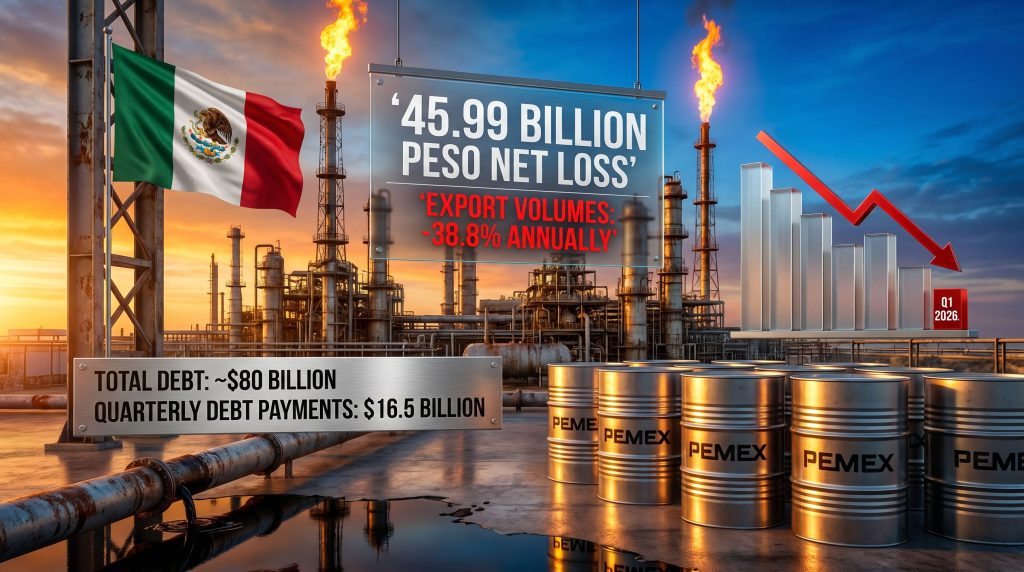
For Pemex, the opposite occurred. The company posted a net loss of 45.99 billion pesos in Q1 2026, its third consecutive quarterly loss. The divergence between rising prices and deteriorating financials is not a statistical anomaly; it is a direct reflection of compounding structural failures.
The data behind that loss is worth examining carefully:
- Total sales revenue declined by 7.6% year-on-year in Q1 2026
- Export revenues collapsed by 25.3% annually, driven overwhelmingly by volume reduction rather than pricing weakness
- Average crude export volumes fell to roughly 405,000 barrels per day, representing a 38.8% annual decline in throughput
- Average crude export prices actually improved by 5.2% year-on-year, confirming the problem lies in volume, not price
When a producer loses nearly 39% of its annual export volume, a 5% improvement in per-barrel pricing delivers only marginal relief. The mathematics of volume collapse are brutal and unforgiving.
The lesson embedded in these figures is critical for understanding how state-owned energy companies can become structurally decoupled from commodity market cycles. Price is a multiplier, not a foundation. If the base production and export volume is collapsing, a higher price multiplier applied to a shrinking base produces an even smaller revenue outcome than expected. Furthermore, oil market disruptions of this magnitude rarely resolve quickly, making volume recovery difficult to forecast with confidence.
Debt Mechanics: How $80 Billion Absorbs Every Windfall
Pemex's debt profile remains one of the most discussed and least fully appreciated dimensions of its financial predicament. As of Q1 2026, total debt stands at approximately $80 billion, which, while reduced to its lowest level in more than a decade, still represents one of the largest absolute debt burdens carried by any state-owned energy company in the world.
The quarterly debt servicing reality is even more confronting:
| Financial Metric | Q1 2026 Figure |
|---|---|
| Total Debt | ~$80 billion |
| Debt Payments (Q1 2026) | $16.5 billion |
| Net Loss (Q1 2026) | 45.99 billion pesos |
| Consecutive Quarterly Losses | 3 |
| Free Cash Flow | Negative |
Quarterly debt repayments of $16.5 billion effectively neutralised any revenue benefit from the oil price rally. This is the fundamental arithmetic of a debt trap: fixed repayment obligations consume cash flows before capital reaches operations, investment, or production development.
What makes this dynamic particularly severe is the concept of negative free cash flow, a condition where total cash outflows across operations, capital expenditure, and debt servicing consistently exceed cash inflows from core business activities. Moody's Ratings has assessed that this condition is expected to persist across the next 12 to 18 months absent a structural improvement in operating performance, meaning Pemex will remain dependent on extraordinary government financial support simply to meet its obligations during a period of historically elevated oil prices.
The Domestic Refining Trade-Off and Its Revenue Cost
One of the less widely understood dimensions of Pemex's revenue compression involves a deliberate policy choice rather than pure operational failure. The Mexican government has strategically prioritised domestic fuel self-sufficiency, directing a greater proportion of crude production toward domestic refining rather than export markets.
On the surface, this is a logical energy sovereignty objective. In practice, it creates a direct and measurable cost to Pemex's financial performance:
- Crude diverted to domestic refineries is crude unavailable for export at globally elevated prices
- Pemex's refining operations remain operationally inefficient, meaning the shift toward domestic processing does not generate proportional economic value
- The combination of reduced export volumes and low refining efficiency creates a double margin compression, where Pemex captures less upside from international prices while simultaneously extracting less value from the barrels it retains domestically
This creates a peculiar strategic contradiction. At the precise moment when global crude prices are at their most favourable, Pemex's policy-driven focus on domestic refining structurally limits how much of that price environment it can monetise through export channels.
Pemex's downstream operations serve a political objective of energy sovereignty, but the financial cost of doing so through inefficient refinery infrastructure is borne entirely by the company's already stressed balance sheet.
Moody's Rating Decision: Understanding What the Affirmation Actually Means
In May 2026, Moody's Ratings affirmed Pemex's B1 Corporate Family Rating and its 'ca' standalone credit strength while simultaneously downgrading Mexico's sovereign rating from Baa2 to Baa3, placing the country just one notch above sub-investment grade, commonly referred to as junk status.
The fact that Pemex avoided a parallel downgrade might initially suggest improving fundamentals. It does not. The affirmation rests entirely on one assumption: that the Mexican government will continue providing very high and timely financial support to the company, as demonstrated throughout 2025 and incorporated into Moody's forward-looking assumptions under the current administration.
The distinction between Pemex's standalone credit quality and its rating with government support is stark:
| Rating Dimension | Assessment |
|---|---|
| Standalone Credit Strength | 'ca' (near-default intrinsic quality) |
| Corporate Family Rating (CFR) | B1 (elevated due to government support overlay) |
| Outlook | Stable (contingent on support continuation) |
| Negative Free Cash Flow Horizon | 12 to 18 months minimum |
A 'ca' standalone assessment reflects a company that, without external intervention, would face severe financial distress. The B1 CFR exists above that level solely because of the government backstop assumption. This creates a structural dependency that is increasingly vulnerable as Mexico's own fiscal position deteriorates. In this respect, state oil company risks of this nature are not unique to Pemex, as comparable state-owned producers have demonstrated similar dependencies elsewhere.
Moody's explicitly identified the following risk factors that could trigger future downgrade action:
- A further downgrade of Mexico's sovereign credit rating
- Reduced government willingness or fiscal capacity to support Pemex
- Continued deterioration in upstream production performance
- Rising operational costs or renewed debt accumulation
- Intensifying liquidity pressures across the business
The stable outlook on Pemex's rating is not a signal of operational recovery. It is a conditional statement about government behaviour. The moment that assumption weakens, the rating trajectory changes immediately.
Production Stabilisation: Why Flat Is Not Recovery
Pemex has grappled with a multi-decade decline in oil and gas production, rooted in underinvestment in upstream infrastructure, aging field assets, and restricted private sector participation. Recent months have shown some signs of output stabilisation, however credit analysts have been explicit that this does not represent a structural reversal of the long-term decline.
Current field development programmes are assessed as unlikely to materially increase production over the medium term. This assessment carries profound financial implications:
- Stabilised production at reduced volumes generates less total revenue than historical output levels
- Flat production against growing debt servicing obligations creates an ongoing cash deficit
- Without genuine upstream growth, Pemex cannot generate the expanding free cash flow needed to simultaneously reduce debt, fund capital expenditure, and return fiscal value to the Mexican government
The private sector participation gap compounds this problem. Big oil companies have largely shunned Mexico as Pemex's difficulties have continued, unlike international peers who have used joint venture structures and production-sharing agreements to accelerate upstream development with private capital. This restricts the pace at which new reserves can be identified, developed, and brought into production.
Understanding Pemex's Position Among Global State-Owned Oil Companies
The severity of Pemex's situation becomes clearer when compared against broader national oil company benchmarks:
| Dimension | Pemex | Typical NOC Peer |
|---|---|---|
| Total Debt | ~$80 billion | Rarely exceeds $50 billion |
| Free Cash Flow | Negative | Positive in high-price environments |
| Production Trend | Declining / Stabilising | Mixed; many growing |
| Government Dependency | Very High | Moderate to High |
| Refining Efficiency | Low | Moderate to High |
| Standalone Credit | 'ca' (very weak) | Typically B to BB range |
Most comparable state-owned producers with equivalent sovereign backing can generate at least modest positive free cash flows during elevated-price environments. Consequently, Pemex's consistent failure to do so during a period of historically high crude prices underscores that its challenges are categorically structural rather than cyclical.
The next major ASX story will hit our subscribers first
Leadership Change and the Governance Risk Dimension
In May 2026, President Claudia Sheinbaum announced that CEO Víctor Rodríguez would be departing Pemex, with Chief Financial Officer Juan Carlos Carpio appointed to lead the company. The transition followed months of internal speculation and came against a backdrop of declining production, operational setbacks, and a significant oil spill earlier in the year.
Leadership instability at heavily indebted state enterprises carries specific credit market implications that are often underweighted by general observers:
- Unexpected executive transitions signal potential strategic uncertainty and unclear recovery priorities
- Credit agencies and institutional investors treat governance continuity as a proxy for operational reliability
- Frequent leadership changes at state-owned producers can delay the implementation of structural reforms already in progress
The oil spill earlier in 2026 added environmental liability exposure to an already complex financial picture. For a company generating negative free cash flow, unplanned remediation costs and regulatory penalties represent genuine material risks that cannot be absorbed without further pressure on an already strained balance sheet.
The Sovereign Feedback Loop: Mexico's Fiscal Position as a Risk Amplifier
Perhaps the most underappreciated systemic risk in the Pemex situation is the feedback loop between the company's credit dependency and Mexico's own sovereign fiscal trajectory. As Mexico's sovereign rating has been downgraded to Baa3, the government's own fiscal space is narrowing precisely when Pemex requires the most support.
This dynamic is further complicated by broader shifts toward a multi-polar world economy, where energy geopolitics and trade alliances are reshaping how state-owned producers are valued by international investors and credit markets alike. This creates a scenario where both parties face simultaneous financial pressure:
- Government injections into Pemex place direct strain on Mexico's public finances
- A deteriorating sovereign rating raises Mexico's own borrowing costs
- Higher sovereign borrowing costs reduce the fiscal capacity available to support Pemex
- Reduced support capacity risks triggering the Moody's downgrade conditions outlined above
The relationship between Pemex and the Mexican government is not simply one of benefactor and recipient. It is increasingly a shared credit risk that can amplify in both directions simultaneously.
What a Genuine Recovery Would Actually Require
For Pemex to materially improve its financial trajectory rather than simply stabilise its decline, analysts broadly identify a convergence of multiple conditions. However, the trade war economic impact on energy markets adds further uncertainty to any recovery timeline, as shifting trade policies could affect both export volumes and investor appetite for Mexican energy assets.
A genuine Pemex recovery would require:
- Sustained crude prices above $90 per barrel to generate meaningful revenue at current export volumes
- A genuine increase in crude export volumes through either production growth or a recalibration of the domestic refining policy priority
- Debt restructuring or refinancing to reduce near-term servicing obligations and redirect capital toward upstream reinvestment
- Material improvement in refining efficiency to generate higher economic value from domestically processed barrels
- Continued and expanded government financial support while structural reforms are implemented
- Accelerated upstream investment, potentially through revised frameworks for private sector participation
None of these conditions is individually sufficient. The Pemex struggles despite the oil price surge illustrate that the company requires simultaneous progress across multiple dimensions, making it one of the more complex financial recovery challenges in the global energy sector. Indeed, Q1 2026 results confirm that higher oil prices alone are categorically insufficient to lift a company whose structural deficiencies run this deep.
This article is intended for informational purposes only and does not constitute financial or investment advice. Forward-looking statements, forecasts, and credit assessments referenced herein reflect the views of third-party analysts and rating agencies at the time of publication and are subject to change. Readers should conduct independent research before making any investment decisions.
Want to Identify Mineral Discoveries Before the Broader Market Does?
Discovery Alert's proprietary Discovery IQ model delivers real-time alerts on significant ASX mineral discoveries, transforming complex geological data into actionable investment insights for both short-term traders and long-term investors — explore the historic returns major discoveries have generated and begin your 14-day free trial at Discovery Alert to position yourself ahead of the market.