
May 15, 2026
Mexico's fiscal landscape reflects deeper structural challenges that extend beyond typical government budget management. The convergence of declining oil revenues, aging energy infrastructure, and persistent state enterprise obligations creates a complex web of financial pressures that reshape how public resources flow through the economy. These dynamics operate independently of political cycles, driven instead by fundamental economic forces that require sustained attention from policymakers and investors alike. Furthermore, similar challenges are emerging across different regions, as evidenced by developments in canada energy transition initiatives and broader saudi energy licenses expansion.
What Makes PEMEX's 2025 Financial Support Historically Unprecedented?
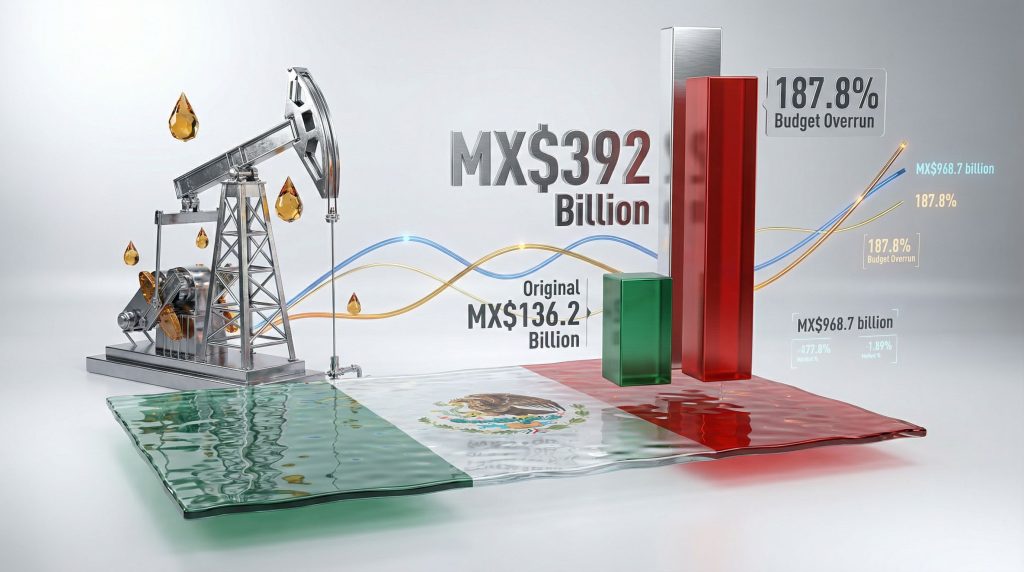
The scale of federal transfers to Mexico's national oil company during 2025 represents a watershed moment in the country's fiscal history. Record PEMEX transfers strain Mexico's finances as the government channelled MX$392 billion to the state-owned enterprise between January and November, according to analysis from the Mexican Institute for Competitiveness (IMCO). This unprecedented figure demonstrates how energy sector obligations increasingly dominate federal budget considerations.
Breaking Down the MX$392 Billion Transfer Scale
The magnitude of support provided to PEMEX during 2025 exceeded all historical precedents by substantial margins. Key metrics reveal the extent of this fiscal commitment:
- Budget overrun of 187.8%: The actual transfers surpassed the originally approved allocation of MX$136.2 billion by MX$255.8 billion
- Year-over-year increase of 121%: Transfers exceeded the same period in 2024 by MX$215 billion
- Monthly acceleration pattern: Transfer velocity increased substantially during the fourth quarter, indicating policy responses to operational pressures
These figures illustrate how PEMEX requirements fundamentally altered Mexico's fiscal trajectory during 2025. The company's needs absorbed resources equivalent to nearly 3% of total government revenues, creating ripple effects throughout the federal budget structure.
Federal Revenue Paradox: Strong Collections, Weakened Net Position
Despite headline revenue growth, Mexico's effective fiscal position deteriorated due to PEMEX transfer requirements. Total government revenues reached MX$7.47 trillion through November 2025, representing 1.7% growth above projections driven primarily by robust income tax collections.
However, this apparent strength masked underlying weakness in the government's net financial position. After accounting for PEMEX transfers, net available resources declined by 6.2%, representing a shortfall of MX$281 billion compared to anticipated levels. This paradox highlights how operational demands from state enterprises can neutralise positive revenue developments across other fiscal categories.
The spending calendar experienced unprecedented disruption as total government expenditure exceeded programmed budgets for the first time during 2025. Actual spending surpassed scheduled levels by MX$35 billion, equivalent to a 0.4% overrun. Without PEMEX-related transfers, overall government spending would have remained 2.6% below approved programs, demonstrating the singular impact of energy sector support on budget execution.
When big ASX news breaks, our subscribers know first
How Do PEMEX Transfers Compare to Mexico's Historical Fiscal Patterns?
Mexico's fiscal history provides crucial context for understanding the unprecedented nature of current PEMEX support levels. The government's fiscal position during 2025 reflects both historical continuities and significant departures from established patterns. In addition, these developments parallel concerns raised in recent global recession analysis and ongoing us inflation and debt challenges.
35-Year Deficit Context and Ranking Analysis
The public sector deficit reached MX$968.7 billion through November 2025, marking the second-largest deficit in 35 years despite representing a 10.6% reduction compared to the same period in 2024. This apparent contradiction underscores the complex dynamics affecting Mexico's fiscal balance.
| Fiscal Metric | 2024 (Jan-Nov) | 2025 (Jan-Nov) | Change |
|---|---|---|---|
| Deficit (MX$ billions) | ~1,081 | 968.7 | -10.6% |
| Debt Service (MX$ billions) | ~899.6 | 1,000+ | +11.2% |
| PEMEX Transfers (MX$ billions) | 177 | 392 | +121% |
The deficit reduction occurred alongside accelerating debt service costs, which exceeded MX$1 trillion for the first time in at least 25 years. This 11.2% real increase in borrowing costs indicates that structural fiscal pressures intensified even as the headline deficit figure improved.
Ministry Budget Allocation Distortions
Resource allocation across government entities revealed significant imbalances driven by energy sector priorities. The Ministry of Energy executed 285% of its approved budget allocation, primarily due to PEMEX-related expenditures. This dramatic overexecution contrasted sharply with underutilisation in other critical areas:
- Ministry of Health: 22% budget underexecution, leaving substantial resources unused
- Ministry of Defense: 6% budget underexecution
- Naval Forces: 12% budget underexecution
These disparities demonstrate how PEMEX support requirements crowded out spending in defence, healthcare, and other government functions. The energy ministry's budget execution rate of 285% represents an extreme outlier in Mexican fiscal management, highlighting the exceptional nature of current support levels.
What Are the Structural Economics Behind PEMEX's Fiscal Drain?
Understanding PEMEX's impact on Mexico's fiscal architecture requires analysing the fundamental economics underlying the government's relationship with its national oil company. The structural dynamics reveal a persistent subsidy mechanism rather than a commercial enterprise model. However, these challenges reflect broader industry evolution trends that affect energy sectors globally.
Revenue Contribution vs. Transfer Requirement Analysis
PEMEX's net fiscal impact demonstrates the extent of government subsidy required to maintain operations. Analysis of the company's financial relationship with the federal treasury reveals significant structural imbalances:
| Component | Amount (MX$ Billions) | Direction |
|---|---|---|
| PEMEX Revenue Contribution | 221 | To Government |
| Federal Transfers Received | 392 | From Government |
| Net Fiscal Impact | -171 | Government Loss |
This MX$171 billion net loss represents a 77% subsidy rate, meaning PEMEX requires MX$1.77 in government support for every peso it contributes to federal revenues. Such metrics indicate operational challenges that extend beyond typical business cycle fluctuations.
The revenue contribution of MX$221 billion, while substantial in absolute terms, covers only 56.4% of the transfers PEMEX receives from government sources. This 43.6% structural gap requires funding through alternative fiscal sources, creating permanent pressure on other budget categories.
Oil Production Decline and Revenue Correlation
PEMEX's operational constraints significantly affect its ability to generate fiscal contributions. Production capacity limitations, combined with refining infrastructure challenges, create ongoing revenue pressures that require government intervention to maintain operations.
The company's refinement capacity utilisation rates relative to domestic fuel demand create additional fiscal pressure through import dependency costs. When domestic refining capacity falls short of consumption requirements, Mexico must import refined products at market prices while subsidising domestic production through PEMEX transfers.
Capital investment requirements compete directly with operational subsidies in government resource allocation decisions. The need to modernise ageing infrastructure while covering current operational deficits creates a dual burden on federal finances that traditional fiscal policy tools struggle to address effectively.
How Does Mexico's NOC Support Compare to Global Sovereign Oil Company Models?
Mexico's approach to national oil company financing differs markedly from international models employed by other resource-rich nations. These comparisons illuminate alternative frameworks for managing state energy assets.
International Benchmarking of State Oil Enterprise Financing
Norway's Equinor Model: Operates under a profit-sharing framework where the company generates returns distributed to government stakeholders. Equinor maintains financial independence while contributing substantial dividends to Norway's sovereign wealth fund, representing a value-creation model rather than subsidy dependence.
Saudi Aramco Structure: Functions through dividend policy mechanisms that channel profits to government shareholders. The company's commercial operations generate cash flows sufficient to fund capital investments while providing substantial returns to the Saudi state.
Brazil's Petrobras Approach: Emphasises debt management strategies and operational independence. Petrobras operates with greater commercial autonomy, accessing capital markets independently while maintaining strategic coordination with government energy policies.
These alternative models demonstrate how national oil companies can function as net contributors to government finances rather than consumers of fiscal resources, highlighting the exceptional nature of PEMEX's current subsidy requirements.
Sovereign Risk Implications for Credit Markets
Mexico's fiscal relationship with PEMEX creates specific considerations for credit rating agencies and bond market participants. The persistent nature of transfer requirements affects sovereign debt dynamics in several ways:
Credit rating methodologies incorporate national oil company obligations as quasi-sovereign liabilities when evaluating government creditworthiness. PEMEX's MX$171 billion annual fiscal drain represents a structural pressure that rating agencies monitor closely for potential sovereign rating implications.
Bond market pricing reflects investor perceptions of fiscal sustainability challenges posed by state enterprise subsidies. Mexican sovereign yield spreads incorporate premiums related to PEMEX-associated fiscal risks, particularly during periods of oil price volatility or operational disruptions. According to S&P Global, Mexico continues supporting Pemex to address its financial strains, indicating persistent structural challenges.
What Investment Crowding-Out Effects Result from PEMEX Prioritisation?
The unprecedented scale of PEMEX transfers creates measurable displacement effects across Mexico's public investment portfolio. These crowding-out dynamics affect long-term economic development prospects beyond immediate fiscal considerations.
Public Infrastructure Investment Displacement
Public physical investment excluding PEMEX-related expenditures declined dramatically during 2025, falling to MX$480.7 billion through November. This represents a 26% real decline compared to the same period in 2024, when non-PEMEX public investment totalled approximately MX$649.6 billion.
The MX$169 billion reduction in infrastructure investment creates opportunity costs across multiple development priorities:
- Transportation network expansion projects faced funding constraints
- Regional development initiatives experienced resource shortfalls
- Educational infrastructure improvements were postponed
- Healthcare facility construction proceeded below planned levels
These investment reductions affect Mexico's long-term productivity growth potential, as infrastructure development typically generates economic returns that exceed the initial capital costs over extended periods.
Social Spending Opportunity Costs
Resource allocation distortions extended beyond infrastructure investment to encompass social programme funding. The Ministry of Health's 22% budget underexecution occurred simultaneously with record energy sector transfers, highlighting misalignment between spending priorities and operational execution capacity.
Healthcare system budget underutilisation while energy receives excess funding creates specific policy contradictions. Available resources remained unused in health services while PEMEX received supplementary transfers beyond original budget authorisations.
Education and social programme resource constraints similarly reflected the prioritisation of energy sector support over human development investments. These allocation decisions carry long-term implications for Mexico's human capital development and social infrastructure quality.
How Might Fiscal Consolidation Scenarios Unfold Under Current Trajectories?
Projecting Mexico's fiscal trajectory requires modelling various scenarios for PEMEX support levels and broader economic conditions. These scenario analyses help investors and policymakers understand potential future developments.
2026-2027 Budget Projection Modelling
Baseline Scenario: Assumes continued PEMEX transfers at current levels, implying annual fiscal transfers approaching MX$450-500 billion. This trajectory suggests persistent deficit pressures and limited fiscal space for discretionary spending increases.
Optimisation Scenario: Incorporates potential operational efficiency improvements that could reduce transfer requirements by 15-20% over two years. Such improvements would require substantial capital investment and operational restructuring initiatives.
Stress-Test Scenario: Models the impact of significant oil price declines or operational disruptions that could increase transfer requirements beyond current levels. This scenario examines fiscal sustainability under adverse conditions.
Policy Reform Pathways for Fiscal Sustainability
Several reform approaches could potentially address the structural challenges posed by current PEMEX transfer levels:
Gradual Subsidy Reduction Timeline: Implementing systematic reductions in transfer levels over 3-5 year periods while simultaneously investing in operational improvements and infrastructure modernisation.
Private Sector Partnership Integration: Developing joint venture arrangements that bring private capital and expertise into PEMEX operations while maintaining government strategic control over energy resources.
Alternative Energy Transition Funding: Redirecting portions of PEMEX transfers toward renewable energy infrastructure development and energy system diversification initiatives.
The next major ASX story will hit our subscribers first
What Do Credit Rating Agencies Signal About Mexico's Fiscal Trajectory?
International credit rating agencies closely monitor Mexico's fiscal relationship with PEMEX as a key factor in sovereign creditworthiness assessments. Their methodologies and communications provide insights into market perceptions of fiscal sustainability. Furthermore, record PEMEX transfers strain Mexico's finances in ways that create broader implications for sovereign risk assessment.
Sovereign Rating Pressure Points
Credit rating agencies evaluate several specific metrics when assessing PEMEX-related fiscal risks:
- Debt service coverage ratios including quasi-sovereign obligations
- Fiscal deficit sustainability incorporating state enterprise subsidies
- Revenue diversification away from oil-dependent income sources
- Reform implementation capacity for addressing structural fiscal challenges
Rating agencies consider transfer levels exceeding 2-3% of GDP as potential negative rating factors, particularly when combined with declining oil production or adverse commodity price movements.
Market Sentiment Indicators
Bond market indicators reflect investor sentiment regarding Mexico's fiscal trajectory and PEMEX-related risks:
Credit Default Swap (CDS) Spreads: Mexican sovereign CDS pricing incorporates premiums related to fiscal sustainability concerns, with PEMEX transfer levels affecting spread volatility during market stress periods.
Foreign Exchange Stability: Peso exchange rate stability reflects market confidence in fiscal management capacity, with large fiscal deficits creating potential pressure on currency valuations.
Foreign Investment Flows: International investment in Mexican government bonds shows sensitivity to fiscal sustainability metrics, including PEMEX-related expenditure levels and debt trajectory projections.
Frequently Asked Questions About PEMEX's Fiscal Impact
Why Can't Mexico Reduce PEMEX Support More Quickly?
PEMEX support reductions face several structural constraints that prevent rapid adjustments. The company provides essential services including domestic fuel supply, employment in key regions, and strategic energy security functions that create political and economic barriers to quick subsidy cuts.
Operational factors also limit adjustment speed. PEMEX's ageing infrastructure requires ongoing maintenance investment to prevent production declines that would worsen the fiscal situation. Rapid support reductions could trigger operational disruptions that increase long-term costs. Recent analysis from Reuters highlights how PEMEX debt remains a red flag for potential partners as Mexico seeks to boost oil output.
How Does PEMEX's Debt Compare to Mexico's Total Sovereign Obligations?
PEMEX maintains substantial debt obligations that create contingent liabilities for the Mexican government. While not formally guaranteed, markets price PEMEX debt with implicit government backing due to the strategic importance of energy sector operations.
The company's debt service requirements compete with government transfer capacity, creating complex interactions between fiscal support levels and debt sustainability metrics for both entities.
What Would Happen to Oil Prices if Mexico Reformed PEMEX Financing?
Mexico's oil production represents a relatively small share of global supply, limiting direct price impact from PEMEX operational changes. However, successful operational improvements could potentially increase Mexican production capacity over medium-term periods.
Reform initiatives that improve efficiency while maintaining production levels would likely have neutral effects on international oil markets, while reforms that significantly reduced Mexican output could create modest upward price pressure.
Are There Successful Examples of NOC Fiscal Reform in Latin America?
Brazil's Petrobras underwent significant restructuring during the 2010s that reduced fiscal burden while maintaining strategic government influence. The reforms included improved governance structures, reduced political interference in operational decisions, and enhanced commercial autonomy.
Colombia's Ecopetrol represents another regional example of successful NOC reform, with the company maintaining commercial viability while contributing substantially to government revenues through dividend payments and tax contributions.
Strategic Implications for Mexico's Economic Future
The current trajectory of PEMEX transfers creates lasting implications for Mexico's economic development model and fiscal architecture. Understanding these strategic dimensions helps frame the broader significance of current fiscal choices. Consequently, record PEMEX transfers strain Mexico's finances in ways that affect long-term development priorities.
Energy Security vs. Fiscal Sustainability Trade-offs
Mexico faces fundamental tensions between energy independence objectives and fiscal sustainability requirements. Maintaining domestic energy production capacity through PEMEX support serves strategic security purposes but creates ongoing fiscal drains that limit resources for other development priorities.
National energy independence provides benefits in terms of reduced import vulnerability and strategic autonomy. However, these benefits must be weighed against the opportunity costs of alternative investment priorities that could generate higher economic returns.
Strategic petroleum reserve implications affect fiscal policy through storage and maintenance costs that add to PEMEX operational requirements. Balancing adequate strategic reserves with fiscal efficiency creates ongoing policy challenges.
Regional Economic Development Dependencies
PEMEX operations provide substantial employment in oil-producing regions, creating economic dependencies that influence fiscal policy decisions. States like Tabasco, Campeche, and Veracruz rely heavily on oil sector employment and related economic activity.
Local supplier ecosystems depend on PEMEX operations for revenue generation, creating multiplier effects throughout regional economies. Rapid changes in PEMEX support levels could trigger broader economic disruptions in these regions.
Tax revenue distribution effects across Mexican municipalities create additional political considerations in fiscal policy formation. Oil-producing regions receive substantial revenue sharing from PEMEX operations that supports local government budgets.
Disclaimer: This analysis is based on publicly available information and should not be considered as financial or investment advice. Fiscal projections and scenario modelling contain inherent uncertainties, and actual outcomes may differ materially from projected results. Readers should consult qualified financial and policy professionals before making investment or policy decisions based on this information.
Looking to Capitalise on Mexico's Shifting Economic Landscape?
Discovery Alert's proprietary Discovery IQ model instantly identifies emerging opportunities across global markets, including regions experiencing significant economic transitions like Mexico. Stay ahead of market movements by accessing real-time alerts on major mineral discoveries that have historically delivered exceptional returns, and begin your 30-day free trial today to position yourself ahead of the market.