June 8, 2026
The Race to Build a Western Rare Earth Supply Chain Has a New Front-Runner
Across the global industrial landscape, few strategic challenges have proven as persistent and structurally complex as the effort to build a viable rare earth supply chain outside Chinese jurisdiction. Decades of underinvestment, environmental hesitancy, and capital market scepticism have left Western economies dangerously exposed at precisely the moment when demand for rare earth permanent magnets is accelerating fastest. Electric vehicles, offshore wind turbines, and precision defence systems all depend on neodymium-iron-boron (NdFeB) magnets containing dysprosium and terbium, two heavy rare earth elements for which China currently controls an estimated 95% of global processing capacity despite holding only a fraction of global reserves.
Against this backdrop, one project in Angola is quietly rewriting the narrative. Pensana Longonjo mine construction is not a concept, not a feasibility study, and not a junior explorer's aspiration. It is a $250 million construction project now 22% complete, backed by a $165 million strategic investment, underpinned by US Export-Import Bank political risk insurance, and surrounded by an offtake partner network spanning Japan, Europe, and the United States. The programme represents arguably the most advanced Western-aligned rare earth development outside Asia currently under active build, and the implications for global supply chain architecture are substantial.
When big ASX news breaks, our subscribers know first
Understanding the Rare Earth Market Dynamics That Make Longonjo Strategically Critical
To appreciate the significance of what Pensana is building in Angola, it helps to understand the specific commercial architecture of the rare earth market and why it has resisted Western re-entry for so long. Furthermore, the rare earth geopolitics shaping this landscape have never been more consequential for Western governments and industrial manufacturers alike.
Rare earth elements are not particularly scarce in the Earth's crust. What makes them strategically critical is the concentrated nature of processing infrastructure and the complexity of separating individual elements from ore. A typical rare earth deposit contains a mixture of 15 to 17 elements with similar chemical properties, requiring sophisticated hydrometallurgical separation circuits that are capital-intensive, technically demanding, and historically dominated by Chinese state-backed processors.
The commercial value of a rare earth deposit is therefore not determined purely by the tonnage of total rare earth oxides (TREO) present. What matters critically is the distribution of individual elements within that TREO figure, particularly the proportion of high-value heavy rare earth elements such as dysprosium (Dy) and terbium (Tb). These two elements sit at the pinnacle of the rare earth value hierarchy, functioning as performance-enabling additives in NdFeB magnets that allow them to operate at elevated temperatures without demagnetising — a property that is non-negotiable in EV traction motors and wind turbine generators.
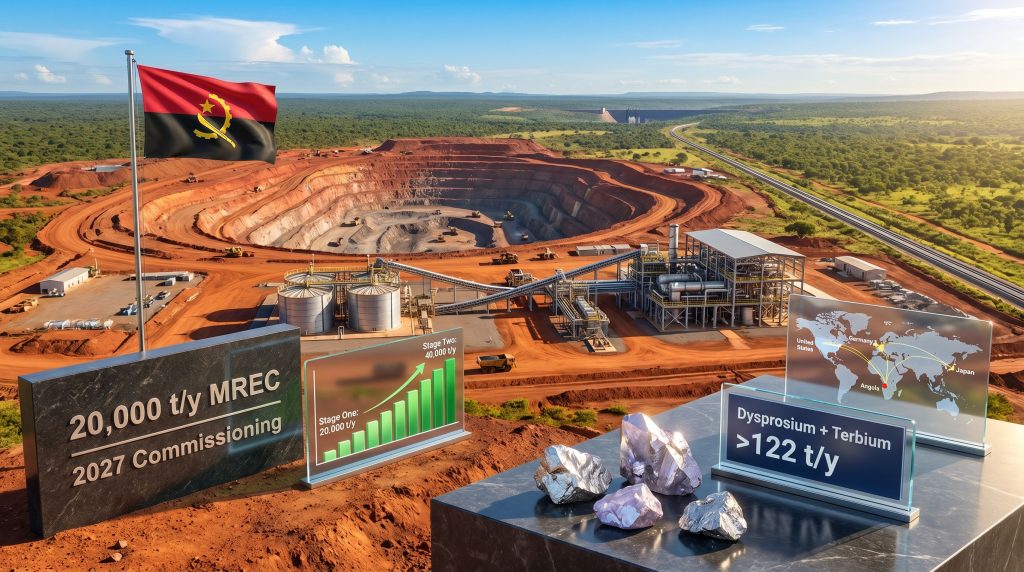
Most Western rare earth projects that have reached production scale are disproportionately weighted toward light rare earths, primarily cerium and lanthanum, which are extracted in large volumes but carry low per-tonne values and face persistent oversupply pressure. Longonjo's resource profile is fundamentally different. The project's dedicated heavy rare earth recovery circuit is targeting dysprosium and terbium output exceeding 122 tonnes per year, a volume that would position Longonjo among the largest heavy rare earth producers in the Western world once fully operational.
This distinction is not merely academic. It is the difference between a commodity concentrate producer and a genuinely strategic asset capable of anchoring Western magnet supply chains.
Pensana Longonjo Mine Construction: Where the Project Stands Today
As of mid-2026, the Pensana Longonjo mine construction programme has passed several critical early milestones and is transitioning into the highest-intensity phase of physical plant installation. The project remains on target and on budget, a statement that carries particular weight given the track record of rare earth developments globally, where cost overruns and schedule delays have derailed multiple well-publicised Western initiatives over the past decade.
Current Construction Metrics at a Glance
| Construction Metric | Status (Mid-2026) |
|---|---|
| Overall Programme Completion | 22% |
| Direct Mine and Processing Plant Expenditure | $36 million spent |
| Total Capex Committed Under Procurement | ~$135 million of $250 million total |
| Total Project Budget | $250 million |
| Long-Lead Equipment Manufacture | Well advanced |
| Main Construction Phase Target Completion | Within 12 months of mid-2026 |
| First MREC Commissioning Target | 2027 |
The early construction phase has focused on foundational works that determine the long-term reliability and performance of the facility. Major site earthworks have been fully executed, completing the ground preparation necessary for permanent plant installation. Geotechnical investigation programmes, drilling campaigns, and test-piling works have all been concluded, providing the verified ground condition data that underpins the structural design of processing buildings and equipment foundations.
On-site concrete batching and aggregate production plants have been commissioned and are operational, enabling continuous concrete production throughout the construction programme without dependence on external supply chains for fundamental materials.
Procurement Programme: The 54% Commitment Milestone
Perhaps the most commercially significant development in the current construction phase is the procurement commitment position. Approximately 54% of total capital expenditure, representing roughly $135 million of the $250 million total budget, has been formally committed under the procurement schedule.
This figure is critical for investors and project watchers to understand correctly. In large-scale mining construction, procurement commitment percentage is a leading indicator of capital cost certainty. Once contracts are signed and fabrication commences, the primary risk of cost overrun shifts from pricing uncertainty to execution uncertainty. At 54% committed, Longonjo has substantially reduced the most unpredictable dimension of its capital cost profile.
Pensana CEO Tim George has confirmed that the completion of detailed engineering design has allowed the bulk of the procurement programme to be locked in, materially reducing exposure to capital cost escalation. The next major construction milestone involves the progressive delivery of process plant equipment from off-site fabrication facilities to the Longonjo site, with equipment arrival expected to build progressively throughout the coming construction phase.
Production Architecture: Stage One and the Expansion to 40,000 t/y
The Longonjo production model is built around a deliberately phased approach that aligns output growth with downstream market development, reducing the risk of oversupplying a market segment before sufficient processing and magnet manufacturing capacity has been constructed to absorb incremental volumes.
Phased Production Roadmap
| Development Phase | Annual MREC Output | Timeline |
|---|---|---|
| Stage One | 20,000 t/y | 2027 commissioning |
| Stage Two Expansion | 40,000 t/y | Year four of operations |
The initial production of 20,000 tonnes per year of mixed rare earth carbonate (MREC) is designed to supply committed and prospective offtake partners directly, with the Stage Two expansion to 40,000 t/y timed to coincide with the build-out of Pensana's planned modular separation facility and the broader ramp-up of downstream magnet manufacturing capacity among its partner network.
Mixed rare earth carbonate is a versatile intermediate product that functions as the primary feedstock for rare earth separation circuits. It is not a finished consumer product but rather a processed upstream material that feeds directly into the downstream value chain. By producing MREC at scale, Longonjo positions itself as a critical upstream anchor for multiple downstream processing and manufacturing facilities, creating a hub-and-spoke supply architecture that enhances both commercial relationships and supply chain resilience.
The project's 20-year mine life provides the duration certainty that downstream partners require when making capital allocation decisions about separation facilities and magnet manufacturing plants. A 20-year supply horizon is typically the minimum required to justify greenfield investment in rare earth separation capacity, making Longonjo's mine life a commercially enabling characteristic rather than simply a geological fact.
The Mine-to-Magnet Vision: Why Vertical Integration Changes Everything
The most strategically ambitious dimension of the Longonjo project is not its mining scale but its integrated commercial architecture. Pensana is not building a conventional concentrate producer that sells ore to whoever will buy it. The company is constructing the upstream anchor of what it envisions as a complete, independent mine-to-magnet supply chain.
The Separation and Metallisation Circuit
A modular rare earth separation facility is currently being engineered in parallel with the main mine construction. This facility is designed to scale progressively alongside the mine's production expansion, processing MREC into separated individual rare earth oxides that can then be converted into metals for direct supply to permanent magnet manufacturers.
The inclusion of a metallisation circuit is a particularly significant technical capability. Most Western rare earth initiatives stop at the oxide separation stage, requiring downstream partners to source metals from additional processors — typically in China or Japan — before the material can be used in magnet production. Longonjo's metallisation capability collapses multiple processing steps into a single integrated facility, enabling the conversion of both light and heavy rare earth oxides into refined metal that can flow directly into a magnet manufacturer's production process.
Why This Captures More Value Per Tonne
The economic logic of vertical integration in rare earths follows a clear value ladder. Indeed, the rare earth processing challenges that have long constrained Western producers make this integrated approach particularly compelling:
- Raw ore carries minimal market value and is rarely traded internationally due to export restriction frameworks
- Mixed rare earth carbonate represents the first commercially meaningful product form, with established international pricing benchmarks
- Separated rare earth oxides command substantial premiums over MREC due to the capital and technical intensity of the separation process
- Rare earth metals carry further premiums that reflect the additional processing complexity of reduction from oxide to metal form
- Magnet alloy represents the highest-value intermediate product before permanent magnet manufacturing
By extending its commercial architecture toward the metal stage, Pensana captures a materially larger share of the value generated from each tonne of ore processed, while simultaneously reducing the number of supply chain intermediaries that downstream partners must manage. This creates both a stronger economic model for the project and a more compelling commercial proposition for offtake partners who benefit from supply chain simplification.
Capital Structure and Financing: How Longonjo Is Being Funded
The financing architecture of the Longonjo project deserves careful examination because it demonstrates a level of capital structure sophistication that distinguishes it from many early-stage critical mineral initiatives that rely predominantly on equity dilution.
Financing Framework Summary
| Financing Component | Value | Provider |
|---|---|---|
| Strategic Equity Investment | $165 million | Cascade Natural Resources |
| Proposed Debt Financing | Up to $160 million | ABSA Bank |
| Risk Insurance | Political and Commercial | US Export-Import Bank |
The $165 million strategic investment from Cascade Natural Resources forms the equity anchor of the project's capital structure, providing both funding depth and strategic alignment with the US rare earth supply chain strategy that Pensana is actively pursuing.
The proposed ABSA debt financing of up to $160 million brings the total capital available to the project well above the $250 million construction budget, providing a meaningful liquidity buffer against cost escalation or schedule extension. Critically, this debt package is underpinned by political and commercial risk insurance from the US Export-Import Bank (US EXIM), an arrangement that substantially reduces the credit risk exposure of ABSA as the lending institution by transferring sovereign and commercial risk to a US government-backed entity.
The involvement of US EXIM reflects the project's alignment with US critical mineral supply chain objectives and the broader Western effort to develop non-Chinese rare earth sources. It is worth noting that risk insurance from US EXIM is a financing mechanism rather than a project-specific endorsement or funding grant; its commercial function is to enable debt financing on terms that would otherwise be unavailable in higher-risk jurisdictions.
Nasdaq Listing: Opening the US Capital Market
Preparations for a Nasdaq listing are actively underway, a strategic capital market move that would extend Pensana's investor base significantly into US equity markets. A Nasdaq listing would increase liquidity, broaden analyst coverage, and position the project within the investment universe of US institutional funds that are specifically mandated to invest in domestic and allied critical mineral supply chains.
The next major ASX story will hit our subscribers first
Offtake Network: A Multi-Continent Commercial Foundation
The commercial validation of any mining project ultimately rests on the depth and quality of its offtake partner network. Longonjo has constructed what is arguably the most geographically and institutionally diverse rare earth offtake agreement framework of any Western rare earth development currently in progress.
Japanese Industrial Partners
| Partner | Role and Relationship |
|---|---|
| Toyota Tsusho Corporation | Proposed offtake of up to 20,000 t/y MREC over five years (MOU, June 2025) |
| Hanwa | Sponsoring rare earth separation investigation under Japan's METI Global South Initiative |
| Shin-Etsu | Major Japanese magnet producer, actively engaged |
| Proterial | Major Japanese magnet producer, actively engaged |
| TDK | Major Japanese magnet producer, actively engaged |
| Honda | Tier 1 automotive supplier, actively engaged |
| Nissan | Tier 1 automotive supplier, actively engaged |
| Daido Electronics | Tier 1 component supplier, actively engaged |
The Toyota Tsusho memorandum of understanding, signed in June 2025, warrants particular attention. Toyota Tsusho is the trading arm of the Toyota Group, one of the world's largest automotive manufacturers, and its engagement with Longonjo at the MOU stage signals that Japan's most prominent automotive conglomerate is actively pursuing upstream rare earth security at the mine level rather than relying on processed material from downstream intermediaries.
The Hanwa engagement through Japan's Ministry of Economy, Trade and Industry (METI) Global South Initiative adds a further dimension: Japanese state-sponsored investigation into rare earth separation from Longonjo material. This reflects Japan's long-standing strategic concern about rare earth supply security, which dates to the 2010 Senkaku Islands territorial dispute during which China briefly restricted rare earth exports to Japan, triggering a national critical minerals strategy that has been progressively strengthened ever since.
US and European Partners
| Partner | Geography | Sector |
|---|---|---|
| ReElement Technologies | United States | Rare earth separation |
| VAC / eVAC Magnetics | US and Germany | Permanent magnet manufacturing |
| Mercedes-Benz | Europe | Automotive OEM |
| Jaguar Land Rover | Europe | Automotive OEM |
| BMW | Europe | Automotive OEM |
| Volkswagen | Europe | Automotive OEM |
| Tesla | United States | Automotive OEM |
| General Motors | United States | Automotive OEM |
The breadth of this engagement network is remarkable. Across the US and Europe, Pensana has established active dialogue with automotive OEMs that collectively represent a substantial share of global EV production volume. The presence of Tesla, General Motors, Mercedes-Benz, BMW, Volkswagen, and Jaguar Land Rover within this engagement framework reflects the growing urgency among Western vehicle manufacturers to secure rare earth supply chains that do not route through Chinese processors.
It is important to note that the current engagement with automotive OEMs and most other partners beyond Toyota Tsusho represents active commercial dialogue and preliminary arrangements rather than binding offtake contracts. Converting these relationships into long-term, binding supply agreements will be a critical commercial milestone for the project in the period ahead.
Infrastructure Advantages: Why Location Matters More Than Many Investors Realise
Rare earth development economics are profoundly influenced by infrastructure context, yet this dimension is frequently underweighted in project assessments that focus primarily on resource grade and processing technology.
The Lobito Corridor: Angola's Strategic Logistics Asset
The Lobito Corridor is a rehabilitated trans-African rail and logistics network connecting Angola's Atlantic port of Lobito to the mineral-rich interior of central Africa. For Longonjo, this corridor provides a dedicated, high-capacity export route with direct Atlantic coast access, eliminating the land transport challenges and cost escalation that affect landlocked rare earth projects in competing African and Central Asian jurisdictions.
The strategic and economic significance of the Lobito Corridor extends beyond immediate project logistics. The corridor is receiving substantial investment from both US and European development finance institutions as part of broader infrastructure competition with Chinese Belt and Road Initiative projects in Africa. This investment environment, furthermore, enhances corridor reliability and capacity over the project's operational life while reinforcing the geopolitical alignment of Longonjo's supply chain orientation toward Western markets.
Hydroelectric Power: The Carbon Advantage
Access to Angola's hydroelectric power network, particularly the extensive capacity developed along the Kwanza River system, provides Longonjo with a low-carbon, cost-competitive energy source that addresses one of the most challenging aspects of rare earth processing economics.
Rare earth processing is exceptionally energy-intensive. Hydrometallurgical separation circuits, metallisation furnaces, and associated processing infrastructure consume substantial quantities of electricity, making power cost and carbon intensity material factors in overall project economics. Longonjo's hydroelectric power access delivers cost-competitive electricity while simultaneously creating a low-carbon production profile that is increasingly commercially valuable as Western regulatory frameworks — including the European Union's Carbon Border Adjustment Mechanism — begin imposing carbon costs on imported materials.
This combination of reliable logistics and renewable power, consequently, provides Longonjo with structural cost and sustainability advantages over competing rare earth projects that depend on road haulage and fossil fuel-based power generation.
Competitive Positioning: How Longonjo Stacks Up Against Peers
| Criteria | Longonjo (Angola) | Typical Competing Projects |
|---|---|---|
| Heavy RE Recovery (Dy + Tb) | Over 122 t/y targeted | Limited or absent in most cases |
| Mine-to-Magnet Integration | Metallisation circuit planned | Concentrate-only in most cases |
| Infrastructure Access | Lobito Corridor plus hydropower | Road-dependent, grid-powered |
| Offtake Network Depth | Multi-continent, multi-partner | Single-region or uncommitted |
| Sovereign Fund Engagement | Angolan sovereign wealth fund active | Variable, often absent |
| Production Timeline | 2027 first commissioning | Many remain at pre-feasibility stage |
| Capital Structure | Equity plus debt plus risk insurance | Often equity-only or single-lender |
The heavy rare earth differentiation is the most commercially decisive point of distinction. Most competing Western rare earth projects are built around deposits dominated by cerium and lanthanum, which are extracted in large volumes but face persistent pricing pressure due to structural oversupply in those specific elements relative to demand. Dysprosium and terbium, by contrast, face genuine scarcity conditions relative to growing demand driven by EV motor and wind turbine manufacturing expansion, with no credible substitutes currently available at commercial scale.
Risks, Milestones, and the Path to First Production
Key Milestones on the Critical Path
- Progressive arrival of process plant equipment from off-site fabrication facilities to the Longonjo site
- Completion of the main construction phase targeted within approximately 12 months of mid-2026
- First MREC commissioning scheduled for 2027
- Progression of Nasdaq listing process to broaden US investor access
- Conversion of existing MOU arrangements, including the Toyota Tsusho agreement, into binding offtake contracts
- Completion of detailed engineering for the modular separation and metallisation facility
Construction Execution Risk
With 22% of the programme complete and $135 million of $250 million committed under procurement, the project is entering its highest-intensity physical construction phase. The primary schedule risk lies in equipment delivery logistics for long-lead process plant items, where supply chain delays in fabrication or international freight can compress installation windows and delay commissioning timelines.
The advance commissioning of on-site concrete batching and aggregate facilities is a deliberate risk mitigation strategy, ensuring that the project is not dependent on external supply chains for fundamental construction materials during the critical installation phase. The level of procurement commitment achieved through detailed engineering completion further reduces the capital cost uncertainty that has historically created the most significant financial risks in comparable projects. According to recent construction updates, the Pensana Longonjo mine construction programme continues to track ahead of expectations on key delivery metrics.
The Offtake Conversion Challenge
The current commercial engagement framework, while impressive in breadth, remains predominantly non-binding. Converting preliminary arrangements and active dialogues into long-term binding offtake contracts will be the defining commercial task of the project's construction phase. The Toyota Tsusho MOU represents the most advanced offtake relationship publicly confirmed, and its conversion to a binding agreement would represent a significant commercial de-risking milestone that investors and downstream partners alike will be watching closely.
Disclaimer: This article is intended for informational purposes only and does not constitute financial advice, investment guidance, or a solicitation to buy or sell securities. Forward-looking statements regarding production timelines, offtake arrangements, capital costs, and market conditions involve inherent uncertainties and risks. Actual outcomes may differ materially from projections. Readers should conduct their own independent research and seek professional advice before making any investment decisions.
Want to Be First to Discover the Next Major Critical Minerals Opportunity on the ASX?
As the race to secure Western rare earth supply chains accelerates, Discovery Alert's proprietary Discovery IQ model delivers real-time notifications on significant ASX mineral discoveries — including critical minerals like rare earths — transforming complex geological data into clear, actionable insights for investors at every level. Explore how historic mineral discoveries have generated extraordinary returns and begin your 14-day free trial today to position yourself ahead of the market.