May 17, 2026
The mining sector is undergoing a transformative shift that prioritises human welfare alongside technological advancement. This people-first approach to mining automation fundamentally reimagines how industry evolution trends can align worker enhancement with operational excellence. Rather than viewing automation as a mechanism for human displacement, forward-thinking organisations are embracing frameworks that position workforce development as the cornerstone of technological integration.
This paradigm represents more than incremental improvement in existing processes. It fundamentally transforms how human expertise, technological capability, and organisational objectives can converge to create unprecedented value across safety, productivity, and career development dimensions.
Understanding the Human-Centered Automation Framework
Traditional approaches to mining automation have typically prioritised efficiency metrics and cost reduction over human outcomes. The emerging people-first approach to mining automation reverses this hierarchy, establishing worker wellbeing and professional development as primary design criteria for technological implementation.
This philosophy encompasses several core principles that distinguish it from conventional automation strategies. Human-centred design principles ensure that technology serves to amplify human capabilities rather than replace them entirely. Workforce enhancement strategies focus on creating pathways for skill development and career advancement within automated environments.
According to industry analysis, this approach recognises that automation affects multiple stakeholder groups simultaneously: the operational workforce, data specialists managing remote systems, local communities impacted by mining activities, investors seeking sustainable returns, and future professionals considering careers in the sector.
Safety-driven transformation removes personnel from hazardous environments whilst simultaneously creating higher-value technical roles. Skills evolution frameworks provide structured pathways for transitioning workers from manual labour positions to technical oversight responsibilities, predictive maintenance specialisation, and advanced data analysis functions.
The cognitive workload management aspect ensures that automated systems reduce mental strain rather than increase complexity for operators. Ergonomic integration addresses physical interface design to minimise repetitive stress and improve long-term occupational health outcomes.
Operational Philosophy Distinctions
People-first automation diverges from technology-first approaches in fundamental ways:
- Decision-making hierarchy: Human judgement remains primary, with technology providing enhanced information and capability
- Risk allocation: Hazardous tasks transfer to automated systems whilst complex problem-solving remains human-driven
- Performance metrics: Success measures include worker satisfaction, career development, and community impact alongside traditional productivity indicators
- Implementation timeline: Deployment schedules accommodate human adaptation requirements rather than purely technical readiness
When big ASX news breaks, our subscribers know first
Operational Transformation Through Human-Machine Collaboration
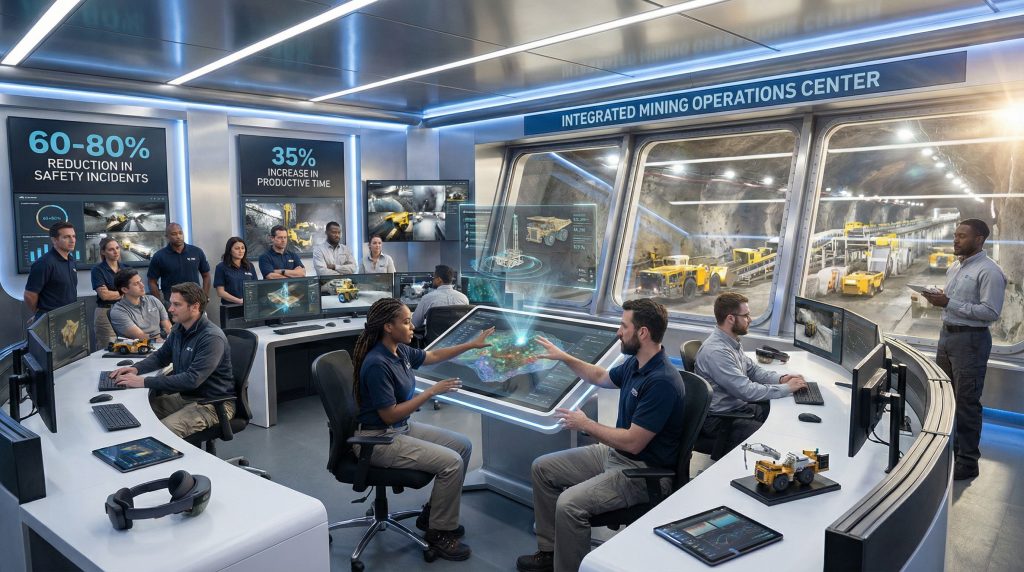
The practical application of people-first principles creates measurable changes across multiple operational dimensions. Remote operation centres represent perhaps the most visible manifestation of this transformation, relocating human operators from hazardous field environments to climate-controlled facilities that can be positioned miles away from active mining sites.
These facilities enable operators to manage multiple automated systems simultaneously whilst maintaining direct oversight of critical decisions. Distance-based safety protocols eliminate exposure to blast zones, unstable geological formations, and extreme environmental conditions without sacrificing operational control.
Furthermore, data-driven mining operations demonstrate that automated vehicles and drones can navigate complex terrain, reducing the need for personnel to work near unstable pit walls, handle high-temperature processing equipment, or operate in high-altitude or underground environments. Remote operation rooms positioned away from blasting zones directly translate to injury prevention and life preservation.
Interface Design and Cognitive Enhancement
Modern mining equipment integrates intuitive control systems that reduce learning curves and operational complexity for human operators. These interfaces incorporate real-time feedback mechanisms that make the transition from manual to automated tasks less challenging for existing workforce members.
Augmented reality training platforms enable skill development through digital twin simulations of actual mining sites, dramatically reducing both learning curves and error rates during the transition period. Workers can practise complex procedures in virtual environments that replicate real-world conditions without associated risks.
In addition, predictive maintenance interfaces utilise AI transforming mining to anticipate equipment needs before failures occur, allowing human specialists to focus on strategic maintenance planning rather than reactive repairs. This shift creates opportunities for deeper technical expertise development among maintenance personnel.
Career Evolution Pathways
As repetitive, physically demanding tasks transition to automated systems, human workers step into higher-value positions requiring critical thinking, creativity, and specialised expertise. These roles offer greater opportunities for professional growth, job satisfaction, and industry recognition.
Data analysis specialists interpret complex datasets for operational optimisation, requiring statistical knowledge and industry expertise that combines traditional mining knowledge with modern analytical capabilities. Remote equipment supervisors oversee multiple automated systems simultaneously, developing skills in systems integration and process optimisation.
Predictive maintenance technicians utilise AI-driven insights to prevent equipment downtime, combining mechanical knowledge with data interpretation skills. Digital twin operators manage virtual representations of physical mining operations, requiring expertise in both traditional mining processes and advanced simulation technologies.
Strategic Importance for Industry Sustainability
The mining sector faces significant challenges in attracting next-generation workforce talent, particularly among professionals comfortable with digital technologies and seeking careers that align with safety and environmental values. The people-first approach to mining automation addresses these recruitment challenges by fundamentally altering the industry's value proposition.
Technology-forward career opportunities appeal to digitally native professionals who might otherwise pursue careers in software development, engineering, or other technical fields. Clean, safe working environments eliminate many traditional safety concerns that have historically deterred potential employees from considering mining careers.
Consequently, professional development pathways leading to specialised technical roles provide clear advancement opportunities with growth potential that extends beyond traditional mining career trajectories. Innovation-driven culture positions mining organisations as high-tech industries rather than extractive operations.
Economic and Operational Advantages
Organisations implementing boosting operational safety through people-first automation report improvements across multiple performance dimensions:
| Performance Metric | Traditional Operations | People-First Automation |
|---|---|---|
| Safety Incidents | Higher injury rates and insurance costs | Minimal human exposure to hazards |
| Operational Hours | Limited by shift changes and human fatigue | 24/7 remote monitoring capabilities |
| Talent Acquisition | Skills shortage in dangerous roles | Attractive technical positions |
| Maintenance Strategy | Reactive repair approaches | Predictive maintenance protocols |
| Training Efficiency | Extended apprenticeship periods | Accelerated digital twin learning |
The transformation from perilous labour to purposeful work creates opportunities for extracting materials critical to modern life whilst providing meaningful career paths that attract diverse talent pools.
Workforce Development Integration
Successful implementation requires comprehensive retraining programmes designed around existing workforce strengths rather than wholesale replacement. Skills assessment and mapping identify current capabilities and future requirements, enabling targeted development initiatives.
Moreover, career pathway visualisation helps existing employees understand progression opportunities from current roles to future technical positions. Mentorship and support systems facilitate smooth transitions to automated environments whilst preserving institutional knowledge and operational expertise.
Implementation Strategies and Change Management
Organisational transformation toward people-first approach to mining automation requires systematic change management that addresses both technological and cultural dimensions. Executive sponsorship programmes ensure sustained leadership commitment to human-centred transformation objectives.
Clear value proposition development articulates benefits for both organisational stakeholders and individual employees, addressing concerns about job security whilst highlighting opportunities for professional advancement. Communication strategies must proactively address workforce anxiety about automation whilst emphasising enhancement rather than replacement.
Success metrics definition should focus on human outcomes alongside operational improvements, measuring employee satisfaction, skill development progress, and career advancement rates in addition to traditional productivity indicators.
Technology Integration Considerations
Human-machine interface optimisation applies user experience design principles to industrial control systems, ensuring that technological complexity remains manageable for operators. Feedback loop mechanisms ensure that operator input continuously shapes system development and refinement.
Customisable interface options accommodate different skill levels and preferences among operators, whilst performance monitoring tools track both system efficiency and operator satisfaction to identify optimisation opportunities.
However, infrastructure requirements include communication network upgrades supporting real-time remote operations, control centre development providing optimal environments for human operators, and training facility establishment for hands-on learning with automated systems.
Cultural Transformation Framework
Leadership alignment requires sustained commitment to human-centred values throughout the transformation process. Organisations must demonstrate genuine commitment to workforce development rather than using people-first rhetoric to disguise cost-cutting initiatives.
For instance, organisational readiness assessment evaluates leadership commitment to sustained transformation initiatives, resource allocation planning for training and technology investments, and timeline development that balances operational needs with human adaptation requirements.
Sector-Specific Applications and Benefits
Different mining operations present unique opportunities for people-first automation implementation. Surface mining operations benefit from autonomous haul truck fleets operated by remote specialists in comfortable facilities, eliminating exposure to dust, noise, and equipment-related hazards.
Drone-based surveying and monitoring removes personnel from unstable pit wall environments whilst providing enhanced data collection capabilities. Automated drilling systems reduce noise exposure and repetitive strain injuries whilst improving precision and consistency.
Underground Mining Applications
Remote-controlled extraction equipment keeps workers away from cave-in risks whilst maintaining operational control over complex extraction processes. Autonomous ventilation management ensures optimal air quality without requiring human intervention in potentially hazardous atmospheric conditions.
Real-time geological monitoring provides early warning systems for ground instability, enabling proactive safety measures that protect both human operators and automated equipment investments.
Processing and Beneficiation
Automated quality control systems reduce human exposure to chemical processes whilst improving consistency and accuracy of product specifications. Predictive maintenance protocols minimise unplanned shutdowns and emergency repairs that often require human intervention in hazardous conditions.
Furthermore, digital optimisation platforms enable process improvements through data analysis, creating opportunities for chemical engineers and process optimisation specialists to enhance operations remotely.
Overcoming Implementation Challenges
Organisations pursuing people-first automation must address cultural resistance among workforce segments comfortable with traditional methods. Job security anxieties among experienced operators require transparent communication about career transition support and long-term employment opportunities.
Technology adoption hesitancy particularly among older workforce segments necessitates comprehensive training programmes and gradual implementation timelines that accommodate different learning preferences and paces. This is where effective job interview preparation becomes crucial for workers transitioning to automated roles.
Skills gap concerns regarding ability to transition to technical roles can be addressed through assessment-based training programmes that build on existing knowledge rather than requiring complete career changes.
Union Relations and Negotiation
Union negotiations around automation implementation require collaborative approaches that emphasise job enhancement rather than elimination. Successful agreements typically include provisions for retraining, career development support, and transition assistance.
Collective bargaining frameworks should address both immediate implementation concerns and long-term workforce development objectives, ensuring that automation benefits both organisational objectives and worker wellbeing.
Technical Infrastructure Development
Communication network upgrades supporting real-time remote operations require significant capital investment and careful planning to ensure reliability and security. Control centre development must provide optimal environments for human operators whilst integrating multiple system interfaces.
In addition, training facility establishment enables hands-on learning with automated systems before full operational deployment. Cybersecurity protocols protect both human operators and automated systems from external threats that could compromise safety or productivity.
The next major ASX story will hit our subscribers first
Future Outlook and Industry Evolution
The trajectory of people-first mining automation points toward increasingly sophisticated human-machine collaboration that leverages artificial intelligence to enhance rather than replace human decision-making capabilities. Machine learning systems will provide operators with increasingly accurate predictive insights whilst preserving human judgement for complex strategic decisions.
Virtual reality training evolution will create increasingly realistic simulation environments that enable rapid skill development without operational risk. Predictive analytics advancement will enable proactive rather than reactive decision-making across operational, maintenance, and strategic planning dimensions.
Moreover, according to recent research, sustainable automation practices will align human welfare objectives with environmental responsibility, creating integrated value propositions that appeal to both workforce and community stakeholders.
Generational Workforce Transformation
Generational workforce shift toward technology-comfortable mining professionals will accelerate adoption of advanced automation systems whilst maintaining focus on human-centred design principles. Safety standard elevation will continue as automated systems eliminate traditional hazards whilst creating new requirements for technical expertise.
Productivity optimisation through human-machine collaboration will deliver superior results compared to either purely manual or fully automated approaches. Innovation acceleration will emerge as human creativity combines with automated precision to solve complex operational challenges.
Industry Competitive Dynamics
Organisations successfully implementing people-first automation will likely establish competitive advantages in talent recruitment, operational safety, productivity optimisation, and community relations. These advantages will become increasingly important as mining operations face greater scrutiny regarding social and environmental impact.
Technology leadership will increasingly depend on human factors engineering capabilities rather than purely technical automation sophistication. Workforce satisfaction will become a key differentiator for attracting and retaining skilled technical professionals.
Strategic Implementation Framework
Mining organisations considering people-first automation should evaluate their organisational readiness across leadership commitment, workforce characteristics, financial resources, and competitive positioning. Pilot programme development enables learning and refinement before full-scale implementation.
Partnership strategies with technology vendors, training institutions, and workforce development organisations can accelerate implementation whilst reducing risks and costs. Performance measurement systems should track both operational metrics and human outcomes to ensure balanced value creation.
Long-term strategic planning must consider evolving technology capabilities, changing workforce demographics, regulatory developments, and community expectations to ensure sustainable competitive advantage.
The people-first approach to mining automation represents a fundamental shift in how organisations conceptualise the relationship between technological advancement and human potential. Success requires genuine commitment to human-centred values, comprehensive change management, and sustained investment in workforce development alongside technological capabilities.
Organisations that master this integration will define the mining industry's future whilst creating meaningful careers for the next generation of mining professionals. The transformation from hazardous manual labour to purposeful technical work offers unprecedented opportunities for both organisational success and human fulfilment within the critical materials sector that supports modern civilisation.
Ready to Capitalise on Mining Automation Trends?
Discovery Alert's proprietary Discovery IQ model delivers instant notifications about significant ASX mineral discoveries in automation and technology-focused mining companies, helping investors identify opportunities as the sector undergoes transformational change. Begin your 30-day free trial today to gain market-leading insights into mining companies positioned at the forefront of human-centred automation innovation.