August 14, 2026
Global supply chain vulnerabilities in critical materials have intensified as manufacturing dependencies concentrate within single geographic regions. Strategic positioning around permanent magnet production represents a key battleground where technological capabilities, resource control, and geopolitical leverage intersect to reshape industrial competitiveness across multiple sectors.
The convergence of electric vehicle adoption, renewable energy deployment, and defence modernisation has elevated rare earth permanent magnets from niche industrial components to strategic assets essential for national economic security. Understanding these dynamics requires examining both the technical requirements driving demand and the concentrated supply structures creating systemic vulnerabilities.
Strategic Forces Behind Permanent Magnet Manufacturing Consolidation
Vertical Integration as Competitive Strategy
China rare earth magnet expansion reflects a calculated transition from raw material extraction toward comprehensive control over value-added manufacturing processes. This strategic pivot concentrates leverage at precisely the supply chain stages where profit margins remain highest and substitution alternatives remain most limited.
State-directed enterprises are systematically consolidating operations across the entire production spectrum: from ore processing through metals refining, alloy production, and finished magnet manufacturing. This integrated approach enables cost optimisation and quality control that fragmented Western supply chains struggle to match.
The financial architecture supporting this expansion demonstrates clear strategic intent. Rather than pursuing immediate shareholder returns, Chinese producers are channelling profits directly into capacity buildouts, indicating long-term positioning objectives that prioritise market control over short-term profitability.
Economic Fundamentals Driving Industrial Scale Investment
China Northern Rare Earth Group reported revenues of approximately $4.2 billion with net profits reaching $360 million during the first three quarters of 2025. These figures represent substantial financial resources available for reinvestment in production capacity and technological advancement.
Furthermore, the company's profit margin of approximately 8.5% reflects the downstream magnet manufacturing economics where volumes compensate for modest per-unit margins through scale advantages. This financial model supports aggressive expansion while maintaining sustainable profitability across market cycles.
Key financial drivers include:
• Cost leadership through vertical integration eliminating third-party processing margins
• Premium pricing power for high-performance applications requiring precise specifications
• Volume growth from expanding electric vehicle and renewable energy demand
• Operational efficiency improvements through automated production technologies
When big ASX news breaks, our subscribers know first
Production Capacity Analysis and Global Market Impact
Scale of New Manufacturing Facilities
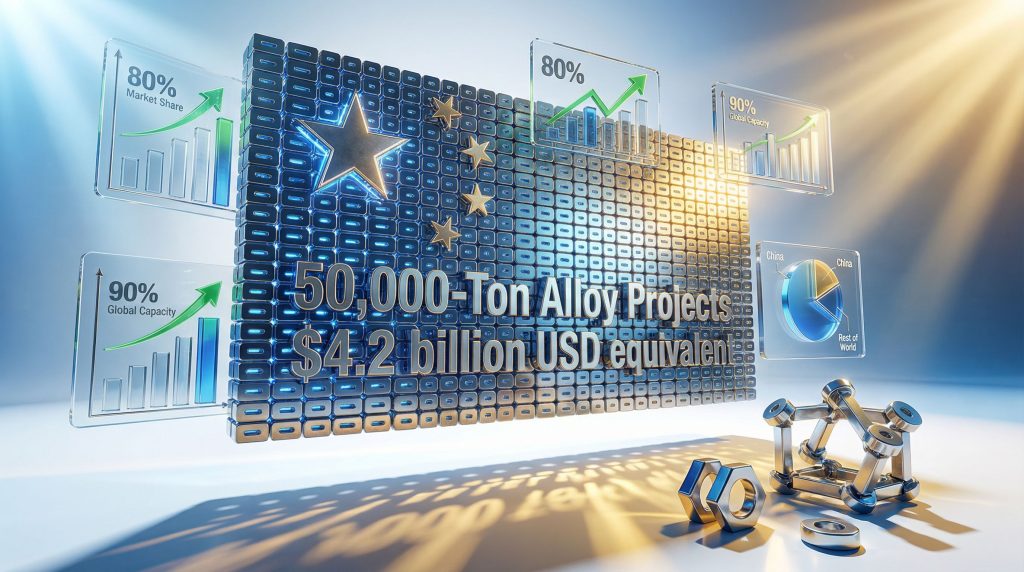
Recent capacity additions represent substantial increases to global permanent magnet production capabilities. The 50,000-ton NdFeB rapid solidification alloy project alone adds approximately 15% to estimated global production capacity for specialised magnet alloys.
| Facility Type | Annual Capacity | Market Segment | Strategic Impact |
|---|---|---|---|
| NdFeB Rapid Solidification Alloy | 50,000 tons | EV motors, wind turbines | +15% global alloy capacity |
| High-Performance Magnet Materials | 3,000 tons | Defence, aerospace, precision | +8% premium segment capacity |
| Green Smelting Operations | Undisclosed | Environmental compliance | Processing efficiency gains |
These facilities employ advanced manufacturing technologies including rapid solidification processes that improve material properties through controlled cooling techniques. Such methods enable consistent quality specifications required for demanding applications whilst also addressing green production sustainability requirements.
Competitive Positioning Against Alternative Suppliers
China's integrated supply chain structure creates cumulative advantages that isolated Western competitors cannot easily replicate. In contrast, whilst countries like Australia, Canada, and Greenland focus on developing mining projects, China has consolidated control over the critical processing and manufacturing stages where technical expertise and capital requirements create the highest barriers to entry.
The technological requirements for NdFeB magnet production involve:
• Precise alloy composition control requiring specialised metallurgical expertise
• Magnetic property optimisation through carefully controlled processing parameters
• Surface treatment and coating applications for corrosion resistance and durability
• Quality assurance systems ensuring consistent performance across high-volume production
Western manufacturers typically operate with separated supply chains, purchasing raw materials from multiple sources and lacking the process integration that enables cost optimisation and quality control throughout the production sequence.
Financial Performance and Investment Strategy Analysis
Revenue Growth and Profitability Trends
The financial performance of major Chinese rare earth producers demonstrates the economic viability of their expansion strategy. With quarterly revenues approaching $1.4 billion and consistent profitability, these companies possess the financial resources necessary for sustained capacity investment.
Moreover, capital allocation patterns reveal strategic priorities focused on market position consolidation rather than immediate returns to shareholders. This approach contrasts sharply with Western market-driven models that typically prioritise quarterly financial performance over long-term strategic positioning.
Investment Priorities and Resource Allocation
Chinese rare earth enterprises are directing investment capital toward specific capability areas:
• Downstream processing capacity for metals and alloys production
• Advanced manufacturing facilities for high-performance magnet materials
• Environmental compliance upgrades improving operational sustainability
• Research and development programmes advancing material science capabilities
This investment pattern strengthens China's position across multiple value chain stages simultaneously, creating redundant supply security whilst improving cost competitiveness relative to international alternatives.
Industry Vulnerability Assessment Across Critical Sectors
Electric Vehicle Manufacturing Dependencies
Global electric vehicle production reached 13.6 million units in 2023, with projections exceeding 18 million vehicles by 2025. Each vehicle requires approximately 1-2 kilograms of high-grade NdFeB magnets for motor applications, creating annual demand approaching 36,000 metric tons for automotive applications alone.
Modern EV motors utilising permanent magnet synchronous designs require specific material properties:
• Energy density ratings of 42-52 MGOe (megagauss-oersteds)
• Temperature stability for sustained operation to 150°C
• Coercivity specifications exceeding 900 kA/m for high-speed applications
Alternative motor designs using induction principles sacrifice efficiency and increase vehicle weight, making permanent magnet motors essential for competitive EV performance. This technical requirement creates supply chain inelasticity that cannot be easily addressed through design modifications.
Renewable Energy Infrastructure Exposure
Wind energy installations represent another critical vulnerability point. Global wind capacity additions of 70+ gigawatts annually require substantial permanent magnet quantities, particularly for direct-drive turbine generators that eliminate mechanical gearboxes through larger permanent magnet assemblies.
Large offshore wind turbines (10+ MW capacity) utilise 200-600 kilograms of NdFeB magnets per turbine. Current installation rates suggest annual demand of 14,000-42,000 metric tons for new wind capacity, with additional requirements for maintenance and replacement of existing installations.
However, the technical specifications for wind turbine magnets include:
• Thermal stability for sustained operation to 120°C in generator housings
• Corrosion resistance for offshore marine environments
• Dimensional precision for rotor balance and vibration control
• Long-term reliability with 20+ year operational lifecycles
Defence and Aerospace Vulnerabilities
Military systems incorporate permanent magnets across numerous applications including precision guidance systems, radar arrays, satellite components, and electronic warfare systems. Defence procurement requires supply chain security with guaranteed availability and quality specifications verified through security-cleared suppliers.
Geographic dependency analysis reveals concerning vulnerabilities:
| Region | Import Dependency | Alternative Sources | Strategic Risk Assessment |
|---|---|---|---|
| United States | 80%+ for processed magnets | Limited domestic capacity | High strategic vulnerability |
| European Union | 95%+ for rare earth magnets | Minimal processing infrastructure | Critical supply risk |
| Japan | 60%+ despite recycling | Some domestic alternatives | Moderate-high exposure |
Western Response Strategies and Alternative Development
United States Strategic Initiatives
American policy responses focus on multiple parallel approaches to reduce dependency on Chinese magnet supplies:
Domestic Production Capacity Development:
• MP Materials facility expansion in California for rare earth processing
• Government loan guarantees supporting private sector magnet manufacturing
• Defence Production Act authorities for critical materials production
International Partnership Development:
• Quad partnership frameworks with Japan, Australia, and India
• NATO critical materials coordination for defence supply chain resilience
• Five Eyes intelligence sharing on supply chain vulnerabilities and alternatives
Consequently, these initiatives are part of a broader critical minerals strategy designed to ensure domestic production capabilities.
European Union Critical Materials Strategy
The EU's Critical Raw Materials Act establishes specific targets for supply chain diversification:
• 10% domestic processing targets by 2030 for critical materials
• Strategic stockpiling requirements for essential industrial inputs
• Supply chain due diligence mandates ensuring responsible sourcing
European initiatives prioritise developing processing capabilities within member states whilst establishing supply partnerships with allied nations possessing raw material resources.
Export Control Measures and Market Disruption
What are the Regulatory Implementation Timelines?
China's implementation of export controls for rare earth materials follows a phased approach designed to minimise immediate market disruption whilst establishing long-term leverage over international buyers:
April 2025: Initial export licensing requirements introduced for selected high-performance magnet materials
October 2025: Expanded controls covering foreign-manufactured products containing Chinese rare earth content
December 2025: Comprehensive technology transfer restrictions implemented
Furthermore, according to Reuters reporting, these measures represent the most significant supply chain restrictions in the sector to date.
Market Impact Assessment
Export volume data indicates significant market disruption following control implementation. Monthly magnet exports declined approximately 75% during the initial control period, stabilising around 5,000-6,000 tons monthly by late 2025.
This reduction created immediate supply constraints for international manufacturers whilst demonstrating China's ability to influence global market access through administrative measures. The stabilised export levels suggest selective licensing favouring strategic customers and applications.
Price impacts from export restrictions include:
• Premium grade magnet prices increased 40-60% for non-Chinese buyers
• Standard specification materials showed 20-30% price increases
• Long-term contract pricing incorporated supply security premiums
• Spot market volatility increased substantially due to uncertainty
In addition, analysis from CNBC highlights how these restrictions are creating both challenges and opportunities for alternative suppliers globally.
The next major ASX story will hit our subscribers first
Investment Opportunities in Supply Chain Restructuring
Upstream Resource Development
Mining sector opportunities focus on developing alternative rare earth sources outside Chinese control:
Australian Heavy Rare Earth Projects:
• Lynas Rare Earths expansion of Malaysian processing facilities
• Northern Minerals Browns Range heavy rare earth development
• Iluka Resources Eneabba rare earth refinery development
North American Resource Development:
• MP Materials Mountain Pass mine expansion and processing integration
• Energy Fuels White Mesa processing facility conversion
• Appia Rare Earths Canadian exploration and development projects
These developments align with broader North American mining trends towards supply chain diversification.
Midstream Processing Capabilities
The most significant investment opportunities exist in developing midstream processing capabilities that currently represent the primary bottleneck in non-Chinese supply chains:
• Separation technology development for converting concentrates to individual rare earth elements
• Metals production facilities for converting separated elements to industrial-grade metals
• Alloy production capabilities for creating magnet-ready materials
• Environmental compliance systems meeting Western regulatory standards
Downstream Manufacturing Alternatives
Magnet manufacturing investments focus on establishing production capacity outside China whilst developing technological alternatives:
• Automated production systems reducing labour cost disadvantages
• Recycling technology development for recovering rare earths from end-of-life products
• Alternative magnet technologies reducing rare earth content requirements
• Specialised application facilities serving defence and aerospace markets
Environmental Regulations and Competitive Positioning
Green Manufacturing as Strategic Advantage
Chinese facilities are incorporating environmental compliance upgrades as competitive positioning tools rather than mere regulatory requirements. Green smelting technologies and emission control systems enable access to environmentally conscious international markets whilst improving operational efficiency.
Environmental compliance provides multiple strategic benefits:
• Market access maintenance in jurisdictions with strict environmental standards
• Premium pricing opportunities for customers requiring sustainable supply chains
• Operational cost reductions through improved process efficiency
• Regulatory risk mitigation for long-term operational continuity
Sustainability Certification Strategies
International environmental standards certification enables Chinese producers to maintain customer relationships despite geopolitical tensions. Certifications from recognised international bodies provide credibility for supply chain sustainability claims.
This approach demonstrates sophisticated understanding of customer requirements in developed markets where environmental performance increasingly influences purchasing decisions for industrial materials.
Long-Term Market Scenario Analysis
Scenario 1: Continued Chinese Market Consolidation
This pathway assumes successful execution of current expansion plans combined with continued export control leverage:
• Market share expansion to 95%+ by 2030 across all magnet categories
• Export controls become permanent policy tools for strategic leverage
• Western industries adapt operational models to accommodate Chinese supply dominance
• Technology transfer requirements for access to Chinese processing capabilities
Investment implications include focusing on sectors with stable Chinese supply access whilst developing contingency capabilities for critical defence applications.
Scenario 2: Successful Western Supply Chain Diversification
Alternative supply chain development achieves meaningful scale and competitiveness:
• 30-40% market share captured by non-Chinese suppliers by 2030
• Technology breakthroughs reduce rare earth intensity in critical applications
• Recycling systems achieve commercial scale for material recovery
• Geopolitical tensions moderate through trade framework development
This scenario requires substantial coordinated investment in processing capabilities and technology development across multiple allied nations, particularly considering the US-China trade impacts on supply chains.
Scenario 3: Technological Disruption and Market Transformation
Breakthrough technologies fundamentally alter market dynamics:
• Rare earth-free alternatives achieve commercial viability for major applications
• Advanced recycling technologies dramatically improve material recovery rates
• Additive manufacturing enables distributed production reducing supply chain vulnerabilities
• Circular economy models minimise virgin material requirements
This transformation would reduce geopolitical leverage from resource control whilst creating new competitive dynamics based on technological innovation.
Strategic Implications for Market Participants
Investment Portfolio Considerations
Investors must evaluate rare earth supply chain exposure across portfolio companies whilst identifying opportunities in alternative supply chain development:
• Supply chain auditing for companies dependent on Chinese magnet inputs
• Alternative technology investments reducing rare earth dependency
• Recycling and circular economy companies developing material recovery capabilities
• Defence contractor exposure to supply chain security requirements
Policymaker Strategic Priorities
Government initiatives require coordinated approaches addressing multiple supply chain vulnerabilities simultaneously:
• Accelerated domestic capacity development through targeted financial incentives
• International cooperation frameworks establishing alternative supply networks
• Strategic stockpiling programmes providing supply security during transition periods
• Research and development funding for technology alternatives and efficiency improvements
These priorities increasingly focus on critical minerals energy security as nations recognise the strategic importance of supply chain control.
Industrial Strategic Planning
Manufacturing companies must develop comprehensive strategies addressing both immediate supply security and long-term competitive positioning:
• Supplier diversification initiatives reducing dependency on single sources
• Alternative technology research minimising rare earth content requirements
• Supply chain transparency systems ensuring regulatory compliance and risk visibility
• Long-term contracting strategies securing access to critical materials
The evolving landscape of China rare earth magnet expansion creates both challenges and opportunities for global stakeholders. Consequently, success in navigating this environment requires understanding the technical, financial, and geopolitical factors shaping market dynamics whilst developing adaptive strategies capable of responding to multiple potential futures.
Disclaimer: This analysis contains forward-looking statements and market projections that involve uncertainties and risks. Actual market developments may differ materially from scenarios presented. Investment decisions should be based on comprehensive due diligence and professional financial advice.
What's Your Strategy for Investing in Critical Minerals Supply Chain Opportunities?
Discovery Alert's proprietary Discovery IQ model delivers instant notifications on significant ASX mineral discoveries, including critical materials essential for supply chain security and technological advancement. With China's consolidation of rare earth magnet production creating new market dynamics, exploring historic discoveries demonstrates how major mineral finds can generate substantial returns whilst positioning investors ahead of supply chain restructuring trends.