August 5, 2026
Understanding Supply Chain Dynamics in Permanent Magnet Manufacturing
Strategic positioning in global supply chains often requires recognising where actual bottlenecks occur rather than where conventional wisdom suggests they should be. The permanent magnet manufacturing ecosystem demonstrates this principle clearly, with processing and fabrication stages creating more significant constraints than raw material availability alone.
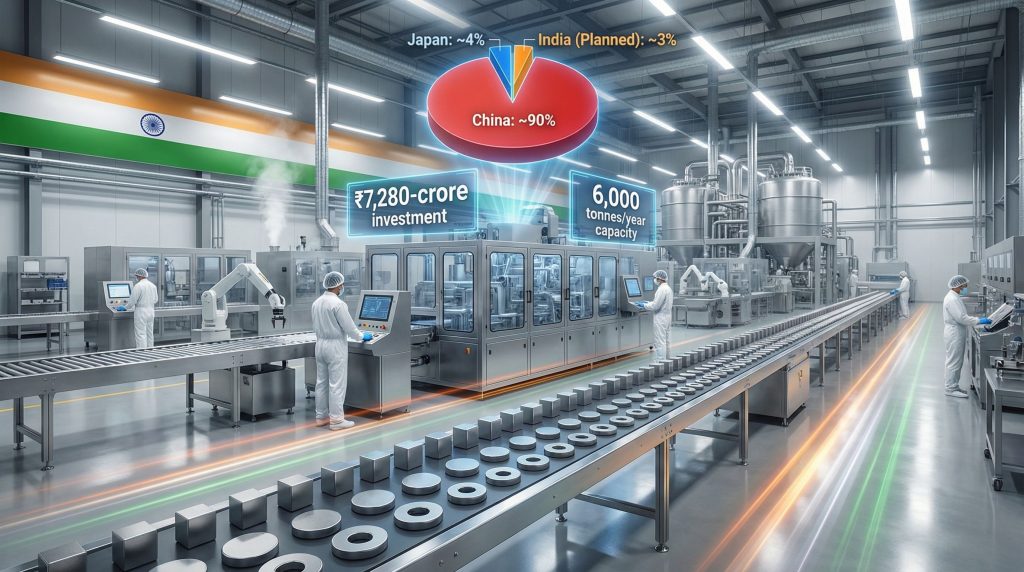
India rare earth magnet production has emerged as a compelling case study in this strategic shift. India's recent commitment of ₹7,280 crores toward developing 6,000 tonnes annually of sintered magnet capacity represents a departure from traditional resource-extraction approaches that have dominated critical minerals strategy frameworks worldwide. This investment framework targets downstream value creation rather than upstream mining expansion, reflecting an understanding of where supply chain leverage actually resides.
When big ASX news breaks, our subscribers know first
The Strategic Shift from Resource Extraction to Value-Added Manufacturing
Economic analysis reveals substantial value differentials between raw material export and finished magnet production. While rare earth oxide concentrates generate approximately $3,000-5,000 per tonne in revenue, processed neodymium-iron-boron magnets command $15,000-25,000 per tonne in international markets. This 300-500% value multiplication occurs primarily through chemical separation, metal production, and magnet fabrication stages.
India's approach emphasises capturing these higher-value manufacturing segments rather than competing solely on mineral extraction volumes. The economic multiplier effects extend beyond direct sales revenue, creating linkages with electric vehicle manufacturing, wind turbine production, and advanced electronics sectors that require reliable permanent magnet supplies.
Furthermore, traditional mining-focused strategies often result in commodity price exposure and limited downstream integration. Countries following extraction-heavy approaches frequently find themselves supplying raw materials to manufacturers in other regions, then importing finished products at substantially higher costs.
Consequently, India's magnet-centric strategy attempts to position the country as a regional hub for value-added manufacturing rather than a raw material supplier. This approach aligns with broader sustainable mining transformation initiatives that prioritise long-term economic value creation over short-term extraction revenues.
Supply Chain Vulnerability Assessment: Where Real Leverage Exists
Global permanent magnet supply chains concentrate risk at specific processing nodes rather than distributing it evenly across all production stages. Chemical separation facilities, which convert rare earth ores into pure individual elements, represent critical bottlenecks requiring specialised equipment, technical expertise, and significant capital investment.
Key vulnerability points include:
• Separation plant capacity – Converting mixed rare earth concentrates into individual elements
• Metal production facilities – Reducing separated oxides to metallic forms
• Magnet fabrication lines – Sintering, machining, and coating finished products
• Quality certification systems – Meeting automotive and aerospace specifications
China's dominance in permanent magnet production stems from integrated control across these processing stages rather than monopolistic control over mineral deposits. Chinese manufacturers operate vertically integrated facilities encompassing separation, metal production, and magnet fabrication under coordinated management structures.
Risk concentration analysis indicates that supply disruptions at magnet production facilities create immediate impacts on electric vehicle manufacturing, wind turbine assembly, and industrial electronics production. These downstream effects propagate more rapidly than disruptions at mining operations, which typically maintain several months of concentrate inventory.
Market Share Analysis and Global Production Landscape
Current global permanent magnet production capacity demonstrates significant geographic concentration, with implications for supply security and pricing dynamics across clean energy sectors. However, recent developments in mining industry evolution suggest emerging opportunities for supply chain diversification.
Global Rare Earth Magnet Production Capacity (2025)
| Region | Capacity (tonnes/year) | Market Share | Primary Producers |
|---|---|---|---|
| China | 180,000-200,000 | 88-92% | State enterprises, private manufacturers |
| Japan | 8,000-10,000 | 4-5% | Shin-Etsu Chemical, TDK Corporation |
| United States | 2,000-3,000 | 1-1.5% | MP Materials, emerging facilities |
| Europe | 2,000-2,500 | 1-1.2% | VAC Germany, emerging EU capacity |
| India (Planned) | 6,000 (target) | 2.8-3% | IREL, Ashvini, others |
| South Korea | 1,500-2,000 | 0.8-1% | Private sector manufacturers |
Strategic Implications of India's Production Scale
India's 6,000-tonne annual target represents approximately 3% of global permanent magnet production at full operational capacity. While this scale does not challenge China's dominant position directly, it creates meaningful supply diversification for regional markets and India's domestic clean energy sectors.
Domestic demand projections indicate significant absorption capacity for Indian magnet production. The country's electric vehicle manufacturing targets of 5 million units by 2030 would require approximately 2,500-7,500 tonnes of permanent magnets annually, depending on vehicle types and motor specifications.
In addition, wind turbine manufacturing for India's renewable energy expansion could absorb an additional 1,000-2,000 tonnes annually. These requirements align with broader energy transition security objectives that emphasise domestic supply chain resilience.
Export potential analysis suggests regional markets in Southeast Asia, the Middle East, and East Africa could provide additional demand for 2,000-4,000 tonnes of Indian magnet production. These markets currently rely primarily on Chinese suppliers and would benefit from supply source diversification.
Timeline projections for achieving operational capacity extend from 2030-2032, assuming regulatory approvals, technology acquisition, and workforce development proceed according to government planning frameworks. This timeline aligns with India's broader clean energy infrastructure development goals and electric vehicle adoption targets.
Technical Infrastructure and Manufacturing Challenges
Establishing competitive permanent magnet manufacturing requires addressing multiple technical and supply chain constraints that extend beyond financial investment alone. For instance, recent India's Manufacturing Push demonstrates the scale of commitment required for successful implementation.
Upstream Raw Material Constraints and Solutions
India Rare Earths Limited (IREL) currently produces approximately 500 tonnes annually of rare earth oxide concentrates from monazite beach sand processing operations. Supporting 6,000 tonnes of magnet production requires 8,000-9,000 tonnes of refined rare earth metals, creating a substantial supply gap.
Current supply constraints include:
• Limited separation capacity – IREL facilities process mixed rare earth concentrates but lack scale for dedicated neodymium-praseodymium separation
• Thorium regulatory complexity – Monazite contains 8-10% thorium, requiring nuclear-grade facility approvals and specialised waste management
• Processing yield limitations – Current recovery rates of 40-50% from monazite concentrates limit effective raw material utilisation
• Import dependency scenarios – Meeting magnet production targets requires importing refined metals or establishing new separation facilities
India possesses substantial monazite reserves along southern coastal areas, with estimated resources of 10-12 million tonnes containing significant rare earth content. However, sustainable extraction rates of 50,000-70,000 tonnes annually face environmental constraints and thorium processing requirements.
Regulatory approval processes for thorium-bearing mineral processing typically require 12-24 months compared to 3-6 months for conventional mineral operations. Compliance costs add an estimated $10-15 million per facility for specialised equipment and waste management systems.
Equipment Sourcing and Technology Transfer Challenges
Permanent magnet manufacturing requires specialised equipment for metal reduction, powder preparation, pressing, sintering, and finishing operations. Current global supply chains for this equipment concentrate heavily in China and Japan, creating potential technology transfer and supply security issues.
Critical equipment categories include:
• Vacuum induction melting furnaces for alloy preparation
• Hydrogen decrepitation systems for powder processing
• Isostatic pressing equipment for magnet forming
• Sintering furnaces with precise atmosphere control
• Coating and magnetising systems for finished products
Chinese equipment suppliers offer competitive pricing but raise concerns about technology dependency and potential export restrictions during geopolitical tensions. Western alternative suppliers typically command 30-50% price premiums whilst offering enhanced technical support and training programmes.
Indigenous technology development through IREL's Visakhapatnam facility aims to reduce foreign equipment dependency over time. However, initial production phases will likely require imported processing lines whilst domestic capabilities develop.
Leading Companies in India's Magnet Development Strategy
Multiple organisations contribute to India rare earth magnet production ecosystem development, with distinct roles in technology development, production scaling, and market development. These initiatives reflect broader patterns observed in innovation expo insights across the global mining and materials sector.
State-Owned Enterprise Strategy: IREL's Foundation Role
Indian Rare Earths Limited operates as the primary state-owned enterprise for rare earth development, with existing infrastructure for mineral processing and emerging capabilities in magnet manufacturing. The company's Visakhapatnam facility serves as the primary development centre for rare earth permanent magnet production technology.
IREL's strategic advantages include:
• Existing rare earth processing infrastructure and regulatory approvals for thorium handling
• Government backing for long-term development programmes and capital investment
• Research partnerships with academic institutions and international technology providers
• Integration potential with upstream monazite processing operations
Current development timelines target initial production capabilities by 2030-2031, with scaling toward commercial volumes through the following two years. Government resource allocation supports both facility development and workforce training programmes necessary for technical operations.
Private Sector Innovation: Ashvini Rare Earth's Commercial Approach
Ashvini Rare Earth has established India's first commercial-scale neodymium-praseodymium metal production facility, with current capacity of 15 tonnes annually. The company represents private sector engagement in rare earth value chains and demonstrates technical feasibility for domestic metal production.
Expansion plans include:
• 600-tonne metal production facility targeting completion by 2028-2029
• Integrated magnet manufacturing capabilities to capture downstream value addition
• Customer base development across automotive, renewable energy, and electronics sectors
• Technology partnerships for advanced magnet grades and specialised applications
The company's market positioning emphasises quality certifications and customer service rather than competing solely on price with Chinese suppliers. This strategy aligns with successful approaches used by Japanese magnet manufacturers to maintain market share despite cost disadvantages.
Emerging Industrial Ecosystem Development
Additional manufacturers and technology companies are entering India's rare earth permanent magnet sector, creating a broader industrial ecosystem beyond the primary state and private operators.
Development initiatives include:
• Regional industrial parks designed specifically for critical mineral processing and manufacturing
• Joint venture opportunities with international equipment suppliers and technology providers
• Academic research programmes at Indian Institutes of Technology and specialised research centres
• Workforce development programmes for technical skills in rare earth processing and magnet manufacturing
Government policies encourage foreign direct investment in critical mineral sectors whilst maintaining strategic control over key facilities and technologies. This approach aims to attract international expertise whilst building domestic capabilities.
Economic Impact Analysis and Strategic Benefits
India's transition toward permanent magnet self-sufficiency creates multiple economic and strategic benefits extending beyond immediate cost savings from import substitution.
Import Substitution and Foreign Exchange Impact
Current Indian permanent magnet imports total approximately $150-200 million annually, representing significant foreign exchange outflows that could be reduced through domestic production capacity. These imports serve electric vehicle manufacturing, wind turbine assembly, industrial motors, and consumer electronics sectors.
Projected economic benefits include:
• Foreign exchange savings of $90-120 million annually at full 6,000-tonne production capacity
• Supply security improvements reducing dependence on single-source suppliers for critical components
• Price stability through domestic production buffers against international market volatility
• Quality control enabling customisation for Indian manufacturing requirements
Supply security considerations extend beyond cost savings to encompass strategic autonomy in clean energy infrastructure development. Domestic magnet production supports India's renewable energy targets and electric vehicle adoption goals without relying on potentially restricted international suppliers.
Industrial Ecosystem Development Opportunities
Permanent magnet manufacturing creates linkage effects across multiple advanced manufacturing sectors, attracting downstream investments and supporting technological capability development.
Ecosystem development opportunities include:
• Electric motor manufacturing for automotive and industrial applications
• Wind turbine generator production supporting renewable energy expansion
• Electronics manufacturing requiring high-performance magnetic components
• Research and development facilities for advanced materials and manufacturing processes
Technology spillover effects from permanent magnet manufacturing extend to related advanced materials sectors, including magnetic sensors, energy storage systems, and precision manufacturing equipment. These spillovers support broader industrial modernisation and technological capability building.
Employment generation in high-skill manufacturing segments provides career opportunities for technical graduates whilst supporting regional economic development. Estimated employment creation includes 2,000-3,000 direct positions and 6,000-9,000 indirect positions across the full industrial ecosystem.
The next major ASX story will hit our subscribers first
Policy Framework and Government Support Structure
India's permanent magnet development strategy operates within broader policy frameworks for critical mineral security and advanced manufacturing promotion. Moreover, recent Government Approval Worth $816 Million demonstrates the scale of governmental commitment to this sector.
National Critical Mineral Mission Integration
The National Critical Mineral Mission provides coordinated policy framework for exploration, development, and processing of strategic minerals including rare earths. This mission coordinates activities across multiple government agencies and establishes timelines for capability development.
Key policy components include:
• Exploration project allocation through 2031 for rare earth and other critical mineral deposits
• Coordination mechanisms between mining rights and processing capacity development
• Environmental clearance streamlining for strategic mineral projects whilst maintaining environmental standards
• International cooperation frameworks for technology transfer and joint development projects
Policy coordination addresses previous fragmentation between mineral exploration, processing development, and end-use manufacturing that limited India's progress in critical mineral value chains.
Financial Incentives and Investment Frameworks
The ₹7,280-crore permanent magnet development scheme operates through multiple financial mechanisms designed to attract private investment whilst maintaining strategic control over critical capabilities.
Investment support mechanisms include:
• Capital subsidies covering 30-50% of eligible project costs for qualifying facilities
• Performance-linked incentives based on production volumes and quality certifications
• Public-private partnership models enabling private sector participation with government backing
• Research and development grants for technology development and process optimisation
Beneficiary selection criteria emphasise technical capability, financial strength, and commitment to long-term operations rather than lowest-cost bidding. This approach aims to ensure successful project execution and sustained operations.
Risk Assessment and Implementation Challenges
Multiple risks could impact the successful implementation of India rare earth magnet production strategy, requiring mitigation planning and adaptive management approaches.
Execution and Scaling Challenges
Historical analysis of Indian critical mineral projects reveals frequent delays and cost overruns related to regulatory approvals, technology acquisition, and workforce development. Permanent magnet manufacturing faces similar implementation risks that require active management.
Primary execution risks include:
• Technical expertise gaps in rare earth separation and advanced magnet manufacturing processes
• Quality control challenges meeting international certification requirements for automotive and aerospace applications
• Equipment procurement delays due to limited global supplier competition and potential export restrictions
• Regulatory approval timelines for thorium-bearing mineral processing and environmental compliance
Timeline risks and mitigation strategies:
• 2025-2027: Regulatory approvals and equipment procurement phase – Risk: 12-18 month delays
• 2028-2030: Construction and commissioning phase – Risk: Technical integration challenges
• 2030-2032: Production ramp-up phase – Risk: Market absorption and quality certification
Successful project execution requires coordinated management across technical, regulatory, and commercial challenges whilst maintaining realistic timelines and budget expectations.
Market and Competitive Response Scenarios
China's dominant position in permanent magnet manufacturing provides multiple options for responding to emerging competition, potentially impacting the commercial viability of Indian facilities.
Potential competitive responses include:
• Aggressive pricing strategies to maintain market share in key customer segments
• Quality and service improvements to strengthen customer relationships and switching costs
• Supply chain integration offering complete solutions from raw materials to finished magnets
• Technology development advancing next-generation magnet materials and manufacturing processes
Market volatility in key end-use sectors also creates demand risks for India rare earth magnet production. Electric vehicle adoption rates, wind turbine installation volumes, and electronics manufacturing growth could vary significantly from current projections, affecting market absorption capacity.
Alternative supply chain development by other countries pursuing similar strategies could create additional competition for non-Chinese magnet supplies, potentially limiting export opportunities for Indian production.
Global Supply Chain Implications and Strategic Signalling
India's focus on permanent magnet manufacturing rather than upstream mining represents broader strategic thinking about critical mineral supply chain resilience and economic development approaches.
Strategic Maturity in Critical Mineral Policy
The emphasis on value-added manufacturing over raw material extraction demonstrates understanding of where actual supply chain leverage resides and how to capture maximum economic benefit from mineral resources.
Policy lessons for other countries include:
• Target bottleneck nodes rather than following conventional mining-focused approaches
• Integrate downstream manufacturing to capture value addition and support related industries
• Build technical capabilities rather than relying solely on foreign technology and expertise
• Coordinate government support across multiple agencies and policy areas
Comparison with United States and European approaches reveals different strategic philosophies, with Western countries often emphasising upstream mining development and alliance-building rather than domestic manufacturing capability development.
Regional cooperation opportunities in South Asia and Indo-Pacific regions could leverage India's permanent magnet manufacturing capabilities to support broader supply chain diversification efforts by allied countries seeking alternatives to Chinese suppliers.
Investment Implications and Market Development
India's permanent magnet strategy creates opportunities for international technology providers, equipment manufacturers, and downstream users seeking supply source diversification.
Investment opportunities include:
• Technology licensing for advanced magnet manufacturing processes and quality control systems
• Equipment supply contracts for specialised processing and manufacturing equipment
• Joint venture partnerships combining international expertise with Indian market access and government support
• Customer relationship development for original equipment manufacturers requiring reliable magnet supplies
Timeline expectations for meaningful global supply chain impact extend through 2032-2035 as Indian facilities achieve full operational capacity and establish quality certifications for international markets. Initial impact will focus on regional supply diversification before expanding to global market participation.
Indian magnet production success could encourage similar strategies in other countries possessing rare earth resources, accelerating global supply chain diversification beyond current China-centred production patterns.
Future Outlook and Development Trajectories
India's permanent magnet manufacturing development occurs within rapidly evolving global technology and policy environments that will influence long-term success and strategic impact.
Technology Evolution and Competitive Positioning
Permanent magnet technology continues advancing through materials science improvements, manufacturing process optimisation, and recycling capability development. Indian facilities must incorporate technological advancement capabilities to maintain competitiveness beyond initial market entry.
Technology development priorities include:
• High-grade magnet production for automotive and aerospace applications requiring superior performance
• Recycling and circular economy capabilities reducing dependence on primary raw materials
• Alternative materials research exploring reduced rare earth content or substitute materials
• Manufacturing automation improving cost competitiveness and quality consistency
International collaboration opportunities could accelerate India's technological capability development whilst providing market access for advanced applications requiring specialised magnet grades and certifications.
Market Demand Projections and Capacity Planning
Global permanent magnet demand projections indicate substantial growth driven by electric vehicle adoption, renewable energy expansion, and industrial automation advancement. India's 6,000-tonne capacity represents approximately 2.4-2.7% of projected 2035 global demand of 220,000-250,000 tonnes annually.
Demand growth drivers include:
• Electric vehicle manufacturing requiring 0.5-1.5 kg of magnets per vehicle motor
• Wind turbine installations using 150-600 kg of magnets per MW of generating capacity
• Industrial automation and robotics requiring high-performance magnetic components
• Energy storage systems incorporating magnetic components for power conversion and control
Capacity expansion opportunities beyond the initial 6,000-tonne target could support both domestic demand growth and export market development as India establishes technical capabilities and market relationships.
This analysis is based on publicly available information and industry research. Investment decisions should consider multiple factors including market conditions, technological developments, and regulatory changes that may affect outcomes differently than projected.
Ready to Position Yourself for the Next Critical Minerals Discovery?
Discovery Alert's proprietary Discovery IQ model delivers instant notifications on significant ASX mineral discoveries, including critical minerals opportunities that could benefit from India's strategic rare earth manufacturing push. With immediate access to actionable investment insights, subscribers can identify emerging opportunities in Australia's resource sector before the broader market recognises their potential. Begin your 30-day free trial today and explore how historic discoveries have generated substantial returns for early-positioned investors.